Why Upgrading to a Tankless Water Heater Is a Smart Move for Homeowners
Tankless water heater benefits and maintenance are two of the most important things to understand before making the switch from a traditional storage tank unit. If you're a homeowner tired of cold showers, high energy bills, or a bulky water heater taking up valuable space, here's the short version of what you need to know:
Key Tankless Water Heater Benefits at a Glance:
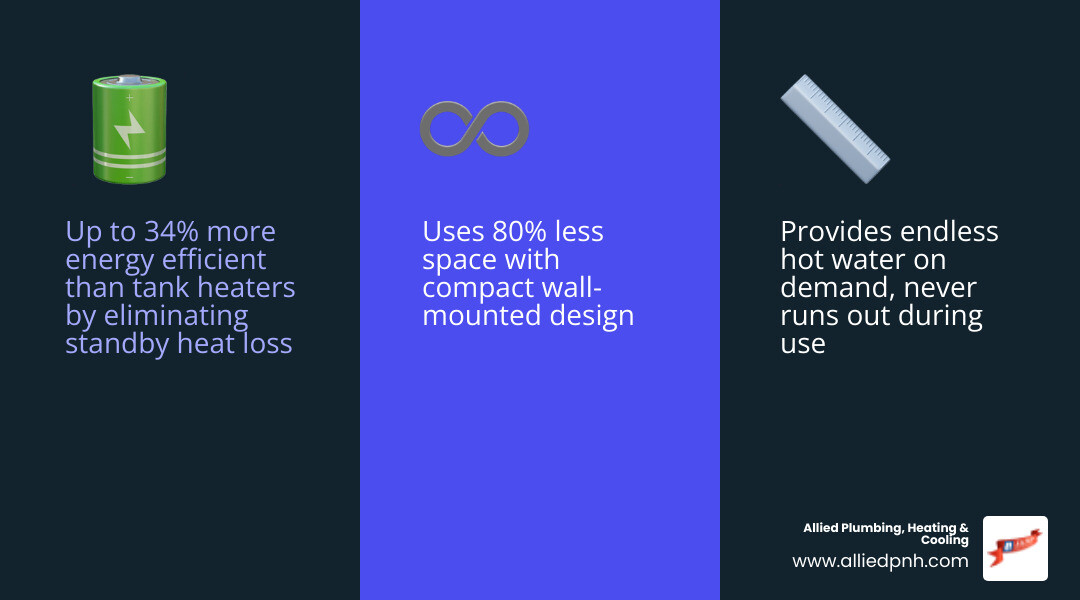
• Energy efficiency - Up to 34% more efficient than conventional tank heaters by eliminating standby heat loss
• Endless hot water - Heats water on demand as it flows through the unit, so you never run out
• Space savings - Wall-mounted design uses roughly 80% less space than a freestanding tank
• Longer lifespan - Can last 20+ years with proper care, compared to 10-15 years for tank models
• Lower leak risk - No storage tank means no risk of a slow, damaging tank leak
Basic Maintenance Requirements:
• Flush and descale the heat exchanger once a year (every 6 months in hard water areas)
• Clean the inlet water filter every 3 months
• Inspect venting and burners annually (gas models)
• Schedule a professional service check once a year
Traditional tank water heaters constantly reheat stored water — even when nobody is using it. That wasted energy, known as standby loss, quietly drives up your utility bills month after month. A tankless system eliminates that problem entirely by heating water only when you turn on the tap.
For homeowners who want reliable hot water, lower energy costs, and a system that lasts, tankless water heaters are worth a serious look. But like any home system, they work best when properly maintained.
Why Homeowners are Switching: Tankless Water Heater Benefits and Maintenance
If you have ever been the last person in your household to hop in the shower, you know the "dreaded cold splash" all too well. One of the primary reasons we see families in Springfield, IL, and surrounding areas like Rochester and Chatham making the switch is the promise of an endless supply of hot water. Unlike traditional tanks that hold a finite amount of water (usually 40 to 50 gallons), a tankless unit heats water as it travels through the system. This means whether you are the first or the fifth person to shower, the temperature stays consistent.
Beyond the luxury of long showers, the space-saving design is a game-changer. Traditional tanks are bulky, often taking up to 16 square feet of floor space. Tankless models are roughly 80% smaller and are typically mounted on a wall. This opens up room in your basement, utility closet, or laundry room for extra storage.
Safety is another major factor. Because there is no large reservoir of water sitting in your home, the risk of a catastrophic tank failure—which can flood a basement in minutes—is significantly reduced. By understanding the advantages of switching to tankless water heaters, you can see how these systems offer peace of mind alongside convenience. For residents looking for tankless water heaters in Rochester, IL, the transition often pays for itself in reclaimed space and reduced stress.
Maximizing Efficiency with Tankless Water Heater Benefits and Maintenance
When we talk about tankless water heater benefits and maintenance, energy efficiency is usually the star of the show. According to the U.S. Department of Energy, these units can be up to 34% more energy-efficient than storage tank heaters for homes that use 41 gallons or less of hot water daily. Even in high-usage homes, the efficiency gains are substantial.
Many of the units we install are ENERGY STAR certified. This certification isn't just a sticker; it represents real-world savings. For a typical four-person household, an ENERGY STAR model can save significant amounts on gas bills over the life of the unit compared to a standard storage model. By heating water only on demand, you stop paying to keep 50 gallons of water hot while you’re at work or sleeping.
Furthermore, these systems offer superior benefits for temperature control. Modern units use advanced sensors to maintain a precise temperature, preventing the "cold water sandwich" effect where the water fluctuates between hot and cold during use. This precision contributes to both comfort and environmental sustainability by reducing wasted energy and water.
Long-Term Durability and Lifespan
A traditional water heater is often on its last legs after 10 to 12 years. In contrast, a well-maintained tankless water heater can last 20 years or more. This longevity is due to the fact that tankless systems are built with replaceable parts. When a component wears out on a tankless unit, we can often swap it out. When a traditional tank rusts through, the whole unit is junk.
Because they don't store water, these systems are naturally more resistant to the internal corrosion that kills standard heaters. Selecting the best tankless water heater for your home involves looking at the quality of the heat exchanger—often made of durable stainless steel or copper—which is designed to withstand decades of rapid heating and cooling cycles.
Essential Upkeep: Protecting Your Investment
While these systems are durable, they are not "set it and forget it" appliances. To truly enjoy the tankless water heater benefits and maintenance must be a priority. The most critical task is the annual flush. Over time, minerals in your water supply can settle on the heat exchanger. This creates a layer of scale that acts as an insulator, forcing the unit to work harder and hotter to heat the water, which can eventually lead to a system failure.
A professional flush involves circulating a food-grade descaling solution (often white vinegar) through the unit for about 45 to 60 minutes. This dissolves the sediment buildup in the tankless water heater, restoring efficiency and protecting the internal components. We also recommend cleaning the air and water filters every few months to ensure proper flow and combustion. For those in our service area, following a Springfield tankless water heater repair guide can help you stay on top of these essential tasks.
Hard Water Impacts on Tankless Water Heater Benefits and Maintenance
In many parts of Illinois, including Athens and Springfield, hard water is a common challenge. Hard water contains high levels of calcium and magnesium. When this water is heated, these minerals solidify and stick to the heat exchanger. If left unaddressed, this scale can cause the unit to overheat or produce lukewarm water.
In areas with particularly hard water, we often recommend flushing the system every six months instead of annually. Installing a water softener or a dedicated scale-prevention system can also significantly reduce the maintenance burden and extend the unit's life. If you notice your water isn't as hot as it used to be, you may need 24-hour tankless water heater repair in Athens, IL to clear out mineral obstructions before they cause permanent damage.
Signs Your System Needs Professional Attention
Your tankless water heater is a smart piece of technology, and it will usually tell you when something is wrong. Most modern units display error codes on a digital screen. If you see a code, don't ignore it. Common signs that you need a professional include:
• Fluctuating Temperatures: If your shower goes from hot to cold suddenly, the unit may be struggling with a blocked heat exchanger or a failing sensor.
• Unusual Noises: A "knocking" or "rumbling" sound often indicates heavy scale buildup that is causing the water to flash-boil inside the unit.
• System Shutdowns: If the unit turns itself off, it may be a safety mechanism triggered by a venting issue or an electrical fault.
Knowing how to handle a tankless water heater shutdown can save you a lot of stress, but for major issues, it’s best to call in the experts. We provide emergency tankless water heater tips for Springfield to help you troubleshoot safely before a technician arrives.
Selecting and Installing Your New System
Choosing the right unit is about more than just picking a brand. You need to consider the "flow rate" and the "temperature rise." The flow rate is how many gallons of hot water you need at one time (e.g., a shower and a dishwasher running simultaneously). The temperature rise is how much the unit needs to heat the incoming cold ground water to reach your desired setting.
• Typical Flow Rate — Gas Tankless Models: 5–10 Gallons Per Minute (GPM) — Electric Tankless Models: 2–5 Gallons Per Minute (GPM)
• Efficiency — Gas Tankless Models: High (especially condensing) — Electric Tankless Models: Very High (nearly 100%)
• Venting — Gas Tankless Models: Required (PVC or Stainless) — Electric Tankless Models: None Required
• Installation Needs — Gas Tankless Models: Gas line & Venting upgrades — Electric Tankless Models: Heavy-duty electrical circuit
• Best For — Gas Tankless Models: Large households/Cold climates — Electric Tankless Models: Small apartments/Point-of-use
Proper installation is non-negotiable. Gas models require specific venting to move exhaust safely outside, and they often need a larger gas line than a traditional tank. Our Springfield installation guide and Chatham installation guide provide deeper insights into what to expect during the process.
Condensing vs. Non-Condensing Technology
When shopping, you’ll encounter two main types of gas tankless heaters: condensing and non-condensing.
Non-condensing units are the traditional tankless design. They are very efficient, but they exhaust very hot gases, which requires expensive stainless steel venting.
Condensing units use a secondary heat exchanger to capture extra heat from the exhaust gases before they leave the unit. This makes them even more efficient (up to 0.96 UEF). Because the exhaust is much cooler, these units can often be vented using inexpensive PVC pipe. While the unit itself may be more advanced, the affordable installation tips for Athens, IL often favor condensing models because the venting costs are so much lower.
Frequently Asked Questions about Tankless Systems
How long do tankless water heaters last compared to traditional tanks?
As we've mentioned, the difference is significant. A traditional tank usually lasts 10 to 15 years. A tankless unit, thanks to its lack of a corrosive storage tank and the ability to replace internal parts, typically lasts 20 years or more with routine maintenance.
Can a tankless unit handle a shower and dishwasher simultaneously?
Yes, provided it is sized correctly. A typical gas-fired tankless unit can produce 5 to 10 gallons of hot water per minute. A standard showerhead uses about 2.5 GPM, and a dishwasher uses about 1.5 GPM. As long as your total simultaneous demand doesn't exceed the unit's GPM rating for our local climate, you won't run out of hot water.
How often does a tankless water heater require professional flushing?
For most homes in the Springfield and Sherman areas, once a year is the gold standard. However, if you have very hard water or a large family that uses a high volume of hot water, we recommend a flush every 6 months to prevent scale from damaging the heat exchanger.
Conclusion
Upgrading your home’s water heating system is a significant decision, but the long-term tankless water heater benefits and maintenance rewards make it one of the best investments you can make for your comfort and your wallet. At Allied Plumbing, Heating & Cooling, we’ve been serving our neighbors in Springfield, Rochester, Chatham, and beyond since 1977. As a three-generation family business, we take pride in our work and stand behind it with the Daikin Comfort Promise and 12-year warranties.
Whether you are dealing with a sudden breakdown or are planning a proactive home upgrade, our team is available 24/7 to ensure your home stays comfortable. Don't settle for lukewarm showers or high energy bills any longer.
Schedule your tankless water heater consultation in Springfield IL today and let us help you find the perfect system for your home.