Will a Mini Split Actually Save You Money? Here's the Quick Answer
The mini split vs central ac cost comparison comes down to one key question: does your home already have ductwork in good condition?
Quick comparison at a glance:
• Best for homes without ducts — Mini Split: Yes — Central AC: No (adds major cost)
• Best for homes with existing ducts — Mini Split: Sometimes — Central AC: Usually yes
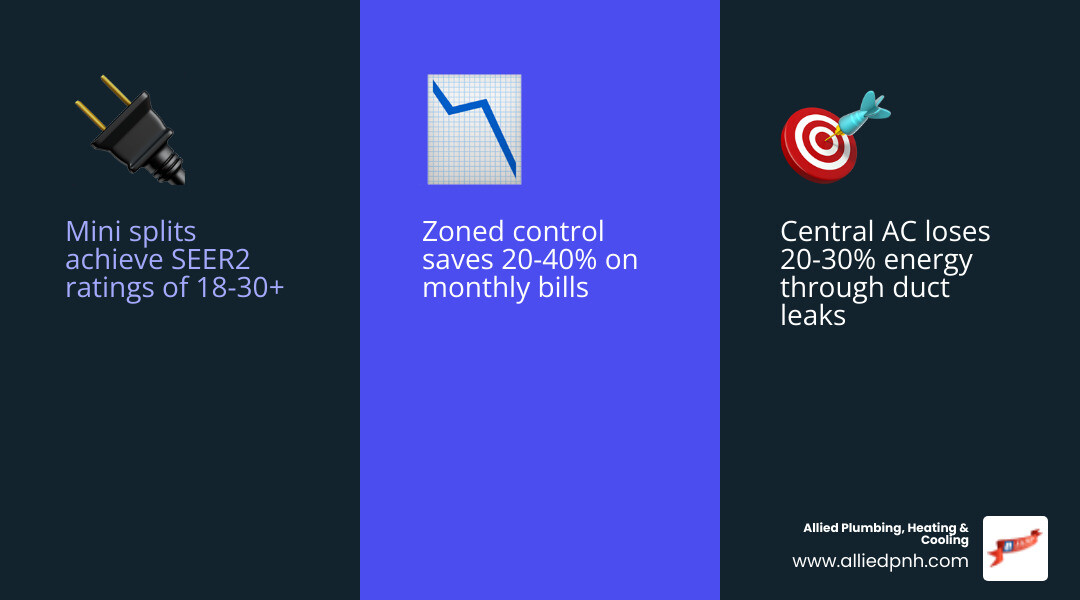
• Energy efficiency (SEER2) — Mini Split: 18-30+ — Central AC: 14-20
• Duct energy losses — Mini Split: None — Central AC: 20-30%
• Zoned temperature control — Mini Split: Built-in — Central AC: Requires add-ons
• Typical lifespan — Mini Split: 15-20 years — Central AC: 12-15 years
• Monthly energy savings vs. central — Mini Split: 20-40% less — Central AC: Baseline
If your home has no ductwork, a mini split is almost always the more cost-effective choice. If you have modern, well-sealed ducts, central AC can still be the smarter option for whole-home cooling.
Most homeowners start this conversation by looking at the sticker price of each system. That's a reasonable place to begin, but it rarely tells the full story. The real answer lives in a combination of what your home already has, how you use your space, and what you'll spend month after month on your utility bill.
Here's what makes this comparison tricky: central air can lose up to 20-30% of cooled air through leaky or poorly insulated ducts before it ever reaches your living room. Mini splits deliver conditioned air directly into each room with no ducts involved, which is a big reason why they consistently outperform central systems on efficiency ratings.
At Allied Plumbing, Heating & Cooling, we help Illinois homeowners work through exactly this kind of decision every day - because getting it right from the start means fewer surprises, lower bills, and a system that keeps your home comfortable for years to come.
Understanding the Mini Split vs Central AC Cost Comparison for Your Home
When we sit down with families in Springfield, IL to discuss a new cooling system, we often find that the choice between ductless and central air isn't just about the hardware—it’s about the architecture of the home itself. A mini split vs central ac cost comparison must account for how the air actually moves through your house.
Central air conditioning relies on a large outdoor condenser and an indoor evaporator coil, usually paired with your furnace. It pushes air through a network of vents to every room simultaneously. Mini splits, on the other hand, use an outdoor unit connected to one or more indoor "heads" mounted on walls or ceilings. This design allows for incredible scalability; you can start with one zone for a master bedroom and expand as needed.
One of the biggest technological shifts in recent years is the move toward variable-speed inverter technology. Unlike traditional central AC units that are either "all the way on" or "all the way off," mini splits use inverters to ramp up or down based on the exact cooling demand. This prevents the energy-heavy "start-stop" cycle, leading to a much more stable indoor environment and lower operational costs over time.
How Ductwork Impacts the Mini Split vs Central AC Cost Comparison
Ductwork is often the "hidden monster" in any HVAC budget. If you live in an older home in areas like Bradfordton, IL or Pleasant Plains, IL, your house might not have ducts at all. In these scenarios, the cost of retrofitting a central system involves tearing into plaster walls, sacrificing closet space, and potentially adding thousands to the total project price.
Even if you have existing ducts, they might be working against you. The Department of Energy estimates that typical Air Conditioning ducts lose 20% to 30% of their energy through leaks, poor insulation, or airflow resistance. This means that even if you buy a high-efficiency central unit, nearly a third of the money you spend on electricity could be cooling your attic or crawlspace instead of your bedroom. Mini splits bypass this issue entirely by delivering air directly where you sit.
Energy Efficiency Ratings in the Mini Split vs Central AC Cost Comparison
To truly understand the mini split vs central ac cost comparison, you have to look at the SEER2 (Seasonal Energy Efficiency Ratio) and HSPF2 (Heating Seasonal Performance Factor) ratings. These industry standards were updated in 2023 to better reflect real-world conditions.
While a standard central AC might offer a SEER2 rating between 14 and 20, ductless mini splits frequently reach ratings of 20 to 30 or higher. For homeowners in Rochester, IL, this jump in efficiency translates to significant monthly savings.
• Central AC — Typical SEER2 Range: 14 - 21 — Potential Energy Waste (Duct Loss): 20 - 30% — Efficiency Technology: Single or Two-Stage
• Ductless Mini Split — Typical SEER2 Range: 18 - 30+ — Potential Energy Waste (Duct Loss): 0% — Efficiency Technology: Inverter-Driven Variable Speed
Long-Term Operating Benefits and Monthly Savings
The "sticker shock" of a multi-zone mini split installation can sometimes be higher than a simple central AC swap-out, but the operating benefits often flip the script within a few years. One of the primary ways mini splits save you money is through targeted cooling.
Think about how you use your home. Do you really need to cool the guest room, the dining room, and the basement to 68 degrees at 2:00 AM while you're asleep upstairs? Central systems treat the whole house as one giant zone. In contrast, a mini split installation in Chatham, IL allows you to turn off the units in unused rooms. This "zoning" capability can reduce your cooling energy consumption by up to 40% compared to a traditional ducted system.
Furthermore, many modern mini splits come equipped with occupancy sensors. These "intelligent eyes" can detect when a room is empty and automatically shift the unit into an energy-saving mode. When you combine this with the fact that mini splits are also highly efficient heat pumps, you're looking at a system that provides year-round value, potentially lowering your heating bills in the winter as well.
Maintenance Requirements and System Longevity
Maintenance is a critical part of the mini split vs central ac cost comparison. Both systems require professional attention to reach their full lifespan, but the tasks differ.
Central AC systems require you to change a large central filter every 1-3 months and occasionally have the ductwork professionally cleaned to maintain indoor air quality. Mini splits use washable filters located inside the indoor heads. While these are easy to clean yourself (we recommend doing this every few weeks), the units also require deep cleanings of the blower wheels and coils to prevent dust buildup and mold.
In terms of longevity, a well-maintained mini split can last 15 to 20 years, whereas a traditional central AC unit typically averages 12 to 15 years. Because mini splits use inverter technology, they experience less mechanical stress from "hard starts," which often contributes to this longer service life.
Professional Care for Maximum ROI
Whether you choose a ductless AC in Glenarm, IL or a central system, regular Air Conditioning Service is the best way to protect your investment. During a precision tune-up, our technicians check refrigerant levels, calibrate thermostats, and ensure the condensate drainage is clear.
For those considering a mini split installation in Sherman, IL, professional installation is non-negotiable. Proper sizing and refrigerant line placement are essential for the system to hit those high SEER2 ratings. Plus, professional installation ensures you remain in compliance with manufacturer warranties, such as the Daikin Comfort Promise, which offers peace of mind through long-term coverage.
When to Choose Ductless Over Central Air in Illinois
In our experience serving communities like Rochester, IL, there are specific scenarios where one system clearly beats the other in a mini split vs central ac cost comparison.
Choose a Mini Split if:
• You have a "problem room": If your upstairs bedroom or sunroom is always five degrees hotter than the rest of the house, a single-zone mini split is a perfect, cost-effective fix.
• You're building an addition: Running new ductwork to a garage conversion or a new master suite can be prohibitively expensive and disruptive. A mini split installation in Pleasant Plains, IL is much simpler.
• Your home is historic: Homes in Elkhart, IL or Athens, IL often lack the wall cavity space for modern ducts. Ductless units only require a small three-to-four-inch hole in the exterior wall.
• You want maximum control: If family members have wildly different temperature preferences, the individual room control of a mini split is a lifesaver.
Choose Central AC if:
• You have great existing ducts: If your home is already ducted and those ducts are in good repair, replacing the central unit is usually the most straightforward and least expensive upfront option.
• You prefer a "hidden" look: Some homeowners prefer the invisibility of central vents over the wall-mounted heads of a mini split.
• You have a very large, open-concept home: Central air is excellent at moving massive volumes of air through large, connected spaces.
Frequently Asked Questions About HVAC Comparisons
Which system is better for a home without existing ductwork?
For homes in Springfield, IL without ducts, mini splits are the clear winner. Installing a Ductless AC in Springfield, IL avoids the massive labor and material costs of a full ductwork retrofit, which can involve significant demolition and reconstruction.
How do SEER2 ratings affect my monthly utility bills?
The SEER2 rating is essentially the "miles per gallon" of your AC. A system with a SEER2 of 20 is significantly more efficient than one with a 14. For a typical summer in Rochester, IL, moving from an older, low-SEER unit to a modern mini split can result in monthly bill reductions of 20% to 40%.
Can a mini split provide both heating and cooling?
Yes! Most mini splits are heat pumps, meaning they can reverse the refrigeration cycle to provide heat in the winter. For our neighbors in Chatham, IL, "Hyper-Heat" models are available that can continue to provide efficient warmth even when Illinois temperatures drop well below zero. This makes them a great alternative or supplement to traditional gas furnaces.
Conclusion: Finding the Best Solution for Your Home Comfort
Choosing between a mini split and central AC isn't a decision you have to make alone. At Allied Plumbing, Heating & Cooling, we’ve spent over 45 years helping families across Sangamon County and beyond find the perfect balance of comfort and value. As a three-generation, family-owned business, we treat your home like our own.
Whether you're in Riddle Hill, IL, Sherman, IL, or Riverton, IL, we are proud to offer the Daikin Comfort Promise. This includes industry-leading 12-year warranties that ensure your investment is protected for the long haul.
The mini split vs central ac cost comparison is about more than just the first check you write—it’s about the comfort of your family and the sustainability of your monthly budget. If you're ready to see which system makes the most sense for your specific floor plan and goals, we’re here to help.
Schedule your professional air conditioning consultation today with the experts at Allied Plumbing, Heating & Cooling. We’ll provide a thorough assessment of your home and help you choose the system that will save you the most money over the next 20 years.