Smart Savings, Warm Home: Affordable & Top-Rated Boiler Replacement in Rochester
Your Guide to a Warm and Efficient Home

When you're searching for boiler replacement best in Rochester, IL, you need a heating system that keeps your home warm through bitter winter nights without breaking your budget. Your boiler is the heart of your home's comfort system, and when it starts showing signs of age—rising energy bills, frequent repairs, or uneven heating—it's time to explore your replacement options.
Quick Answer: What Makes a Boiler Replacement "Best" in Rochester, IL?
- High efficiency rating (90%+ AFUE) to lower your heating costs
- Right fuel type for your home (gas, electric, or oil)
- Proper sizing based on your home's heating needs
- Professional installation by certified, experienced technicians
- Strong warranty protection for long-term peace of mind
- Local expertise familiar with Rochester's winter demands
If you're experiencing comfort issues throughout your home, learn more about comprehensive heating solutions in Rochester, IL, or contact our team today for a boiler replacement consultation.
Rochester winters don't give you second chances. When your boiler is over 15 years old, you're likely paying more than you should for heat while risking an inconvenient breakdown during the coldest days of the year. Modern high-efficiency boilers can reduce your heating costs by 20-30% compared to older units operating at just 60-75% efficiency. Beyond the savings, a new boiler means reliable warmth, better safety, and fewer repair calls.
This guide walks you through everything you need to know about boiler replacement in Rochester—from recognizing the warning signs to understanding efficiency ratings and choosing the right system for your home.
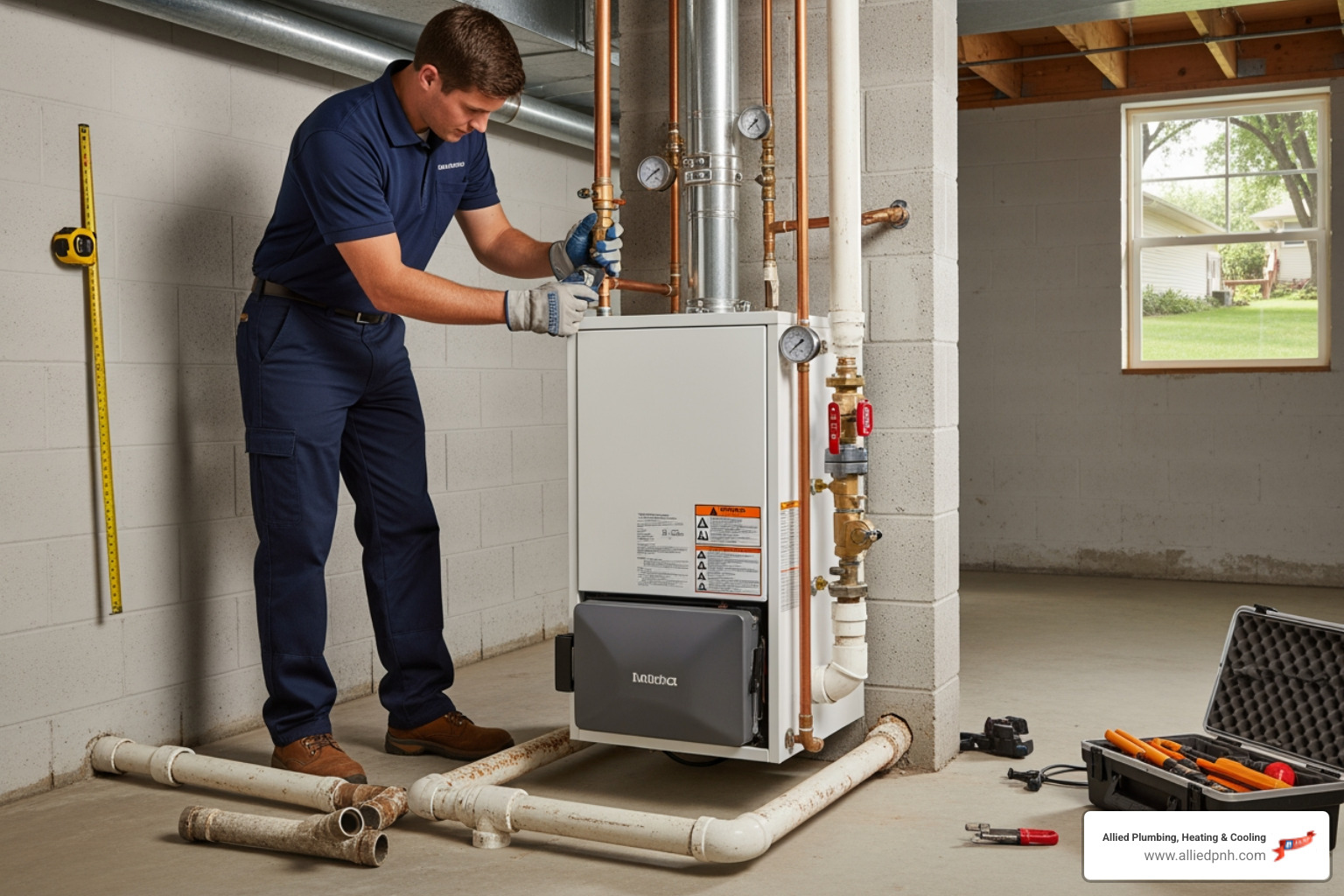
Is It Time for a New Boiler? Key Signs to Watch For
Even the most robust heating systems have a lifespan. For boilers, this typically averages around 15 years. As your boiler approaches or surpasses this age, it naturally becomes less efficient and more prone to issues. This decline isn't just an inconvenience; it can significantly impact your comfort and your wallet.
The main reasons to consider replacing your boiler in Rochester, IL, often boil down to two things: performance and cost. An aging boiler might struggle to keep your home consistently warm, leading to cold spots or a general chill that no amount of thermostat fiddling seems to fix. More importantly, it could be costing you a fortune in energy bills. Old boilers operating at 60-75% AFUE (Annual Fuel Utilization Efficiency) are simply wasting too much fuel compared to modern units.
Here are the signs that indicate your boiler might be ready for retirement:
- Increasing Energy Bills: If you notice your heating costs creeping up year after year, even with similar usage, your boiler is likely losing efficiency. It's working harder to produce the same amount of heat, consuming more fuel in the process.
- Frequent Breakdowns and Costly Repairs: Are you calling us for boiler repairs more often? Or are the repairs becoming increasingly expensive? This is a major red flag. Continual breakdowns indicate underlying issues that patchwork fixes can't solve long-term.
- Uneven Heating: If some rooms are toasty while others remain chilly, your boiler might not be distributing heat effectively. This could be due to internal component failures or a system struggling to keep up with your home's demands.
- Leaks and Corrosion: Visible water leaks around your boiler, or rust and corrosion on its body or internal components, are serious concerns. Leaks can cause water damage and indicate structural integrity issues, while corrosion can lead to system failure.
- Age: If your boiler is over 15 years old, it’s definitely time to start thinking about replacement. While some boilers might last longer with meticulous maintenance, their efficiency will inevitably decline, making them less economical to run.
When you notice these signs, it's crucial to address them promptly. Ignoring them can lead to a complete system failure, leaving you without heat when you need it most. For immediate concerns, especially if you suspect a malfunction, our team is ready to help with boiler repair in Rochester, IL.
Repair or Replace? Making the Right Call
Deciding whether to repair your boiler or invest in a new one can be a tough call. We understand that nobody wants unexpected expenses. However, sometimes replacement is the more economical and safer choice in the long run.
Indicators for Repair:If your boiler is relatively new (under 10-12 years old) and experiencing minor issues, a repair is often the best solution. Small leaks, a faulty thermostat, or a clogged component can typically be fixed without replacing the entire unit. For issues like low pressure, which can sometimes be a simple fix, you can learn more about why your boiler is losing pressure constantly. Similarly, if your boiler is short cycling, meaning it turns on and off too frequently, it might just need some troubleshooting rather than a full replacement. We have insights into troubleshooting a boiler that's short cycling that can help identify the problem.
Indicators for Replacement:
- Boiler Age: As mentioned, boilers over 15 years old are typically nearing the end of their efficient life. The cost of a major repair on an old unit might be better invested in a new, high-efficiency system.
- Frequent or Expensive Repairs: If you're constantly spending money on repairs, or facing a repair bill that's half the cost of a new boiler, it's a clear sign that replacement is the smarter move.
- Safety Concerns: This is paramount. If your boiler is emitting unusual odors (especially gas smells), producing yellow flames (for gas boilers), or if your carbon monoxide detector goes off, it's an immediate safety hazard. These issues often indicate severe internal problems, such as a cracked heat exchanger, which necessitate replacement.
- Inefficiency: If your energy bills are consistently high, your boiler is likely operating inefficiently. Upgrading to a modern, high-efficiency model can significantly reduce your heating costs and environmental footprint.
Telltale Noises and What They Mean
Boilers are generally quiet operators, so any unusual sounds should grab your attention. These noises aren't just annoying; they're often your boiler's way of telling you something is wrong.
- Banging Sounds (Kettling): This is one of the most common and concerning boiler noises. It often sounds like a kettle boiling loudly and is usually caused by a buildup of limescale or sludge on the heat exchanger. This buildup restricts water flow, causing the water to overheat and steam to form, which then collapses with a banging noise. Kettling reduces efficiency and can damage the boiler.
- Whistling Noises: A whistling sound can also be related to kettling or a buildup of air in the system. For more detailed information, check out our guide on why your boiler is making whistling sounds.
- Gurgling: Gurgling noises often indicate air trapped in the system, particularly in the pipes or radiators. It can also point to low water pressure. While sometimes a simple fix like bleeding radiators, persistent gurgling might signal a more complex issue.
- Hissing: A hissing sound might indicate a leak, especially if accompanied by visible moisture. Steam leaks can be dangerous and should be addressed immediately.
- Clunking or Grinding: These harsher mechanical sounds usually point to a problem with the pump or another moving part within the boiler system.
Ignoring these noises can lead to more severe damage and potentially more expensive repairs or even an early replacement. If your boiler is vocalizing its distress, it’s time to call in the professionals.
Choosing the Right System: Your Guide to Boiler Replacement Best in Rochester, IL
When it comes to selecting a new heating system, especially for a boiler replacement best in Rochester, IL, understanding the differences between heating technologies is key. Boilers offer a unique set of advantages that make them a popular choice for many homes in our service areas, including Rochester, Springfield, and Chatham.
How Does a Boiler Differ from a Furnace or Heat Pump?
Boilers, furnaces, and heat pumps all aim to keep your home warm, but they achieve this in fundamentally different ways:
- Heating Method: A boiler generates hot water or steam, which then circulates through pipes to radiators, baseboard heaters, or radiant floor systems. A furnace heats air and distributes it through a ductwork system and vents. A heat pump moves heat from one place to another (outside to inside for heating, or inside to outside for cooling).
- Heat Delivery: Boilers provide radiant heat, warming objects in a room (floors, furniture, walls) which then radiate warmth to you. This creates a gentle, consistent, and even warmth. Furnaces and heat pumps (in heating mode) deliver forced air, which can feel less even and sometimes dry out the air.
- Comfort Feel: Many homeowners find radiant heat from a boiler to be a more comfortable and cozy warmth, without the drafts and temperature fluctuations often associated with forced-air systems.
- Indoor Air Quality: Because boilers use a sealed system and don't blow air through ducts, they don't circulate dust, allergens, or other airborne particles throughout your home as much as forced-air systems do. This can lead to better indoor air quality, a significant advantage for those with allergies or respiratory sensitivities. This cleaner form of heating is a big plus for homeowners.
For comprehensive heating solutions, regardless of your system type, you can always rely on our expertise in heating in Rochester, IL.
Understanding Boiler Types and Fuel Sources
When considering a boiler replacement best in Rochester, IL, you'll encounter several types, primarily differentiated by their fuel source. The best choice for your home depends on local availability, efficiency goals, and existing infrastructure.
| Boiler Type | Fuel Source | Performance & Local Availability in Central IL |
|---|---|---|
| Gas Boilers | Natural Gas, Propane | Highly effective and affordable in areas with natural gas lines. Propane is an option where natural gas isn't available. |
| Electric Boilers | Electricity | Compact and a good choice for smaller spaces or homes without gas lines. Can be more expensive to operate depending on electricity rates. |
| Oil Boilers | Heating Oil | Common in rural areas where natural gas isn't accessible. Require a storage tank for fuel. |
- Gas Boilers: These are a favored option in our service areas due to the widespread availability of natural gas lines and their cost-effectiveness. Natural gas is generally an efficient and affordable fuel.
- Electric Boilers: For homes without access to natural gas or propane, electric boilers are an excellent alternative. They are typically compact, making them suitable for smaller homes or apartments. While their operational cost can be higher depending on electricity rates, their installation costs are often lower.
- Oil Boilers: In more rural parts of Central Illinois where natural gas infrastructure is limited, oil boilers remain a viable option. They require a fuel storage tank, which needs to be refilled periodically.
- Combi-Boilers: These innovative systems combine home heating and domestic hot water production into a single unit, eliminating the need for a separate water heater. This can save space and simplify your plumbing system. If you're also considering a water heater replacement in Rochester, IL, a combi-boiler might be a smart, integrated solution.
- Hydronic Systems: Most modern boilers are part of a hydronic system, meaning they use water or fluid to transfer heat. This includes baseboard radiators, radiant floor heating, or hydro-air systems. These systems are highly efficient and deliver that comfortable, even radiant heat we talked about.
Efficiency Matters: What to Look for in the Boiler Replacement Best in Rochester, IL
When choosing a new boiler, efficiency should be a top priority. The colder Rochester winters demand a system that can deliver reliable heat without draining your bank account.
- AFUE Ratings: The key metric for boiler efficiency is the Annual Fuel Utilization Efficiency (AFUE) rating. This percentage tells you how much of the fuel your boiler consumes is converted into usable heat for your home, versus how much is wasted through the flue. For example, an old boiler with a 70% AFUE rating means 30% of the fuel you pay for is literally going up in smoke!
- High-Efficiency Models (90%+ AFUE): Modern high-efficiency boilers are rated at 90% AFUE and above. Upgrading from an older, less efficient unit to one of these models can lead to significant energy savings and lower utility bills. We're talking about models that convert 90% or more of their fuel into heat!
- Condensing Boilers: These are the pinnacle of high-efficiency. Condensing boilers capture heat from the exhaust gases (flue gases) that would normally be expelled, using it to further heat the water within the system. This allows them to achieve AFUE ratings of 95% or higher, making them incredibly economical to operate.
- Energy Savings and Environmental Impact: A high-efficiency boiler not only saves you money but also reduces your home's carbon footprint. By consuming less fuel, you're contributing to a healthier environment, which is something we can all feel good about in Rochester, IL and beyond.
- Government Incentives: While federal programs can change, it's always worth researching if there are any current government rebates or incentives available for boiler replacement in Illinois. These programs often aim to encourage homeowners to adopt more energy-efficient heating solutions, potentially offsetting some of the upfront cost of a new system. We can help guide you on any applicable incentives during your consultation.
Investing in a high-efficiency boiler is a smart long-term decision for your comfort, your budget, and the environment.
The Professional Boiler Installation Process
Replacing a boiler is a significant home improvement project that requires expertise and precision. When you choose us for your boiler replacement best in Rochester, IL, you're choosing a team that ensures a smooth, efficient, and safe installation from start to finish.
Our installation process begins with a thorough home assessment. Our certified technicians will evaluate your home's heating needs, considering factors like square footage, insulation, and your family's comfort preferences. This allows us to accurately size your new boiler, ensuring it's neither too small (and unable to keep your home warm) nor too large (which can lead to inefficiency and short cycling).
Next, we handle the careful removal and disposal of your old unit. This includes safely disconnecting fuel lines, water pipes, and venting, and ensuring the old boiler is removed responsibly. Then, we carefully prepare the site for your new boiler's placement, ensuring proper clearances and a stable foundation.
The installation of the new boiler involves connecting it to your home's heating system, including water pipes, fuel lines (gas or oil), and the electrical supply. Crucially, we ensure proper venting for combustion gases, which is vital for both efficiency and safety. Our team serves various communities in Central Illinois, including our service areas like Springfield, Auburn, and Pawnee, ensuring consistent quality across all locations.
Once the physical installation is complete, we rigorously test the entire system to ensure it's operating correctly, efficiently, and safely. This includes checking for leaks, verifying pressure levels, and calibrating controls.
What to Expect on Installation Day
On the day of your new boiler installation, our team arrives ready to work efficiently and with respect for your home. We understand that having work done in your home can be disruptive, so we strive to make the process as seamless as possible.
- Protecting Your Home: Our technicians will take precautions to protect your home, laying down drop cloths and ensuring work areas are kept clean.
- Certified Technicians: You can expect our certified and experienced technicians to handle every aspect of the installation. Our team is trained to the highest standards, ensuring your new boiler is installed correctly and safely. As a 3-generation business since 1977, our extensive experience speaks for itself. You can learn more about our commitment to customer satisfaction and our history on our About Us page.
- Step-by-Step Process: We will keep you informed throughout the installation process, explaining what we're doing and answering any questions you may have.
- Final Walkthrough and System Commissioning: Once the installation is complete, we'll conduct a final walkthrough with you. We'll show you how to operate your new boiler, explain its features, and provide important maintenance tips. We'll also ensure the system is properly commissioned, meaning it's optimized for peak performance and efficiency in your home.
Post-Installation: Ensuring Longevity and Performance
A new boiler is a significant investment, and proper care after installation is essential to ensure its longevity and maintain its high efficiency.
- Maintenance Impact: Regular boiler maintenance is not just a recommendation; it's a necessity. It significantly impacts your boiler's lifespan and efficiency. Think of it like regular oil changes for your car – small, consistent care prevents major, costly problems down the road.
- Annual Service: We recommend scheduling annual boiler maintenance appointments. During these visits, our technicians will inspect, clean, and tune your system, identifying potential issues before they become serious breakdowns. This proactive approach ensures your boiler runs optimally, saving you money on energy bills and extending its operational life.
- Warranty Requirements: Many boiler manufacturers require annual professional maintenance to keep your warranty valid. Neglecting maintenance could void your warranty, leaving you responsible for costly repairs that would otherwise be covered.
- Efficiency Preservation: Proper maintenance helps preserve your boiler's high efficiency rating. Over time, components can get dirty or out of calibration, reducing efficiency. Regular tuning keeps everything running smoothly, ensuring you continue to reap the benefits of your investment.
A well-maintained boiler is a happy boiler. And a happy boiler means a warm home and smart savings for you. Just as we ensure your plumbing is in top shape, we ensure your boiler performs its best. Learn more about our comprehensive plumbing services in Rochester, IL.
Frequently Asked Questions about Boiler Replacement
We often hear similar questions from homeowners considering a boiler replacement. Here are some of the most common ones, answered to help you make an informed decision.
How does a boiler differ from a furnace or heat pump?
As we discussed, the primary difference lies in the method of heat transfer and delivery:
- Heating Method (Water vs. Air): Boilers heat water or create steam, which then circulates to distribute warmth. Furnaces heat air directly, and heat pumps transfer existing heat.
- Heat Delivery (Radiators vs. Vents): Boilers deliver heat through radiators, baseboard heaters, or radiant floor systems. Furnaces and heat pumps use a system of ducts and vents to blow heated air into rooms.
- Comfort Feel (Radiant vs. Forced Air): Boilers provide radiant heat, which warms objects and surfaces, creating a gentle, consistent warmth without drafts. Forced-air systems from furnaces or heat pumps can lead to varying temperatures and air movement.
- Indoor Air Quality Impact: Boilers operate in a sealed system, reducing the circulation of dust, allergens, and other airborne particles, which can result in better indoor air quality compared to forced-air systems.
What are the main advantages of upgrading to a high-efficiency boiler?
Upgrading to a high-efficiency boiler offers a wealth of benefits that go beyond just keeping your home warm:
- Reduced Energy Consumption: High-efficiency boilers, particularly condensing models with AFUE ratings of 90% or more, convert a much larger percentage of fuel into usable heat. This means they consume significantly less fuel to achieve the same level of warmth.
- Lower Utility Bills: Less fuel consumption directly translates to lower monthly heating bills. This can lead to substantial savings over the lifespan of the boiler, especially during our cold Rochester winters.
- Smaller Carbon Footprint: By using less energy, you're reducing your home's environmental impact. This is a benefit for the planet and a point of pride for environmentally conscious homeowners.
- Improved Home Comfort: Modern boilers often provide more consistent and even heating, eliminating cold spots and maintaining a more comfortable indoor temperature.
- Quieter Operation: Newer boiler models are generally much quieter than older units, contributing to a more peaceful home environment.
How does boiler maintenance impact its lifespan and efficiency?
Boiler maintenance is perhaps one of the most underestimated aspects of home heating, yet its impact is profound:
- Prevents Breakdowns: Regular check-ups allow our technicians to spot minor issues before they escalate into major, expensive breakdowns. This proactive approach saves you from inconvenient and costly emergency repairs.
- Extends Lifespan: A well-maintained boiler will simply last longer. Cleaning, lubrication, and calibration of components reduce wear and tear, ensuring your investment serves you for many years, potentially beyond its average lifespan.
- Ensures Safety: Maintenance checks include verifying proper combustion and venting, which are critical for preventing dangerous carbon monoxide leaks. This is a non-negotiable aspect of boiler care.
- Maintains High Efficiency: Over time, components can become dirty or misaligned, causing the boiler to work harder and lose efficiency. Regular tuning and cleaning restore it to optimal performance, ensuring you continue to enjoy those lower energy bills.
- Protects Warranty: As mentioned, most manufacturers require proof of annual professional maintenance to keep your warranty valid. Skipping these services could mean you're on the hook for future repair costs.
Just as we recommend regular maintenance for your heating system, we also advise keeping an eye on your home's cooling needs. For insights into maintaining your AC, you can check out our tips on Rochester air conditioning.
Trust the Experts for Your Rochester Boiler Replacement
Choosing the boiler replacement best in Rochester, IL is about more than just buying a new appliance; it's about investing in your home's comfort, safety, and long-term value. With our cold Illinois winters, a reliable and efficient boiler isn't a luxury—it's a necessity.
When you partner with us for your boiler replacement, you're choosing a team dedicated to ensuring your winter readiness, enhancing your home's safety, and delivering long-term savings. Our decades of experience, spanning three generations, mean we understand the unique heating challenges faced by homeowners in Rochester and the surrounding areas like Springfield, Chatham, and Auburn.
We pride ourselves on customer satisfaction, backed by our Daikin Comfort Promise and 12-year warranties, giving you unparalleled peace of mind. We believe in doing the job right, ensuring your new boiler is perfectly sized, professionally installed, and optimized for peak performance from day one.
Don't wait for your old boiler to leave you in the cold. Take control of your home's comfort and energy efficiency today. Our team is ready to guide you through every step of the process, from choosing the right system to a flawless installation.
Contact our team today to learn more about our expert boiler services in Rochester, IL!

Your Guide to a Warm and Efficient Home

When you're searching for boiler replacement best in Rochester, IL, you need a heating system that keeps your home warm through bitter winter nights without breaking your budget. Your boiler is the heart of your home's comfort system, and when it starts showing signs of age—rising energy bills, frequent repairs, or uneven heating—it's time to explore your replacement options.
Quick Answer: What Makes a Boiler Replacement "Best" in Rochester, IL?
- High efficiency rating (90%+ AFUE) to lower your heating costs
- Right fuel type for your home (gas, electric, or oil)
- Proper sizing based on your home's heating needs
- Professional installation by certified, experienced technicians
- Strong warranty protection for long-term peace of mind
- Local expertise familiar with Rochester's winter demands
If you're experiencing comfort issues throughout your home, learn more about comprehensive heating solutions in Rochester, IL, or contact our team today for a boiler replacement consultation.
Rochester winters don't give you second chances. When your boiler is over 15 years old, you're likely paying more than you should for heat while risking an inconvenient breakdown during the coldest days of the year. Modern high-efficiency boilers can reduce your heating costs by 20-30% compared to older units operating at just 60-75% efficiency. Beyond the savings, a new boiler means reliable warmth, better safety, and fewer repair calls.
This guide walks you through everything you need to know about boiler replacement in Rochester—from recognizing the warning signs to understanding efficiency ratings and choosing the right system for your home.

Is It Time for a New Boiler? Key Signs to Watch For
Even the most robust heating systems have a lifespan. For boilers, this typically averages around 15 years. As your boiler approaches or surpasses this age, it naturally becomes less efficient and more prone to issues. This decline isn't just an inconvenience; it can significantly impact your comfort and your wallet.
The main reasons to consider replacing your boiler in Rochester, IL, often boil down to two things: performance and cost. An aging boiler might struggle to keep your home consistently warm, leading to cold spots or a general chill that no amount of thermostat fiddling seems to fix. More importantly, it could be costing you a fortune in energy bills. Old boilers operating at 60-75% AFUE (Annual Fuel Utilization Efficiency) are simply wasting too much fuel compared to modern units.
Here are the signs that indicate your boiler might be ready for retirement:
- Increasing Energy Bills: If you notice your heating costs creeping up year after year, even with similar usage, your boiler is likely losing efficiency. It's working harder to produce the same amount of heat, consuming more fuel in the process.
- Frequent Breakdowns and Costly Repairs: Are you calling us for boiler repairs more often? Or are the repairs becoming increasingly expensive? This is a major red flag. Continual breakdowns indicate underlying issues that patchwork fixes can't solve long-term.
- Uneven Heating: If some rooms are toasty while others remain chilly, your boiler might not be distributing heat effectively. This could be due to internal component failures or a system struggling to keep up with your home's demands.
- Leaks and Corrosion: Visible water leaks around your boiler, or rust and corrosion on its body or internal components, are serious concerns. Leaks can cause water damage and indicate structural integrity issues, while corrosion can lead to system failure.
- Age: If your boiler is over 15 years old, it’s definitely time to start thinking about replacement. While some boilers might last longer with meticulous maintenance, their efficiency will inevitably decline, making them less economical to run.
When you notice these signs, it's crucial to address them promptly. Ignoring them can lead to a complete system failure, leaving you without heat when you need it most. For immediate concerns, especially if you suspect a malfunction, our team is ready to help with boiler repair in Rochester, IL.
Repair or Replace? Making the Right Call
Deciding whether to repair your boiler or invest in a new one can be a tough call. We understand that nobody wants unexpected expenses. However, sometimes replacement is the more economical and safer choice in the long run.
Indicators for Repair:If your boiler is relatively new (under 10-12 years old) and experiencing minor issues, a repair is often the best solution. Small leaks, a faulty thermostat, or a clogged component can typically be fixed without replacing the entire unit. For issues like low pressure, which can sometimes be a simple fix, you can learn more about why your boiler is losing pressure constantly. Similarly, if your boiler is short cycling, meaning it turns on and off too frequently, it might just need some troubleshooting rather than a full replacement. We have insights into troubleshooting a boiler that's short cycling that can help identify the problem.
Indicators for Replacement:
- Boiler Age: As mentioned, boilers over 15 years old are typically nearing the end of their efficient life. The cost of a major repair on an old unit might be better invested in a new, high-efficiency system.
- Frequent or Expensive Repairs: If you're constantly spending money on repairs, or facing a repair bill that's half the cost of a new boiler, it's a clear sign that replacement is the smarter move.
- Safety Concerns: This is paramount. If your boiler is emitting unusual odors (especially gas smells), producing yellow flames (for gas boilers), or if your carbon monoxide detector goes off, it's an immediate safety hazard. These issues often indicate severe internal problems, such as a cracked heat exchanger, which necessitate replacement.
- Inefficiency: If your energy bills are consistently high, your boiler is likely operating inefficiently. Upgrading to a modern, high-efficiency model can significantly reduce your heating costs and environmental footprint.
Telltale Noises and What They Mean
Boilers are generally quiet operators, so any unusual sounds should grab your attention. These noises aren't just annoying; they're often your boiler's way of telling you something is wrong.
- Banging Sounds (Kettling): This is one of the most common and concerning boiler noises. It often sounds like a kettle boiling loudly and is usually caused by a buildup of limescale or sludge on the heat exchanger. This buildup restricts water flow, causing the water to overheat and steam to form, which then collapses with a banging noise. Kettling reduces efficiency and can damage the boiler.
- Whistling Noises: A whistling sound can also be related to kettling or a buildup of air in the system. For more detailed information, check out our guide on why your boiler is making whistling sounds.
- Gurgling: Gurgling noises often indicate air trapped in the system, particularly in the pipes or radiators. It can also point to low water pressure. While sometimes a simple fix like bleeding radiators, persistent gurgling might signal a more complex issue.
- Hissing: A hissing sound might indicate a leak, especially if accompanied by visible moisture. Steam leaks can be dangerous and should be addressed immediately.
- Clunking or Grinding: These harsher mechanical sounds usually point to a problem with the pump or another moving part within the boiler system.
Ignoring these noises can lead to more severe damage and potentially more expensive repairs or even an early replacement. If your boiler is vocalizing its distress, it’s time to call in the professionals.
Choosing the Right System: Your Guide to Boiler Replacement Best in Rochester, IL
When it comes to selecting a new heating system, especially for a boiler replacement best in Rochester, IL, understanding the differences between heating technologies is key. Boilers offer a unique set of advantages that make them a popular choice for many homes in our service areas, including Rochester, Springfield, and Chatham.
How Does a Boiler Differ from a Furnace or Heat Pump?
Boilers, furnaces, and heat pumps all aim to keep your home warm, but they achieve this in fundamentally different ways:
- Heating Method: A boiler generates hot water or steam, which then circulates through pipes to radiators, baseboard heaters, or radiant floor systems. A furnace heats air and distributes it through a ductwork system and vents. A heat pump moves heat from one place to another (outside to inside for heating, or inside to outside for cooling).
- Heat Delivery: Boilers provide radiant heat, warming objects in a room (floors, furniture, walls) which then radiate warmth to you. This creates a gentle, consistent, and even warmth. Furnaces and heat pumps (in heating mode) deliver forced air, which can feel less even and sometimes dry out the air.
- Comfort Feel: Many homeowners find radiant heat from a boiler to be a more comfortable and cozy warmth, without the drafts and temperature fluctuations often associated with forced-air systems.
- Indoor Air Quality: Because boilers use a sealed system and don't blow air through ducts, they don't circulate dust, allergens, or other airborne particles throughout your home as much as forced-air systems do. This can lead to better indoor air quality, a significant advantage for those with allergies or respiratory sensitivities. This cleaner form of heating is a big plus for homeowners.
For comprehensive heating solutions, regardless of your system type, you can always rely on our expertise in heating in Rochester, IL.
Understanding Boiler Types and Fuel Sources
When considering a boiler replacement best in Rochester, IL, you'll encounter several types, primarily differentiated by their fuel source. The best choice for your home depends on local availability, efficiency goals, and existing infrastructure.
| Boiler Type | Fuel Source | Performance & Local Availability in Central IL |
|---|---|---|
| Gas Boilers | Natural Gas, Propane | Highly effective and affordable in areas with natural gas lines. Propane is an option where natural gas isn't available. |
| Electric Boilers | Electricity | Compact and a good choice for smaller spaces or homes without gas lines. Can be more expensive to operate depending on electricity rates. |
| Oil Boilers | Heating Oil | Common in rural areas where natural gas isn't accessible. Require a storage tank for fuel. |
- Gas Boilers: These are a favored option in our service areas due to the widespread availability of natural gas lines and their cost-effectiveness. Natural gas is generally an efficient and affordable fuel.
- Electric Boilers: For homes without access to natural gas or propane, electric boilers are an excellent alternative. They are typically compact, making them suitable for smaller homes or apartments. While their operational cost can be higher depending on electricity rates, their installation costs are often lower.
- Oil Boilers: In more rural parts of Central Illinois where natural gas infrastructure is limited, oil boilers remain a viable option. They require a fuel storage tank, which needs to be refilled periodically.
- Combi-Boilers: These innovative systems combine home heating and domestic hot water production into a single unit, eliminating the need for a separate water heater. This can save space and simplify your plumbing system. If you're also considering a water heater replacement in Rochester, IL, a combi-boiler might be a smart, integrated solution.
- Hydronic Systems: Most modern boilers are part of a hydronic system, meaning they use water or fluid to transfer heat. This includes baseboard radiators, radiant floor heating, or hydro-air systems. These systems are highly efficient and deliver that comfortable, even radiant heat we talked about.
Efficiency Matters: What to Look for in the Boiler Replacement Best in Rochester, IL
When choosing a new boiler, efficiency should be a top priority. The colder Rochester winters demand a system that can deliver reliable heat without draining your bank account.
- AFUE Ratings: The key metric for boiler efficiency is the Annual Fuel Utilization Efficiency (AFUE) rating. This percentage tells you how much of the fuel your boiler consumes is converted into usable heat for your home, versus how much is wasted through the flue. For example, an old boiler with a 70% AFUE rating means 30% of the fuel you pay for is literally going up in smoke!
- High-Efficiency Models (90%+ AFUE): Modern high-efficiency boilers are rated at 90% AFUE and above. Upgrading from an older, less efficient unit to one of these models can lead to significant energy savings and lower utility bills. We're talking about models that convert 90% or more of their fuel into heat!
- Condensing Boilers: These are the pinnacle of high-efficiency. Condensing boilers capture heat from the exhaust gases (flue gases) that would normally be expelled, using it to further heat the water within the system. This allows them to achieve AFUE ratings of 95% or higher, making them incredibly economical to operate.
- Energy Savings and Environmental Impact: A high-efficiency boiler not only saves you money but also reduces your home's carbon footprint. By consuming less fuel, you're contributing to a healthier environment, which is something we can all feel good about in Rochester, IL and beyond.
- Government Incentives: While federal programs can change, it's always worth researching if there are any current government rebates or incentives available for boiler replacement in Illinois. These programs often aim to encourage homeowners to adopt more energy-efficient heating solutions, potentially offsetting some of the upfront cost of a new system. We can help guide you on any applicable incentives during your consultation.
Investing in a high-efficiency boiler is a smart long-term decision for your comfort, your budget, and the environment.
The Professional Boiler Installation Process
Replacing a boiler is a significant home improvement project that requires expertise and precision. When you choose us for your boiler replacement best in Rochester, IL, you're choosing a team that ensures a smooth, efficient, and safe installation from start to finish.
Our installation process begins with a thorough home assessment. Our certified technicians will evaluate your home's heating needs, considering factors like square footage, insulation, and your family's comfort preferences. This allows us to accurately size your new boiler, ensuring it's neither too small (and unable to keep your home warm) nor too large (which can lead to inefficiency and short cycling).
Next, we handle the careful removal and disposal of your old unit. This includes safely disconnecting fuel lines, water pipes, and venting, and ensuring the old boiler is removed responsibly. Then, we carefully prepare the site for your new boiler's placement, ensuring proper clearances and a stable foundation.
The installation of the new boiler involves connecting it to your home's heating system, including water pipes, fuel lines (gas or oil), and the electrical supply. Crucially, we ensure proper venting for combustion gases, which is vital for both efficiency and safety. Our team serves various communities in Central Illinois, including our service areas like Springfield, Auburn, and Pawnee, ensuring consistent quality across all locations.
Once the physical installation is complete, we rigorously test the entire system to ensure it's operating correctly, efficiently, and safely. This includes checking for leaks, verifying pressure levels, and calibrating controls.
What to Expect on Installation Day
On the day of your new boiler installation, our team arrives ready to work efficiently and with respect for your home. We understand that having work done in your home can be disruptive, so we strive to make the process as seamless as possible.
- Protecting Your Home: Our technicians will take precautions to protect your home, laying down drop cloths and ensuring work areas are kept clean.
- Certified Technicians: You can expect our certified and experienced technicians to handle every aspect of the installation. Our team is trained to the highest standards, ensuring your new boiler is installed correctly and safely. As a 3-generation business since 1977, our extensive experience speaks for itself. You can learn more about our commitment to customer satisfaction and our history on our About Us page.
- Step-by-Step Process: We will keep you informed throughout the installation process, explaining what we're doing and answering any questions you may have.
- Final Walkthrough and System Commissioning: Once the installation is complete, we'll conduct a final walkthrough with you. We'll show you how to operate your new boiler, explain its features, and provide important maintenance tips. We'll also ensure the system is properly commissioned, meaning it's optimized for peak performance and efficiency in your home.
Post-Installation: Ensuring Longevity and Performance
A new boiler is a significant investment, and proper care after installation is essential to ensure its longevity and maintain its high efficiency.
- Maintenance Impact: Regular boiler maintenance is not just a recommendation; it's a necessity. It significantly impacts your boiler's lifespan and efficiency. Think of it like regular oil changes for your car – small, consistent care prevents major, costly problems down the road.
- Annual Service: We recommend scheduling annual boiler maintenance appointments. During these visits, our technicians will inspect, clean, and tune your system, identifying potential issues before they become serious breakdowns. This proactive approach ensures your boiler runs optimally, saving you money on energy bills and extending its operational life.
- Warranty Requirements: Many boiler manufacturers require annual professional maintenance to keep your warranty valid. Neglecting maintenance could void your warranty, leaving you responsible for costly repairs that would otherwise be covered.
- Efficiency Preservation: Proper maintenance helps preserve your boiler's high efficiency rating. Over time, components can get dirty or out of calibration, reducing efficiency. Regular tuning keeps everything running smoothly, ensuring you continue to reap the benefits of your investment.
A well-maintained boiler is a happy boiler. And a happy boiler means a warm home and smart savings for you. Just as we ensure your plumbing is in top shape, we ensure your boiler performs its best. Learn more about our comprehensive plumbing services in Rochester, IL.
Frequently Asked Questions about Boiler Replacement
We often hear similar questions from homeowners considering a boiler replacement. Here are some of the most common ones, answered to help you make an informed decision.
How does a boiler differ from a furnace or heat pump?
As we discussed, the primary difference lies in the method of heat transfer and delivery:
- Heating Method (Water vs. Air): Boilers heat water or create steam, which then circulates to distribute warmth. Furnaces heat air directly, and heat pumps transfer existing heat.
- Heat Delivery (Radiators vs. Vents): Boilers deliver heat through radiators, baseboard heaters, or radiant floor systems. Furnaces and heat pumps use a system of ducts and vents to blow heated air into rooms.
- Comfort Feel (Radiant vs. Forced Air): Boilers provide radiant heat, which warms objects and surfaces, creating a gentle, consistent warmth without drafts. Forced-air systems from furnaces or heat pumps can lead to varying temperatures and air movement.
- Indoor Air Quality Impact: Boilers operate in a sealed system, reducing the circulation of dust, allergens, and other airborne particles, which can result in better indoor air quality compared to forced-air systems.
What are the main advantages of upgrading to a high-efficiency boiler?
Upgrading to a high-efficiency boiler offers a wealth of benefits that go beyond just keeping your home warm:
- Reduced Energy Consumption: High-efficiency boilers, particularly condensing models with AFUE ratings of 90% or more, convert a much larger percentage of fuel into usable heat. This means they consume significantly less fuel to achieve the same level of warmth.
- Lower Utility Bills: Less fuel consumption directly translates to lower monthly heating bills. This can lead to substantial savings over the lifespan of the boiler, especially during our cold Rochester winters.
- Smaller Carbon Footprint: By using less energy, you're reducing your home's environmental impact. This is a benefit for the planet and a point of pride for environmentally conscious homeowners.
- Improved Home Comfort: Modern boilers often provide more consistent and even heating, eliminating cold spots and maintaining a more comfortable indoor temperature.
- Quieter Operation: Newer boiler models are generally much quieter than older units, contributing to a more peaceful home environment.
How does boiler maintenance impact its lifespan and efficiency?
Boiler maintenance is perhaps one of the most underestimated aspects of home heating, yet its impact is profound:
- Prevents Breakdowns: Regular check-ups allow our technicians to spot minor issues before they escalate into major, expensive breakdowns. This proactive approach saves you from inconvenient and costly emergency repairs.
- Extends Lifespan: A well-maintained boiler will simply last longer. Cleaning, lubrication, and calibration of components reduce wear and tear, ensuring your investment serves you for many years, potentially beyond its average lifespan.
- Ensures Safety: Maintenance checks include verifying proper combustion and venting, which are critical for preventing dangerous carbon monoxide leaks. This is a non-negotiable aspect of boiler care.
- Maintains High Efficiency: Over time, components can become dirty or misaligned, causing the boiler to work harder and lose efficiency. Regular tuning and cleaning restore it to optimal performance, ensuring you continue to enjoy those lower energy bills.
- Protects Warranty: As mentioned, most manufacturers require proof of annual professional maintenance to keep your warranty valid. Skipping these services could mean you're on the hook for future repair costs.
Just as we recommend regular maintenance for your heating system, we also advise keeping an eye on your home's cooling needs. For insights into maintaining your AC, you can check out our tips on Rochester air conditioning.
Trust the Experts for Your Rochester Boiler Replacement
Choosing the boiler replacement best in Rochester, IL is about more than just buying a new appliance; it's about investing in your home's comfort, safety, and long-term value. With our cold Illinois winters, a reliable and efficient boiler isn't a luxury—it's a necessity.
When you partner with us for your boiler replacement, you're choosing a team dedicated to ensuring your winter readiness, enhancing your home's safety, and delivering long-term savings. Our decades of experience, spanning three generations, mean we understand the unique heating challenges faced by homeowners in Rochester and the surrounding areas like Springfield, Chatham, and Auburn.
We pride ourselves on customer satisfaction, backed by our Daikin Comfort Promise and 12-year warranties, giving you unparalleled peace of mind. We believe in doing the job right, ensuring your new boiler is perfectly sized, professionally installed, and optimized for peak performance from day one.
Don't wait for your old boiler to leave you in the cold. Take control of your home's comfort and energy efficiency today. Our team is ready to guide you through every step of the process, from choosing the right system to a flawless installation.
Contact our team today to learn more about our expert boiler services in Rochester, IL!
Your Guide to a Warm and Efficient Home

When you're searching for boiler replacement best in Rochester, IL, you need a heating system that keeps your home warm through bitter winter nights without breaking your budget. Your boiler is the heart of your home's comfort system, and when it starts showing signs of age—rising energy bills, frequent repairs, or uneven heating—it's time to explore your replacement options.
Quick Answer: What Makes a Boiler Replacement "Best" in Rochester, IL?
- High efficiency rating (90%+ AFUE) to lower your heating costs
- Right fuel type for your home (gas, electric, or oil)
- Proper sizing based on your home's heating needs
- Professional installation by certified, experienced technicians
- Strong warranty protection for long-term peace of mind
- Local expertise familiar with Rochester's winter demands
If you're experiencing comfort issues throughout your home, learn more about comprehensive heating solutions in Rochester, IL, or contact our team today for a boiler replacement consultation.
Rochester winters don't give you second chances. When your boiler is over 15 years old, you're likely paying more than you should for heat while risking an inconvenient breakdown during the coldest days of the year. Modern high-efficiency boilers can reduce your heating costs by 20-30% compared to older units operating at just 60-75% efficiency. Beyond the savings, a new boiler means reliable warmth, better safety, and fewer repair calls.
This guide walks you through everything you need to know about boiler replacement in Rochester—from recognizing the warning signs to understanding efficiency ratings and choosing the right system for your home.

Is It Time for a New Boiler? Key Signs to Watch For
Even the most robust heating systems have a lifespan. For boilers, this typically averages around 15 years. As your boiler approaches or surpasses this age, it naturally becomes less efficient and more prone to issues. This decline isn't just an inconvenience; it can significantly impact your comfort and your wallet.
The main reasons to consider replacing your boiler in Rochester, IL, often boil down to two things: performance and cost. An aging boiler might struggle to keep your home consistently warm, leading to cold spots or a general chill that no amount of thermostat fiddling seems to fix. More importantly, it could be costing you a fortune in energy bills. Old boilers operating at 60-75% AFUE (Annual Fuel Utilization Efficiency) are simply wasting too much fuel compared to modern units.
Here are the signs that indicate your boiler might be ready for retirement:
- Increasing Energy Bills: If you notice your heating costs creeping up year after year, even with similar usage, your boiler is likely losing efficiency. It's working harder to produce the same amount of heat, consuming more fuel in the process.
- Frequent Breakdowns and Costly Repairs: Are you calling us for boiler repairs more often? Or are the repairs becoming increasingly expensive? This is a major red flag. Continual breakdowns indicate underlying issues that patchwork fixes can't solve long-term.
- Uneven Heating: If some rooms are toasty while others remain chilly, your boiler might not be distributing heat effectively. This could be due to internal component failures or a system struggling to keep up with your home's demands.
- Leaks and Corrosion: Visible water leaks around your boiler, or rust and corrosion on its body or internal components, are serious concerns. Leaks can cause water damage and indicate structural integrity issues, while corrosion can lead to system failure.
- Age: If your boiler is over 15 years old, it’s definitely time to start thinking about replacement. While some boilers might last longer with meticulous maintenance, their efficiency will inevitably decline, making them less economical to run.
When you notice these signs, it's crucial to address them promptly. Ignoring them can lead to a complete system failure, leaving you without heat when you need it most. For immediate concerns, especially if you suspect a malfunction, our team is ready to help with boiler repair in Rochester, IL.
Repair or Replace? Making the Right Call
Deciding whether to repair your boiler or invest in a new one can be a tough call. We understand that nobody wants unexpected expenses. However, sometimes replacement is the more economical and safer choice in the long run.
Indicators for Repair:If your boiler is relatively new (under 10-12 years old) and experiencing minor issues, a repair is often the best solution. Small leaks, a faulty thermostat, or a clogged component can typically be fixed without replacing the entire unit. For issues like low pressure, which can sometimes be a simple fix, you can learn more about why your boiler is losing pressure constantly. Similarly, if your boiler is short cycling, meaning it turns on and off too frequently, it might just need some troubleshooting rather than a full replacement. We have insights into troubleshooting a boiler that's short cycling that can help identify the problem.
Indicators for Replacement:
- Boiler Age: As mentioned, boilers over 15 years old are typically nearing the end of their efficient life. The cost of a major repair on an old unit might be better invested in a new, high-efficiency system.
- Frequent or Expensive Repairs: If you're constantly spending money on repairs, or facing a repair bill that's half the cost of a new boiler, it's a clear sign that replacement is the smarter move.
- Safety Concerns: This is paramount. If your boiler is emitting unusual odors (especially gas smells), producing yellow flames (for gas boilers), or if your carbon monoxide detector goes off, it's an immediate safety hazard. These issues often indicate severe internal problems, such as a cracked heat exchanger, which necessitate replacement.
- Inefficiency: If your energy bills are consistently high, your boiler is likely operating inefficiently. Upgrading to a modern, high-efficiency model can significantly reduce your heating costs and environmental footprint.
Telltale Noises and What They Mean
Boilers are generally quiet operators, so any unusual sounds should grab your attention. These noises aren't just annoying; they're often your boiler's way of telling you something is wrong.
- Banging Sounds (Kettling): This is one of the most common and concerning boiler noises. It often sounds like a kettle boiling loudly and is usually caused by a buildup of limescale or sludge on the heat exchanger. This buildup restricts water flow, causing the water to overheat and steam to form, which then collapses with a banging noise. Kettling reduces efficiency and can damage the boiler.
- Whistling Noises: A whistling sound can also be related to kettling or a buildup of air in the system. For more detailed information, check out our guide on why your boiler is making whistling sounds.
- Gurgling: Gurgling noises often indicate air trapped in the system, particularly in the pipes or radiators. It can also point to low water pressure. While sometimes a simple fix like bleeding radiators, persistent gurgling might signal a more complex issue.
- Hissing: A hissing sound might indicate a leak, especially if accompanied by visible moisture. Steam leaks can be dangerous and should be addressed immediately.
- Clunking or Grinding: These harsher mechanical sounds usually point to a problem with the pump or another moving part within the boiler system.
Ignoring these noises can lead to more severe damage and potentially more expensive repairs or even an early replacement. If your boiler is vocalizing its distress, it’s time to call in the professionals.
Choosing the Right System: Your Guide to Boiler Replacement Best in Rochester, IL
When it comes to selecting a new heating system, especially for a boiler replacement best in Rochester, IL, understanding the differences between heating technologies is key. Boilers offer a unique set of advantages that make them a popular choice for many homes in our service areas, including Rochester, Springfield, and Chatham.
How Does a Boiler Differ from a Furnace or Heat Pump?
Boilers, furnaces, and heat pumps all aim to keep your home warm, but they achieve this in fundamentally different ways:
- Heating Method: A boiler generates hot water or steam, which then circulates through pipes to radiators, baseboard heaters, or radiant floor systems. A furnace heats air and distributes it through a ductwork system and vents. A heat pump moves heat from one place to another (outside to inside for heating, or inside to outside for cooling).
- Heat Delivery: Boilers provide radiant heat, warming objects in a room (floors, furniture, walls) which then radiate warmth to you. This creates a gentle, consistent, and even warmth. Furnaces and heat pumps (in heating mode) deliver forced air, which can feel less even and sometimes dry out the air.
- Comfort Feel: Many homeowners find radiant heat from a boiler to be a more comfortable and cozy warmth, without the drafts and temperature fluctuations often associated with forced-air systems.
- Indoor Air Quality: Because boilers use a sealed system and don't blow air through ducts, they don't circulate dust, allergens, or other airborne particles throughout your home as much as forced-air systems do. This can lead to better indoor air quality, a significant advantage for those with allergies or respiratory sensitivities. This cleaner form of heating is a big plus for homeowners.
For comprehensive heating solutions, regardless of your system type, you can always rely on our expertise in heating in Rochester, IL.
Understanding Boiler Types and Fuel Sources
When considering a boiler replacement best in Rochester, IL, you'll encounter several types, primarily differentiated by their fuel source. The best choice for your home depends on local availability, efficiency goals, and existing infrastructure.
| Boiler Type | Fuel Source | Performance & Local Availability in Central IL |
|---|---|---|
| Gas Boilers | Natural Gas, Propane | Highly effective and affordable in areas with natural gas lines. Propane is an option where natural gas isn't available. |
| Electric Boilers | Electricity | Compact and a good choice for smaller spaces or homes without gas lines. Can be more expensive to operate depending on electricity rates. |
| Oil Boilers | Heating Oil | Common in rural areas where natural gas isn't accessible. Require a storage tank for fuel. |
- Gas Boilers: These are a favored option in our service areas due to the widespread availability of natural gas lines and their cost-effectiveness. Natural gas is generally an efficient and affordable fuel.
- Electric Boilers: For homes without access to natural gas or propane, electric boilers are an excellent alternative. They are typically compact, making them suitable for smaller homes or apartments. While their operational cost can be higher depending on electricity rates, their installation costs are often lower.
- Oil Boilers: In more rural parts of Central Illinois where natural gas infrastructure is limited, oil boilers remain a viable option. They require a fuel storage tank, which needs to be refilled periodically.
- Combi-Boilers: These innovative systems combine home heating and domestic hot water production into a single unit, eliminating the need for a separate water heater. This can save space and simplify your plumbing system. If you're also considering a water heater replacement in Rochester, IL, a combi-boiler might be a smart, integrated solution.
- Hydronic Systems: Most modern boilers are part of a hydronic system, meaning they use water or fluid to transfer heat. This includes baseboard radiators, radiant floor heating, or hydro-air systems. These systems are highly efficient and deliver that comfortable, even radiant heat we talked about.
Efficiency Matters: What to Look for in the Boiler Replacement Best in Rochester, IL
When choosing a new boiler, efficiency should be a top priority. The colder Rochester winters demand a system that can deliver reliable heat without draining your bank account.
- AFUE Ratings: The key metric for boiler efficiency is the Annual Fuel Utilization Efficiency (AFUE) rating. This percentage tells you how much of the fuel your boiler consumes is converted into usable heat for your home, versus how much is wasted through the flue. For example, an old boiler with a 70% AFUE rating means 30% of the fuel you pay for is literally going up in smoke!
- High-Efficiency Models (90%+ AFUE): Modern high-efficiency boilers are rated at 90% AFUE and above. Upgrading from an older, less efficient unit to one of these models can lead to significant energy savings and lower utility bills. We're talking about models that convert 90% or more of their fuel into heat!
- Condensing Boilers: These are the pinnacle of high-efficiency. Condensing boilers capture heat from the exhaust gases (flue gases) that would normally be expelled, using it to further heat the water within the system. This allows them to achieve AFUE ratings of 95% or higher, making them incredibly economical to operate.
- Energy Savings and Environmental Impact: A high-efficiency boiler not only saves you money but also reduces your home's carbon footprint. By consuming less fuel, you're contributing to a healthier environment, which is something we can all feel good about in Rochester, IL and beyond.
- Government Incentives: While federal programs can change, it's always worth researching if there are any current government rebates or incentives available for boiler replacement in Illinois. These programs often aim to encourage homeowners to adopt more energy-efficient heating solutions, potentially offsetting some of the upfront cost of a new system. We can help guide you on any applicable incentives during your consultation.
Investing in a high-efficiency boiler is a smart long-term decision for your comfort, your budget, and the environment.
The Professional Boiler Installation Process
Replacing a boiler is a significant home improvement project that requires expertise and precision. When you choose us for your boiler replacement best in Rochester, IL, you're choosing a team that ensures a smooth, efficient, and safe installation from start to finish.
Our installation process begins with a thorough home assessment. Our certified technicians will evaluate your home's heating needs, considering factors like square footage, insulation, and your family's comfort preferences. This allows us to accurately size your new boiler, ensuring it's neither too small (and unable to keep your home warm) nor too large (which can lead to inefficiency and short cycling).
Next, we handle the careful removal and disposal of your old unit. This includes safely disconnecting fuel lines, water pipes, and venting, and ensuring the old boiler is removed responsibly. Then, we carefully prepare the site for your new boiler's placement, ensuring proper clearances and a stable foundation.
The installation of the new boiler involves connecting it to your home's heating system, including water pipes, fuel lines (gas or oil), and the electrical supply. Crucially, we ensure proper venting for combustion gases, which is vital for both efficiency and safety. Our team serves various communities in Central Illinois, including our service areas like Springfield, Auburn, and Pawnee, ensuring consistent quality across all locations.
Once the physical installation is complete, we rigorously test the entire system to ensure it's operating correctly, efficiently, and safely. This includes checking for leaks, verifying pressure levels, and calibrating controls.
What to Expect on Installation Day
On the day of your new boiler installation, our team arrives ready to work efficiently and with respect for your home. We understand that having work done in your home can be disruptive, so we strive to make the process as seamless as possible.
- Protecting Your Home: Our technicians will take precautions to protect your home, laying down drop cloths and ensuring work areas are kept clean.
- Certified Technicians: You can expect our certified and experienced technicians to handle every aspect of the installation. Our team is trained to the highest standards, ensuring your new boiler is installed correctly and safely. As a 3-generation business since 1977, our extensive experience speaks for itself. You can learn more about our commitment to customer satisfaction and our history on our About Us page.
- Step-by-Step Process: We will keep you informed throughout the installation process, explaining what we're doing and answering any questions you may have.
- Final Walkthrough and System Commissioning: Once the installation is complete, we'll conduct a final walkthrough with you. We'll show you how to operate your new boiler, explain its features, and provide important maintenance tips. We'll also ensure the system is properly commissioned, meaning it's optimized for peak performance and efficiency in your home.
Post-Installation: Ensuring Longevity and Performance
A new boiler is a significant investment, and proper care after installation is essential to ensure its longevity and maintain its high efficiency.
- Maintenance Impact: Regular boiler maintenance is not just a recommendation; it's a necessity. It significantly impacts your boiler's lifespan and efficiency. Think of it like regular oil changes for your car – small, consistent care prevents major, costly problems down the road.
- Annual Service: We recommend scheduling annual boiler maintenance appointments. During these visits, our technicians will inspect, clean, and tune your system, identifying potential issues before they become serious breakdowns. This proactive approach ensures your boiler runs optimally, saving you money on energy bills and extending its operational life.
- Warranty Requirements: Many boiler manufacturers require annual professional maintenance to keep your warranty valid. Neglecting maintenance could void your warranty, leaving you responsible for costly repairs that would otherwise be covered.
- Efficiency Preservation: Proper maintenance helps preserve your boiler's high efficiency rating. Over time, components can get dirty or out of calibration, reducing efficiency. Regular tuning keeps everything running smoothly, ensuring you continue to reap the benefits of your investment.
A well-maintained boiler is a happy boiler. And a happy boiler means a warm home and smart savings for you. Just as we ensure your plumbing is in top shape, we ensure your boiler performs its best. Learn more about our comprehensive plumbing services in Rochester, IL.
Frequently Asked Questions about Boiler Replacement
We often hear similar questions from homeowners considering a boiler replacement. Here are some of the most common ones, answered to help you make an informed decision.
How does a boiler differ from a furnace or heat pump?
As we discussed, the primary difference lies in the method of heat transfer and delivery:
- Heating Method (Water vs. Air): Boilers heat water or create steam, which then circulates to distribute warmth. Furnaces heat air directly, and heat pumps transfer existing heat.
- Heat Delivery (Radiators vs. Vents): Boilers deliver heat through radiators, baseboard heaters, or radiant floor systems. Furnaces and heat pumps use a system of ducts and vents to blow heated air into rooms.
- Comfort Feel (Radiant vs. Forced Air): Boilers provide radiant heat, which warms objects and surfaces, creating a gentle, consistent warmth without drafts. Forced-air systems from furnaces or heat pumps can lead to varying temperatures and air movement.
- Indoor Air Quality Impact: Boilers operate in a sealed system, reducing the circulation of dust, allergens, and other airborne particles, which can result in better indoor air quality compared to forced-air systems.
What are the main advantages of upgrading to a high-efficiency boiler?
Upgrading to a high-efficiency boiler offers a wealth of benefits that go beyond just keeping your home warm:
- Reduced Energy Consumption: High-efficiency boilers, particularly condensing models with AFUE ratings of 90% or more, convert a much larger percentage of fuel into usable heat. This means they consume significantly less fuel to achieve the same level of warmth.
- Lower Utility Bills: Less fuel consumption directly translates to lower monthly heating bills. This can lead to substantial savings over the lifespan of the boiler, especially during our cold Rochester winters.
- Smaller Carbon Footprint: By using less energy, you're reducing your home's environmental impact. This is a benefit for the planet and a point of pride for environmentally conscious homeowners.
- Improved Home Comfort: Modern boilers often provide more consistent and even heating, eliminating cold spots and maintaining a more comfortable indoor temperature.
- Quieter Operation: Newer boiler models are generally much quieter than older units, contributing to a more peaceful home environment.
How does boiler maintenance impact its lifespan and efficiency?
Boiler maintenance is perhaps one of the most underestimated aspects of home heating, yet its impact is profound:
- Prevents Breakdowns: Regular check-ups allow our technicians to spot minor issues before they escalate into major, expensive breakdowns. This proactive approach saves you from inconvenient and costly emergency repairs.
- Extends Lifespan: A well-maintained boiler will simply last longer. Cleaning, lubrication, and calibration of components reduce wear and tear, ensuring your investment serves you for many years, potentially beyond its average lifespan.
- Ensures Safety: Maintenance checks include verifying proper combustion and venting, which are critical for preventing dangerous carbon monoxide leaks. This is a non-negotiable aspect of boiler care.
- Maintains High Efficiency: Over time, components can become dirty or misaligned, causing the boiler to work harder and lose efficiency. Regular tuning and cleaning restore it to optimal performance, ensuring you continue to enjoy those lower energy bills.
- Protects Warranty: As mentioned, most manufacturers require proof of annual professional maintenance to keep your warranty valid. Skipping these services could mean you're on the hook for future repair costs.
Just as we recommend regular maintenance for your heating system, we also advise keeping an eye on your home's cooling needs. For insights into maintaining your AC, you can check out our tips on Rochester air conditioning.
Trust the Experts for Your Rochester Boiler Replacement
Choosing the boiler replacement best in Rochester, IL is about more than just buying a new appliance; it's about investing in your home's comfort, safety, and long-term value. With our cold Illinois winters, a reliable and efficient boiler isn't a luxury—it's a necessity.
When you partner with us for your boiler replacement, you're choosing a team dedicated to ensuring your winter readiness, enhancing your home's safety, and delivering long-term savings. Our decades of experience, spanning three generations, mean we understand the unique heating challenges faced by homeowners in Rochester and the surrounding areas like Springfield, Chatham, and Auburn.
We pride ourselves on customer satisfaction, backed by our Daikin Comfort Promise and 12-year warranties, giving you unparalleled peace of mind. We believe in doing the job right, ensuring your new boiler is perfectly sized, professionally installed, and optimized for peak performance from day one.
Don't wait for your old boiler to leave you in the cold. Take control of your home's comfort and energy efficiency today. Our team is ready to guide you through every step of the process, from choosing the right system to a flawless installation.
Contact our team today to learn more about our expert boiler services in Rochester, IL!
Your Guide to a Warm and Efficient Home

When you're searching for boiler replacement best in Rochester, IL, you need a heating system that keeps your home warm through bitter winter nights without breaking your budget. Your boiler is the heart of your home's comfort system, and when it starts showing signs of age—rising energy bills, frequent repairs, or uneven heating—it's time to explore your replacement options.
Quick Answer: What Makes a Boiler Replacement "Best" in Rochester, IL?
- High efficiency rating (90%+ AFUE) to lower your heating costs
- Right fuel type for your home (gas, electric, or oil)
- Proper sizing based on your home's heating needs
- Professional installation by certified, experienced technicians
- Strong warranty protection for long-term peace of mind
- Local expertise familiar with Rochester's winter demands
If you're experiencing comfort issues throughout your home, learn more about comprehensive heating solutions in Rochester, IL, or contact our team today for a boiler replacement consultation.
Rochester winters don't give you second chances. When your boiler is over 15 years old, you're likely paying more than you should for heat while risking an inconvenient breakdown during the coldest days of the year. Modern high-efficiency boilers can reduce your heating costs by 20-30% compared to older units operating at just 60-75% efficiency. Beyond the savings, a new boiler means reliable warmth, better safety, and fewer repair calls.
This guide walks you through everything you need to know about boiler replacement in Rochester—from recognizing the warning signs to understanding efficiency ratings and choosing the right system for your home.

Is It Time for a New Boiler? Key Signs to Watch For
Even the most robust heating systems have a lifespan. For boilers, this typically averages around 15 years. As your boiler approaches or surpasses this age, it naturally becomes less efficient and more prone to issues. This decline isn't just an inconvenience; it can significantly impact your comfort and your wallet.
The main reasons to consider replacing your boiler in Rochester, IL, often boil down to two things: performance and cost. An aging boiler might struggle to keep your home consistently warm, leading to cold spots or a general chill that no amount of thermostat fiddling seems to fix. More importantly, it could be costing you a fortune in energy bills. Old boilers operating at 60-75% AFUE (Annual Fuel Utilization Efficiency) are simply wasting too much fuel compared to modern units.
Here are the signs that indicate your boiler might be ready for retirement:
- Increasing Energy Bills: If you notice your heating costs creeping up year after year, even with similar usage, your boiler is likely losing efficiency. It's working harder to produce the same amount of heat, consuming more fuel in the process.
- Frequent Breakdowns and Costly Repairs: Are you calling us for boiler repairs more often? Or are the repairs becoming increasingly expensive? This is a major red flag. Continual breakdowns indicate underlying issues that patchwork fixes can't solve long-term.
- Uneven Heating: If some rooms are toasty while others remain chilly, your boiler might not be distributing heat effectively. This could be due to internal component failures or a system struggling to keep up with your home's demands.
- Leaks and Corrosion: Visible water leaks around your boiler, or rust and corrosion on its body or internal components, are serious concerns. Leaks can cause water damage and indicate structural integrity issues, while corrosion can lead to system failure.
- Age: If your boiler is over 15 years old, it’s definitely time to start thinking about replacement. While some boilers might last longer with meticulous maintenance, their efficiency will inevitably decline, making them less economical to run.
When you notice these signs, it's crucial to address them promptly. Ignoring them can lead to a complete system failure, leaving you without heat when you need it most. For immediate concerns, especially if you suspect a malfunction, our team is ready to help with boiler repair in Rochester, IL.
Repair or Replace? Making the Right Call
Deciding whether to repair your boiler or invest in a new one can be a tough call. We understand that nobody wants unexpected expenses. However, sometimes replacement is the more economical and safer choice in the long run.
Indicators for Repair:If your boiler is relatively new (under 10-12 years old) and experiencing minor issues, a repair is often the best solution. Small leaks, a faulty thermostat, or a clogged component can typically be fixed without replacing the entire unit. For issues like low pressure, which can sometimes be a simple fix, you can learn more about why your boiler is losing pressure constantly. Similarly, if your boiler is short cycling, meaning it turns on and off too frequently, it might just need some troubleshooting rather than a full replacement. We have insights into troubleshooting a boiler that's short cycling that can help identify the problem.
Indicators for Replacement:
- Boiler Age: As mentioned, boilers over 15 years old are typically nearing the end of their efficient life. The cost of a major repair on an old unit might be better invested in a new, high-efficiency system.
- Frequent or Expensive Repairs: If you're constantly spending money on repairs, or facing a repair bill that's half the cost of a new boiler, it's a clear sign that replacement is the smarter move.
- Safety Concerns: This is paramount. If your boiler is emitting unusual odors (especially gas smells), producing yellow flames (for gas boilers), or if your carbon monoxide detector goes off, it's an immediate safety hazard. These issues often indicate severe internal problems, such as a cracked heat exchanger, which necessitate replacement.
- Inefficiency: If your energy bills are consistently high, your boiler is likely operating inefficiently. Upgrading to a modern, high-efficiency model can significantly reduce your heating costs and environmental footprint.
Telltale Noises and What They Mean
Boilers are generally quiet operators, so any unusual sounds should grab your attention. These noises aren't just annoying; they're often your boiler's way of telling you something is wrong.
- Banging Sounds (Kettling): This is one of the most common and concerning boiler noises. It often sounds like a kettle boiling loudly and is usually caused by a buildup of limescale or sludge on the heat exchanger. This buildup restricts water flow, causing the water to overheat and steam to form, which then collapses with a banging noise. Kettling reduces efficiency and can damage the boiler.
- Whistling Noises: A whistling sound can also be related to kettling or a buildup of air in the system. For more detailed information, check out our guide on why your boiler is making whistling sounds.
- Gurgling: Gurgling noises often indicate air trapped in the system, particularly in the pipes or radiators. It can also point to low water pressure. While sometimes a simple fix like bleeding radiators, persistent gurgling might signal a more complex issue.
- Hissing: A hissing sound might indicate a leak, especially if accompanied by visible moisture. Steam leaks can be dangerous and should be addressed immediately.
- Clunking or Grinding: These harsher mechanical sounds usually point to a problem with the pump or another moving part within the boiler system.
Ignoring these noises can lead to more severe damage and potentially more expensive repairs or even an early replacement. If your boiler is vocalizing its distress, it’s time to call in the professionals.
Choosing the Right System: Your Guide to Boiler Replacement Best in Rochester, IL
When it comes to selecting a new heating system, especially for a boiler replacement best in Rochester, IL, understanding the differences between heating technologies is key. Boilers offer a unique set of advantages that make them a popular choice for many homes in our service areas, including Rochester, Springfield, and Chatham.
How Does a Boiler Differ from a Furnace or Heat Pump?
Boilers, furnaces, and heat pumps all aim to keep your home warm, but they achieve this in fundamentally different ways:
- Heating Method: A boiler generates hot water or steam, which then circulates through pipes to radiators, baseboard heaters, or radiant floor systems. A furnace heats air and distributes it through a ductwork system and vents. A heat pump moves heat from one place to another (outside to inside for heating, or inside to outside for cooling).
- Heat Delivery: Boilers provide radiant heat, warming objects in a room (floors, furniture, walls) which then radiate warmth to you. This creates a gentle, consistent, and even warmth. Furnaces and heat pumps (in heating mode) deliver forced air, which can feel less even and sometimes dry out the air.
- Comfort Feel: Many homeowners find radiant heat from a boiler to be a more comfortable and cozy warmth, without the drafts and temperature fluctuations often associated with forced-air systems.
- Indoor Air Quality: Because boilers use a sealed system and don't blow air through ducts, they don't circulate dust, allergens, or other airborne particles throughout your home as much as forced-air systems do. This can lead to better indoor air quality, a significant advantage for those with allergies or respiratory sensitivities. This cleaner form of heating is a big plus for homeowners.
For comprehensive heating solutions, regardless of your system type, you can always rely on our expertise in heating in Rochester, IL.
Understanding Boiler Types and Fuel Sources
When considering a boiler replacement best in Rochester, IL, you'll encounter several types, primarily differentiated by their fuel source. The best choice for your home depends on local availability, efficiency goals, and existing infrastructure.
| Boiler Type | Fuel Source | Performance & Local Availability in Central IL |
|---|---|---|
| Gas Boilers | Natural Gas, Propane | Highly effective and affordable in areas with natural gas lines. Propane is an option where natural gas isn't available. |
| Electric Boilers | Electricity | Compact and a good choice for smaller spaces or homes without gas lines. Can be more expensive to operate depending on electricity rates. |
| Oil Boilers | Heating Oil | Common in rural areas where natural gas isn't accessible. Require a storage tank for fuel. |
- Gas Boilers: These are a favored option in our service areas due to the widespread availability of natural gas lines and their cost-effectiveness. Natural gas is generally an efficient and affordable fuel.
- Electric Boilers: For homes without access to natural gas or propane, electric boilers are an excellent alternative. They are typically compact, making them suitable for smaller homes or apartments. While their operational cost can be higher depending on electricity rates, their installation costs are often lower.
- Oil Boilers: In more rural parts of Central Illinois where natural gas infrastructure is limited, oil boilers remain a viable option. They require a fuel storage tank, which needs to be refilled periodically.
- Combi-Boilers: These innovative systems combine home heating and domestic hot water production into a single unit, eliminating the need for a separate water heater. This can save space and simplify your plumbing system. If you're also considering a water heater replacement in Rochester, IL, a combi-boiler might be a smart, integrated solution.
- Hydronic Systems: Most modern boilers are part of a hydronic system, meaning they use water or fluid to transfer heat. This includes baseboard radiators, radiant floor heating, or hydro-air systems. These systems are highly efficient and deliver that comfortable, even radiant heat we talked about.
Efficiency Matters: What to Look for in the Boiler Replacement Best in Rochester, IL
When choosing a new boiler, efficiency should be a top priority. The colder Rochester winters demand a system that can deliver reliable heat without draining your bank account.
- AFUE Ratings: The key metric for boiler efficiency is the Annual Fuel Utilization Efficiency (AFUE) rating. This percentage tells you how much of the fuel your boiler consumes is converted into usable heat for your home, versus how much is wasted through the flue. For example, an old boiler with a 70% AFUE rating means 30% of the fuel you pay for is literally going up in smoke!
- High-Efficiency Models (90%+ AFUE): Modern high-efficiency boilers are rated at 90% AFUE and above. Upgrading from an older, less efficient unit to one of these models can lead to significant energy savings and lower utility bills. We're talking about models that convert 90% or more of their fuel into heat!
- Condensing Boilers: These are the pinnacle of high-efficiency. Condensing boilers capture heat from the exhaust gases (flue gases) that would normally be expelled, using it to further heat the water within the system. This allows them to achieve AFUE ratings of 95% or higher, making them incredibly economical to operate.
- Energy Savings and Environmental Impact: A high-efficiency boiler not only saves you money but also reduces your home's carbon footprint. By consuming less fuel, you're contributing to a healthier environment, which is something we can all feel good about in Rochester, IL and beyond.
- Government Incentives: While federal programs can change, it's always worth researching if there are any current government rebates or incentives available for boiler replacement in Illinois. These programs often aim to encourage homeowners to adopt more energy-efficient heating solutions, potentially offsetting some of the upfront cost of a new system. We can help guide you on any applicable incentives during your consultation.
Investing in a high-efficiency boiler is a smart long-term decision for your comfort, your budget, and the environment.
The Professional Boiler Installation Process
Replacing a boiler is a significant home improvement project that requires expertise and precision. When you choose us for your boiler replacement best in Rochester, IL, you're choosing a team that ensures a smooth, efficient, and safe installation from start to finish.
Our installation process begins with a thorough home assessment. Our certified technicians will evaluate your home's heating needs, considering factors like square footage, insulation, and your family's comfort preferences. This allows us to accurately size your new boiler, ensuring it's neither too small (and unable to keep your home warm) nor too large (which can lead to inefficiency and short cycling).
Next, we handle the careful removal and disposal of your old unit. This includes safely disconnecting fuel lines, water pipes, and venting, and ensuring the old boiler is removed responsibly. Then, we carefully prepare the site for your new boiler's placement, ensuring proper clearances and a stable foundation.
The installation of the new boiler involves connecting it to your home's heating system, including water pipes, fuel lines (gas or oil), and the electrical supply. Crucially, we ensure proper venting for combustion gases, which is vital for both efficiency and safety. Our team serves various communities in Central Illinois, including our service areas like Springfield, Auburn, and Pawnee, ensuring consistent quality across all locations.
Once the physical installation is complete, we rigorously test the entire system to ensure it's operating correctly, efficiently, and safely. This includes checking for leaks, verifying pressure levels, and calibrating controls.
What to Expect on Installation Day
On the day of your new boiler installation, our team arrives ready to work efficiently and with respect for your home. We understand that having work done in your home can be disruptive, so we strive to make the process as seamless as possible.
- Protecting Your Home: Our technicians will take precautions to protect your home, laying down drop cloths and ensuring work areas are kept clean.
- Certified Technicians: You can expect our certified and experienced technicians to handle every aspect of the installation. Our team is trained to the highest standards, ensuring your new boiler is installed correctly and safely. As a 3-generation business since 1977, our extensive experience speaks for itself. You can learn more about our commitment to customer satisfaction and our history on our About Us page.
- Step-by-Step Process: We will keep you informed throughout the installation process, explaining what we're doing and answering any questions you may have.
- Final Walkthrough and System Commissioning: Once the installation is complete, we'll conduct a final walkthrough with you. We'll show you how to operate your new boiler, explain its features, and provide important maintenance tips. We'll also ensure the system is properly commissioned, meaning it's optimized for peak performance and efficiency in your home.
Post-Installation: Ensuring Longevity and Performance
A new boiler is a significant investment, and proper care after installation is essential to ensure its longevity and maintain its high efficiency.
- Maintenance Impact: Regular boiler maintenance is not just a recommendation; it's a necessity. It significantly impacts your boiler's lifespan and efficiency. Think of it like regular oil changes for your car – small, consistent care prevents major, costly problems down the road.
- Annual Service: We recommend scheduling annual boiler maintenance appointments. During these visits, our technicians will inspect, clean, and tune your system, identifying potential issues before they become serious breakdowns. This proactive approach ensures your boiler runs optimally, saving you money on energy bills and extending its operational life.
- Warranty Requirements: Many boiler manufacturers require annual professional maintenance to keep your warranty valid. Neglecting maintenance could void your warranty, leaving you responsible for costly repairs that would otherwise be covered.
- Efficiency Preservation: Proper maintenance helps preserve your boiler's high efficiency rating. Over time, components can get dirty or out of calibration, reducing efficiency. Regular tuning keeps everything running smoothly, ensuring you continue to reap the benefits of your investment.
A well-maintained boiler is a happy boiler. And a happy boiler means a warm home and smart savings for you. Just as we ensure your plumbing is in top shape, we ensure your boiler performs its best. Learn more about our comprehensive plumbing services in Rochester, IL.
Frequently Asked Questions about Boiler Replacement
We often hear similar questions from homeowners considering a boiler replacement. Here are some of the most common ones, answered to help you make an informed decision.
How does a boiler differ from a furnace or heat pump?
As we discussed, the primary difference lies in the method of heat transfer and delivery:
- Heating Method (Water vs. Air): Boilers heat water or create steam, which then circulates to distribute warmth. Furnaces heat air directly, and heat pumps transfer existing heat.
- Heat Delivery (Radiators vs. Vents): Boilers deliver heat through radiators, baseboard heaters, or radiant floor systems. Furnaces and heat pumps use a system of ducts and vents to blow heated air into rooms.
- Comfort Feel (Radiant vs. Forced Air): Boilers provide radiant heat, which warms objects and surfaces, creating a gentle, consistent warmth without drafts. Forced-air systems from furnaces or heat pumps can lead to varying temperatures and air movement.
- Indoor Air Quality Impact: Boilers operate in a sealed system, reducing the circulation of dust, allergens, and other airborne particles, which can result in better indoor air quality compared to forced-air systems.
What are the main advantages of upgrading to a high-efficiency boiler?
Upgrading to a high-efficiency boiler offers a wealth of benefits that go beyond just keeping your home warm:
- Reduced Energy Consumption: High-efficiency boilers, particularly condensing models with AFUE ratings of 90% or more, convert a much larger percentage of fuel into usable heat. This means they consume significantly less fuel to achieve the same level of warmth.
- Lower Utility Bills: Less fuel consumption directly translates to lower monthly heating bills. This can lead to substantial savings over the lifespan of the boiler, especially during our cold Rochester winters.
- Smaller Carbon Footprint: By using less energy, you're reducing your home's environmental impact. This is a benefit for the planet and a point of pride for environmentally conscious homeowners.
- Improved Home Comfort: Modern boilers often provide more consistent and even heating, eliminating cold spots and maintaining a more comfortable indoor temperature.
- Quieter Operation: Newer boiler models are generally much quieter than older units, contributing to a more peaceful home environment.
How does boiler maintenance impact its lifespan and efficiency?
Boiler maintenance is perhaps one of the most underestimated aspects of home heating, yet its impact is profound:
- Prevents Breakdowns: Regular check-ups allow our technicians to spot minor issues before they escalate into major, expensive breakdowns. This proactive approach saves you from inconvenient and costly emergency repairs.
- Extends Lifespan: A well-maintained boiler will simply last longer. Cleaning, lubrication, and calibration of components reduce wear and tear, ensuring your investment serves you for many years, potentially beyond its average lifespan.
- Ensures Safety: Maintenance checks include verifying proper combustion and venting, which are critical for preventing dangerous carbon monoxide leaks. This is a non-negotiable aspect of boiler care.
- Maintains High Efficiency: Over time, components can become dirty or misaligned, causing the boiler to work harder and lose efficiency. Regular tuning and cleaning restore it to optimal performance, ensuring you continue to enjoy those lower energy bills.
- Protects Warranty: As mentioned, most manufacturers require proof of annual professional maintenance to keep your warranty valid. Skipping these services could mean you're on the hook for future repair costs.
Just as we recommend regular maintenance for your heating system, we also advise keeping an eye on your home's cooling needs. For insights into maintaining your AC, you can check out our tips on Rochester air conditioning.
Trust the Experts for Your Rochester Boiler Replacement
Choosing the boiler replacement best in Rochester, IL is about more than just buying a new appliance; it's about investing in your home's comfort, safety, and long-term value. With our cold Illinois winters, a reliable and efficient boiler isn't a luxury—it's a necessity.
When you partner with us for your boiler replacement, you're choosing a team dedicated to ensuring your winter readiness, enhancing your home's safety, and delivering long-term savings. Our decades of experience, spanning three generations, mean we understand the unique heating challenges faced by homeowners in Rochester and the surrounding areas like Springfield, Chatham, and Auburn.
We pride ourselves on customer satisfaction, backed by our Daikin Comfort Promise and 12-year warranties, giving you unparalleled peace of mind. We believe in doing the job right, ensuring your new boiler is perfectly sized, professionally installed, and optimized for peak performance from day one.
Don't wait for your old boiler to leave you in the cold. Take control of your home's comfort and energy efficiency today. Our team is ready to guide you through every step of the process, from choosing the right system to a flawless installation.
Contact our team today to learn more about our expert boiler services in Rochester, IL!

Your Guide to a Warm and Efficient Home

When you're searching for boiler replacement best in Rochester, IL, you need a heating system that keeps your home warm through bitter winter nights without breaking your budget. Your boiler is the heart of your home's comfort system, and when it starts showing signs of age—rising energy bills, frequent repairs, or uneven heating—it's time to explore your replacement options.
Quick Answer: What Makes a Boiler Replacement "Best" in Rochester, IL?
- High efficiency rating (90%+ AFUE) to lower your heating costs
- Right fuel type for your home (gas, electric, or oil)
- Proper sizing based on your home's heating needs
- Professional installation by certified, experienced technicians
- Strong warranty protection for long-term peace of mind
- Local expertise familiar with Rochester's winter demands
If you're experiencing comfort issues throughout your home, learn more about comprehensive heating solutions in Rochester, IL, or contact our team today for a boiler replacement consultation.
Rochester winters don't give you second chances. When your boiler is over 15 years old, you're likely paying more than you should for heat while risking an inconvenient breakdown during the coldest days of the year. Modern high-efficiency boilers can reduce your heating costs by 20-30% compared to older units operating at just 60-75% efficiency. Beyond the savings, a new boiler means reliable warmth, better safety, and fewer repair calls.
This guide walks you through everything you need to know about boiler replacement in Rochester—from recognizing the warning signs to understanding efficiency ratings and choosing the right system for your home.

Is It Time for a New Boiler? Key Signs to Watch For
Even the most robust heating systems have a lifespan. For boilers, this typically averages around 15 years. As your boiler approaches or surpasses this age, it naturally becomes less efficient and more prone to issues. This decline isn't just an inconvenience; it can significantly impact your comfort and your wallet.
The main reasons to consider replacing your boiler in Rochester, IL, often boil down to two things: performance and cost. An aging boiler might struggle to keep your home consistently warm, leading to cold spots or a general chill that no amount of thermostat fiddling seems to fix. More importantly, it could be costing you a fortune in energy bills. Old boilers operating at 60-75% AFUE (Annual Fuel Utilization Efficiency) are simply wasting too much fuel compared to modern units.
Here are the signs that indicate your boiler might be ready for retirement:
- Increasing Energy Bills: If you notice your heating costs creeping up year after year, even with similar usage, your boiler is likely losing efficiency. It's working harder to produce the same amount of heat, consuming more fuel in the process.
- Frequent Breakdowns and Costly Repairs: Are you calling us for boiler repairs more often? Or are the repairs becoming increasingly expensive? This is a major red flag. Continual breakdowns indicate underlying issues that patchwork fixes can't solve long-term.
- Uneven Heating: If some rooms are toasty while others remain chilly, your boiler might not be distributing heat effectively. This could be due to internal component failures or a system struggling to keep up with your home's demands.
- Leaks and Corrosion: Visible water leaks around your boiler, or rust and corrosion on its body or internal components, are serious concerns. Leaks can cause water damage and indicate structural integrity issues, while corrosion can lead to system failure.
- Age: If your boiler is over 15 years old, it’s definitely time to start thinking about replacement. While some boilers might last longer with meticulous maintenance, their efficiency will inevitably decline, making them less economical to run.
When you notice these signs, it's crucial to address them promptly. Ignoring them can lead to a complete system failure, leaving you without heat when you need it most. For immediate concerns, especially if you suspect a malfunction, our team is ready to help with boiler repair in Rochester, IL.
Repair or Replace? Making the Right Call
Deciding whether to repair your boiler or invest in a new one can be a tough call. We understand that nobody wants unexpected expenses. However, sometimes replacement is the more economical and safer choice in the long run.
Indicators for Repair:If your boiler is relatively new (under 10-12 years old) and experiencing minor issues, a repair is often the best solution. Small leaks, a faulty thermostat, or a clogged component can typically be fixed without replacing the entire unit. For issues like low pressure, which can sometimes be a simple fix, you can learn more about why your boiler is losing pressure constantly. Similarly, if your boiler is short cycling, meaning it turns on and off too frequently, it might just need some troubleshooting rather than a full replacement. We have insights into troubleshooting a boiler that's short cycling that can help identify the problem.
Indicators for Replacement:
- Boiler Age: As mentioned, boilers over 15 years old are typically nearing the end of their efficient life. The cost of a major repair on an old unit might be better invested in a new, high-efficiency system.
- Frequent or Expensive Repairs: If you're constantly spending money on repairs, or facing a repair bill that's half the cost of a new boiler, it's a clear sign that replacement is the smarter move.
- Safety Concerns: This is paramount. If your boiler is emitting unusual odors (especially gas smells), producing yellow flames (for gas boilers), or if your carbon monoxide detector goes off, it's an immediate safety hazard. These issues often indicate severe internal problems, such as a cracked heat exchanger, which necessitate replacement.
- Inefficiency: If your energy bills are consistently high, your boiler is likely operating inefficiently. Upgrading to a modern, high-efficiency model can significantly reduce your heating costs and environmental footprint.
Telltale Noises and What They Mean
Boilers are generally quiet operators, so any unusual sounds should grab your attention. These noises aren't just annoying; they're often your boiler's way of telling you something is wrong.
- Banging Sounds (Kettling): This is one of the most common and concerning boiler noises. It often sounds like a kettle boiling loudly and is usually caused by a buildup of limescale or sludge on the heat exchanger. This buildup restricts water flow, causing the water to overheat and steam to form, which then collapses with a banging noise. Kettling reduces efficiency and can damage the boiler.
- Whistling Noises: A whistling sound can also be related to kettling or a buildup of air in the system. For more detailed information, check out our guide on why your boiler is making whistling sounds.
- Gurgling: Gurgling noises often indicate air trapped in the system, particularly in the pipes or radiators. It can also point to low water pressure. While sometimes a simple fix like bleeding radiators, persistent gurgling might signal a more complex issue.
- Hissing: A hissing sound might indicate a leak, especially if accompanied by visible moisture. Steam leaks can be dangerous and should be addressed immediately.
- Clunking or Grinding: These harsher mechanical sounds usually point to a problem with the pump or another moving part within the boiler system.
Ignoring these noises can lead to more severe damage and potentially more expensive repairs or even an early replacement. If your boiler is vocalizing its distress, it’s time to call in the professionals.
Choosing the Right System: Your Guide to Boiler Replacement Best in Rochester, IL
When it comes to selecting a new heating system, especially for a boiler replacement best in Rochester, IL, understanding the differences between heating technologies is key. Boilers offer a unique set of advantages that make them a popular choice for many homes in our service areas, including Rochester, Springfield, and Chatham.
How Does a Boiler Differ from a Furnace or Heat Pump?
Boilers, furnaces, and heat pumps all aim to keep your home warm, but they achieve this in fundamentally different ways:
- Heating Method: A boiler generates hot water or steam, which then circulates through pipes to radiators, baseboard heaters, or radiant floor systems. A furnace heats air and distributes it through a ductwork system and vents. A heat pump moves heat from one place to another (outside to inside for heating, or inside to outside for cooling).
- Heat Delivery: Boilers provide radiant heat, warming objects in a room (floors, furniture, walls) which then radiate warmth to you. This creates a gentle, consistent, and even warmth. Furnaces and heat pumps (in heating mode) deliver forced air, which can feel less even and sometimes dry out the air.
- Comfort Feel: Many homeowners find radiant heat from a boiler to be a more comfortable and cozy warmth, without the drafts and temperature fluctuations often associated with forced-air systems.
- Indoor Air Quality: Because boilers use a sealed system and don't blow air through ducts, they don't circulate dust, allergens, or other airborne particles throughout your home as much as forced-air systems do. This can lead to better indoor air quality, a significant advantage for those with allergies or respiratory sensitivities. This cleaner form of heating is a big plus for homeowners.
For comprehensive heating solutions, regardless of your system type, you can always rely on our expertise in heating in Rochester, IL.
Understanding Boiler Types and Fuel Sources
When considering a boiler replacement best in Rochester, IL, you'll encounter several types, primarily differentiated by their fuel source. The best choice for your home depends on local availability, efficiency goals, and existing infrastructure.
| Boiler Type | Fuel Source | Performance & Local Availability in Central IL |
|---|---|---|
| Gas Boilers | Natural Gas, Propane | Highly effective and affordable in areas with natural gas lines. Propane is an option where natural gas isn't available. |
| Electric Boilers | Electricity | Compact and a good choice for smaller spaces or homes without gas lines. Can be more expensive to operate depending on electricity rates. |
| Oil Boilers | Heating Oil | Common in rural areas where natural gas isn't accessible. Require a storage tank for fuel. |
- Gas Boilers: These are a favored option in our service areas due to the widespread availability of natural gas lines and their cost-effectiveness. Natural gas is generally an efficient and affordable fuel.
- Electric Boilers: For homes without access to natural gas or propane, electric boilers are an excellent alternative. They are typically compact, making them suitable for smaller homes or apartments. While their operational cost can be higher depending on electricity rates, their installation costs are often lower.
- Oil Boilers: In more rural parts of Central Illinois where natural gas infrastructure is limited, oil boilers remain a viable option. They require a fuel storage tank, which needs to be refilled periodically.
- Combi-Boilers: These innovative systems combine home heating and domestic hot water production into a single unit, eliminating the need for a separate water heater. This can save space and simplify your plumbing system. If you're also considering a water heater replacement in Rochester, IL, a combi-boiler might be a smart, integrated solution.
- Hydronic Systems: Most modern boilers are part of a hydronic system, meaning they use water or fluid to transfer heat. This includes baseboard radiators, radiant floor heating, or hydro-air systems. These systems are highly efficient and deliver that comfortable, even radiant heat we talked about.
Efficiency Matters: What to Look for in the Boiler Replacement Best in Rochester, IL
When choosing a new boiler, efficiency should be a top priority. The colder Rochester winters demand a system that can deliver reliable heat without draining your bank account.
- AFUE Ratings: The key metric for boiler efficiency is the Annual Fuel Utilization Efficiency (AFUE) rating. This percentage tells you how much of the fuel your boiler consumes is converted into usable heat for your home, versus how much is wasted through the flue. For example, an old boiler with a 70% AFUE rating means 30% of the fuel you pay for is literally going up in smoke!
- High-Efficiency Models (90%+ AFUE): Modern high-efficiency boilers are rated at 90% AFUE and above. Upgrading from an older, less efficient unit to one of these models can lead to significant energy savings and lower utility bills. We're talking about models that convert 90% or more of their fuel into heat!
- Condensing Boilers: These are the pinnacle of high-efficiency. Condensing boilers capture heat from the exhaust gases (flue gases) that would normally be expelled, using it to further heat the water within the system. This allows them to achieve AFUE ratings of 95% or higher, making them incredibly economical to operate.
- Energy Savings and Environmental Impact: A high-efficiency boiler not only saves you money but also reduces your home's carbon footprint. By consuming less fuel, you're contributing to a healthier environment, which is something we can all feel good about in Rochester, IL and beyond.
- Government Incentives: While federal programs can change, it's always worth researching if there are any current government rebates or incentives available for boiler replacement in Illinois. These programs often aim to encourage homeowners to adopt more energy-efficient heating solutions, potentially offsetting some of the upfront cost of a new system. We can help guide you on any applicable incentives during your consultation.
Investing in a high-efficiency boiler is a smart long-term decision for your comfort, your budget, and the environment.
The Professional Boiler Installation Process
Replacing a boiler is a significant home improvement project that requires expertise and precision. When you choose us for your boiler replacement best in Rochester, IL, you're choosing a team that ensures a smooth, efficient, and safe installation from start to finish.
Our installation process begins with a thorough home assessment. Our certified technicians will evaluate your home's heating needs, considering factors like square footage, insulation, and your family's comfort preferences. This allows us to accurately size your new boiler, ensuring it's neither too small (and unable to keep your home warm) nor too large (which can lead to inefficiency and short cycling).
Next, we handle the careful removal and disposal of your old unit. This includes safely disconnecting fuel lines, water pipes, and venting, and ensuring the old boiler is removed responsibly. Then, we carefully prepare the site for your new boiler's placement, ensuring proper clearances and a stable foundation.
The installation of the new boiler involves connecting it to your home's heating system, including water pipes, fuel lines (gas or oil), and the electrical supply. Crucially, we ensure proper venting for combustion gases, which is vital for both efficiency and safety. Our team serves various communities in Central Illinois, including our service areas like Springfield, Auburn, and Pawnee, ensuring consistent quality across all locations.
Once the physical installation is complete, we rigorously test the entire system to ensure it's operating correctly, efficiently, and safely. This includes checking for leaks, verifying pressure levels, and calibrating controls.
What to Expect on Installation Day
On the day of your new boiler installation, our team arrives ready to work efficiently and with respect for your home. We understand that having work done in your home can be disruptive, so we strive to make the process as seamless as possible.
- Protecting Your Home: Our technicians will take precautions to protect your home, laying down drop cloths and ensuring work areas are kept clean.
- Certified Technicians: You can expect our certified and experienced technicians to handle every aspect of the installation. Our team is trained to the highest standards, ensuring your new boiler is installed correctly and safely. As a 3-generation business since 1977, our extensive experience speaks for itself. You can learn more about our commitment to customer satisfaction and our history on our About Us page.
- Step-by-Step Process: We will keep you informed throughout the installation process, explaining what we're doing and answering any questions you may have.
- Final Walkthrough and System Commissioning: Once the installation is complete, we'll conduct a final walkthrough with you. We'll show you how to operate your new boiler, explain its features, and provide important maintenance tips. We'll also ensure the system is properly commissioned, meaning it's optimized for peak performance and efficiency in your home.
Post-Installation: Ensuring Longevity and Performance
A new boiler is a significant investment, and proper care after installation is essential to ensure its longevity and maintain its high efficiency.
- Maintenance Impact: Regular boiler maintenance is not just a recommendation; it's a necessity. It significantly impacts your boiler's lifespan and efficiency. Think of it like regular oil changes for your car – small, consistent care prevents major, costly problems down the road.
- Annual Service: We recommend scheduling annual boiler maintenance appointments. During these visits, our technicians will inspect, clean, and tune your system, identifying potential issues before they become serious breakdowns. This proactive approach ensures your boiler runs optimally, saving you money on energy bills and extending its operational life.
- Warranty Requirements: Many boiler manufacturers require annual professional maintenance to keep your warranty valid. Neglecting maintenance could void your warranty, leaving you responsible for costly repairs that would otherwise be covered.
- Efficiency Preservation: Proper maintenance helps preserve your boiler's high efficiency rating. Over time, components can get dirty or out of calibration, reducing efficiency. Regular tuning keeps everything running smoothly, ensuring you continue to reap the benefits of your investment.
A well-maintained boiler is a happy boiler. And a happy boiler means a warm home and smart savings for you. Just as we ensure your plumbing is in top shape, we ensure your boiler performs its best. Learn more about our comprehensive plumbing services in Rochester, IL.
Frequently Asked Questions about Boiler Replacement
We often hear similar questions from homeowners considering a boiler replacement. Here are some of the most common ones, answered to help you make an informed decision.
How does a boiler differ from a furnace or heat pump?
As we discussed, the primary difference lies in the method of heat transfer and delivery:
- Heating Method (Water vs. Air): Boilers heat water or create steam, which then circulates to distribute warmth. Furnaces heat air directly, and heat pumps transfer existing heat.
- Heat Delivery (Radiators vs. Vents): Boilers deliver heat through radiators, baseboard heaters, or radiant floor systems. Furnaces and heat pumps use a system of ducts and vents to blow heated air into rooms.
- Comfort Feel (Radiant vs. Forced Air): Boilers provide radiant heat, which warms objects and surfaces, creating a gentle, consistent warmth without drafts. Forced-air systems from furnaces or heat pumps can lead to varying temperatures and air movement.
- Indoor Air Quality Impact: Boilers operate in a sealed system, reducing the circulation of dust, allergens, and other airborne particles, which can result in better indoor air quality compared to forced-air systems.
What are the main advantages of upgrading to a high-efficiency boiler?
Upgrading to a high-efficiency boiler offers a wealth of benefits that go beyond just keeping your home warm:
- Reduced Energy Consumption: High-efficiency boilers, particularly condensing models with AFUE ratings of 90% or more, convert a much larger percentage of fuel into usable heat. This means they consume significantly less fuel to achieve the same level of warmth.
- Lower Utility Bills: Less fuel consumption directly translates to lower monthly heating bills. This can lead to substantial savings over the lifespan of the boiler, especially during our cold Rochester winters.
- Smaller Carbon Footprint: By using less energy, you're reducing your home's environmental impact. This is a benefit for the planet and a point of pride for environmentally conscious homeowners.
- Improved Home Comfort: Modern boilers often provide more consistent and even heating, eliminating cold spots and maintaining a more comfortable indoor temperature.
- Quieter Operation: Newer boiler models are generally much quieter than older units, contributing to a more peaceful home environment.
How does boiler maintenance impact its lifespan and efficiency?
Boiler maintenance is perhaps one of the most underestimated aspects of home heating, yet its impact is profound:
- Prevents Breakdowns: Regular check-ups allow our technicians to spot minor issues before they escalate into major, expensive breakdowns. This proactive approach saves you from inconvenient and costly emergency repairs.
- Extends Lifespan: A well-maintained boiler will simply last longer. Cleaning, lubrication, and calibration of components reduce wear and tear, ensuring your investment serves you for many years, potentially beyond its average lifespan.
- Ensures Safety: Maintenance checks include verifying proper combustion and venting, which are critical for preventing dangerous carbon monoxide leaks. This is a non-negotiable aspect of boiler care.
- Maintains High Efficiency: Over time, components can become dirty or misaligned, causing the boiler to work harder and lose efficiency. Regular tuning and cleaning restore it to optimal performance, ensuring you continue to enjoy those lower energy bills.
- Protects Warranty: As mentioned, most manufacturers require proof of annual professional maintenance to keep your warranty valid. Skipping these services could mean you're on the hook for future repair costs.
Just as we recommend regular maintenance for your heating system, we also advise keeping an eye on your home's cooling needs. For insights into maintaining your AC, you can check out our tips on Rochester air conditioning.
Trust the Experts for Your Rochester Boiler Replacement
Choosing the boiler replacement best in Rochester, IL is about more than just buying a new appliance; it's about investing in your home's comfort, safety, and long-term value. With our cold Illinois winters, a reliable and efficient boiler isn't a luxury—it's a necessity.
When you partner with us for your boiler replacement, you're choosing a team dedicated to ensuring your winter readiness, enhancing your home's safety, and delivering long-term savings. Our decades of experience, spanning three generations, mean we understand the unique heating challenges faced by homeowners in Rochester and the surrounding areas like Springfield, Chatham, and Auburn.
We pride ourselves on customer satisfaction, backed by our Daikin Comfort Promise and 12-year warranties, giving you unparalleled peace of mind. We believe in doing the job right, ensuring your new boiler is perfectly sized, professionally installed, and optimized for peak performance from day one.
Don't wait for your old boiler to leave you in the cold. Take control of your home's comfort and energy efficiency today. Our team is ready to guide you through every step of the process, from choosing the right system to a flawless installation.
Contact our team today to learn more about our expert boiler services in Rochester, IL!
Customer Testimonials
Financing Available
We offer some financing options with affordable monthly payments.
Short Heading Goes Here


Rochester Businesses: Expert Commercial Boiler Replacement Solutions
