10 Sump Pump Services Rules You Must Follow in Rochester, IL
Why Sump Pumps Services in Rochester, IL Are Essential for Every Homeowner
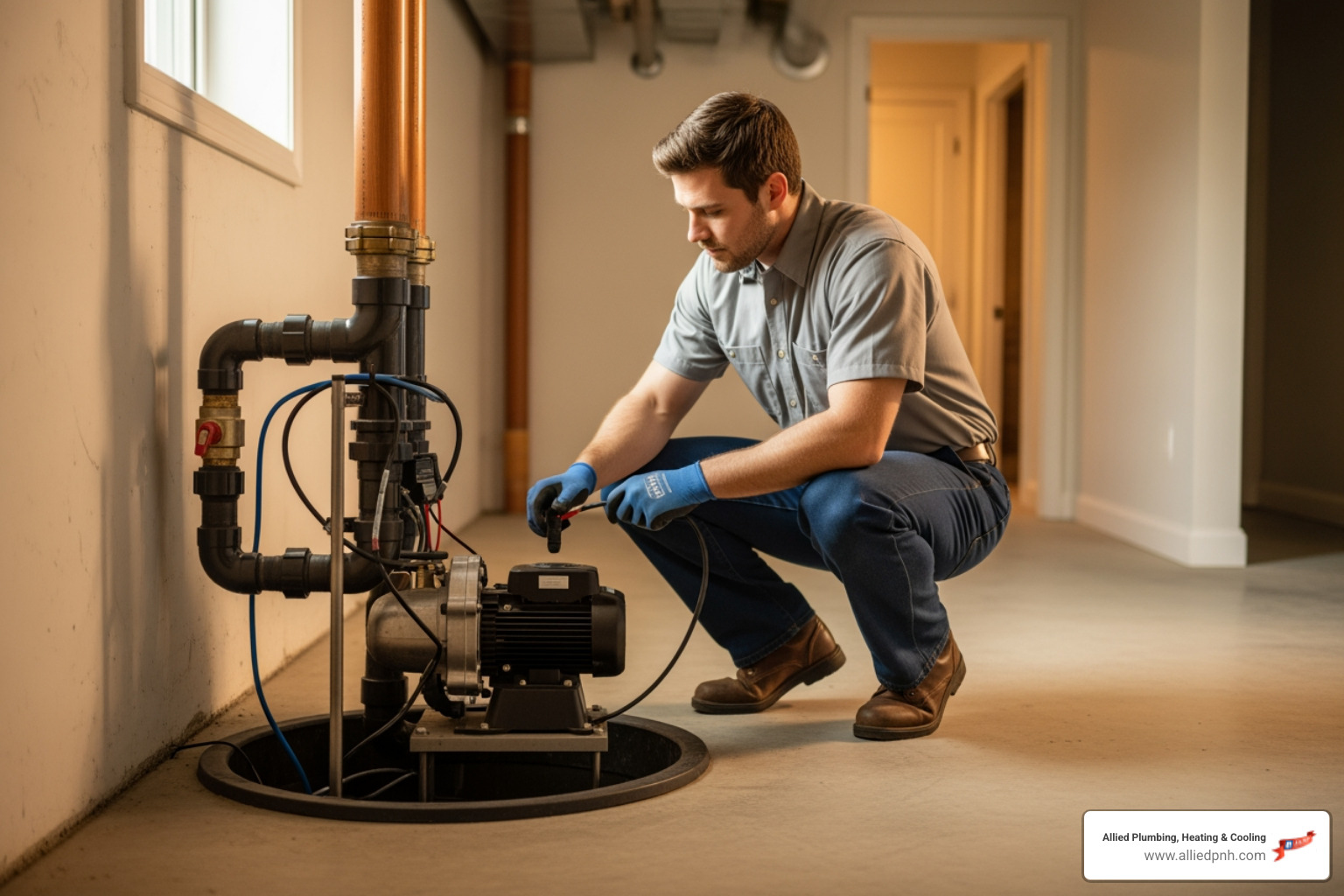
Sump pumps services in Rochester, IL are one of the most important — and most overlooked — protections your home can have. Rochester sits in Central Illinois, where heavy spring rains, rapid snowmelt, and severe storms can push groundwater into your basement fast. When your sump pump fails, the damage can happen within hours.
Here's a quick overview of what local homeowners need to know:
- What it does: A sump pump removes water that collects in a pit beneath your basement, keeping your foundation dry
- Common failure causes: Float switch problems, power outages, clogged discharge lines, and motor wear
- Typical lifespan: 7-10 years, depending on usage and maintenance
- Key services available: Installation, repair, replacement, maintenance, and backup system installation
- Backup options: Battery-powered backup units and water-pressure-powered backup systems for protection during outages
- Warning signs: Constant running, strange noises, visible rust, or water near the basement surface
- When to call a pro: Any time you notice unusual pump behavior — especially before storm season
Most pumps don't fail on a sunny day. They fail during the worst possible storm, at the worst possible time. That's why knowing the rules for maintaining and managing your sump pump system isn't just helpful — it's critical for protecting your home and avoiding costly water damage, mold growth, and foundation issues.
In this guide, Allied Plumbing, Heating & Cooling walks you through the 10 essential rules every Rochester homeowner should follow to keep their basement dry and their sump pump ready for whatever Illinois weather throws at it.
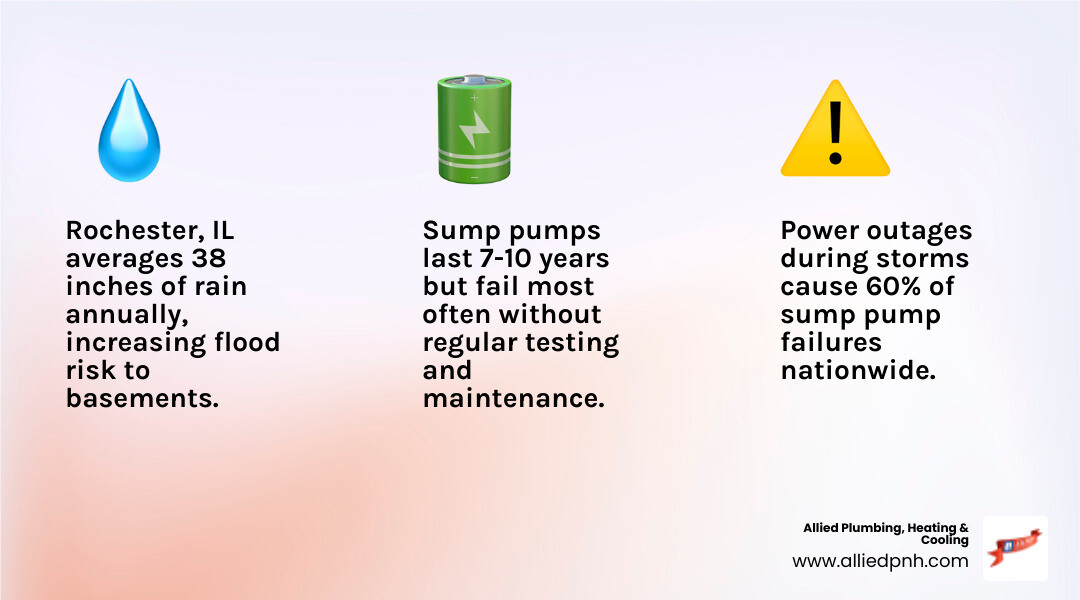
Rules 1-3: Identifying Signs of Failure and Motor Issues
When it comes to your basement's defense system, silence isn't always golden, and noise isn't always normal. The first three rules of maintaining your home involve being an observant homeowner. You don't need to be a master plumber to spot the Signs Your Sump Pump Needs Repair.
Rule 1: Listen for Unusual Noises and Vibrations
Your sump pump should hum along relatively quietly. If you start hearing thumping, rattling, or grinding noises, it’s a major red flag. These sounds often indicate that the impeller (the fan-like component that moves the water) is damaged or jammed with debris. Excessive vibration is another warning sign; if the pump has sucked up a small stone or piece of hard debris, the impeller can become unbalanced, which puts immense strain on the motor and can lead to a total system meltdown during a Rochester downpour.
Rule 2: Monitor the Age and Health of the Motor
Like any mechanical device, a sump pump motor has a finite lifespan. In our neck of the woods, where the water table can fluctuate wildly, these motors work hard. If you notice the Signs Sump Pump Motor is Failing in Rochester, such as the unit struggling to start or smelling like burnt electrical components, it’s time to act. Most units are rated to last between 7 and 10 years. If yours is pushing a decade, you’re essentially living on borrowed time. Visible corrosion or rust on the exterior of the pump is another sign that the housing is degrading, which can lead to internal electrical shorts.
Rule 3: Don't Ignore a Pump That Won't Quit
Is your pump working overtime even when the sun is shining? There are several reasons Why Sump Pump is Running Constantly in Rochester. The most frequent culprit is a stuck float switch. The float switch acts like a toilet tank sensor; as water rises, the float lifts and triggers the pump. If it gets pinned against the side of the basin or tangled in wires, it will keep the pump running until the motor burns out. You can often Troubleshoot Sump Pump that Wont Stop Running by checking the basin for debris that might be obstructing the switch, but if the switch itself has failed internally, a professional repair is necessary.
Rules 4-6: Selecting Professional Sump Pumps Services in Rochester, IL
Choosing the right equipment and the right team is just as important as identifying a problem. When you're looking for Sump Pumps Rochester IL, you need to understand the different types of technology available to protect your foundation.
Rule 4: Choose the Right Pump Type for Your Basin
There are two primary types of sump pumps used in Illinois homes: submersible and pedestal. Submersible pumps are designed to sit entirely underwater at the bottom of the sump pit. They are generally quieter and more powerful, making them ideal for finished basements. Pedestal pumps have the motor mounted on a shaft above the water line. While they are easier to service and often last longer because the motor stays dry, they are louder and less aesthetically pleasing.
| Feature | Submersible Pump | Pedestal Pump |
|---|---|---|
| Placement | Fully inside the sump pit | Motor sits above the pit |
| Noise Level | Very Quiet | Noticeable Hum |
| Lifespan | 5-10 Years | 10-15 Years |
| Clog Risk | Low (if screened) | Moderate |
| Best For | Finished Basements | Narrow Sump Pits |
Rule 5: Ensure Correct Sizing and Installation
A pump that is too small won't be able to keep up with a heavy Rochester storm, while a pump that is too large will "short cycle," turning on and off too rapidly and wearing out the motor prematurely. This is How Experts Handle Sump Pump Repair and installation—by calculating the "head pressure" (how high and far the water must be pumped) and the volume of water entering your home. Proper installation also involves ensuring the check valve is working correctly to prevent water from flowing back into the pit once the pump shuts off.
Rule 6: Only Use Licensed Local Plumbers
Rochester has specific plumbing codes that must be followed to ensure your discharge lines don't cause issues for your neighbors or the city's infrastructure. By staying within our Rochester IL Service Area, you ensure that your technician understands local soil conditions and drainage requirements. Hiring a pro for Plumbing Rochester IL guarantees that the work is bonded, insured, and built to last.
Rules 7-10: Maintenance, Backups, and Weather Readiness
The final rules focus on long-term reliability. A sump pump is only as good as its ability to run when the power goes out or the temperature drops.
Rule 7: Invest in a Reliable Backup System
In Rochester, severe storms often bring power outages. If your primary pump relies solely on your home's electrical grid, your basement is vulnerable the moment the lights flicker out. We recommend two main types of backups:
- Battery Backup: These systems use a dedicated battery (often a heavy-duty marine battery) to power a secondary pump if the main one fails or loses power. Modern systems can pump thousands of gallons on a single charge.
- Water Pressure Backup: These are ingenious devices that use your home's municipal water pressure to create a vacuum that sucks water out of the pit. Since they don't require electricity or batteries, they are incredibly reliable as long as your city water is running.
Rule 8: Perform Seasonal Maintenance
Don't wait for a flood to check your equipment. Follow this seasonal checklist to stay ahead of the weather:
- Spring: Clean the sump pit of any silt, gravel, or debris. Test the pump by pouring a five-gallon bucket of water into the pit.
- Summer: Check the discharge line outside to ensure it isn't blocked by grass clippings or mulch.
- Fall: Ensure the "weep hole" in the discharge pipe isn't clogged.
- Winter: Inspect the outdoor discharge point to ensure it hasn't become a block of ice.
Rule 9: Prevent Frozen Discharge Lines
One of the most common winter failures in Central Illinois is a frozen discharge line. If the water inside the pipe freezes, the pump will continue to run against a solid block of ice, eventually overheating and failing. We recommend insulating the exterior portion of the pipe or using an "ice guard" attachment that allows water to escape near the foundation if the main line further out is frozen.
Rule 10: Integrate with Total Home Health
Your sump pump is part of a larger ecosystem. If your pump is struggling, it might be time to look at other moisture-related services. For example, a constantly wet basement can affect your Water Heaters Rochester IL. High humidity in the basement can lead to corrosion on the bottom of a traditional tank, leading homeowners to seek Water Heater Replacement Rochester IL sooner than expected. In some cases, upgrading to Tankless Water Heaters Rochester IL can save space and reduce the risk of flood damage to your appliances. Furthermore, if you run a business, a Commercial Plumber Rochester IL can help ensure your commercial sump and ejector pumps are up to the task of protecting your inventory and foundation.
Frequently Asked Questions About Sump Pumps Services in Rochester, IL
How often should I test my sump pumps services in Rochester, IL?
We recommend testing your system at least twice a year—once in the early spring before the heavy rains begin, and once in the late fall. The easiest way to do this is the "bucket test." Slowly pour about five gallons of water into the sump pit. The float should rise, the pump should kick on, the water level should drop quickly, and the pump should shut off. If the pump struggles to start or the water doesn't move, call us immediately.
What are the best backup options for sump pumps services in Rochester, IL?
The "best" option depends on your home. Battery backups are the most common and are excellent for handling short-to-medium power outages. They can typically move between 8,000 and 14,000 gallons depending on the battery size. If you are on a municipal water line and want a "set it and forget it" solution that never needs a battery replacement, a water-pressure-powered backup is a fantastic choice. These can move about 12-14 gallons per minute using only your home's water pressure.
When should I choose repair over replacement for my sump pump?
If your pump is less than five years old and has a simple issue like a tangled float switch or a clogged intake screen, a repair is usually the most cost-effective route. However, if the motor is over 7 years old, has visible rust, or has already failed once during a storm, replacement is the safer bet. When the cost of a complex repair approaches the cost of a new, high-efficiency unit with a fresh warranty, we always recommend replacement to give you total peace of mind.
Conclusion: Trust Allied Plumbing, Heating & Cooling for Your Basement Protection
At Allied Plumbing, Heating & Cooling, we understand that a dry basement is the foundation of a happy home. As a 3-generation family business serving the Rochester area since 1977, we’ve seen every type of flooding scenario Central Illinois can produce. We don't just "fix pipes"—we provide security for your family's biggest investment.
Whether you need an emergency repair in the middle of a thunderstorm or you want to upgrade to a state-of-the-art backup system, we are here for you 24/7. Our commitment to quality is backed by the Daikin Comfort Promise, ensuring that every job we do is handled with the utmost professionalism and reliability.
Don't wait for the water to start rising. If you have concerns about your Sump Pumps Rochester IL, contact us today. We’ll make sure your home stays dry, your foundation stays strong, and your mind stays at ease, no matter what the weather report says.

Why Sump Pumps Services in Rochester, IL Are Essential for Every Homeowner

Sump pumps services in Rochester, IL are one of the most important — and most overlooked — protections your home can have. Rochester sits in Central Illinois, where heavy spring rains, rapid snowmelt, and severe storms can push groundwater into your basement fast. When your sump pump fails, the damage can happen within hours.
Here's a quick overview of what local homeowners need to know:
- What it does: A sump pump removes water that collects in a pit beneath your basement, keeping your foundation dry
- Common failure causes: Float switch problems, power outages, clogged discharge lines, and motor wear
- Typical lifespan: 7-10 years, depending on usage and maintenance
- Key services available: Installation, repair, replacement, maintenance, and backup system installation
- Backup options: Battery-powered backup units and water-pressure-powered backup systems for protection during outages
- Warning signs: Constant running, strange noises, visible rust, or water near the basement surface
- When to call a pro: Any time you notice unusual pump behavior — especially before storm season
Most pumps don't fail on a sunny day. They fail during the worst possible storm, at the worst possible time. That's why knowing the rules for maintaining and managing your sump pump system isn't just helpful — it's critical for protecting your home and avoiding costly water damage, mold growth, and foundation issues.
In this guide, Allied Plumbing, Heating & Cooling walks you through the 10 essential rules every Rochester homeowner should follow to keep their basement dry and their sump pump ready for whatever Illinois weather throws at it.

Rules 1-3: Identifying Signs of Failure and Motor Issues
When it comes to your basement's defense system, silence isn't always golden, and noise isn't always normal. The first three rules of maintaining your home involve being an observant homeowner. You don't need to be a master plumber to spot the Signs Your Sump Pump Needs Repair.
Rule 1: Listen for Unusual Noises and Vibrations
Your sump pump should hum along relatively quietly. If you start hearing thumping, rattling, or grinding noises, it’s a major red flag. These sounds often indicate that the impeller (the fan-like component that moves the water) is damaged or jammed with debris. Excessive vibration is another warning sign; if the pump has sucked up a small stone or piece of hard debris, the impeller can become unbalanced, which puts immense strain on the motor and can lead to a total system meltdown during a Rochester downpour.
Rule 2: Monitor the Age and Health of the Motor
Like any mechanical device, a sump pump motor has a finite lifespan. In our neck of the woods, where the water table can fluctuate wildly, these motors work hard. If you notice the Signs Sump Pump Motor is Failing in Rochester, such as the unit struggling to start or smelling like burnt electrical components, it’s time to act. Most units are rated to last between 7 and 10 years. If yours is pushing a decade, you’re essentially living on borrowed time. Visible corrosion or rust on the exterior of the pump is another sign that the housing is degrading, which can lead to internal electrical shorts.
Rule 3: Don't Ignore a Pump That Won't Quit
Is your pump working overtime even when the sun is shining? There are several reasons Why Sump Pump is Running Constantly in Rochester. The most frequent culprit is a stuck float switch. The float switch acts like a toilet tank sensor; as water rises, the float lifts and triggers the pump. If it gets pinned against the side of the basin or tangled in wires, it will keep the pump running until the motor burns out. You can often Troubleshoot Sump Pump that Wont Stop Running by checking the basin for debris that might be obstructing the switch, but if the switch itself has failed internally, a professional repair is necessary.
Rules 4-6: Selecting Professional Sump Pumps Services in Rochester, IL
Choosing the right equipment and the right team is just as important as identifying a problem. When you're looking for Sump Pumps Rochester IL, you need to understand the different types of technology available to protect your foundation.
Rule 4: Choose the Right Pump Type for Your Basin
There are two primary types of sump pumps used in Illinois homes: submersible and pedestal. Submersible pumps are designed to sit entirely underwater at the bottom of the sump pit. They are generally quieter and more powerful, making them ideal for finished basements. Pedestal pumps have the motor mounted on a shaft above the water line. While they are easier to service and often last longer because the motor stays dry, they are louder and less aesthetically pleasing.
| Feature | Submersible Pump | Pedestal Pump |
|---|---|---|
| Placement | Fully inside the sump pit | Motor sits above the pit |
| Noise Level | Very Quiet | Noticeable Hum |
| Lifespan | 5-10 Years | 10-15 Years |
| Clog Risk | Low (if screened) | Moderate |
| Best For | Finished Basements | Narrow Sump Pits |
Rule 5: Ensure Correct Sizing and Installation
A pump that is too small won't be able to keep up with a heavy Rochester storm, while a pump that is too large will "short cycle," turning on and off too rapidly and wearing out the motor prematurely. This is How Experts Handle Sump Pump Repair and installation—by calculating the "head pressure" (how high and far the water must be pumped) and the volume of water entering your home. Proper installation also involves ensuring the check valve is working correctly to prevent water from flowing back into the pit once the pump shuts off.
Rule 6: Only Use Licensed Local Plumbers
Rochester has specific plumbing codes that must be followed to ensure your discharge lines don't cause issues for your neighbors or the city's infrastructure. By staying within our Rochester IL Service Area, you ensure that your technician understands local soil conditions and drainage requirements. Hiring a pro for Plumbing Rochester IL guarantees that the work is bonded, insured, and built to last.
Rules 7-10: Maintenance, Backups, and Weather Readiness
The final rules focus on long-term reliability. A sump pump is only as good as its ability to run when the power goes out or the temperature drops.
Rule 7: Invest in a Reliable Backup System
In Rochester, severe storms often bring power outages. If your primary pump relies solely on your home's electrical grid, your basement is vulnerable the moment the lights flicker out. We recommend two main types of backups:
- Battery Backup: These systems use a dedicated battery (often a heavy-duty marine battery) to power a secondary pump if the main one fails or loses power. Modern systems can pump thousands of gallons on a single charge.
- Water Pressure Backup: These are ingenious devices that use your home's municipal water pressure to create a vacuum that sucks water out of the pit. Since they don't require electricity or batteries, they are incredibly reliable as long as your city water is running.
Rule 8: Perform Seasonal Maintenance
Don't wait for a flood to check your equipment. Follow this seasonal checklist to stay ahead of the weather:
- Spring: Clean the sump pit of any silt, gravel, or debris. Test the pump by pouring a five-gallon bucket of water into the pit.
- Summer: Check the discharge line outside to ensure it isn't blocked by grass clippings or mulch.
- Fall: Ensure the "weep hole" in the discharge pipe isn't clogged.
- Winter: Inspect the outdoor discharge point to ensure it hasn't become a block of ice.
Rule 9: Prevent Frozen Discharge Lines
One of the most common winter failures in Central Illinois is a frozen discharge line. If the water inside the pipe freezes, the pump will continue to run against a solid block of ice, eventually overheating and failing. We recommend insulating the exterior portion of the pipe or using an "ice guard" attachment that allows water to escape near the foundation if the main line further out is frozen.
Rule 10: Integrate with Total Home Health
Your sump pump is part of a larger ecosystem. If your pump is struggling, it might be time to look at other moisture-related services. For example, a constantly wet basement can affect your Water Heaters Rochester IL. High humidity in the basement can lead to corrosion on the bottom of a traditional tank, leading homeowners to seek Water Heater Replacement Rochester IL sooner than expected. In some cases, upgrading to Tankless Water Heaters Rochester IL can save space and reduce the risk of flood damage to your appliances. Furthermore, if you run a business, a Commercial Plumber Rochester IL can help ensure your commercial sump and ejector pumps are up to the task of protecting your inventory and foundation.
Frequently Asked Questions About Sump Pumps Services in Rochester, IL
How often should I test my sump pumps services in Rochester, IL?
We recommend testing your system at least twice a year—once in the early spring before the heavy rains begin, and once in the late fall. The easiest way to do this is the "bucket test." Slowly pour about five gallons of water into the sump pit. The float should rise, the pump should kick on, the water level should drop quickly, and the pump should shut off. If the pump struggles to start or the water doesn't move, call us immediately.
What are the best backup options for sump pumps services in Rochester, IL?
The "best" option depends on your home. Battery backups are the most common and are excellent for handling short-to-medium power outages. They can typically move between 8,000 and 14,000 gallons depending on the battery size. If you are on a municipal water line and want a "set it and forget it" solution that never needs a battery replacement, a water-pressure-powered backup is a fantastic choice. These can move about 12-14 gallons per minute using only your home's water pressure.
When should I choose repair over replacement for my sump pump?
If your pump is less than five years old and has a simple issue like a tangled float switch or a clogged intake screen, a repair is usually the most cost-effective route. However, if the motor is over 7 years old, has visible rust, or has already failed once during a storm, replacement is the safer bet. When the cost of a complex repair approaches the cost of a new, high-efficiency unit with a fresh warranty, we always recommend replacement to give you total peace of mind.
Conclusion: Trust Allied Plumbing, Heating & Cooling for Your Basement Protection
At Allied Plumbing, Heating & Cooling, we understand that a dry basement is the foundation of a happy home. As a 3-generation family business serving the Rochester area since 1977, we’ve seen every type of flooding scenario Central Illinois can produce. We don't just "fix pipes"—we provide security for your family's biggest investment.
Whether you need an emergency repair in the middle of a thunderstorm or you want to upgrade to a state-of-the-art backup system, we are here for you 24/7. Our commitment to quality is backed by the Daikin Comfort Promise, ensuring that every job we do is handled with the utmost professionalism and reliability.
Don't wait for the water to start rising. If you have concerns about your Sump Pumps Rochester IL, contact us today. We’ll make sure your home stays dry, your foundation stays strong, and your mind stays at ease, no matter what the weather report says.
Why Sump Pumps Services in Rochester, IL Are Essential for Every Homeowner

Sump pumps services in Rochester, IL are one of the most important — and most overlooked — protections your home can have. Rochester sits in Central Illinois, where heavy spring rains, rapid snowmelt, and severe storms can push groundwater into your basement fast. When your sump pump fails, the damage can happen within hours.
Here's a quick overview of what local homeowners need to know:
- What it does: A sump pump removes water that collects in a pit beneath your basement, keeping your foundation dry
- Common failure causes: Float switch problems, power outages, clogged discharge lines, and motor wear
- Typical lifespan: 7-10 years, depending on usage and maintenance
- Key services available: Installation, repair, replacement, maintenance, and backup system installation
- Backup options: Battery-powered backup units and water-pressure-powered backup systems for protection during outages
- Warning signs: Constant running, strange noises, visible rust, or water near the basement surface
- When to call a pro: Any time you notice unusual pump behavior — especially before storm season
Most pumps don't fail on a sunny day. They fail during the worst possible storm, at the worst possible time. That's why knowing the rules for maintaining and managing your sump pump system isn't just helpful — it's critical for protecting your home and avoiding costly water damage, mold growth, and foundation issues.
In this guide, Allied Plumbing, Heating & Cooling walks you through the 10 essential rules every Rochester homeowner should follow to keep their basement dry and their sump pump ready for whatever Illinois weather throws at it.

Rules 1-3: Identifying Signs of Failure and Motor Issues
When it comes to your basement's defense system, silence isn't always golden, and noise isn't always normal. The first three rules of maintaining your home involve being an observant homeowner. You don't need to be a master plumber to spot the Signs Your Sump Pump Needs Repair.
Rule 1: Listen for Unusual Noises and Vibrations
Your sump pump should hum along relatively quietly. If you start hearing thumping, rattling, or grinding noises, it’s a major red flag. These sounds often indicate that the impeller (the fan-like component that moves the water) is damaged or jammed with debris. Excessive vibration is another warning sign; if the pump has sucked up a small stone or piece of hard debris, the impeller can become unbalanced, which puts immense strain on the motor and can lead to a total system meltdown during a Rochester downpour.
Rule 2: Monitor the Age and Health of the Motor
Like any mechanical device, a sump pump motor has a finite lifespan. In our neck of the woods, where the water table can fluctuate wildly, these motors work hard. If you notice the Signs Sump Pump Motor is Failing in Rochester, such as the unit struggling to start or smelling like burnt electrical components, it’s time to act. Most units are rated to last between 7 and 10 years. If yours is pushing a decade, you’re essentially living on borrowed time. Visible corrosion or rust on the exterior of the pump is another sign that the housing is degrading, which can lead to internal electrical shorts.
Rule 3: Don't Ignore a Pump That Won't Quit
Is your pump working overtime even when the sun is shining? There are several reasons Why Sump Pump is Running Constantly in Rochester. The most frequent culprit is a stuck float switch. The float switch acts like a toilet tank sensor; as water rises, the float lifts and triggers the pump. If it gets pinned against the side of the basin or tangled in wires, it will keep the pump running until the motor burns out. You can often Troubleshoot Sump Pump that Wont Stop Running by checking the basin for debris that might be obstructing the switch, but if the switch itself has failed internally, a professional repair is necessary.
Rules 4-6: Selecting Professional Sump Pumps Services in Rochester, IL
Choosing the right equipment and the right team is just as important as identifying a problem. When you're looking for Sump Pumps Rochester IL, you need to understand the different types of technology available to protect your foundation.
Rule 4: Choose the Right Pump Type for Your Basin
There are two primary types of sump pumps used in Illinois homes: submersible and pedestal. Submersible pumps are designed to sit entirely underwater at the bottom of the sump pit. They are generally quieter and more powerful, making them ideal for finished basements. Pedestal pumps have the motor mounted on a shaft above the water line. While they are easier to service and often last longer because the motor stays dry, they are louder and less aesthetically pleasing.
| Feature | Submersible Pump | Pedestal Pump |
|---|---|---|
| Placement | Fully inside the sump pit | Motor sits above the pit |
| Noise Level | Very Quiet | Noticeable Hum |
| Lifespan | 5-10 Years | 10-15 Years |
| Clog Risk | Low (if screened) | Moderate |
| Best For | Finished Basements | Narrow Sump Pits |
Rule 5: Ensure Correct Sizing and Installation
A pump that is too small won't be able to keep up with a heavy Rochester storm, while a pump that is too large will "short cycle," turning on and off too rapidly and wearing out the motor prematurely. This is How Experts Handle Sump Pump Repair and installation—by calculating the "head pressure" (how high and far the water must be pumped) and the volume of water entering your home. Proper installation also involves ensuring the check valve is working correctly to prevent water from flowing back into the pit once the pump shuts off.
Rule 6: Only Use Licensed Local Plumbers
Rochester has specific plumbing codes that must be followed to ensure your discharge lines don't cause issues for your neighbors or the city's infrastructure. By staying within our Rochester IL Service Area, you ensure that your technician understands local soil conditions and drainage requirements. Hiring a pro for Plumbing Rochester IL guarantees that the work is bonded, insured, and built to last.
Rules 7-10: Maintenance, Backups, and Weather Readiness
The final rules focus on long-term reliability. A sump pump is only as good as its ability to run when the power goes out or the temperature drops.
Rule 7: Invest in a Reliable Backup System
In Rochester, severe storms often bring power outages. If your primary pump relies solely on your home's electrical grid, your basement is vulnerable the moment the lights flicker out. We recommend two main types of backups:
- Battery Backup: These systems use a dedicated battery (often a heavy-duty marine battery) to power a secondary pump if the main one fails or loses power. Modern systems can pump thousands of gallons on a single charge.
- Water Pressure Backup: These are ingenious devices that use your home's municipal water pressure to create a vacuum that sucks water out of the pit. Since they don't require electricity or batteries, they are incredibly reliable as long as your city water is running.
Rule 8: Perform Seasonal Maintenance
Don't wait for a flood to check your equipment. Follow this seasonal checklist to stay ahead of the weather:
- Spring: Clean the sump pit of any silt, gravel, or debris. Test the pump by pouring a five-gallon bucket of water into the pit.
- Summer: Check the discharge line outside to ensure it isn't blocked by grass clippings or mulch.
- Fall: Ensure the "weep hole" in the discharge pipe isn't clogged.
- Winter: Inspect the outdoor discharge point to ensure it hasn't become a block of ice.
Rule 9: Prevent Frozen Discharge Lines
One of the most common winter failures in Central Illinois is a frozen discharge line. If the water inside the pipe freezes, the pump will continue to run against a solid block of ice, eventually overheating and failing. We recommend insulating the exterior portion of the pipe or using an "ice guard" attachment that allows water to escape near the foundation if the main line further out is frozen.
Rule 10: Integrate with Total Home Health
Your sump pump is part of a larger ecosystem. If your pump is struggling, it might be time to look at other moisture-related services. For example, a constantly wet basement can affect your Water Heaters Rochester IL. High humidity in the basement can lead to corrosion on the bottom of a traditional tank, leading homeowners to seek Water Heater Replacement Rochester IL sooner than expected. In some cases, upgrading to Tankless Water Heaters Rochester IL can save space and reduce the risk of flood damage to your appliances. Furthermore, if you run a business, a Commercial Plumber Rochester IL can help ensure your commercial sump and ejector pumps are up to the task of protecting your inventory and foundation.
Frequently Asked Questions About Sump Pumps Services in Rochester, IL
How often should I test my sump pumps services in Rochester, IL?
We recommend testing your system at least twice a year—once in the early spring before the heavy rains begin, and once in the late fall. The easiest way to do this is the "bucket test." Slowly pour about five gallons of water into the sump pit. The float should rise, the pump should kick on, the water level should drop quickly, and the pump should shut off. If the pump struggles to start or the water doesn't move, call us immediately.
What are the best backup options for sump pumps services in Rochester, IL?
The "best" option depends on your home. Battery backups are the most common and are excellent for handling short-to-medium power outages. They can typically move between 8,000 and 14,000 gallons depending on the battery size. If you are on a municipal water line and want a "set it and forget it" solution that never needs a battery replacement, a water-pressure-powered backup is a fantastic choice. These can move about 12-14 gallons per minute using only your home's water pressure.
When should I choose repair over replacement for my sump pump?
If your pump is less than five years old and has a simple issue like a tangled float switch or a clogged intake screen, a repair is usually the most cost-effective route. However, if the motor is over 7 years old, has visible rust, or has already failed once during a storm, replacement is the safer bet. When the cost of a complex repair approaches the cost of a new, high-efficiency unit with a fresh warranty, we always recommend replacement to give you total peace of mind.
Conclusion: Trust Allied Plumbing, Heating & Cooling for Your Basement Protection
At Allied Plumbing, Heating & Cooling, we understand that a dry basement is the foundation of a happy home. As a 3-generation family business serving the Rochester area since 1977, we’ve seen every type of flooding scenario Central Illinois can produce. We don't just "fix pipes"—we provide security for your family's biggest investment.
Whether you need an emergency repair in the middle of a thunderstorm or you want to upgrade to a state-of-the-art backup system, we are here for you 24/7. Our commitment to quality is backed by the Daikin Comfort Promise, ensuring that every job we do is handled with the utmost professionalism and reliability.
Don't wait for the water to start rising. If you have concerns about your Sump Pumps Rochester IL, contact us today. We’ll make sure your home stays dry, your foundation stays strong, and your mind stays at ease, no matter what the weather report says.
Why Sump Pumps Services in Rochester, IL Are Essential for Every Homeowner

Sump pumps services in Rochester, IL are one of the most important — and most overlooked — protections your home can have. Rochester sits in Central Illinois, where heavy spring rains, rapid snowmelt, and severe storms can push groundwater into your basement fast. When your sump pump fails, the damage can happen within hours.
Here's a quick overview of what local homeowners need to know:
- What it does: A sump pump removes water that collects in a pit beneath your basement, keeping your foundation dry
- Common failure causes: Float switch problems, power outages, clogged discharge lines, and motor wear
- Typical lifespan: 7-10 years, depending on usage and maintenance
- Key services available: Installation, repair, replacement, maintenance, and backup system installation
- Backup options: Battery-powered backup units and water-pressure-powered backup systems for protection during outages
- Warning signs: Constant running, strange noises, visible rust, or water near the basement surface
- When to call a pro: Any time you notice unusual pump behavior — especially before storm season
Most pumps don't fail on a sunny day. They fail during the worst possible storm, at the worst possible time. That's why knowing the rules for maintaining and managing your sump pump system isn't just helpful — it's critical for protecting your home and avoiding costly water damage, mold growth, and foundation issues.
In this guide, Allied Plumbing, Heating & Cooling walks you through the 10 essential rules every Rochester homeowner should follow to keep their basement dry and their sump pump ready for whatever Illinois weather throws at it.

Rules 1-3: Identifying Signs of Failure and Motor Issues
When it comes to your basement's defense system, silence isn't always golden, and noise isn't always normal. The first three rules of maintaining your home involve being an observant homeowner. You don't need to be a master plumber to spot the Signs Your Sump Pump Needs Repair.
Rule 1: Listen for Unusual Noises and Vibrations
Your sump pump should hum along relatively quietly. If you start hearing thumping, rattling, or grinding noises, it’s a major red flag. These sounds often indicate that the impeller (the fan-like component that moves the water) is damaged or jammed with debris. Excessive vibration is another warning sign; if the pump has sucked up a small stone or piece of hard debris, the impeller can become unbalanced, which puts immense strain on the motor and can lead to a total system meltdown during a Rochester downpour.
Rule 2: Monitor the Age and Health of the Motor
Like any mechanical device, a sump pump motor has a finite lifespan. In our neck of the woods, where the water table can fluctuate wildly, these motors work hard. If you notice the Signs Sump Pump Motor is Failing in Rochester, such as the unit struggling to start or smelling like burnt electrical components, it’s time to act. Most units are rated to last between 7 and 10 years. If yours is pushing a decade, you’re essentially living on borrowed time. Visible corrosion or rust on the exterior of the pump is another sign that the housing is degrading, which can lead to internal electrical shorts.
Rule 3: Don't Ignore a Pump That Won't Quit
Is your pump working overtime even when the sun is shining? There are several reasons Why Sump Pump is Running Constantly in Rochester. The most frequent culprit is a stuck float switch. The float switch acts like a toilet tank sensor; as water rises, the float lifts and triggers the pump. If it gets pinned against the side of the basin or tangled in wires, it will keep the pump running until the motor burns out. You can often Troubleshoot Sump Pump that Wont Stop Running by checking the basin for debris that might be obstructing the switch, but if the switch itself has failed internally, a professional repair is necessary.
Rules 4-6: Selecting Professional Sump Pumps Services in Rochester, IL
Choosing the right equipment and the right team is just as important as identifying a problem. When you're looking for Sump Pumps Rochester IL, you need to understand the different types of technology available to protect your foundation.
Rule 4: Choose the Right Pump Type for Your Basin
There are two primary types of sump pumps used in Illinois homes: submersible and pedestal. Submersible pumps are designed to sit entirely underwater at the bottom of the sump pit. They are generally quieter and more powerful, making them ideal for finished basements. Pedestal pumps have the motor mounted on a shaft above the water line. While they are easier to service and often last longer because the motor stays dry, they are louder and less aesthetically pleasing.
| Feature | Submersible Pump | Pedestal Pump |
|---|---|---|
| Placement | Fully inside the sump pit | Motor sits above the pit |
| Noise Level | Very Quiet | Noticeable Hum |
| Lifespan | 5-10 Years | 10-15 Years |
| Clog Risk | Low (if screened) | Moderate |
| Best For | Finished Basements | Narrow Sump Pits |
Rule 5: Ensure Correct Sizing and Installation
A pump that is too small won't be able to keep up with a heavy Rochester storm, while a pump that is too large will "short cycle," turning on and off too rapidly and wearing out the motor prematurely. This is How Experts Handle Sump Pump Repair and installation—by calculating the "head pressure" (how high and far the water must be pumped) and the volume of water entering your home. Proper installation also involves ensuring the check valve is working correctly to prevent water from flowing back into the pit once the pump shuts off.
Rule 6: Only Use Licensed Local Plumbers
Rochester has specific plumbing codes that must be followed to ensure your discharge lines don't cause issues for your neighbors or the city's infrastructure. By staying within our Rochester IL Service Area, you ensure that your technician understands local soil conditions and drainage requirements. Hiring a pro for Plumbing Rochester IL guarantees that the work is bonded, insured, and built to last.
Rules 7-10: Maintenance, Backups, and Weather Readiness
The final rules focus on long-term reliability. A sump pump is only as good as its ability to run when the power goes out or the temperature drops.
Rule 7: Invest in a Reliable Backup System
In Rochester, severe storms often bring power outages. If your primary pump relies solely on your home's electrical grid, your basement is vulnerable the moment the lights flicker out. We recommend two main types of backups:
- Battery Backup: These systems use a dedicated battery (often a heavy-duty marine battery) to power a secondary pump if the main one fails or loses power. Modern systems can pump thousands of gallons on a single charge.
- Water Pressure Backup: These are ingenious devices that use your home's municipal water pressure to create a vacuum that sucks water out of the pit. Since they don't require electricity or batteries, they are incredibly reliable as long as your city water is running.
Rule 8: Perform Seasonal Maintenance
Don't wait for a flood to check your equipment. Follow this seasonal checklist to stay ahead of the weather:
- Spring: Clean the sump pit of any silt, gravel, or debris. Test the pump by pouring a five-gallon bucket of water into the pit.
- Summer: Check the discharge line outside to ensure it isn't blocked by grass clippings or mulch.
- Fall: Ensure the "weep hole" in the discharge pipe isn't clogged.
- Winter: Inspect the outdoor discharge point to ensure it hasn't become a block of ice.
Rule 9: Prevent Frozen Discharge Lines
One of the most common winter failures in Central Illinois is a frozen discharge line. If the water inside the pipe freezes, the pump will continue to run against a solid block of ice, eventually overheating and failing. We recommend insulating the exterior portion of the pipe or using an "ice guard" attachment that allows water to escape near the foundation if the main line further out is frozen.
Rule 10: Integrate with Total Home Health
Your sump pump is part of a larger ecosystem. If your pump is struggling, it might be time to look at other moisture-related services. For example, a constantly wet basement can affect your Water Heaters Rochester IL. High humidity in the basement can lead to corrosion on the bottom of a traditional tank, leading homeowners to seek Water Heater Replacement Rochester IL sooner than expected. In some cases, upgrading to Tankless Water Heaters Rochester IL can save space and reduce the risk of flood damage to your appliances. Furthermore, if you run a business, a Commercial Plumber Rochester IL can help ensure your commercial sump and ejector pumps are up to the task of protecting your inventory and foundation.
Frequently Asked Questions About Sump Pumps Services in Rochester, IL
How often should I test my sump pumps services in Rochester, IL?
We recommend testing your system at least twice a year—once in the early spring before the heavy rains begin, and once in the late fall. The easiest way to do this is the "bucket test." Slowly pour about five gallons of water into the sump pit. The float should rise, the pump should kick on, the water level should drop quickly, and the pump should shut off. If the pump struggles to start or the water doesn't move, call us immediately.
What are the best backup options for sump pumps services in Rochester, IL?
The "best" option depends on your home. Battery backups are the most common and are excellent for handling short-to-medium power outages. They can typically move between 8,000 and 14,000 gallons depending on the battery size. If you are on a municipal water line and want a "set it and forget it" solution that never needs a battery replacement, a water-pressure-powered backup is a fantastic choice. These can move about 12-14 gallons per minute using only your home's water pressure.
When should I choose repair over replacement for my sump pump?
If your pump is less than five years old and has a simple issue like a tangled float switch or a clogged intake screen, a repair is usually the most cost-effective route. However, if the motor is over 7 years old, has visible rust, or has already failed once during a storm, replacement is the safer bet. When the cost of a complex repair approaches the cost of a new, high-efficiency unit with a fresh warranty, we always recommend replacement to give you total peace of mind.
Conclusion: Trust Allied Plumbing, Heating & Cooling for Your Basement Protection
At Allied Plumbing, Heating & Cooling, we understand that a dry basement is the foundation of a happy home. As a 3-generation family business serving the Rochester area since 1977, we’ve seen every type of flooding scenario Central Illinois can produce. We don't just "fix pipes"—we provide security for your family's biggest investment.
Whether you need an emergency repair in the middle of a thunderstorm or you want to upgrade to a state-of-the-art backup system, we are here for you 24/7. Our commitment to quality is backed by the Daikin Comfort Promise, ensuring that every job we do is handled with the utmost professionalism and reliability.
Don't wait for the water to start rising. If you have concerns about your Sump Pumps Rochester IL, contact us today. We’ll make sure your home stays dry, your foundation stays strong, and your mind stays at ease, no matter what the weather report says.

Why Sump Pumps Services in Rochester, IL Are Essential for Every Homeowner

Sump pumps services in Rochester, IL are one of the most important — and most overlooked — protections your home can have. Rochester sits in Central Illinois, where heavy spring rains, rapid snowmelt, and severe storms can push groundwater into your basement fast. When your sump pump fails, the damage can happen within hours.
Here's a quick overview of what local homeowners need to know:
- What it does: A sump pump removes water that collects in a pit beneath your basement, keeping your foundation dry
- Common failure causes: Float switch problems, power outages, clogged discharge lines, and motor wear
- Typical lifespan: 7-10 years, depending on usage and maintenance
- Key services available: Installation, repair, replacement, maintenance, and backup system installation
- Backup options: Battery-powered backup units and water-pressure-powered backup systems for protection during outages
- Warning signs: Constant running, strange noises, visible rust, or water near the basement surface
- When to call a pro: Any time you notice unusual pump behavior — especially before storm season
Most pumps don't fail on a sunny day. They fail during the worst possible storm, at the worst possible time. That's why knowing the rules for maintaining and managing your sump pump system isn't just helpful — it's critical for protecting your home and avoiding costly water damage, mold growth, and foundation issues.
In this guide, Allied Plumbing, Heating & Cooling walks you through the 10 essential rules every Rochester homeowner should follow to keep their basement dry and their sump pump ready for whatever Illinois weather throws at it.

Rules 1-3: Identifying Signs of Failure and Motor Issues
When it comes to your basement's defense system, silence isn't always golden, and noise isn't always normal. The first three rules of maintaining your home involve being an observant homeowner. You don't need to be a master plumber to spot the Signs Your Sump Pump Needs Repair.
Rule 1: Listen for Unusual Noises and Vibrations
Your sump pump should hum along relatively quietly. If you start hearing thumping, rattling, or grinding noises, it’s a major red flag. These sounds often indicate that the impeller (the fan-like component that moves the water) is damaged or jammed with debris. Excessive vibration is another warning sign; if the pump has sucked up a small stone or piece of hard debris, the impeller can become unbalanced, which puts immense strain on the motor and can lead to a total system meltdown during a Rochester downpour.
Rule 2: Monitor the Age and Health of the Motor
Like any mechanical device, a sump pump motor has a finite lifespan. In our neck of the woods, where the water table can fluctuate wildly, these motors work hard. If you notice the Signs Sump Pump Motor is Failing in Rochester, such as the unit struggling to start or smelling like burnt electrical components, it’s time to act. Most units are rated to last between 7 and 10 years. If yours is pushing a decade, you’re essentially living on borrowed time. Visible corrosion or rust on the exterior of the pump is another sign that the housing is degrading, which can lead to internal electrical shorts.
Rule 3: Don't Ignore a Pump That Won't Quit
Is your pump working overtime even when the sun is shining? There are several reasons Why Sump Pump is Running Constantly in Rochester. The most frequent culprit is a stuck float switch. The float switch acts like a toilet tank sensor; as water rises, the float lifts and triggers the pump. If it gets pinned against the side of the basin or tangled in wires, it will keep the pump running until the motor burns out. You can often Troubleshoot Sump Pump that Wont Stop Running by checking the basin for debris that might be obstructing the switch, but if the switch itself has failed internally, a professional repair is necessary.
Rules 4-6: Selecting Professional Sump Pumps Services in Rochester, IL
Choosing the right equipment and the right team is just as important as identifying a problem. When you're looking for Sump Pumps Rochester IL, you need to understand the different types of technology available to protect your foundation.
Rule 4: Choose the Right Pump Type for Your Basin
There are two primary types of sump pumps used in Illinois homes: submersible and pedestal. Submersible pumps are designed to sit entirely underwater at the bottom of the sump pit. They are generally quieter and more powerful, making them ideal for finished basements. Pedestal pumps have the motor mounted on a shaft above the water line. While they are easier to service and often last longer because the motor stays dry, they are louder and less aesthetically pleasing.
| Feature | Submersible Pump | Pedestal Pump |
|---|---|---|
| Placement | Fully inside the sump pit | Motor sits above the pit |
| Noise Level | Very Quiet | Noticeable Hum |
| Lifespan | 5-10 Years | 10-15 Years |
| Clog Risk | Low (if screened) | Moderate |
| Best For | Finished Basements | Narrow Sump Pits |
Rule 5: Ensure Correct Sizing and Installation
A pump that is too small won't be able to keep up with a heavy Rochester storm, while a pump that is too large will "short cycle," turning on and off too rapidly and wearing out the motor prematurely. This is How Experts Handle Sump Pump Repair and installation—by calculating the "head pressure" (how high and far the water must be pumped) and the volume of water entering your home. Proper installation also involves ensuring the check valve is working correctly to prevent water from flowing back into the pit once the pump shuts off.
Rule 6: Only Use Licensed Local Plumbers
Rochester has specific plumbing codes that must be followed to ensure your discharge lines don't cause issues for your neighbors or the city's infrastructure. By staying within our Rochester IL Service Area, you ensure that your technician understands local soil conditions and drainage requirements. Hiring a pro for Plumbing Rochester IL guarantees that the work is bonded, insured, and built to last.
Rules 7-10: Maintenance, Backups, and Weather Readiness
The final rules focus on long-term reliability. A sump pump is only as good as its ability to run when the power goes out or the temperature drops.
Rule 7: Invest in a Reliable Backup System
In Rochester, severe storms often bring power outages. If your primary pump relies solely on your home's electrical grid, your basement is vulnerable the moment the lights flicker out. We recommend two main types of backups:
- Battery Backup: These systems use a dedicated battery (often a heavy-duty marine battery) to power a secondary pump if the main one fails or loses power. Modern systems can pump thousands of gallons on a single charge.
- Water Pressure Backup: These are ingenious devices that use your home's municipal water pressure to create a vacuum that sucks water out of the pit. Since they don't require electricity or batteries, they are incredibly reliable as long as your city water is running.
Rule 8: Perform Seasonal Maintenance
Don't wait for a flood to check your equipment. Follow this seasonal checklist to stay ahead of the weather:
- Spring: Clean the sump pit of any silt, gravel, or debris. Test the pump by pouring a five-gallon bucket of water into the pit.
- Summer: Check the discharge line outside to ensure it isn't blocked by grass clippings or mulch.
- Fall: Ensure the "weep hole" in the discharge pipe isn't clogged.
- Winter: Inspect the outdoor discharge point to ensure it hasn't become a block of ice.
Rule 9: Prevent Frozen Discharge Lines
One of the most common winter failures in Central Illinois is a frozen discharge line. If the water inside the pipe freezes, the pump will continue to run against a solid block of ice, eventually overheating and failing. We recommend insulating the exterior portion of the pipe or using an "ice guard" attachment that allows water to escape near the foundation if the main line further out is frozen.
Rule 10: Integrate with Total Home Health
Your sump pump is part of a larger ecosystem. If your pump is struggling, it might be time to look at other moisture-related services. For example, a constantly wet basement can affect your Water Heaters Rochester IL. High humidity in the basement can lead to corrosion on the bottom of a traditional tank, leading homeowners to seek Water Heater Replacement Rochester IL sooner than expected. In some cases, upgrading to Tankless Water Heaters Rochester IL can save space and reduce the risk of flood damage to your appliances. Furthermore, if you run a business, a Commercial Plumber Rochester IL can help ensure your commercial sump and ejector pumps are up to the task of protecting your inventory and foundation.
Frequently Asked Questions About Sump Pumps Services in Rochester, IL
How often should I test my sump pumps services in Rochester, IL?
We recommend testing your system at least twice a year—once in the early spring before the heavy rains begin, and once in the late fall. The easiest way to do this is the "bucket test." Slowly pour about five gallons of water into the sump pit. The float should rise, the pump should kick on, the water level should drop quickly, and the pump should shut off. If the pump struggles to start or the water doesn't move, call us immediately.
What are the best backup options for sump pumps services in Rochester, IL?
The "best" option depends on your home. Battery backups are the most common and are excellent for handling short-to-medium power outages. They can typically move between 8,000 and 14,000 gallons depending on the battery size. If you are on a municipal water line and want a "set it and forget it" solution that never needs a battery replacement, a water-pressure-powered backup is a fantastic choice. These can move about 12-14 gallons per minute using only your home's water pressure.
When should I choose repair over replacement for my sump pump?
If your pump is less than five years old and has a simple issue like a tangled float switch or a clogged intake screen, a repair is usually the most cost-effective route. However, if the motor is over 7 years old, has visible rust, or has already failed once during a storm, replacement is the safer bet. When the cost of a complex repair approaches the cost of a new, high-efficiency unit with a fresh warranty, we always recommend replacement to give you total peace of mind.
Conclusion: Trust Allied Plumbing, Heating & Cooling for Your Basement Protection
At Allied Plumbing, Heating & Cooling, we understand that a dry basement is the foundation of a happy home. As a 3-generation family business serving the Rochester area since 1977, we’ve seen every type of flooding scenario Central Illinois can produce. We don't just "fix pipes"—we provide security for your family's biggest investment.
Whether you need an emergency repair in the middle of a thunderstorm or you want to upgrade to a state-of-the-art backup system, we are here for you 24/7. Our commitment to quality is backed by the Daikin Comfort Promise, ensuring that every job we do is handled with the utmost professionalism and reliability.
Don't wait for the water to start rising. If you have concerns about your Sump Pumps Rochester IL, contact us today. We’ll make sure your home stays dry, your foundation stays strong, and your mind stays at ease, no matter what the weather report says.
Customer Testimonials
Financing Available
We offer some financing options with affordable monthly payments.
Short Heading Goes Here


Springfield Furnace Repair: Who to Call When the Heat Goes Out
