Is a Tankless Water Heater Worth the Investment? Here's How Long It Actually Lasts
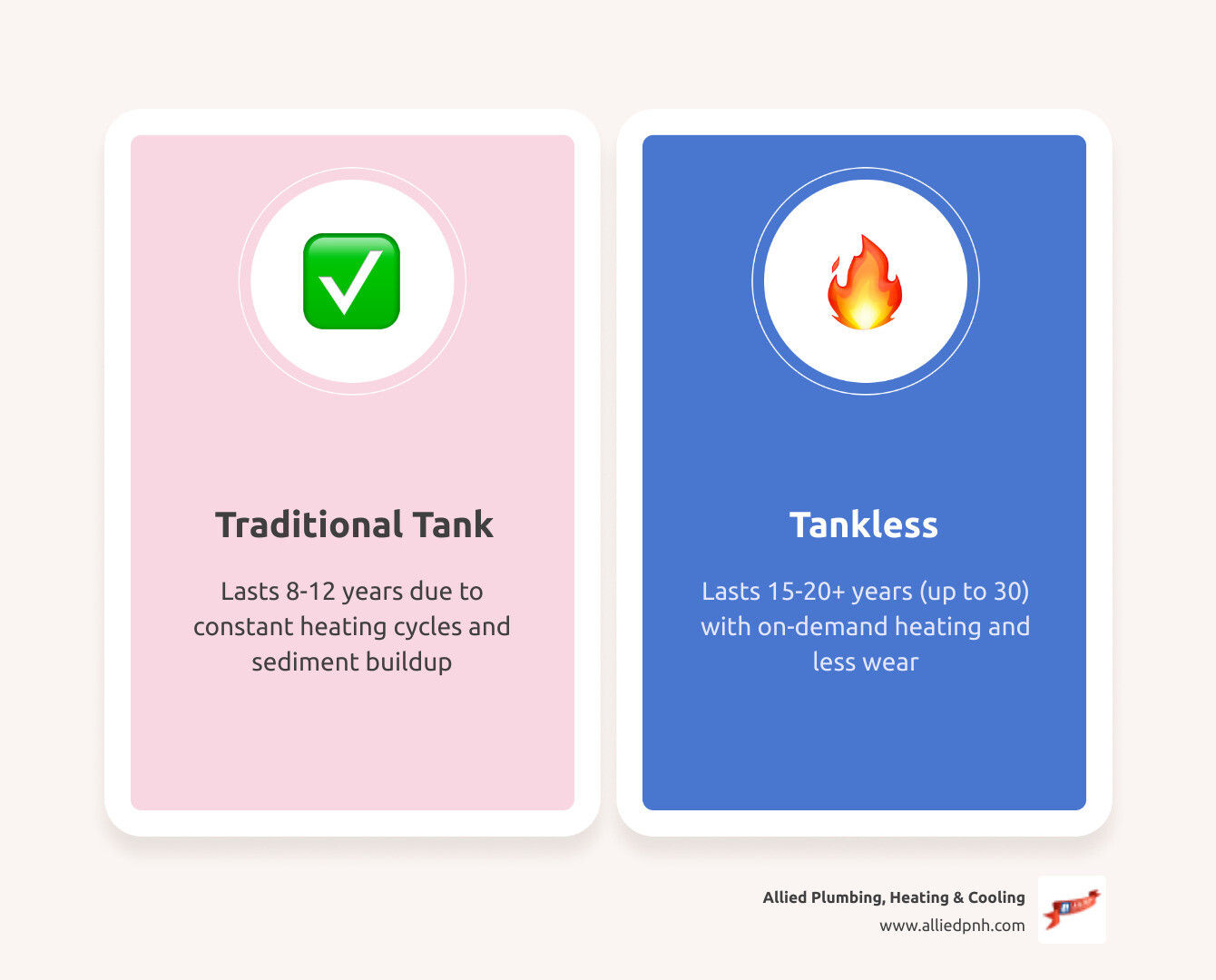
How long does a tankless water heater last is one of the first questions homeowners ask before making the switch — and the answer is reassuring. With proper care, most tankless units last 15 to 20 years, and some well-maintained models can push past 30 years. That's roughly double the lifespan of a traditional tank water heater, which typically needs replacing every 8 to 12 years.
The reason for that longer life comes down to how these units work. Because tankless heaters only fire up when you need hot water, they avoid the constant heating and reheating cycles that wear traditional tanks down over time. Less continuous stress on the system means fewer breakdowns and a longer overall service life.
That said, "lasting 20 years" isn't automatic. Your water quality, maintenance habits, the type of heat exchanger inside the unit, and how well it was installed all play a real role in whether your system hits that benchmark — or falls short of it.
Here's a quick look at what to expect:
• Tankless (well-maintained) — Average Lifespan: 15–20 years (up to 30+)
• Tankless (neglected or hard water) — Average Lifespan: 10–15 years
• Traditional tank water heater — Average Lifespan: 8–12 years
The sections below break down exactly what affects longevity, what warning signs to watch for, and what you can do to get the most out of your investment.
Understanding the Average Lifespan: How Long Does a Tankless Water Heater Last?
When we talk about the 20-year benchmark for tankless units, we are looking at a technology that has been proven over decades. While tankless systems might feel like a "new" trend in Central Illinois, they have been the standard in places like Japan and Europe since the 1990s. In our experience serving communities from Springfield to Chatham, we’ve seen that these units consistently outperform their tank-style counterparts.
The primary reason for this double longevity is the absence of a large steel storage tank. Traditional water heaters eventually fail because water sits in the tank 24/7, leading to inevitable corrosion and sediment collection at the bottom. Once that tank rusts through, there is no "repairing" it—the unit is finished. Tankless models, however, are modular. They heat water on demand using a heat exchanger, meaning there is no standing water to eat away at the chassis.
By choosing to explore the Advantages Switching to Tankless Water Heaters, homeowners are often investing in a system that will outlast two generations of traditional tanks. This makes them a "set it and (mostly) forget it" solution for long-term home ownership.
Key Factors Influencing System Longevity
Not every tankless unit is created equal. Several variables dictate whether your unit will reach that 20 or 30-year goal. One of the most significant hardware choices is the material of the heat exchanger—the component that actually transfers heat to your water.
• Average Lifespan — Copper Heat Exchanger: 12–20 years — Stainless Steel Heat Exchanger: 20–30 years
• Warranty Length — Copper Heat Exchanger: 12–15 years — Stainless Steel Heat Exchanger: 15–25 years
• Corrosion Resistance — Copper Heat Exchanger: Moderate — Stainless Steel Heat Exchanger: High
• Efficiency — Copper Heat Exchanger: Excellent thermal transfer — Stainless Steel Heat Exchanger: High durability, slightly lower transfer
Beyond the hardware, the quality of the installation is paramount. A unit that is undersized for a large household in Rochester or Sherman will have to work much harder, cycling on and off constantly, which accelerates wear on the internal electronics and burners. This is why we emphasize professional sizing for all Tankless Water Heaters Springfield IL installations.
How Water Quality Impacts How Long a Tankless Water Heater Lasts
If there is a "tankless killer" in Illinois, it is hard water. Many of our local water sources contain high levels of calcium and magnesium. When this water is heated, these minerals solidify and create scale.
In a tankless unit, this scale accumulates inside the narrow passages of the heat exchanger. Think of it like "cholesterol" for your water heater. As the scale thickens, it acts as an insulator, forcing the burners to run longer and hotter to get the water to the desired temperature. This causes thermal fatigue, which can lead to the heat exchanger cracking prematurely. Understanding Sediment Buildup in Tankless Water Heater is the first step in preventing a 20-year unit from failing in year seven.
The Role of Maintenance in How Long a Tankless Water Heater Lasts
We can’t stress this enough: maintenance is the bridge between a 10-year lifespan and a 20-year lifespan. Because these units are highly sophisticated, they require a bit of annual "TLC" to stay efficient.
Key maintenance tasks include:
• Annual Flushing: Using a descaling solution to dissolve mineral buildup.
• Filter Cleaning: Checking the water inlet filter for debris.
• Fan and Vent Inspection: Ensuring the unit can "breathe" properly and exhaust gases safely.
• Component Testing: Checking the ignition system and sensors for wear.
Following a Tankless Water Heater Repair Springfield Guide can help you stay on top of these requirements, ensuring your warranty remains valid and your showers stay hot.
Recognizing Signs of a Failing Tankless Unit
Your tankless water heater is smart—it will usually tell you when something is wrong. However, some signs are more subtle than a flashing error code on the display.
If you start noticing lukewarm water or inconsistent temperatures (the "cold water sandwich" effect), it often means the unit is struggling to maintain a steady flame or the heat exchanger is coated in scale. You can read more about Tankless Water Heater Producing Lukewarm Water to troubleshoot these early warnings.
Other red flags include:
• Strange Noises: Rumbling or clicking can indicate significant scale buildup or a failing fan motor.
• Low Water Pressure: If your hot water pressure is significantly lower than your cold water pressure, a blockage is likely.
• Frequent Resets: If you have to flip the breaker or hit the power button often, the internal control board may be nearing the end of its life.
When to Repair vs. Replace
Deciding whether to fix an old unit or buy a new one usually comes down to the "50% Rule." If the repair costs more than half the price of a new unit—and the system is over 12-15 years old—replacement is often the smarter financial move.
A cracked heat exchanger is the most common reason for a total system replacement, as the part itself is incredibly expensive. If you are dealing with a Fixing a Tankless Water Heater Shutdown situation, we recommend a professional evaluation to see if a simple sensor replacement can get you another five years of service.
Proactive Steps to Maximize Your Investment
To ensure your unit reaches its full potential in towns like Auburn or Pleasant Plains, we recommend a few proactive upgrades:
1. Install a Water Softener: This is the single best thing you can do for your plumbing. By removing minerals before they reach the heater, you virtually eliminate scale issues.
2. Scale Inhibitors: If a full softener isn't an option, an inline scale inhibitor can provide a chemical barrier that prevents minerals from sticking to the heat exchanger.
3. Proper Sizing: Never "guess" on the GPM (gallons per minute) you need. Ensure your unit can handle your peak demand (e.g., two showers and a dishwasher running at once).
4. Climate Control: While some units are rated for outdoor use, keeping your tankless heater in a basement or utility closet protects it from the extreme Illinois winters.
For more localized advice, check out our Tankless Heater Repair Springfield IL Tips.
Frequently Asked Questions about Tankless Longevity
How often should I flush my tankless water heater?
In most Central Illinois homes, an annual flush is the standard. If you have exceptionally hard water and no softener, you might need to do it every six months. If you have a high-quality water softener, you might be able to stretch it to every two years.
Does a stainless steel heat exchanger really last longer than copper?
Yes. Stainless steel is much more resistant to the corrosive effects of hard water and the acidic condensate produced by high-efficiency (condensing) units. While copper is a better conductor of heat, stainless steel is the "marathon runner" of the two materials.
Can a tankless water heater last 30 years?
It is possible! We have seen high-end, stainless steel units in homes with perfect water chemistry and meticulous maintenance records hit the 25 to 30-year mark. While 20 years is the average, 30 is the "gold standard."
Conclusion
Investing in a tankless water heater is a commitment to long-term home efficiency and comfort. By understanding how long does a tankless water heater last, you can better appreciate the value it brings to your home over the decades. Whether you are in Springfield, Chatham, or any of our surrounding communities, the key to longevity is a combination of professional installation and consistent care.
At Allied Plumbing, Heating & Cooling, we bring three generations of expertise to every job. As a family-owned business since 1977, we understand the unique needs of Illinois homeowners. We are proud to offer the Daikin Comfort Promise, which includes 12-year warranties on select systems to give you ultimate peace of mind. If you're ready to upgrade or need a professional to look at your current system, we offer 24/7 reliability to keep your home running smoothly.
Ready for endless hot water? Explore our services for Tankless Water Heaters Springfield IL and let us help you maximize your investment today.