Is a Tankless Water Heater Worth the Investment for Your Home?
Is a tankless water heater worth the investment? For most homeowners, the answer depends on a few key factors: how long you plan to stay in your home, how much hot water your household uses daily, and whether your current setup can handle the upgrade without major infrastructure changes.
Here's a quick summary to help you decide:
• Energy efficiency — Tankless Wins If...: You use 41 gallons/day or less
• Lifespan — Tankless Wins If...: You want 20+ years vs. 10-15 for tanks
• Space — Tankless Wins If...: You have limited utility room space
• Upfront cost — Tankless Wins If...: You can absorb a higher initial investment
• Payback period — Tankless Wins If...: You plan to stay home 12-27+ years
• Hot water demand — Tankless Wins If...: You need continuous, on-demand supply
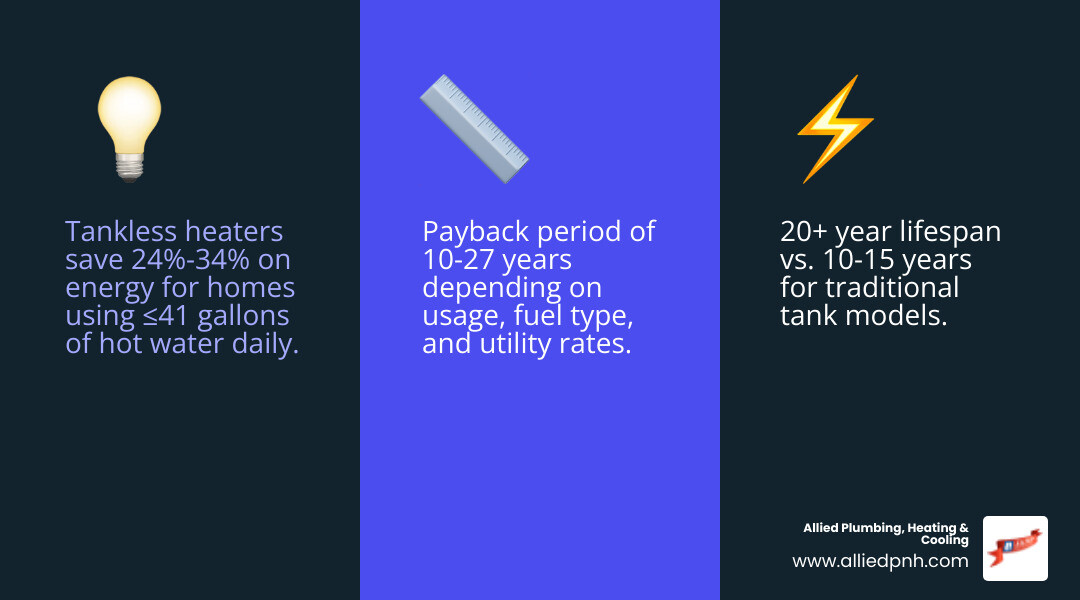
Tankless water heaters heat water only when you need it, which means no energy wasted keeping a full tank hot around the clock. According to the U.S. Department of Energy, homes that use 41 gallons of hot water or less per day can see energy efficiency gains of 24% to 34% over traditional storage tank models. For higher-usage homes, those gains drop to around 8% to 14%.
The catch? The upfront investment is significantly higher than a standard tank heater, and in many homes, installation requires upgrades to gas lines or electrical panels that can add to the total cost. The payback period can range anywhere from 10 to 27 years depending on your fuel type, usage habits, and local utility rates.
That range tells you everything: this is not a one-size-fits-all decision. It's a financial and practical trade-off that deserves a clear-eyed look before you commit.
How On-Demand Water Heating Works
To understand if a tankless system is right for you, we first need to look under the hood. Unlike different types of water heaters that store 40 to 80 gallons of water in a large tank, a tankless unit—often called a "demand-type" heater—remains idle until you turn on a hot water tap.
When you flip that faucet, cold water travels into the unit through a pipe. A flow sensor detects this movement and immediately triggers the heating source. In a gas-fired model, a powerful burner ignites; in an electric model, heavy-duty heating elements switch on. This energy is transferred to the water through a component called a heat exchanger.
The biggest financial benefit here is the elimination of "standby loss." Traditional tanks lose heat through the walls of the tank 24 hours a day, requiring the burner to kick on periodically just to keep the water sitting there hot. Tankless units only use energy when you are actually using water, which is why they are often touted as the gold standard for efficiency.
Understanding the Flow Rate
The performance of these units is measured in Gallons Per Minute (GPM). Because there is no reservoir of pre-heated water, the unit must be powerful enough to heat the water as fast as it flows through the pipes.
The "activation sensor" requires a minimum amount of water flow to start the heating process. Once active, the unit works to achieve a specific "temperature rise"—the difference between the cold groundwater entering your home and the hot water exiting the tap. This is where the benefits of temperature control with tankless systems shine, as they provide consistent, precise heat without the "temperature creep" often seen in aging tank models.
Weighing the Pros and Cons of Tankless Systems
When we talk to homeowners in Springfield or Chatham, the conversation usually starts with space and supply. A tankless unit is roughly the size of a carry-on suitcase and mounts to the wall, freeing up valuable floor space in your basement or utility closet.
The Pros:
• Endless Hot Water: As long as you don't exceed the GPM limit, you will never run out of hot water mid-shower.
• Longevity: These units typically last 20 years or more, nearly double the 10-to-15-year lifespan of a traditional tank.
• Reduced Risk of Water Damage: Without a 50-gallon tank that can rust through and flood your basement, the risk of catastrophic water damage is significantly lower.
• Efficiency: You can find many advantages of switching to tankless water heaters, including lower monthly utility bills.
The Cons:
• Higher Upfront Investment: The units themselves are more complex, and the installation is more intensive.
• Flow Rate Limitations: While the hot water is "endless," it isn't "simultaneous" in unlimited quantities. Running three showers, the dishwasher, and the laundry at once can overwhelm a single unit.
• Infrastructure Requirements: Many older homes in our area require larger gas lines or electrical panel upgrades to support the high-power demand of a tankless unit.
Tank vs. Tankless: At a Glance
• Average Lifespan — Traditional Storage Tank: 10–15 Years — Tankless (On-Demand): 20+ Years
• Efficiency (UEF) — Traditional Storage Tank: 0.60 – 0.70 — Tankless (On-Demand): 0.80 – 0.99
• Space Required — Traditional Storage Tank: High (Floor Standing) — Tankless (On-Demand): Low (Wall Mounted)
• Hot Water Supply — Traditional Storage Tank: Limited by Tank Size — Tankless (On-Demand): Endless (within GPM limits)
• Maintenance — Traditional Storage Tank: Low (Periodic Flushing) — Tankless (On-Demand): Moderate (Annual Descaling)
Determining if a Tankless Water Heater is Worth the Investment
Efficiency is the primary driver for most people asking, "is a tankless water heater worth the investment?" When shopping, look for the Uniform Energy Factor (UEF). High-efficiency tankless units often have a UEF of 0.95 or higher, meaning 95% of the fuel used goes directly into heating the water.
Beyond monthly savings, there is the question of home resale value. Modern, energy-efficient upgrades are highly attractive to buyers. While you might not recoup every dollar of the installation immediately, a tankless system is a premium feature that sets a home apart. Furthermore, the environmental impact of using less fuel is a significant "pro" for eco-conscious families. For those ready to move forward, our tankless water heater installation Springfield IL guide provides a deeper look at the local process.
Is a tankless water heater worth the investment for large families?
Large families often struggle with the "morning rush" where the last person in the shower inevitably gets a cold surprise. A tankless unit solves this by providing continuous hot water. However, if your household frequently runs multiple hot-water appliances at once, a single unit might struggle.
In these cases, we often recommend:
1. High-Capacity Gas Units: Gas models generally have higher GPM outputs than electric ones.
2. Multiple Unit Configurations: Installing two units in tandem to double the GPM.
3. Point-of-Use Models: Adding a small, dedicated unit for a master bath or a kitchen.
Homeowners looking for tankless water heaters in Chatham, IL often find that sizing the unit correctly for their specific peak demand is the difference between a great investment and a frustrating one.
Calculating the payback period: Is a tankless water heater worth the investment?
The "payback period" is the time it takes for your monthly energy savings to cover the extra cost of the tankless system compared to a standard tank. For most, this window falls between 10 and 25 years.
If you use a lot of hot water and plan to stay in your home for the next two decades, the investment is a no-brainer. If you are planning to sell in three years, you likely won't see the full financial return on energy savings alone. However, don't forget to check for federal tax credits. Under the current Energy Star guidelines, some high-efficiency models qualify for significant tax credits, which can shorten your payback period considerably. For residents considering tankless water heaters in Sherman, IL, these incentives make the switch much more palatable.
Sizing and Selecting the Right Unit for Your Household
Choosing the right unit isn't just about the number of bathrooms; it's about your local climate. In Illinois, our groundwater can get quite cold in the winter. This means your water heater has to work harder to bring that water up to 120°F.
When selecting a unit, you'll choose between:
• Non-Condensing: These are the traditional tankless units. They are reliable but require specific stainless steel venting to handle high-temperature exhaust.
• Condensing: These units use a second heat exchanger to capture extra heat from the exhaust gases. They are more efficient and can often be vented using cheaper PVC pipe.
If you're exploring tankless water heaters in Rochester, IL, our team can help you calculate your "peak demand" to ensure your unit never leaves you in the cold.
Climate Impact on Performance
In colder climates, the GPM capacity of a tankless unit drops. A unit that provides 5 GPM in Florida might only provide 3 GPM during a Springfield winter because it takes longer to heat the freezing incoming water. This is a critical factor to consider for tankless water heaters in Glenarm, IL, where winter temperatures can be unforgiving.
Long-Term Reliability and Maintenance Requirements
One of the most common myths is that tankless heaters are "maintenance-free." In reality, they require a bit more attention than a tank. Because they heat water so quickly, minerals like calcium and magnesium can "flash" out of the water and create scale buildup on the heat exchanger.
To keep your investment running for 20+ years, you should perform:
• Annual Flushing: Using a descaling solution (often food-grade vinegar) to clear out mineral deposits.
• Filter Cleaning: Most units have a small screen filter to catch debris from the water line.
• Hard Water Mitigation: If you have very hard water, a water softener is highly recommended to protect the unit.
Ignoring sediment buildup in tankless water heater systems can lead to decreased efficiency and eventually a system failure.
Troubleshooting Common Issues
While these units are highly reliable, they aren't immune to hiccups. If you find your tankless water heater producing lukewarm water, it might be a simple case of a dirty filter or a high-demand scenario exceeding the unit's capacity. More serious issues, like fixing a tankless water heater shutdown, often involve the venting or the ignition system. For local residents, our tankless water heater repair Springfield guide offers practical tips for keeping your system in top shape.
Frequently Asked Questions about Tankless Upgrades
How long do tankless water heaters typically last?
A well-maintained tankless unit has a 20-year expectancy. One reason they last so long is that almost every part is replaceable. Unlike a tank heater, where a single leak in the reservoir usually means the entire unit is trash, a tankless unit can often be repaired by replacing a single valve or sensor. This makes finding the best tankless water heater for your needs a long-term win for your home's infrastructure.
Do tankless water heaters require a lot of maintenance?
They don't require "a lot" of maintenance, but the maintenance they do require is non-negotiable. Annual descaling is the big one. If you live in an area with hard water, this is the only way to ensure the unit reaches its full 20-year lifespan. For a step-by-step on what this looks like, check out our tankless repair Springfield IL guide.
Can a tankless unit handle multiple showers at once?
Yes, provided it is sized correctly. A typical shower uses about 1.5 to 2.5 GPM. If you have a unit rated for 5 GPM, you can easily run two showers. However, if you add a dishwasher (another 1.5 GPM) into the mix, you might notice a drop in temperature or pressure. This is why proper sizing is the most important part of the installation process for tankless water heaters in Pleasant Plains, IL.
Conclusion
So, is a tankless water heater worth the investment? If you value endless hot water, want to maximize your home's energy efficiency, and plan to stay in your residence for a decade or more, the answer is a resounding yes. While the initial hurdle is higher, the long-term benefits of space, durability, and monthly savings make it a smart choice for many Illinois families.
At Allied Plumbing, Heating & Cooling, we’ve been helping our neighbors make these decisions since 1977. As a 3-generation family business, we take pride in providing honest advice and expert service. We stand behind our work with the Daikin Comfort Promise and 12-year warranties, ensuring you have peace of mind along with your hot water.
Whether you are in Springfield, Sherman, or Rochester, we are here for you 24/7. If you're ready to see how an on-demand system can fit into your home, contact us today to discuss tankless water heaters in Springfield, IL and let us help you find the perfect fit for your wallet and your lifestyle.