Home
/

Water Heater Woes: Troubleshooting Your Leaky T&P Valve

Your Water Heater's Most Important Safety Feature

A gas hot water heater leaking from pressure relief valve is a serious concern. Here's what you need to know right now:

Quick Action Steps:

  1. Turn off the gas supply to your water heater immediately
  2. Shut off the cold water inlet valve to stop water flow
  3. Place a bucket under the discharge pipe to catch dripping water
  4. Do not touch the water—it may be scalding hot
  5. Call a professional if the leak persists or worsens

The Temperature and Pressure Relief (T&P) valve is a critical safety device. It prevents your tank from exploding by automatically opening to release excess pressure (over 150 psi) or temperature (above 210°F). A functioning T&P valve is the difference between a minor issue and a catastrophe that could destroy your home.

For homeowners in Springfield, IL, understanding why this valve leaks is key to preventing property damage, injuries, and high utility bills. While an occasional drip can be normal, a constant stream of water signals a problem needing immediate attention. The cause could be excessive pressure, a faulty thermostat, or sediment buildup, and identifying it is the first step to a safe fix.

If you're experiencing other water heater issues, check out our guide on Signs You Need Water Heater Repair - Expert Help. For professional diagnosis and repair, visit our Water Heater Repair Springfield Guide page.
Infographic showing how a T&P valve works: diagram of a water heater tank with arrows indicating rising temperature and pressure, the T&P valve at the top opening when thresholds are exceeded (150 psi or 210°F), and water safely discharging through the relief pipe to prevent tank rupture or explosion - gas hot water heater leaking from pressure relief valve

Identifying the Leak: Signs and Symptoms

A gas hot water heater leaking from pressure relief valve will show several signs. Recognizing them early can prevent major problems for your home in Rochester, IL, or any of our service areas.

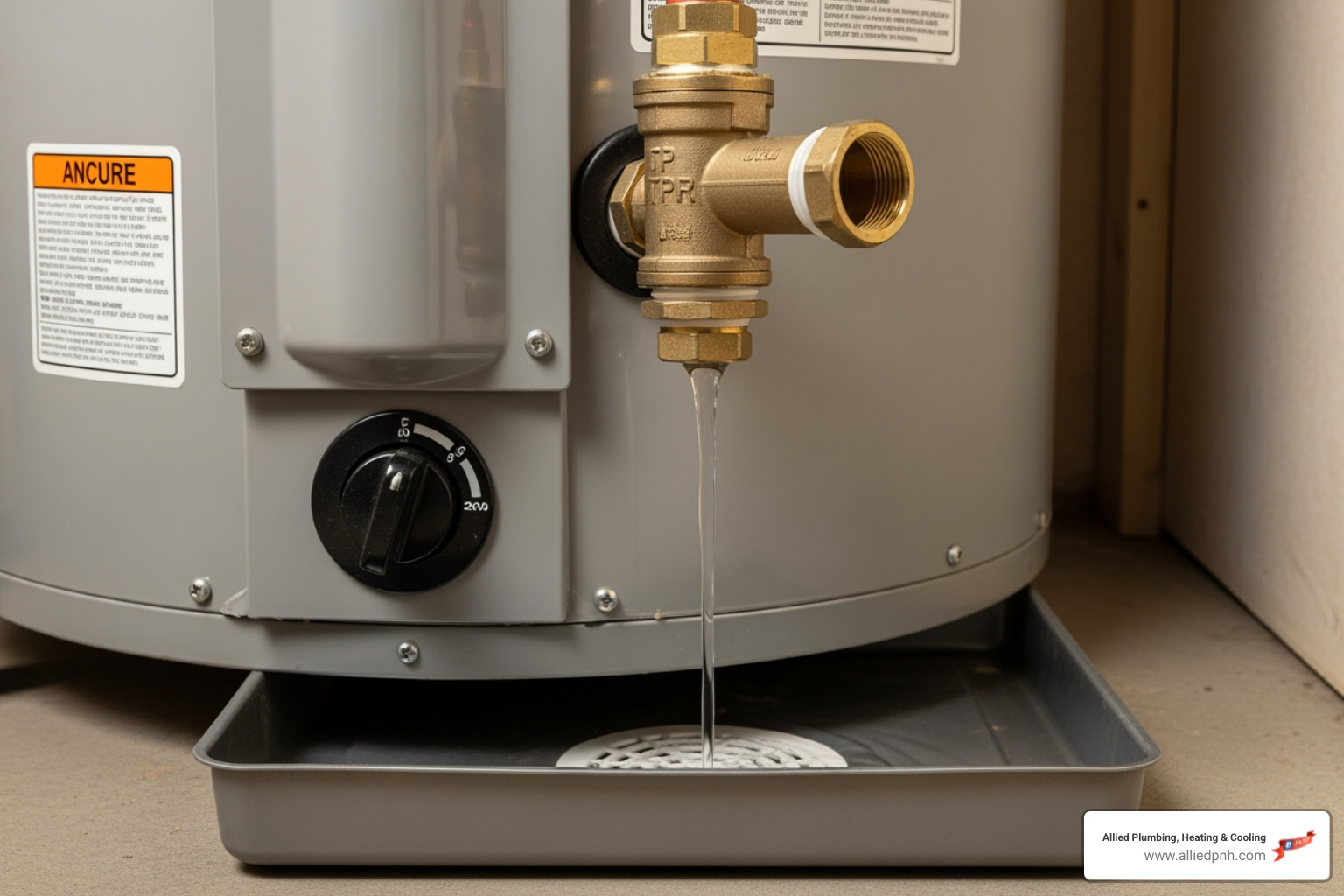
The most obvious sign is water pooling around the water heater's base, coming from the T&P valve's discharge pipe. This confirms the valve has activated. You might also hear hissing or whistling, which indicates pressure is being released through the valve. It's a sign your water heater is under stress.

Less direct signs include rust-colored water from your taps, which can indicate internal tank corrosion, or a sudden spike in energy bills. These suggest your water heater is working inefficiently, possibly due to a leak.

For a broader understanding of water heater warning signs, explore our detailed guide on Signs You Need Water Heater Repair - Expert Help.

Differentiating a Drip from a Defect

It's important for homeowners in areas like Sherman, IL, and Pleasant Plains, IL to understand the difference between a normal drip and a defect.

The T&P valve is designed to release water when pressure or temperature gets too high. This means occasional drips, especially during periods of high usage, can be normal operation. It's the valve preventing a dangerous buildup.

However, a constant flow of water, a steady stream, or frequent dripping indicates a more serious issue. If you're constantly emptying a bucket or hear persistent whistling, the valve may be faulty, or there's a chronic problem with your water heater's pressure or temperature regulation.

A constantly leaking T&P valve suggests that conditions inside your water heater are consistently exceeding safe limits, or the valve itself has worn out. This constant activation can also lead to premature wear on the valve. If you're hearing unusual sounds from your water heater, such as banging, these can be related to excessive pressure. For more on strange water heater noises, you can read our insights on Water heater makes strange noises in Springfield.

Why Is My Gas Hot Water Heater Leaking From the Pressure Relief Valve?

When your gas hot water heater is leaking from the pressure relief valve, the valve itself may not be the problem. The leak is often a symptom of a larger issue. Understanding the common causes can help you diagnose the problem in your Elkhart, IL, or Glenarm, IL home.

  • Excessive pressure: Water heaters operate between 40-80 psi. If pressure exceeds the 150 psi limit, the T&P valve opens. Constant activation means your system is over-pressurized.
  • High temperature: A faulty thermostat or one set too high can cause overheating. The T&P valve opens when temperatures exceed 210°F to prevent dangerous steam buildup.
  • Thermal expansion: Water expands when heated. In a closed system without a working expansion tank, this builds pressure, forcing the T&P valve to open.
  • Faulty valve: The valve itself can fail. It can wear out, corrode, or fail to seal, causing a leak even when pressure and temperature are normal.
  • Sediment buildup: Minerals from hard water can build up as sediment in the tank. This can prevent the T&P valve from sealing properly, causing a drip. Sediment also reduces efficiency and can lead to overheating. For more on this, see our article on Sediment Buildup in Tankless Water Heater.

The Role of Pressure and Thermal Expansion

Water pressure and thermal expansion are often the root causes of a gas hot water heater leaking from the pressure relief valve. When water is heated in a 40-gallon tank, it can expand by half a gallon. In a closed system, this expansion causes a dangerous pressure spike in your Springfield, IL, or Chatham, IL, home.

High incoming water pressure (above 80 psi) from your municipal supply can also be a problem. Combined with thermal expansion, this high pressure will frequently trigger the T&P valve, causing it to leak.

An expansion tank solves this problem. This small tank connects to the cold water inlet and absorbs the expanded water, preventing pressure buildup. Without a functioning expansion tank, your T&P valve takes the full force of thermal expansion, leading to frequent leaks. If your boiler is losing pressure constantly, it points to similar system imbalances. You can learn more about related pressure issues in our guide on Why is your boiler losing pressure constantly.

How Temperature and Sediment Cause Leaks

Besides pressure, high temperature and sediment buildup also cause a gas hot water heater to leak from the pressure relief valve.

A thermostat malfunction can cause the water to overheat. The T&P valve opens at 210°F to release superheated water. A faulty thermostat can cause constant activation. For safety and efficiency, set your thermostat to 120-125°F. If your water is scalding, check the setting. If you're experiencing issues with getting hot water, our No Hot Water - Expert Troubleshooting Guide might offer some insights.

Sediment buildup from hard water minerals is another common cause. Sediment insulates the tank, reducing efficiency and causing overheating. More importantly, debris can get stuck in the T&P valve, preventing it from sealing properly after opening, which results in a constant leak.

How to Safely Address a Leaking T&P Valve

Finding a gas hot water heater leaking from pressure relief valve is alarming, but addressing it safely is paramount. For homeowners in Riddle Hill, IL, and Bradfordton, IL, immediate action is crucial to prevent damage and hazards.

The immediate steps from the introduction—shutting off gas and water, and catching drips—are critical for stabilizing the situation. Addressing the root cause, however, requires further investigation. Safety is the top priority, as the water from the T&P valve can be scalding hot. Avoid contact and ensure you have good lighting and a clear workspace before inspecting the unit.

Troubleshooting requires a systematic approach to determine if you need professional help. Our team handles repairs efficiently to get your system back in safe working order. Learn more about our approach in How We Handle Water Heater Repair Efficiently.

Immediate Steps for a Gas Hot Water Heater Leaking From the Pressure Relief Valve

If you see your gas hot water heater leaking from the pressure relief valve, act quickly. Here is a recap of the immediate steps for gas units:

  1. Turn off the gas supply: Find the gas shut-off valve on the line to your water heater and turn it perpendicular to the pipe. Also, turn the gas control knob to "OFF." This stops the heating process.
  2. Shut off the cold water inlet valve: Shut off the cold water inlet valve, usually on the right with a blue handle. Turn it clockwise to stop water from entering the tank.
  3. Place a bucket: Place a large bucket under the T&P valve's discharge pipe to catch water and prevent floor damage.
  4. Avoid touching hot water: The leaking water can be scalding hot. Avoid all direct contact to prevent severe burns.
  5. Assess the situation: After containing the immediate hazards, observe the leak. Is it a drip or a stream? Does it stop when the water cools? This information helps with diagnosis.

For comprehensive guidance on water heater repair, especially in Springfield, IL, our Water Heater Repair Springfield Guide offers valuable information.

Testing and Troubleshooting the Valve

After taking safety measures, you can perform basic tests to find out why your gas hot water heater is leaking from the pressure relief valve. This provides clues for the repair.

First, perform a manual test. With the gas and water off and the tank cooled, lift the T&P valve's test lever. Water should flow out and stop when you release it. If it keeps flowing or doesn't flow at all, the valve is likely faulty. Test your valve this way every 6-12 months.

Next, check for debris. Debris can get caught in the valve. With the water and gas off, lift and release the test lever a few times to dislodge any obstructions. If the leak stops, you've likely found the cause.

Monitor the leak after testing. Turn the water back on (gas off). If it leaks immediately, the valve is likely faulty. If it only leaks when the water is heated, the problem is excessive pressure or temperature.

Finally, check your home's water pressure with a gauge on an outdoor spigot. Ideal pressure for homes in Auburn, IL, or Athens, IL, is 40-80 psi. If your gauge reads consistently above 80 psi, or if it spikes significantly when the water heater is running, high water pressure is likely contributing to your leaking T&P valve. Persistent high pressure can also cause issues in other plumbing systems, similar to Low Pressure Issues in Your Home Boiler System.

DIY vs. Pro: Fixing a Gas Hot Water Heater Leaking From the Pressure Relief Valve

When your gas hot water heater is leaking from the pressure relief valve, you may wonder if it's a DIY fix. While some troubleshooting is possible, understanding the risks is crucial. For homeowners in Virden, IL, or Thayer, IL, making the right call ensures safety.

Here's a comparison to help you assess:

ActionDIY FeasibilityProfessional Intervention Recommended
Simple TroubleshootingYes (e.g., turning off utilities, placing a bucket, gently lifting/releasing test lever, checking water pressure with a gauge, adjusting thermostat settings)No, unless you're uncomfortable or unsure about the process.
Cleaning the ValveLimited (only if a minor obstruction is easily dislodged by cycling the lever a few times)Yes, for thorough inspection and cleaning, especially if sediment is deeply lodged or corrosion is present.
Valve ReplacementPossible for experienced DIYers with proper tools and knowledge of plumbing and gas safety. Requires shutting off gas, draining the tank, and proper sealing.Highly Recommended. Professionals have the expertise, tools, and safety training to correctly replace the valve, ensure proper sealing, and comply with local plumbing codes. Incorrect installation can lead to continued leaks or, worse, safety hazards.
Diagnosing Complex IssuesLimited (e.g., determining if high water pressure is from the municipal line vs. thermal expansion, or if the thermostat is faulty)Yes. Professionals can accurately diagnose underlying causes like a failed expansion tank, consistently high incoming water pressure requiring a pressure-reducing valve, or a malfunctioning thermostat.
Addressing Gas Line IssuesNo. Never.Absolutely Yes. Any work involving gas lines should only be performed by a licensed professional due to extreme safety risks.
Full Water Heater ReplacementNo.Yes. If the water heater is old or the tank itself is compromised, replacement is the safest and most efficient long-term solution. Our technicians specialize in Water Heater Replacement by Our Technicians.

If basic troubleshooting doesn't stop the leak, or you suspect a complex issue, call an expert. The safety risks of gas water heaters and potential for catastrophic failure from a bad T&P valve are too great. According to the U.S. Consumer Product Safety Commission (CPSC), water heater failures cause thousands of injuries annually. A malfunctioning valve can lead to an explosion and severe property damage. We are here to ensure your water heater operates safely.

Preventing Future Leaks

Preventing your gas hot water heater from leaking from the pressure relief valve is key. Regular maintenance can extend your water heater's life and prevent leaks for homeowners in communities like Chatham, IL, and Buffalo, IL.

Here are our top recommendations for preventing future T&P valve leaks:

  • Annual Maintenance Checks: Schedule an annual professional inspection. A technician will assess your unit's health, check the T&P valve for wear, and ensure all parts function correctly.
  • Flushing the Tank Annually: Flush your tank annually to remove sediment. This prevents buildup from interfering with the T&P valve's seal and improves efficiency.
  • Checking the Anode Rod: Check and replace the sacrificial anode rod every 3-5 years. It protects the tank from corrosion, which can damage other components like the T&P valve.
  • Installing an Expansion Tank: Install an expansion tank if you don't have one. It absorbs pressure from heated water, reducing stress on the T&P valve. It's crucial for closed plumbing systems.
  • Monitoring Home Water Pressure: Regularly check your home's water pressure. If it's over 80 psi, install a pressure-reducing valve (PRV) to protect your plumbing system and water heater.
  • Setting the Correct Temperature: Set your water heater's thermostat to 120-125°F. This prevents overheating and unnecessary T&P valve activation.

By following these maintenance practices, you can significantly reduce the likelihood of your gas hot water heater leaking from pressure relief valve and ensure a long, reliable life for your unit. For more preventative measures, especially in Sherman, IL, check out our guide on Prevent Water Heater Problems in Sherman.

Frequently Asked Questions about Leaking T&P Valves

Homeowners from Springfield, IL, to Rochester, IL, often ask the same questions when their gas hot water heater is leaking from the pressure relief valve. Here are the most common ones:

What are the risks of ignoring a leaking pressure relief valve?

Ignoring a leaking T&P valve is extremely risky. It can cause property water damage from continuous leaks, leading to mold and costly repairs. There is also a significant scalding hazard from the extremely hot water. A persistent leak also leads to increased utility bills as the heater works harder. The greatest risk is catastrophic tank failure. If a leaking T&P valve fails completely, the tank can explode. The U.S. Consumer Product Safety Commission (CPSC) links thousands of injuries yearly to water heater failures, with faulty T&P valves being a major factor. This risk is why immediate attention is crucial.

Can I just cap the leaking valve?

Absolutely not. Never cap a leaking T&P valve. It is a critical safety device that prevents your water heater from exploding. Capping it removes the only escape for dangerous pressure and temperature. A leaking valve is releasing excess pressure. Capping it traps that energy, turning the tank into a potential bomb. This is extremely dangerous and violates plumbing codes. A leaking valve must be repaired or replaced, not disabled.

How often should a T&P valve be tested or replaced?

We recommend testing your T&P valve annually. Lift the test lever to ensure water flows and then stops. If it fails this test, it needs replacement. A T&P valve doesn't have a fixed lifespan, but water heaters last 8-20 years. A leaking valve can signal an aging unit. If your heater is old and the valve leaks persistently, replacing the entire unit may be safer and more cost-effective. We typically replace the T&P valve with any new water heater installation for safety. For those considering an upgrade, our Water Heater Replacement Springfield services can help.

Don't Let a Small Drip Become a Big Disaster

A leaking T&P valve on your gas hot water heater is more than a minor inconvenience; ignoring it is a serious gamble. The risks range from property damage to a potential water heater explosion. When your T&P valve leaks, it's a critical signal that requires immediate attention.

At Allied Plumbing, Heating & Cooling, we've served the communities of Springfield, Rochester, Sherman, and beyond since 1977. With three generations of experience, we understand water heater issues and the need for prompt, professional service. We are committed to your home's safety and comfort, backed by our Daikin Comfort Promise and extensive warranties.

Don't let a small drip become a disaster. If your gas hot water heater is leaking from the pressure relief valve, or if you have any other water heater concerns, our expert team is ready to help. We'll diagnose the problem, provide a reliable solution, and give you peace of mind.

For professional inspection and repair of your water heaters in Springfield, IL, contact our experts today.

Your Water Heater's Most Important Safety Feature

A gas hot water heater leaking from pressure relief valve is a serious concern. Here's what you need to know right now:

Quick Action Steps:

  1. Turn off the gas supply to your water heater immediately
  2. Shut off the cold water inlet valve to stop water flow
  3. Place a bucket under the discharge pipe to catch dripping water
  4. Do not touch the water—it may be scalding hot
  5. Call a professional if the leak persists or worsens

The Temperature and Pressure Relief (T&P) valve is a critical safety device. It prevents your tank from exploding by automatically opening to release excess pressure (over 150 psi) or temperature (above 210°F). A functioning T&P valve is the difference between a minor issue and a catastrophe that could destroy your home.

For homeowners in Springfield, IL, understanding why this valve leaks is key to preventing property damage, injuries, and high utility bills. While an occasional drip can be normal, a constant stream of water signals a problem needing immediate attention. The cause could be excessive pressure, a faulty thermostat, or sediment buildup, and identifying it is the first step to a safe fix.

If you're experiencing other water heater issues, check out our guide on Signs You Need Water Heater Repair - Expert Help. For professional diagnosis and repair, visit our Water Heater Repair Springfield Guide page.

Infographic showing how a T&P valve works: diagram of a water heater tank with arrows indicating rising temperature and pressure, the T&P valve at the top opening when thresholds are exceeded (150 psi or 210°F), and water safely discharging through the relief pipe to prevent tank rupture or explosion - gas hot water heater leaking from pressure relief valve

Identifying the Leak: Signs and Symptoms

A gas hot water heater leaking from pressure relief valve will show several signs. Recognizing them early can prevent major problems for your home in Rochester, IL, or any of our service areas.

The most obvious sign is water pooling around the water heater's base, coming from the T&P valve's discharge pipe. This confirms the valve has activated. You might also hear hissing or whistling, which indicates pressure is being released through the valve. It's a sign your water heater is under stress.

Less direct signs include rust-colored water from your taps, which can indicate internal tank corrosion, or a sudden spike in energy bills. These suggest your water heater is working inefficiently, possibly due to a leak.

For a broader understanding of water heater warning signs, explore our detailed guide on Signs You Need Water Heater Repair - Expert Help.

Differentiating a Drip from a Defect

It's important for homeowners in areas like Sherman, IL, and Pleasant Plains, IL to understand the difference between a normal drip and a defect.

The T&P valve is designed to release water when pressure or temperature gets too high. This means occasional drips, especially during periods of high usage, can be normal operation. It's the valve preventing a dangerous buildup.

However, a constant flow of water, a steady stream, or frequent dripping indicates a more serious issue. If you're constantly emptying a bucket or hear persistent whistling, the valve may be faulty, or there's a chronic problem with your water heater's pressure or temperature regulation.

A constantly leaking T&P valve suggests that conditions inside your water heater are consistently exceeding safe limits, or the valve itself has worn out. This constant activation can also lead to premature wear on the valve. If you're hearing unusual sounds from your water heater, such as banging, these can be related to excessive pressure. For more on strange water heater noises, you can read our insights on Water heater makes strange noises in Springfield.

Why Is My Gas Hot Water Heater Leaking From the Pressure Relief Valve?

When your gas hot water heater is leaking from the pressure relief valve, the valve itself may not be the problem. The leak is often a symptom of a larger issue. Understanding the common causes can help you diagnose the problem in your Elkhart, IL, or Glenarm, IL home.

  • Excessive pressure: Water heaters operate between 40-80 psi. If pressure exceeds the 150 psi limit, the T&P valve opens. Constant activation means your system is over-pressurized.
  • High temperature: A faulty thermostat or one set too high can cause overheating. The T&P valve opens when temperatures exceed 210°F to prevent dangerous steam buildup.
  • Thermal expansion: Water expands when heated. In a closed system without a working expansion tank, this builds pressure, forcing the T&P valve to open.
  • Faulty valve: The valve itself can fail. It can wear out, corrode, or fail to seal, causing a leak even when pressure and temperature are normal.
  • Sediment buildup: Minerals from hard water can build up as sediment in the tank. This can prevent the T&P valve from sealing properly, causing a drip. Sediment also reduces efficiency and can lead to overheating. For more on this, see our article on Sediment Buildup in Tankless Water Heater.

The Role of Pressure and Thermal Expansion

Water pressure and thermal expansion are often the root causes of a gas hot water heater leaking from the pressure relief valve. When water is heated in a 40-gallon tank, it can expand by half a gallon. In a closed system, this expansion causes a dangerous pressure spike in your Springfield, IL, or Chatham, IL, home.

High incoming water pressure (above 80 psi) from your municipal supply can also be a problem. Combined with thermal expansion, this high pressure will frequently trigger the T&P valve, causing it to leak.

An expansion tank solves this problem. This small tank connects to the cold water inlet and absorbs the expanded water, preventing pressure buildup. Without a functioning expansion tank, your T&P valve takes the full force of thermal expansion, leading to frequent leaks. If your boiler is losing pressure constantly, it points to similar system imbalances. You can learn more about related pressure issues in our guide on Why is your boiler losing pressure constantly.

How Temperature and Sediment Cause Leaks

Besides pressure, high temperature and sediment buildup also cause a gas hot water heater to leak from the pressure relief valve.

A thermostat malfunction can cause the water to overheat. The T&P valve opens at 210°F to release superheated water. A faulty thermostat can cause constant activation. For safety and efficiency, set your thermostat to 120-125°F. If your water is scalding, check the setting. If you're experiencing issues with getting hot water, our No Hot Water - Expert Troubleshooting Guide might offer some insights.

Sediment buildup from hard water minerals is another common cause. Sediment insulates the tank, reducing efficiency and causing overheating. More importantly, debris can get stuck in the T&P valve, preventing it from sealing properly after opening, which results in a constant leak.

How to Safely Address a Leaking T&P Valve

Finding a gas hot water heater leaking from pressure relief valve is alarming, but addressing it safely is paramount. For homeowners in Riddle Hill, IL, and Bradfordton, IL, immediate action is crucial to prevent damage and hazards.

The immediate steps from the introduction—shutting off gas and water, and catching drips—are critical for stabilizing the situation. Addressing the root cause, however, requires further investigation. Safety is the top priority, as the water from the T&P valve can be scalding hot. Avoid contact and ensure you have good lighting and a clear workspace before inspecting the unit.

Troubleshooting requires a systematic approach to determine if you need professional help. Our team handles repairs efficiently to get your system back in safe working order. Learn more about our approach in How We Handle Water Heater Repair Efficiently.

Immediate Steps for a Gas Hot Water Heater Leaking From the Pressure Relief Valve

If you see your gas hot water heater leaking from the pressure relief valve, act quickly. Here is a recap of the immediate steps for gas units:

  1. Turn off the gas supply: Find the gas shut-off valve on the line to your water heater and turn it perpendicular to the pipe. Also, turn the gas control knob to "OFF." This stops the heating process.
  2. Shut off the cold water inlet valve: Shut off the cold water inlet valve, usually on the right with a blue handle. Turn it clockwise to stop water from entering the tank.
  3. Place a bucket: Place a large bucket under the T&P valve's discharge pipe to catch water and prevent floor damage.
  4. Avoid touching hot water: The leaking water can be scalding hot. Avoid all direct contact to prevent severe burns.
  5. Assess the situation: After containing the immediate hazards, observe the leak. Is it a drip or a stream? Does it stop when the water cools? This information helps with diagnosis.

For comprehensive guidance on water heater repair, especially in Springfield, IL, our Water Heater Repair Springfield Guide offers valuable information.

Testing and Troubleshooting the Valve

After taking safety measures, you can perform basic tests to find out why your gas hot water heater is leaking from the pressure relief valve. This provides clues for the repair.

First, perform a manual test. With the gas and water off and the tank cooled, lift the T&P valve's test lever. Water should flow out and stop when you release it. If it keeps flowing or doesn't flow at all, the valve is likely faulty. Test your valve this way every 6-12 months.

Next, check for debris. Debris can get caught in the valve. With the water and gas off, lift and release the test lever a few times to dislodge any obstructions. If the leak stops, you've likely found the cause.

Monitor the leak after testing. Turn the water back on (gas off). If it leaks immediately, the valve is likely faulty. If it only leaks when the water is heated, the problem is excessive pressure or temperature.

Finally, check your home's water pressure with a gauge on an outdoor spigot. Ideal pressure for homes in Auburn, IL, or Athens, IL, is 40-80 psi. If your gauge reads consistently above 80 psi, or if it spikes significantly when the water heater is running, high water pressure is likely contributing to your leaking T&P valve. Persistent high pressure can also cause issues in other plumbing systems, similar to Low Pressure Issues in Your Home Boiler System.

DIY vs. Pro: Fixing a Gas Hot Water Heater Leaking From the Pressure Relief Valve

When your gas hot water heater is leaking from the pressure relief valve, you may wonder if it's a DIY fix. While some troubleshooting is possible, understanding the risks is crucial. For homeowners in Virden, IL, or Thayer, IL, making the right call ensures safety.

Here's a comparison to help you assess:

ActionDIY FeasibilityProfessional Intervention Recommended
Simple TroubleshootingYes (e.g., turning off utilities, placing a bucket, gently lifting/releasing test lever, checking water pressure with a gauge, adjusting thermostat settings)No, unless you're uncomfortable or unsure about the process.
Cleaning the ValveLimited (only if a minor obstruction is easily dislodged by cycling the lever a few times)Yes, for thorough inspection and cleaning, especially if sediment is deeply lodged or corrosion is present.
Valve ReplacementPossible for experienced DIYers with proper tools and knowledge of plumbing and gas safety. Requires shutting off gas, draining the tank, and proper sealing.Highly Recommended. Professionals have the expertise, tools, and safety training to correctly replace the valve, ensure proper sealing, and comply with local plumbing codes. Incorrect installation can lead to continued leaks or, worse, safety hazards.
Diagnosing Complex IssuesLimited (e.g., determining if high water pressure is from the municipal line vs. thermal expansion, or if the thermostat is faulty)Yes. Professionals can accurately diagnose underlying causes like a failed expansion tank, consistently high incoming water pressure requiring a pressure-reducing valve, or a malfunctioning thermostat.
Addressing Gas Line IssuesNo. Never.Absolutely Yes. Any work involving gas lines should only be performed by a licensed professional due to extreme safety risks.
Full Water Heater ReplacementNo.Yes. If the water heater is old or the tank itself is compromised, replacement is the safest and most efficient long-term solution. Our technicians specialize in Water Heater Replacement by Our Technicians.

If basic troubleshooting doesn't stop the leak, or you suspect a complex issue, call an expert. The safety risks of gas water heaters and potential for catastrophic failure from a bad T&P valve are too great. According to the U.S. Consumer Product Safety Commission (CPSC), water heater failures cause thousands of injuries annually. A malfunctioning valve can lead to an explosion and severe property damage. We are here to ensure your water heater operates safely.

Preventing Future Leaks

Preventing your gas hot water heater from leaking from the pressure relief valve is key. Regular maintenance can extend your water heater's life and prevent leaks for homeowners in communities like Chatham, IL, and Buffalo, IL.

Here are our top recommendations for preventing future T&P valve leaks:

  • Annual Maintenance Checks: Schedule an annual professional inspection. A technician will assess your unit's health, check the T&P valve for wear, and ensure all parts function correctly.
  • Flushing the Tank Annually: Flush your tank annually to remove sediment. This prevents buildup from interfering with the T&P valve's seal and improves efficiency.
  • Checking the Anode Rod: Check and replace the sacrificial anode rod every 3-5 years. It protects the tank from corrosion, which can damage other components like the T&P valve.
  • Installing an Expansion Tank: Install an expansion tank if you don't have one. It absorbs pressure from heated water, reducing stress on the T&P valve. It's crucial for closed plumbing systems.
  • Monitoring Home Water Pressure: Regularly check your home's water pressure. If it's over 80 psi, install a pressure-reducing valve (PRV) to protect your plumbing system and water heater.
  • Setting the Correct Temperature: Set your water heater's thermostat to 120-125°F. This prevents overheating and unnecessary T&P valve activation.

By following these maintenance practices, you can significantly reduce the likelihood of your gas hot water heater leaking from pressure relief valve and ensure a long, reliable life for your unit. For more preventative measures, especially in Sherman, IL, check out our guide on Prevent Water Heater Problems in Sherman.

Frequently Asked Questions about Leaking T&P Valves

Homeowners from Springfield, IL, to Rochester, IL, often ask the same questions when their gas hot water heater is leaking from the pressure relief valve. Here are the most common ones:

What are the risks of ignoring a leaking pressure relief valve?

Ignoring a leaking T&P valve is extremely risky. It can cause property water damage from continuous leaks, leading to mold and costly repairs. There is also a significant scalding hazard from the extremely hot water. A persistent leak also leads to increased utility bills as the heater works harder. The greatest risk is catastrophic tank failure. If a leaking T&P valve fails completely, the tank can explode. The U.S. Consumer Product Safety Commission (CPSC) links thousands of injuries yearly to water heater failures, with faulty T&P valves being a major factor. This risk is why immediate attention is crucial.

Can I just cap the leaking valve?

Absolutely not. Never cap a leaking T&P valve. It is a critical safety device that prevents your water heater from exploding. Capping it removes the only escape for dangerous pressure and temperature. A leaking valve is releasing excess pressure. Capping it traps that energy, turning the tank into a potential bomb. This is extremely dangerous and violates plumbing codes. A leaking valve must be repaired or replaced, not disabled.

How often should a T&P valve be tested or replaced?

We recommend testing your T&P valve annually. Lift the test lever to ensure water flows and then stops. If it fails this test, it needs replacement. A T&P valve doesn't have a fixed lifespan, but water heaters last 8-20 years. A leaking valve can signal an aging unit. If your heater is old and the valve leaks persistently, replacing the entire unit may be safer and more cost-effective. We typically replace the T&P valve with any new water heater installation for safety. For those considering an upgrade, our Water Heater Replacement Springfield services can help.

Don't Let a Small Drip Become a Big Disaster

A leaking T&P valve on your gas hot water heater is more than a minor inconvenience; ignoring it is a serious gamble. The risks range from property damage to a potential water heater explosion. When your T&P valve leaks, it's a critical signal that requires immediate attention.

At Allied Plumbing, Heating & Cooling, we've served the communities of Springfield, Rochester, Sherman, and beyond since 1977. With three generations of experience, we understand water heater issues and the need for prompt, professional service. We are committed to your home's safety and comfort, backed by our Daikin Comfort Promise and extensive warranties.

Don't let a small drip become a disaster. If your gas hot water heater is leaking from the pressure relief valve, or if you have any other water heater concerns, our expert team is ready to help. We'll diagnose the problem, provide a reliable solution, and give you peace of mind.

For professional inspection and repair of your water heaters in Springfield, IL, contact our experts today.

Your Water Heater's Most Important Safety Feature

A gas hot water heater leaking from pressure relief valve is a serious concern. Here's what you need to know right now:

Quick Action Steps:

  1. Turn off the gas supply to your water heater immediately
  2. Shut off the cold water inlet valve to stop water flow
  3. Place a bucket under the discharge pipe to catch dripping water
  4. Do not touch the water—it may be scalding hot
  5. Call a professional if the leak persists or worsens

The Temperature and Pressure Relief (T&P) valve is a critical safety device. It prevents your tank from exploding by automatically opening to release excess pressure (over 150 psi) or temperature (above 210°F). A functioning T&P valve is the difference between a minor issue and a catastrophe that could destroy your home.

For homeowners in Springfield, IL, understanding why this valve leaks is key to preventing property damage, injuries, and high utility bills. While an occasional drip can be normal, a constant stream of water signals a problem needing immediate attention. The cause could be excessive pressure, a faulty thermostat, or sediment buildup, and identifying it is the first step to a safe fix.

If you're experiencing other water heater issues, check out our guide on Signs You Need Water Heater Repair - Expert Help. For professional diagnosis and repair, visit our Water Heater Repair Springfield Guide page.

Infographic showing how a T&P valve works: diagram of a water heater tank with arrows indicating rising temperature and pressure, the T&P valve at the top opening when thresholds are exceeded (150 psi or 210°F), and water safely discharging through the relief pipe to prevent tank rupture or explosion - gas hot water heater leaking from pressure relief valve

Identifying the Leak: Signs and Symptoms

A gas hot water heater leaking from pressure relief valve will show several signs. Recognizing them early can prevent major problems for your home in Rochester, IL, or any of our service areas.

The most obvious sign is water pooling around the water heater's base, coming from the T&P valve's discharge pipe. This confirms the valve has activated. You might also hear hissing or whistling, which indicates pressure is being released through the valve. It's a sign your water heater is under stress.

Less direct signs include rust-colored water from your taps, which can indicate internal tank corrosion, or a sudden spike in energy bills. These suggest your water heater is working inefficiently, possibly due to a leak.

For a broader understanding of water heater warning signs, explore our detailed guide on Signs You Need Water Heater Repair - Expert Help.

Differentiating a Drip from a Defect

It's important for homeowners in areas like Sherman, IL, and Pleasant Plains, IL to understand the difference between a normal drip and a defect.

The T&P valve is designed to release water when pressure or temperature gets too high. This means occasional drips, especially during periods of high usage, can be normal operation. It's the valve preventing a dangerous buildup.

However, a constant flow of water, a steady stream, or frequent dripping indicates a more serious issue. If you're constantly emptying a bucket or hear persistent whistling, the valve may be faulty, or there's a chronic problem with your water heater's pressure or temperature regulation.

A constantly leaking T&P valve suggests that conditions inside your water heater are consistently exceeding safe limits, or the valve itself has worn out. This constant activation can also lead to premature wear on the valve. If you're hearing unusual sounds from your water heater, such as banging, these can be related to excessive pressure. For more on strange water heater noises, you can read our insights on Water heater makes strange noises in Springfield.

Why Is My Gas Hot Water Heater Leaking From the Pressure Relief Valve?

When your gas hot water heater is leaking from the pressure relief valve, the valve itself may not be the problem. The leak is often a symptom of a larger issue. Understanding the common causes can help you diagnose the problem in your Elkhart, IL, or Glenarm, IL home.

  • Excessive pressure: Water heaters operate between 40-80 psi. If pressure exceeds the 150 psi limit, the T&P valve opens. Constant activation means your system is over-pressurized.
  • High temperature: A faulty thermostat or one set too high can cause overheating. The T&P valve opens when temperatures exceed 210°F to prevent dangerous steam buildup.
  • Thermal expansion: Water expands when heated. In a closed system without a working expansion tank, this builds pressure, forcing the T&P valve to open.
  • Faulty valve: The valve itself can fail. It can wear out, corrode, or fail to seal, causing a leak even when pressure and temperature are normal.
  • Sediment buildup: Minerals from hard water can build up as sediment in the tank. This can prevent the T&P valve from sealing properly, causing a drip. Sediment also reduces efficiency and can lead to overheating. For more on this, see our article on Sediment Buildup in Tankless Water Heater.

The Role of Pressure and Thermal Expansion

Water pressure and thermal expansion are often the root causes of a gas hot water heater leaking from the pressure relief valve. When water is heated in a 40-gallon tank, it can expand by half a gallon. In a closed system, this expansion causes a dangerous pressure spike in your Springfield, IL, or Chatham, IL, home.

High incoming water pressure (above 80 psi) from your municipal supply can also be a problem. Combined with thermal expansion, this high pressure will frequently trigger the T&P valve, causing it to leak.

An expansion tank solves this problem. This small tank connects to the cold water inlet and absorbs the expanded water, preventing pressure buildup. Without a functioning expansion tank, your T&P valve takes the full force of thermal expansion, leading to frequent leaks. If your boiler is losing pressure constantly, it points to similar system imbalances. You can learn more about related pressure issues in our guide on Why is your boiler losing pressure constantly.

How Temperature and Sediment Cause Leaks

Besides pressure, high temperature and sediment buildup also cause a gas hot water heater to leak from the pressure relief valve.

A thermostat malfunction can cause the water to overheat. The T&P valve opens at 210°F to release superheated water. A faulty thermostat can cause constant activation. For safety and efficiency, set your thermostat to 120-125°F. If your water is scalding, check the setting. If you're experiencing issues with getting hot water, our No Hot Water - Expert Troubleshooting Guide might offer some insights.

Sediment buildup from hard water minerals is another common cause. Sediment insulates the tank, reducing efficiency and causing overheating. More importantly, debris can get stuck in the T&P valve, preventing it from sealing properly after opening, which results in a constant leak.

How to Safely Address a Leaking T&P Valve

Finding a gas hot water heater leaking from pressure relief valve is alarming, but addressing it safely is paramount. For homeowners in Riddle Hill, IL, and Bradfordton, IL, immediate action is crucial to prevent damage and hazards.

The immediate steps from the introduction—shutting off gas and water, and catching drips—are critical for stabilizing the situation. Addressing the root cause, however, requires further investigation. Safety is the top priority, as the water from the T&P valve can be scalding hot. Avoid contact and ensure you have good lighting and a clear workspace before inspecting the unit.

Troubleshooting requires a systematic approach to determine if you need professional help. Our team handles repairs efficiently to get your system back in safe working order. Learn more about our approach in How We Handle Water Heater Repair Efficiently.

Immediate Steps for a Gas Hot Water Heater Leaking From the Pressure Relief Valve

If you see your gas hot water heater leaking from the pressure relief valve, act quickly. Here is a recap of the immediate steps for gas units:

  1. Turn off the gas supply: Find the gas shut-off valve on the line to your water heater and turn it perpendicular to the pipe. Also, turn the gas control knob to "OFF." This stops the heating process.
  2. Shut off the cold water inlet valve: Shut off the cold water inlet valve, usually on the right with a blue handle. Turn it clockwise to stop water from entering the tank.
  3. Place a bucket: Place a large bucket under the T&P valve's discharge pipe to catch water and prevent floor damage.
  4. Avoid touching hot water: The leaking water can be scalding hot. Avoid all direct contact to prevent severe burns.
  5. Assess the situation: After containing the immediate hazards, observe the leak. Is it a drip or a stream? Does it stop when the water cools? This information helps with diagnosis.

For comprehensive guidance on water heater repair, especially in Springfield, IL, our Water Heater Repair Springfield Guide offers valuable information.

Testing and Troubleshooting the Valve

After taking safety measures, you can perform basic tests to find out why your gas hot water heater is leaking from the pressure relief valve. This provides clues for the repair.

First, perform a manual test. With the gas and water off and the tank cooled, lift the T&P valve's test lever. Water should flow out and stop when you release it. If it keeps flowing or doesn't flow at all, the valve is likely faulty. Test your valve this way every 6-12 months.

Next, check for debris. Debris can get caught in the valve. With the water and gas off, lift and release the test lever a few times to dislodge any obstructions. If the leak stops, you've likely found the cause.

Monitor the leak after testing. Turn the water back on (gas off). If it leaks immediately, the valve is likely faulty. If it only leaks when the water is heated, the problem is excessive pressure or temperature.

Finally, check your home's water pressure with a gauge on an outdoor spigot. Ideal pressure for homes in Auburn, IL, or Athens, IL, is 40-80 psi. If your gauge reads consistently above 80 psi, or if it spikes significantly when the water heater is running, high water pressure is likely contributing to your leaking T&P valve. Persistent high pressure can also cause issues in other plumbing systems, similar to Low Pressure Issues in Your Home Boiler System.

DIY vs. Pro: Fixing a Gas Hot Water Heater Leaking From the Pressure Relief Valve

When your gas hot water heater is leaking from the pressure relief valve, you may wonder if it's a DIY fix. While some troubleshooting is possible, understanding the risks is crucial. For homeowners in Virden, IL, or Thayer, IL, making the right call ensures safety.

Here's a comparison to help you assess:

ActionDIY FeasibilityProfessional Intervention Recommended
Simple TroubleshootingYes (e.g., turning off utilities, placing a bucket, gently lifting/releasing test lever, checking water pressure with a gauge, adjusting thermostat settings)No, unless you're uncomfortable or unsure about the process.
Cleaning the ValveLimited (only if a minor obstruction is easily dislodged by cycling the lever a few times)Yes, for thorough inspection and cleaning, especially if sediment is deeply lodged or corrosion is present.
Valve ReplacementPossible for experienced DIYers with proper tools and knowledge of plumbing and gas safety. Requires shutting off gas, draining the tank, and proper sealing.Highly Recommended. Professionals have the expertise, tools, and safety training to correctly replace the valve, ensure proper sealing, and comply with local plumbing codes. Incorrect installation can lead to continued leaks or, worse, safety hazards.
Diagnosing Complex IssuesLimited (e.g., determining if high water pressure is from the municipal line vs. thermal expansion, or if the thermostat is faulty)Yes. Professionals can accurately diagnose underlying causes like a failed expansion tank, consistently high incoming water pressure requiring a pressure-reducing valve, or a malfunctioning thermostat.
Addressing Gas Line IssuesNo. Never.Absolutely Yes. Any work involving gas lines should only be performed by a licensed professional due to extreme safety risks.
Full Water Heater ReplacementNo.Yes. If the water heater is old or the tank itself is compromised, replacement is the safest and most efficient long-term solution. Our technicians specialize in Water Heater Replacement by Our Technicians.

If basic troubleshooting doesn't stop the leak, or you suspect a complex issue, call an expert. The safety risks of gas water heaters and potential for catastrophic failure from a bad T&P valve are too great. According to the U.S. Consumer Product Safety Commission (CPSC), water heater failures cause thousands of injuries annually. A malfunctioning valve can lead to an explosion and severe property damage. We are here to ensure your water heater operates safely.

Preventing Future Leaks

Preventing your gas hot water heater from leaking from the pressure relief valve is key. Regular maintenance can extend your water heater's life and prevent leaks for homeowners in communities like Chatham, IL, and Buffalo, IL.

Here are our top recommendations for preventing future T&P valve leaks:

  • Annual Maintenance Checks: Schedule an annual professional inspection. A technician will assess your unit's health, check the T&P valve for wear, and ensure all parts function correctly.
  • Flushing the Tank Annually: Flush your tank annually to remove sediment. This prevents buildup from interfering with the T&P valve's seal and improves efficiency.
  • Checking the Anode Rod: Check and replace the sacrificial anode rod every 3-5 years. It protects the tank from corrosion, which can damage other components like the T&P valve.
  • Installing an Expansion Tank: Install an expansion tank if you don't have one. It absorbs pressure from heated water, reducing stress on the T&P valve. It's crucial for closed plumbing systems.
  • Monitoring Home Water Pressure: Regularly check your home's water pressure. If it's over 80 psi, install a pressure-reducing valve (PRV) to protect your plumbing system and water heater.
  • Setting the Correct Temperature: Set your water heater's thermostat to 120-125°F. This prevents overheating and unnecessary T&P valve activation.

By following these maintenance practices, you can significantly reduce the likelihood of your gas hot water heater leaking from pressure relief valve and ensure a long, reliable life for your unit. For more preventative measures, especially in Sherman, IL, check out our guide on Prevent Water Heater Problems in Sherman.

Frequently Asked Questions about Leaking T&P Valves

Homeowners from Springfield, IL, to Rochester, IL, often ask the same questions when their gas hot water heater is leaking from the pressure relief valve. Here are the most common ones:

What are the risks of ignoring a leaking pressure relief valve?

Ignoring a leaking T&P valve is extremely risky. It can cause property water damage from continuous leaks, leading to mold and costly repairs. There is also a significant scalding hazard from the extremely hot water. A persistent leak also leads to increased utility bills as the heater works harder. The greatest risk is catastrophic tank failure. If a leaking T&P valve fails completely, the tank can explode. The U.S. Consumer Product Safety Commission (CPSC) links thousands of injuries yearly to water heater failures, with faulty T&P valves being a major factor. This risk is why immediate attention is crucial.

Can I just cap the leaking valve?

Absolutely not. Never cap a leaking T&P valve. It is a critical safety device that prevents your water heater from exploding. Capping it removes the only escape for dangerous pressure and temperature. A leaking valve is releasing excess pressure. Capping it traps that energy, turning the tank into a potential bomb. This is extremely dangerous and violates plumbing codes. A leaking valve must be repaired or replaced, not disabled.

How often should a T&P valve be tested or replaced?

We recommend testing your T&P valve annually. Lift the test lever to ensure water flows and then stops. If it fails this test, it needs replacement. A T&P valve doesn't have a fixed lifespan, but water heaters last 8-20 years. A leaking valve can signal an aging unit. If your heater is old and the valve leaks persistently, replacing the entire unit may be safer and more cost-effective. We typically replace the T&P valve with any new water heater installation for safety. For those considering an upgrade, our Water Heater Replacement Springfield services can help.

Don't Let a Small Drip Become a Big Disaster

A leaking T&P valve on your gas hot water heater is more than a minor inconvenience; ignoring it is a serious gamble. The risks range from property damage to a potential water heater explosion. When your T&P valve leaks, it's a critical signal that requires immediate attention.

At Allied Plumbing, Heating & Cooling, we've served the communities of Springfield, Rochester, Sherman, and beyond since 1977. With three generations of experience, we understand water heater issues and the need for prompt, professional service. We are committed to your home's safety and comfort, backed by our Daikin Comfort Promise and extensive warranties.

Don't let a small drip become a disaster. If your gas hot water heater is leaking from the pressure relief valve, or if you have any other water heater concerns, our expert team is ready to help. We'll diagnose the problem, provide a reliable solution, and give you peace of mind.

For professional inspection and repair of your water heaters in Springfield, IL, contact our experts today.

Your Water Heater's Most Important Safety Feature

A gas hot water heater leaking from pressure relief valve is a serious concern. Here's what you need to know right now:

Quick Action Steps:

  1. Turn off the gas supply to your water heater immediately
  2. Shut off the cold water inlet valve to stop water flow
  3. Place a bucket under the discharge pipe to catch dripping water
  4. Do not touch the water—it may be scalding hot
  5. Call a professional if the leak persists or worsens

The Temperature and Pressure Relief (T&P) valve is a critical safety device. It prevents your tank from exploding by automatically opening to release excess pressure (over 150 psi) or temperature (above 210°F). A functioning T&P valve is the difference between a minor issue and a catastrophe that could destroy your home.

For homeowners in Springfield, IL, understanding why this valve leaks is key to preventing property damage, injuries, and high utility bills. While an occasional drip can be normal, a constant stream of water signals a problem needing immediate attention. The cause could be excessive pressure, a faulty thermostat, or sediment buildup, and identifying it is the first step to a safe fix.

If you're experiencing other water heater issues, check out our guide on Signs You Need Water Heater Repair - Expert Help. For professional diagnosis and repair, visit our Water Heater Repair Springfield Guide page.

Infographic showing how a T&P valve works: diagram of a water heater tank with arrows indicating rising temperature and pressure, the T&P valve at the top opening when thresholds are exceeded (150 psi or 210°F), and water safely discharging through the relief pipe to prevent tank rupture or explosion - gas hot water heater leaking from pressure relief valve

Identifying the Leak: Signs and Symptoms

A gas hot water heater leaking from pressure relief valve will show several signs. Recognizing them early can prevent major problems for your home in Rochester, IL, or any of our service areas.

The most obvious sign is water pooling around the water heater's base, coming from the T&P valve's discharge pipe. This confirms the valve has activated. You might also hear hissing or whistling, which indicates pressure is being released through the valve. It's a sign your water heater is under stress.

Less direct signs include rust-colored water from your taps, which can indicate internal tank corrosion, or a sudden spike in energy bills. These suggest your water heater is working inefficiently, possibly due to a leak.

For a broader understanding of water heater warning signs, explore our detailed guide on Signs You Need Water Heater Repair - Expert Help.

Differentiating a Drip from a Defect

It's important for homeowners in areas like Sherman, IL, and Pleasant Plains, IL to understand the difference between a normal drip and a defect.

The T&P valve is designed to release water when pressure or temperature gets too high. This means occasional drips, especially during periods of high usage, can be normal operation. It's the valve preventing a dangerous buildup.

However, a constant flow of water, a steady stream, or frequent dripping indicates a more serious issue. If you're constantly emptying a bucket or hear persistent whistling, the valve may be faulty, or there's a chronic problem with your water heater's pressure or temperature regulation.

A constantly leaking T&P valve suggests that conditions inside your water heater are consistently exceeding safe limits, or the valve itself has worn out. This constant activation can also lead to premature wear on the valve. If you're hearing unusual sounds from your water heater, such as banging, these can be related to excessive pressure. For more on strange water heater noises, you can read our insights on Water heater makes strange noises in Springfield.

Why Is My Gas Hot Water Heater Leaking From the Pressure Relief Valve?

When your gas hot water heater is leaking from the pressure relief valve, the valve itself may not be the problem. The leak is often a symptom of a larger issue. Understanding the common causes can help you diagnose the problem in your Elkhart, IL, or Glenarm, IL home.

  • Excessive pressure: Water heaters operate between 40-80 psi. If pressure exceeds the 150 psi limit, the T&P valve opens. Constant activation means your system is over-pressurized.
  • High temperature: A faulty thermostat or one set too high can cause overheating. The T&P valve opens when temperatures exceed 210°F to prevent dangerous steam buildup.
  • Thermal expansion: Water expands when heated. In a closed system without a working expansion tank, this builds pressure, forcing the T&P valve to open.
  • Faulty valve: The valve itself can fail. It can wear out, corrode, or fail to seal, causing a leak even when pressure and temperature are normal.
  • Sediment buildup: Minerals from hard water can build up as sediment in the tank. This can prevent the T&P valve from sealing properly, causing a drip. Sediment also reduces efficiency and can lead to overheating. For more on this, see our article on Sediment Buildup in Tankless Water Heater.

The Role of Pressure and Thermal Expansion

Water pressure and thermal expansion are often the root causes of a gas hot water heater leaking from the pressure relief valve. When water is heated in a 40-gallon tank, it can expand by half a gallon. In a closed system, this expansion causes a dangerous pressure spike in your Springfield, IL, or Chatham, IL, home.

High incoming water pressure (above 80 psi) from your municipal supply can also be a problem. Combined with thermal expansion, this high pressure will frequently trigger the T&P valve, causing it to leak.

An expansion tank solves this problem. This small tank connects to the cold water inlet and absorbs the expanded water, preventing pressure buildup. Without a functioning expansion tank, your T&P valve takes the full force of thermal expansion, leading to frequent leaks. If your boiler is losing pressure constantly, it points to similar system imbalances. You can learn more about related pressure issues in our guide on Why is your boiler losing pressure constantly.

How Temperature and Sediment Cause Leaks

Besides pressure, high temperature and sediment buildup also cause a gas hot water heater to leak from the pressure relief valve.

A thermostat malfunction can cause the water to overheat. The T&P valve opens at 210°F to release superheated water. A faulty thermostat can cause constant activation. For safety and efficiency, set your thermostat to 120-125°F. If your water is scalding, check the setting. If you're experiencing issues with getting hot water, our No Hot Water - Expert Troubleshooting Guide might offer some insights.

Sediment buildup from hard water minerals is another common cause. Sediment insulates the tank, reducing efficiency and causing overheating. More importantly, debris can get stuck in the T&P valve, preventing it from sealing properly after opening, which results in a constant leak.

How to Safely Address a Leaking T&P Valve

Finding a gas hot water heater leaking from pressure relief valve is alarming, but addressing it safely is paramount. For homeowners in Riddle Hill, IL, and Bradfordton, IL, immediate action is crucial to prevent damage and hazards.

The immediate steps from the introduction—shutting off gas and water, and catching drips—are critical for stabilizing the situation. Addressing the root cause, however, requires further investigation. Safety is the top priority, as the water from the T&P valve can be scalding hot. Avoid contact and ensure you have good lighting and a clear workspace before inspecting the unit.

Troubleshooting requires a systematic approach to determine if you need professional help. Our team handles repairs efficiently to get your system back in safe working order. Learn more about our approach in How We Handle Water Heater Repair Efficiently.

Immediate Steps for a Gas Hot Water Heater Leaking From the Pressure Relief Valve

If you see your gas hot water heater leaking from the pressure relief valve, act quickly. Here is a recap of the immediate steps for gas units:

  1. Turn off the gas supply: Find the gas shut-off valve on the line to your water heater and turn it perpendicular to the pipe. Also, turn the gas control knob to "OFF." This stops the heating process.
  2. Shut off the cold water inlet valve: Shut off the cold water inlet valve, usually on the right with a blue handle. Turn it clockwise to stop water from entering the tank.
  3. Place a bucket: Place a large bucket under the T&P valve's discharge pipe to catch water and prevent floor damage.
  4. Avoid touching hot water: The leaking water can be scalding hot. Avoid all direct contact to prevent severe burns.
  5. Assess the situation: After containing the immediate hazards, observe the leak. Is it a drip or a stream? Does it stop when the water cools? This information helps with diagnosis.

For comprehensive guidance on water heater repair, especially in Springfield, IL, our Water Heater Repair Springfield Guide offers valuable information.

Testing and Troubleshooting the Valve

After taking safety measures, you can perform basic tests to find out why your gas hot water heater is leaking from the pressure relief valve. This provides clues for the repair.

First, perform a manual test. With the gas and water off and the tank cooled, lift the T&P valve's test lever. Water should flow out and stop when you release it. If it keeps flowing or doesn't flow at all, the valve is likely faulty. Test your valve this way every 6-12 months.

Next, check for debris. Debris can get caught in the valve. With the water and gas off, lift and release the test lever a few times to dislodge any obstructions. If the leak stops, you've likely found the cause.

Monitor the leak after testing. Turn the water back on (gas off). If it leaks immediately, the valve is likely faulty. If it only leaks when the water is heated, the problem is excessive pressure or temperature.

Finally, check your home's water pressure with a gauge on an outdoor spigot. Ideal pressure for homes in Auburn, IL, or Athens, IL, is 40-80 psi. If your gauge reads consistently above 80 psi, or if it spikes significantly when the water heater is running, high water pressure is likely contributing to your leaking T&P valve. Persistent high pressure can also cause issues in other plumbing systems, similar to Low Pressure Issues in Your Home Boiler System.

DIY vs. Pro: Fixing a Gas Hot Water Heater Leaking From the Pressure Relief Valve

When your gas hot water heater is leaking from the pressure relief valve, you may wonder if it's a DIY fix. While some troubleshooting is possible, understanding the risks is crucial. For homeowners in Virden, IL, or Thayer, IL, making the right call ensures safety.

Here's a comparison to help you assess:

ActionDIY FeasibilityProfessional Intervention Recommended
Simple TroubleshootingYes (e.g., turning off utilities, placing a bucket, gently lifting/releasing test lever, checking water pressure with a gauge, adjusting thermostat settings)No, unless you're uncomfortable or unsure about the process.
Cleaning the ValveLimited (only if a minor obstruction is easily dislodged by cycling the lever a few times)Yes, for thorough inspection and cleaning, especially if sediment is deeply lodged or corrosion is present.
Valve ReplacementPossible for experienced DIYers with proper tools and knowledge of plumbing and gas safety. Requires shutting off gas, draining the tank, and proper sealing.Highly Recommended. Professionals have the expertise, tools, and safety training to correctly replace the valve, ensure proper sealing, and comply with local plumbing codes. Incorrect installation can lead to continued leaks or, worse, safety hazards.
Diagnosing Complex IssuesLimited (e.g., determining if high water pressure is from the municipal line vs. thermal expansion, or if the thermostat is faulty)Yes. Professionals can accurately diagnose underlying causes like a failed expansion tank, consistently high incoming water pressure requiring a pressure-reducing valve, or a malfunctioning thermostat.
Addressing Gas Line IssuesNo. Never.Absolutely Yes. Any work involving gas lines should only be performed by a licensed professional due to extreme safety risks.
Full Water Heater ReplacementNo.Yes. If the water heater is old or the tank itself is compromised, replacement is the safest and most efficient long-term solution. Our technicians specialize in Water Heater Replacement by Our Technicians.

If basic troubleshooting doesn't stop the leak, or you suspect a complex issue, call an expert. The safety risks of gas water heaters and potential for catastrophic failure from a bad T&P valve are too great. According to the U.S. Consumer Product Safety Commission (CPSC), water heater failures cause thousands of injuries annually. A malfunctioning valve can lead to an explosion and severe property damage. We are here to ensure your water heater operates safely.

Preventing Future Leaks

Preventing your gas hot water heater from leaking from the pressure relief valve is key. Regular maintenance can extend your water heater's life and prevent leaks for homeowners in communities like Chatham, IL, and Buffalo, IL.

Here are our top recommendations for preventing future T&P valve leaks:

  • Annual Maintenance Checks: Schedule an annual professional inspection. A technician will assess your unit's health, check the T&P valve for wear, and ensure all parts function correctly.
  • Flushing the Tank Annually: Flush your tank annually to remove sediment. This prevents buildup from interfering with the T&P valve's seal and improves efficiency.
  • Checking the Anode Rod: Check and replace the sacrificial anode rod every 3-5 years. It protects the tank from corrosion, which can damage other components like the T&P valve.
  • Installing an Expansion Tank: Install an expansion tank if you don't have one. It absorbs pressure from heated water, reducing stress on the T&P valve. It's crucial for closed plumbing systems.
  • Monitoring Home Water Pressure: Regularly check your home's water pressure. If it's over 80 psi, install a pressure-reducing valve (PRV) to protect your plumbing system and water heater.
  • Setting the Correct Temperature: Set your water heater's thermostat to 120-125°F. This prevents overheating and unnecessary T&P valve activation.

By following these maintenance practices, you can significantly reduce the likelihood of your gas hot water heater leaking from pressure relief valve and ensure a long, reliable life for your unit. For more preventative measures, especially in Sherman, IL, check out our guide on Prevent Water Heater Problems in Sherman.

Frequently Asked Questions about Leaking T&P Valves

Homeowners from Springfield, IL, to Rochester, IL, often ask the same questions when their gas hot water heater is leaking from the pressure relief valve. Here are the most common ones:

What are the risks of ignoring a leaking pressure relief valve?

Ignoring a leaking T&P valve is extremely risky. It can cause property water damage from continuous leaks, leading to mold and costly repairs. There is also a significant scalding hazard from the extremely hot water. A persistent leak also leads to increased utility bills as the heater works harder. The greatest risk is catastrophic tank failure. If a leaking T&P valve fails completely, the tank can explode. The U.S. Consumer Product Safety Commission (CPSC) links thousands of injuries yearly to water heater failures, with faulty T&P valves being a major factor. This risk is why immediate attention is crucial.

Can I just cap the leaking valve?

Absolutely not. Never cap a leaking T&P valve. It is a critical safety device that prevents your water heater from exploding. Capping it removes the only escape for dangerous pressure and temperature. A leaking valve is releasing excess pressure. Capping it traps that energy, turning the tank into a potential bomb. This is extremely dangerous and violates plumbing codes. A leaking valve must be repaired or replaced, not disabled.

How often should a T&P valve be tested or replaced?

We recommend testing your T&P valve annually. Lift the test lever to ensure water flows and then stops. If it fails this test, it needs replacement. A T&P valve doesn't have a fixed lifespan, but water heaters last 8-20 years. A leaking valve can signal an aging unit. If your heater is old and the valve leaks persistently, replacing the entire unit may be safer and more cost-effective. We typically replace the T&P valve with any new water heater installation for safety. For those considering an upgrade, our Water Heater Replacement Springfield services can help.

Don't Let a Small Drip Become a Big Disaster

A leaking T&P valve on your gas hot water heater is more than a minor inconvenience; ignoring it is a serious gamble. The risks range from property damage to a potential water heater explosion. When your T&P valve leaks, it's a critical signal that requires immediate attention.

At Allied Plumbing, Heating & Cooling, we've served the communities of Springfield, Rochester, Sherman, and beyond since 1977. With three generations of experience, we understand water heater issues and the need for prompt, professional service. We are committed to your home's safety and comfort, backed by our Daikin Comfort Promise and extensive warranties.

Don't let a small drip become a disaster. If your gas hot water heater is leaking from the pressure relief valve, or if you have any other water heater concerns, our expert team is ready to help. We'll diagnose the problem, provide a reliable solution, and give you peace of mind.

For professional inspection and repair of your water heaters in Springfield, IL, contact our experts today.

Your Water Heater's Most Important Safety Feature

A gas hot water heater leaking from pressure relief valve is a serious concern. Here's what you need to know right now:

Quick Action Steps:

  1. Turn off the gas supply to your water heater immediately
  2. Shut off the cold water inlet valve to stop water flow
  3. Place a bucket under the discharge pipe to catch dripping water
  4. Do not touch the water—it may be scalding hot
  5. Call a professional if the leak persists or worsens

The Temperature and Pressure Relief (T&P) valve is a critical safety device. It prevents your tank from exploding by automatically opening to release excess pressure (over 150 psi) or temperature (above 210°F). A functioning T&P valve is the difference between a minor issue and a catastrophe that could destroy your home.

For homeowners in Springfield, IL, understanding why this valve leaks is key to preventing property damage, injuries, and high utility bills. While an occasional drip can be normal, a constant stream of water signals a problem needing immediate attention. The cause could be excessive pressure, a faulty thermostat, or sediment buildup, and identifying it is the first step to a safe fix.

If you're experiencing other water heater issues, check out our guide on Signs You Need Water Heater Repair - Expert Help. For professional diagnosis and repair, visit our Water Heater Repair Springfield Guide page.

Infographic showing how a T&P valve works: diagram of a water heater tank with arrows indicating rising temperature and pressure, the T&P valve at the top opening when thresholds are exceeded (150 psi or 210°F), and water safely discharging through the relief pipe to prevent tank rupture or explosion - gas hot water heater leaking from pressure relief valve

Identifying the Leak: Signs and Symptoms

A gas hot water heater leaking from pressure relief valve will show several signs. Recognizing them early can prevent major problems for your home in Rochester, IL, or any of our service areas.

The most obvious sign is water pooling around the water heater's base, coming from the T&P valve's discharge pipe. This confirms the valve has activated. You might also hear hissing or whistling, which indicates pressure is being released through the valve. It's a sign your water heater is under stress.

Less direct signs include rust-colored water from your taps, which can indicate internal tank corrosion, or a sudden spike in energy bills. These suggest your water heater is working inefficiently, possibly due to a leak.

For a broader understanding of water heater warning signs, explore our detailed guide on Signs You Need Water Heater Repair - Expert Help.

Differentiating a Drip from a Defect

It's important for homeowners in areas like Sherman, IL, and Pleasant Plains, IL to understand the difference between a normal drip and a defect.

The T&P valve is designed to release water when pressure or temperature gets too high. This means occasional drips, especially during periods of high usage, can be normal operation. It's the valve preventing a dangerous buildup.

However, a constant flow of water, a steady stream, or frequent dripping indicates a more serious issue. If you're constantly emptying a bucket or hear persistent whistling, the valve may be faulty, or there's a chronic problem with your water heater's pressure or temperature regulation.

A constantly leaking T&P valve suggests that conditions inside your water heater are consistently exceeding safe limits, or the valve itself has worn out. This constant activation can also lead to premature wear on the valve. If you're hearing unusual sounds from your water heater, such as banging, these can be related to excessive pressure. For more on strange water heater noises, you can read our insights on Water heater makes strange noises in Springfield.

Why Is My Gas Hot Water Heater Leaking From the Pressure Relief Valve?

When your gas hot water heater is leaking from the pressure relief valve, the valve itself may not be the problem. The leak is often a symptom of a larger issue. Understanding the common causes can help you diagnose the problem in your Elkhart, IL, or Glenarm, IL home.

  • Excessive pressure: Water heaters operate between 40-80 psi. If pressure exceeds the 150 psi limit, the T&P valve opens. Constant activation means your system is over-pressurized.
  • High temperature: A faulty thermostat or one set too high can cause overheating. The T&P valve opens when temperatures exceed 210°F to prevent dangerous steam buildup.
  • Thermal expansion: Water expands when heated. In a closed system without a working expansion tank, this builds pressure, forcing the T&P valve to open.
  • Faulty valve: The valve itself can fail. It can wear out, corrode, or fail to seal, causing a leak even when pressure and temperature are normal.
  • Sediment buildup: Minerals from hard water can build up as sediment in the tank. This can prevent the T&P valve from sealing properly, causing a drip. Sediment also reduces efficiency and can lead to overheating. For more on this, see our article on Sediment Buildup in Tankless Water Heater.

The Role of Pressure and Thermal Expansion

Water pressure and thermal expansion are often the root causes of a gas hot water heater leaking from the pressure relief valve. When water is heated in a 40-gallon tank, it can expand by half a gallon. In a closed system, this expansion causes a dangerous pressure spike in your Springfield, IL, or Chatham, IL, home.

High incoming water pressure (above 80 psi) from your municipal supply can also be a problem. Combined with thermal expansion, this high pressure will frequently trigger the T&P valve, causing it to leak.

An expansion tank solves this problem. This small tank connects to the cold water inlet and absorbs the expanded water, preventing pressure buildup. Without a functioning expansion tank, your T&P valve takes the full force of thermal expansion, leading to frequent leaks. If your boiler is losing pressure constantly, it points to similar system imbalances. You can learn more about related pressure issues in our guide on Why is your boiler losing pressure constantly.

How Temperature and Sediment Cause Leaks

Besides pressure, high temperature and sediment buildup also cause a gas hot water heater to leak from the pressure relief valve.

A thermostat malfunction can cause the water to overheat. The T&P valve opens at 210°F to release superheated water. A faulty thermostat can cause constant activation. For safety and efficiency, set your thermostat to 120-125°F. If your water is scalding, check the setting. If you're experiencing issues with getting hot water, our No Hot Water - Expert Troubleshooting Guide might offer some insights.

Sediment buildup from hard water minerals is another common cause. Sediment insulates the tank, reducing efficiency and causing overheating. More importantly, debris can get stuck in the T&P valve, preventing it from sealing properly after opening, which results in a constant leak.

How to Safely Address a Leaking T&P Valve

Finding a gas hot water heater leaking from pressure relief valve is alarming, but addressing it safely is paramount. For homeowners in Riddle Hill, IL, and Bradfordton, IL, immediate action is crucial to prevent damage and hazards.

The immediate steps from the introduction—shutting off gas and water, and catching drips—are critical for stabilizing the situation. Addressing the root cause, however, requires further investigation. Safety is the top priority, as the water from the T&P valve can be scalding hot. Avoid contact and ensure you have good lighting and a clear workspace before inspecting the unit.

Troubleshooting requires a systematic approach to determine if you need professional help. Our team handles repairs efficiently to get your system back in safe working order. Learn more about our approach in How We Handle Water Heater Repair Efficiently.

Immediate Steps for a Gas Hot Water Heater Leaking From the Pressure Relief Valve

If you see your gas hot water heater leaking from the pressure relief valve, act quickly. Here is a recap of the immediate steps for gas units:

  1. Turn off the gas supply: Find the gas shut-off valve on the line to your water heater and turn it perpendicular to the pipe. Also, turn the gas control knob to "OFF." This stops the heating process.
  2. Shut off the cold water inlet valve: Shut off the cold water inlet valve, usually on the right with a blue handle. Turn it clockwise to stop water from entering the tank.
  3. Place a bucket: Place a large bucket under the T&P valve's discharge pipe to catch water and prevent floor damage.
  4. Avoid touching hot water: The leaking water can be scalding hot. Avoid all direct contact to prevent severe burns.
  5. Assess the situation: After containing the immediate hazards, observe the leak. Is it a drip or a stream? Does it stop when the water cools? This information helps with diagnosis.

For comprehensive guidance on water heater repair, especially in Springfield, IL, our Water Heater Repair Springfield Guide offers valuable information.

Testing and Troubleshooting the Valve

After taking safety measures, you can perform basic tests to find out why your gas hot water heater is leaking from the pressure relief valve. This provides clues for the repair.

First, perform a manual test. With the gas and water off and the tank cooled, lift the T&P valve's test lever. Water should flow out and stop when you release it. If it keeps flowing or doesn't flow at all, the valve is likely faulty. Test your valve this way every 6-12 months.

Next, check for debris. Debris can get caught in the valve. With the water and gas off, lift and release the test lever a few times to dislodge any obstructions. If the leak stops, you've likely found the cause.

Monitor the leak after testing. Turn the water back on (gas off). If it leaks immediately, the valve is likely faulty. If it only leaks when the water is heated, the problem is excessive pressure or temperature.

Finally, check your home's water pressure with a gauge on an outdoor spigot. Ideal pressure for homes in Auburn, IL, or Athens, IL, is 40-80 psi. If your gauge reads consistently above 80 psi, or if it spikes significantly when the water heater is running, high water pressure is likely contributing to your leaking T&P valve. Persistent high pressure can also cause issues in other plumbing systems, similar to Low Pressure Issues in Your Home Boiler System.

DIY vs. Pro: Fixing a Gas Hot Water Heater Leaking From the Pressure Relief Valve

When your gas hot water heater is leaking from the pressure relief valve, you may wonder if it's a DIY fix. While some troubleshooting is possible, understanding the risks is crucial. For homeowners in Virden, IL, or Thayer, IL, making the right call ensures safety.

Here's a comparison to help you assess:

ActionDIY FeasibilityProfessional Intervention Recommended
Simple TroubleshootingYes (e.g., turning off utilities, placing a bucket, gently lifting/releasing test lever, checking water pressure with a gauge, adjusting thermostat settings)No, unless you're uncomfortable or unsure about the process.
Cleaning the ValveLimited (only if a minor obstruction is easily dislodged by cycling the lever a few times)Yes, for thorough inspection and cleaning, especially if sediment is deeply lodged or corrosion is present.
Valve ReplacementPossible for experienced DIYers with proper tools and knowledge of plumbing and gas safety. Requires shutting off gas, draining the tank, and proper sealing.Highly Recommended. Professionals have the expertise, tools, and safety training to correctly replace the valve, ensure proper sealing, and comply with local plumbing codes. Incorrect installation can lead to continued leaks or, worse, safety hazards.
Diagnosing Complex IssuesLimited (e.g., determining if high water pressure is from the municipal line vs. thermal expansion, or if the thermostat is faulty)Yes. Professionals can accurately diagnose underlying causes like a failed expansion tank, consistently high incoming water pressure requiring a pressure-reducing valve, or a malfunctioning thermostat.
Addressing Gas Line IssuesNo. Never.Absolutely Yes. Any work involving gas lines should only be performed by a licensed professional due to extreme safety risks.
Full Water Heater ReplacementNo.Yes. If the water heater is old or the tank itself is compromised, replacement is the safest and most efficient long-term solution. Our technicians specialize in Water Heater Replacement by Our Technicians.

If basic troubleshooting doesn't stop the leak, or you suspect a complex issue, call an expert. The safety risks of gas water heaters and potential for catastrophic failure from a bad T&P valve are too great. According to the U.S. Consumer Product Safety Commission (CPSC), water heater failures cause thousands of injuries annually. A malfunctioning valve can lead to an explosion and severe property damage. We are here to ensure your water heater operates safely.

Preventing Future Leaks

Preventing your gas hot water heater from leaking from the pressure relief valve is key. Regular maintenance can extend your water heater's life and prevent leaks for homeowners in communities like Chatham, IL, and Buffalo, IL.

Here are our top recommendations for preventing future T&P valve leaks:

  • Annual Maintenance Checks: Schedule an annual professional inspection. A technician will assess your unit's health, check the T&P valve for wear, and ensure all parts function correctly.
  • Flushing the Tank Annually: Flush your tank annually to remove sediment. This prevents buildup from interfering with the T&P valve's seal and improves efficiency.
  • Checking the Anode Rod: Check and replace the sacrificial anode rod every 3-5 years. It protects the tank from corrosion, which can damage other components like the T&P valve.
  • Installing an Expansion Tank: Install an expansion tank if you don't have one. It absorbs pressure from heated water, reducing stress on the T&P valve. It's crucial for closed plumbing systems.
  • Monitoring Home Water Pressure: Regularly check your home's water pressure. If it's over 80 psi, install a pressure-reducing valve (PRV) to protect your plumbing system and water heater.
  • Setting the Correct Temperature: Set your water heater's thermostat to 120-125°F. This prevents overheating and unnecessary T&P valve activation.

By following these maintenance practices, you can significantly reduce the likelihood of your gas hot water heater leaking from pressure relief valve and ensure a long, reliable life for your unit. For more preventative measures, especially in Sherman, IL, check out our guide on Prevent Water Heater Problems in Sherman.

Frequently Asked Questions about Leaking T&P Valves

Homeowners from Springfield, IL, to Rochester, IL, often ask the same questions when their gas hot water heater is leaking from the pressure relief valve. Here are the most common ones:

What are the risks of ignoring a leaking pressure relief valve?

Ignoring a leaking T&P valve is extremely risky. It can cause property water damage from continuous leaks, leading to mold and costly repairs. There is also a significant scalding hazard from the extremely hot water. A persistent leak also leads to increased utility bills as the heater works harder. The greatest risk is catastrophic tank failure. If a leaking T&P valve fails completely, the tank can explode. The U.S. Consumer Product Safety Commission (CPSC) links thousands of injuries yearly to water heater failures, with faulty T&P valves being a major factor. This risk is why immediate attention is crucial.

Can I just cap the leaking valve?

Absolutely not. Never cap a leaking T&P valve. It is a critical safety device that prevents your water heater from exploding. Capping it removes the only escape for dangerous pressure and temperature. A leaking valve is releasing excess pressure. Capping it traps that energy, turning the tank into a potential bomb. This is extremely dangerous and violates plumbing codes. A leaking valve must be repaired or replaced, not disabled.

How often should a T&P valve be tested or replaced?

We recommend testing your T&P valve annually. Lift the test lever to ensure water flows and then stops. If it fails this test, it needs replacement. A T&P valve doesn't have a fixed lifespan, but water heaters last 8-20 years. A leaking valve can signal an aging unit. If your heater is old and the valve leaks persistently, replacing the entire unit may be safer and more cost-effective. We typically replace the T&P valve with any new water heater installation for safety. For those considering an upgrade, our Water Heater Replacement Springfield services can help.

Don't Let a Small Drip Become a Big Disaster

A leaking T&P valve on your gas hot water heater is more than a minor inconvenience; ignoring it is a serious gamble. The risks range from property damage to a potential water heater explosion. When your T&P valve leaks, it's a critical signal that requires immediate attention.

At Allied Plumbing, Heating & Cooling, we've served the communities of Springfield, Rochester, Sherman, and beyond since 1977. With three generations of experience, we understand water heater issues and the need for prompt, professional service. We are committed to your home's safety and comfort, backed by our Daikin Comfort Promise and extensive warranties.

Don't let a small drip become a disaster. If your gas hot water heater is leaking from the pressure relief valve, or if you have any other water heater concerns, our expert team is ready to help. We'll diagnose the problem, provide a reliable solution, and give you peace of mind.

For professional inspection and repair of your water heaters in Springfield, IL, contact our experts today.

testimonials

Customer Testimonials

Financing Available

optimus

We offer some financing options with affordable monthly payments.

Short Heading Goes Here

Sed iaculis aenean sit sed risus arcu vitae integer elit.
Home
5 min read
Leaking Relief Valve? Your Hot Water Heater's SOS Signal
Guide
5 min read
Water Heater Woes: Troubleshooting Your Leaky T&P Valve
Guide
5 min read
Expert Commercial Water Heater Installation Keeps Springfield Commerce Flowing