Why Leaving a Failing AC Unrepaired Over Winter Guarantees a Spring Replacement
Why Leaving a Failing AC Unrepaired Over Winter Guarantees a Spring Replacement
The September Dilemma: Ignoring a Struggling AC at the Finish Line
If your cooling unit has been limping through the end of summer, you might not realize why leaving a failing AC unrepaired over winter guarantees a spring replacement. At Allied Plumbing Heating & Cooling, a pattern we see often in Springfield homes is equipment running nonstop, yet the house still feels warm, or perhaps homeowners suspect a slow refrigerant leak is causing a steady decline in performance. As the September transition to heating season arrives, the easiest choice seems to be shutting the system off at the thermostat and dealing with the cooling issues next year. However, turning a compromised unit off for the winter does not pause the damage—it actually accelerates it.
Many homeowners operate under the assumption that an air conditioner behaves like a car engine: if it is turned off, the wear and tear stops. This is a dangerous misconception for modern cooling equipment. When evaluating your home's air conditioning systems, ignoring a struggling unit at the end of the season sets off a silent, irreversible chain reaction. A system that is low on refrigerant is not just inefficient; it is structurally vulnerable.
Common signs your AC is limping to the finish line:
• Continuous operation: The unit runs for hours without satisfying the thermostat setting.
• Warm air from vents: The air blowing into your rooms feels lukewarm rather than crisp.
• Ice accumulation: Frost or solid ice builds up on the indoor evaporator coil or the outdoor copper lines.
• Hissing or bubbling sounds: Audible noises near the outdoor unit indicating a pressurized leak.
The temptation to simply power down the unit and switch to heating mode is strong. But ignoring these symptoms during the September transition to heating season allows a highly destructive process to begin. An immediate fall repair is the only reliable way to prevent a minor leak or electrical fault from snowballing into a catastrophic failure while the equipment sits dormant.
The Hidden Danger of Depressurized Refrigerant Lines
To understand why an idle air conditioner deteriorates, you have to look at how the system is designed to operate. Healthy air conditioning equipment operates under immense internal pressure. This positive pressure is what circulates the refrigerant between the indoor and outdoor coils, but it serves a secondary, equally important purpose: it keeps the outside environment completely locked out of the copper lines.
When a system develops a slow leak, it loses refrigerant, which directly results in a loss of line pressure allowing moisture intrusion. While the unit is still running in late summer, the remaining pressure might be just enough to keep the outside air at bay. But the moment you shut the system down for the winter, the internal pressure drops significantly.
This drop in pressure creates a subtle vacuum effect inside the closed loop. Because the internal pressure is now lower than the atmospheric pressure outside, ambient air is slowly drawn into the system through the exact same micro-leak that let the refrigerant escape. If you are limping a 15-year-old AC through the end of the season, the seals and brazed joints are already worn, making this vacuum effect even more pronounced.
The mechanics of off-season depressurization:
1. A small leak develops during the summer cooling months.
2. Refrigerant slowly escapes, lowering the overall pressure of the closed loop.
3. The homeowner shuts the system off for the winter, causing internal pressure to drop further.
4. The pressure differential sucks ambient outdoor air into the copper lines.
5. The humidity (moisture) carried by that ambient air becomes trapped inside the system.
This unseen process occurs continuously throughout the off-season. Every day the unit sits depressurized, more ambient air and moisture are pulled into the heart of the system, setting the stage for a severe chemical reaction.
The Chemistry of Failure: Moisture and POE Oils
The infiltration of outside air might not sound like a critical emergency until you examine the specific chemistry of modern air conditioning systems. Older refrigerants (like R-22) utilized mineral oil to keep the compressor lubricated. Mineral oil was relatively forgiving because it did not easily mix with water. Modern refrigerants, however, rely on POE (polyolester) or PVE oils for compressor lubrication.
POE oils are incredibly effective lubricants, but they have one major drawback: they are highly hygroscopic. This means they act exactly like a chemical sponge, aggressively attracting and absorbing any moisture they come into contact with. When a loss of line pressure allowing moisture intrusion occurs, the POE oil inside the compressor immediately absorbs the water vapor from the ambient air.
Once moisture mixes with POE refrigerant oil, a chemical reaction known as hydrolysis takes place. The water and oil break down and form a highly corrosive acid. Because this happens inside a sealed loop, the acid has nowhere to go. It remains trapped inside the compressor and the copper lines, pooling and concentrating over the long winter months.
Why this chemical reaction is so destructive:
• It is silent: There are no warning noises or visible signs that acid is forming inside the unit.
• It is continuous: As long as the leak exists and moisture enters, the oil will continue generating acid.
• It is irreversible: Once POE oil breaks down into acid, it cannot be reversed. The entire system must be flushed, and the oil must be completely replaced.
This chemical reality is why shutting down a leaking system is so dangerous. The equipment isn't resting; it is actively degrading from the inside out.
How Acid Silently Destroys Compressor Windings
Connecting the chemical reaction to the eventual mechanical failure reveals exactly why a spring breakdown is inevitable. The compressor is the heart of your air conditioning system, functioning as a powerful electric pump. Inside this heavy steel shell sits a motor made of tightly coiled copper wires, known as windings.
These copper windings carry high-voltage electricity. To prevent the electricity from jumping between the wires and shorting out, the windings are coated in a thin, protective layer of enamel insulation. When the newly formed acid circulates through the system, it begins etching the copper lines from the inside out, but its most devastating impact is on that thin enamel insulation.
The step-by-step destruction of the compressor:
1. Acid accumulation: Throughout the winter, the acid pools in the bottom of the compressor where the oil rests.
2. Insulation erosion: The highly corrosive acid slowly eats away at the protective enamel coating on the copper windings.
3. Exposed wiring: By the time spring arrives, the insulation is gone, leaving bare copper wires touching each other inside the compressor.
4. Catastrophic short circuit: The moment the thermostat calls for cooling in May, high-voltage electricity is sent to the compressor. The bare wires instantly short to ground.
5. Total failure: The compressor is permanently destroyed, turning what could have been a manageable leak repair into a total system failure.
This sequence of events proves that waiting to fix a leak is never a cost-saving measure. If you suspect your system is losing pressure, exploring air conditioning replacement or repair options in the fall is the only way to protect the internal components from acid damage.
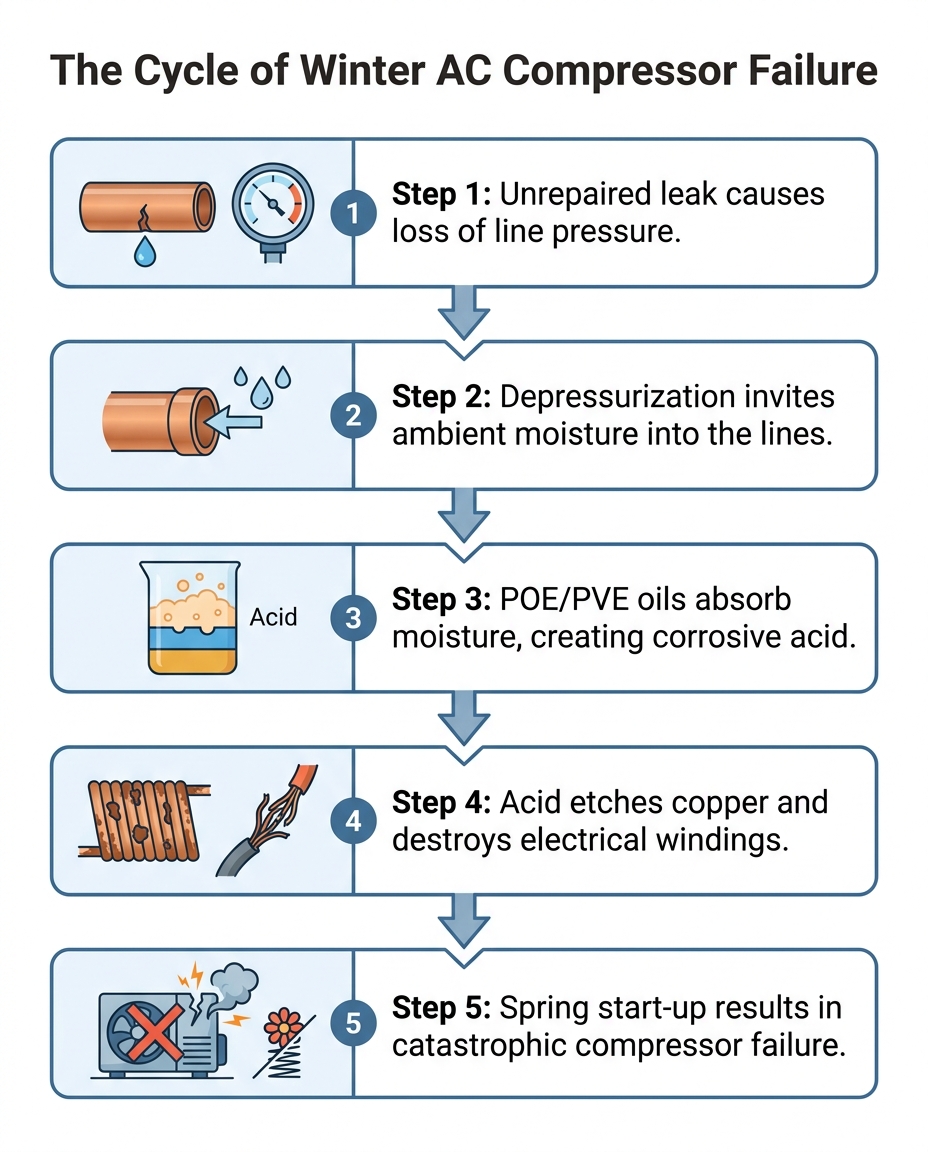
The Cycle of Winter AC Compressor Failure
The Impact of Freezing Temperatures on Dormant Equipment
The specific climate of the Midwest drastically accelerates the damage caused by a depressurized system. With Springfield, IL experiencing a 5-6 month deep freeze every winter, our technicians at Allied Plumbing Heating & Cooling know firsthand how outdoor equipment is subjected to extreme temperature fluctuations. Prolonged freezing temperatures cause all metal components in the AC unit to undergo thermal contraction.
When the copper lines, brass fittings, and aluminum coils shrink in the freezing cold, existing micro-leaks are forced to expand. A tiny pinhole leak that was barely losing refrigerant in August can open up significantly during a January freeze. This thermal contraction worsens the loss of line pressure allowing moisture intrusion, creating a wider pathway for humid ambient air to enter the dormant system.
A system sitting completely unused for half the year in freezing conditions is at its absolute most vulnerable state. The constant freeze-and-thaw cycle shifts the metal joints daily. If the system is not sealed and properly pressurized before the deep freeze sets in, the volume of moisture pulled into the lines will overwhelm the filter drier, guaranteeing heavy acid formation by the time the snow melts.
Securing Your HVAC System During the Fall Transition
The shift between cooling and heating seasons is the most critical window for home maintenance. This transition period is the ideal time to fully resolve AC issues rather than just shutting off the breaker and hoping for the best next year. Ensuring the air conditioner is sealed, repaired, and pressurized protects the investment while the home shifts to heating mode.
Recently, our Allied team visited a local Springfield homeowner who scheduled routine maintenance and a parts replacement on their furnace during this exact seasonal window. Because our professional technician was evaluating the entire HVAC ecosystem, we were able to identify a struggling AC unit before the winter freeze began. Addressing both systems simultaneously ensures that the cooling equipment is safely buttoned up while the heating equipment is optimized for the heavy winter load. If you are scheduling heating services, having the technician verify the integrity of the dormant AC is a vital protective measure.
The Value of Comprehensive Pre-Season Diagnostics
Professional diagnostics go far beyond simply changing an air filter. During the September transition to heating season, a thorough evaluation secures the cooling system against winter damage.
• Pressure verification: Technicians catch pressure drops before major moisture infiltration begins, sealing leaks while the weather is still mild.
• Electrical inspection: Checking capacitors and contactors ensures that pitted or failing components don't cause a hard-start failure in the spring.
• System isolation: Proper shutdown procedures ensure the refrigerant is safely contained and the system is shielded from ambient air.
The True Cost of Waiting Until Spring: Why Leaving a Failing AC Unrepaired Over Winter Guarantees a Spring Replacement
The difference between addressing a struggling air conditioner in September versus waiting until May is monumental. Patching a leak and recharging the refrigerant in the fall is a straightforward, routine procedure. Replacing a dead compressor—or the entire outdoor unit—because acid destroyed the electrical windings is a major mechanical overhaul.
Because the chemical damage happens silently while the unit is off, a spring failure often comes as a complete shock to homeowners who thought their system was safely resting. As a family-owned local HVAC expert, our team at Allied Plumbing Heating & Cooling understands the specific toll Midwest winters take on residential equipment, and we prioritize warning our Springfield neighbors so they can save their equipment from avoidable destruction.
• Technician locates and brazes the micro-leak. — Discovering the Failure in May: Acid has completely destroyed the compressor windings.
• System is vacuumed and recharged with clean refrigerant. — Discovering the Failure in May: Entire system must be flushed to remove corrosive acid.
• Positive pressure keeps winter moisture out. — Discovering the Failure in May: Compressor replacement or total system replacement required.
• System starts up smoothly on the first hot spring day. — Discovering the Failure in May: Homeowner faces days without cooling during the spring rush.
Proactive maintenance preserves the lifespan of the equipment. By acting during the September transition to heating season, you lock out moisture, prevent acid formation, and ensure total readiness for the next cooling season. Keep in mind that if total replacement becomes necessary, qualifying high-efficiency systems may be eligible for federal tax credits or local utility incentives, which you should verify with your utility provider or a tax professional.
Frequently Asked Questions About Dormant AC Systems
What happens if I don't fix an AC refrigerant leak before winter?
Leaving a leak unrepaired allows the system to lose internal pressure, which creates a vacuum that pulls in outdoor air and moisture. Once that moisture mixes with the refrigerant oil, it creates a corrosive acid that eats away at the internal components of the compressor all winter long. By spring, the damage is often irreversible.
Can an AC sit broken over the winter without causing more damage?
No, a broken AC will actively deteriorate if left unpressurized over the winter. The loss of line pressure allowing moisture intrusion means the system is constantly pulling in humid air, which degrades the lubricants and causes internal rusting and acid etching while the unit sits dormant.
Why does moisture inside an AC compressor cause it to fail?
Moisture reacts chemically with the highly hygroscopic POE oils used in modern refrigerants, generating acid. This acid circulates through the compressor and eats away the thin enamel insulation protecting the electrical copper windings, inevitably causing a massive short circuit when the unit is powered on.
Should I fix my AC in the fall or wait until spring?
You should always fix an air conditioner in the fall before the freezing temperatures arrive. Repairing it in the fall seals the system and restores positive pressure, which is the only way to keep ambient moisture out and prevent catastrophic chemical damage during the off-season.
How does freezing weather affect a depressurized air conditioner?
Freezing weather causes the metal components, fittings, and copper lines of the air conditioner to undergo thermal contraction. This shrinking effect can force existing micro-leaks to expand, accelerating the rate at which moisture and outside air are pulled into the depressurized system.
Protect Your Cooling System Before Winter Arrives
Understanding the unseen chemical reactions happening inside your dormant equipment proves that immediate action is necessary to save the unit. The combination of depressurization, moisture intrusion, and freezing temperatures creates a perfect storm that will silently destroy a compressor over the winter months. If you noticed your cooling unit struggling during the September transition to heating season, do not ignore the warning signs. We recommend having your system professionally evaluated and sealed before the deep freeze sets in, ensuring your equipment survives the winter and is ready to perform when the spring heat returns.
Why Leaving a Failing AC Unrepaired Over Winter Guarantees a Spring Replacement
September 22, 2026
Shutting off a struggling air conditioner for the winter doesn't stop the damage—it accelerates it. Unseen chemical reactions inside dormant lines turn minor leaks into total failures.
Shutting off a struggling air conditioner for the winter doesn't stop the damage—it accelerates it. Unseen chemical reactions inside dormant lines turn minor leaks into total failures.
Deciding Between an 80% and 96% AFUE Furnace for a Springfield Area Home
September 21, 2026
Before the Midwest winter hits, choosing a new heating system goes beyond the energy label. See how physical venting requirements impact your upgrade choice.
Before the Midwest winter hits, choosing a new heating system goes beyond the energy label. See how physical venting requirements impact your upgrade choice.
Why Falling Leaves and Acorns Are a Hidden Threat to Your Exterior Drain Cleanouts
September 18, 2026
During early fall yard prep, a cracked or missing exterior cleanout cap can act as a direct funnel for yard debris. Find out how this hidden vulnerability leads to severe main sewer line blockages.
During early fall yard prep, a cracked or missing exterior cleanout cap can act as a direct funnel for yard debris. Find out how this hidden vulnerability leads to severe main sewer line blockages.