Deciding Between an 80% and 96% AFUE Furnace for a Springfield Area Home
Deciding Between an 80% and 96% AFUE Furnace for a Springfield Area Home
Beyond the EnergyGuide Label: Choosing the Right Furnace for Midwest Winters
There is a widespread myth that upgrading your heating equipment is simply a matter of picking the highest number on a yellow sticker, but deciding between an 80% and 96% AFUE furnace for a Springfield area home is actually a complex structural decision. In our years of serving the Springfield community, our team at Allied Plumbing Heating & Cooling frequently sees homeowners assume that moving to a higher efficiency rating is an automatic, drop-in replacement for their older system. In reality, modern heating technology requires specific physical infrastructure to operate safely. As we approach September pre-heating season prep for Midwest winters, understanding the difference between standard and high-efficiency units is the first step toward a comfortable, reliable winter.
The decision ultimately comes down to weighing the physical installation requirements of your unique house against the long-term gas efficiency of the unit. The acronym AFUE stands for Annual Fuel Utilization Efficiency. This rating measures how efficiently a furnace converts gas into heating energy over the course of a typical year. An 80% AFUE rating means that eighty cents of every dollar spent on gas becomes usable heat for your living space, while the remaining twenty cents is lost as exhaust. A 96% AFUE unit captures significantly more of that heat. However, capturing that extra heat changes the physical byproduct of the combustion process, which drastically alters how the system must be installed in your basement or utility closet.
Understanding the Mechanics: 80% vs. 96% AFUE in Springfield
To make an informed choice, you need to understand how these two systems extract heat. The fundamental mechanics dictate why an 80% standard vs 96% condensing furnace have entirely different venting requirements, specifically the difference between a traditional metal flue and modern PVC piping. When the temperature drops below freezing, the way your system processes combustion gases determines both your daily comfort and the structural footprint of the equipment.
We see the importance of reliable heat extraction firsthand every winter. Just last season, our team expedited an emergency service call for a local homeowner whose older furnace went out on one of the coldest days of the year. We replaced the broken system with a new, properly sized unit in a matter of hours, restoring safety to the home. Whether you choose a standard or high-efficiency model, having a system that operates reliably under heavy Midwest winter strain is non-negotiable.
Standard 80% AFUE (Non-Condensing)
A standard 80% AFUE furnace operates using a traditional single heat exchanger design. When the burners ignite, the heat exchanger absorbs the thermal energy, and the blower motor pushes that warmed air through your ductwork. Because it only extracts about 80% of the available heat, the leftover combustion gases remain very hot. These hot gases rise naturally through a standard metal chimney or flue. For older homes with this existing infrastructure already in place, our technicians often find that installing a new 80% unit is a faster, more straightforward process that requires fewer structural modifications.
High-Efficiency 96% AFUE (Condensing)
A high-efficiency 96% AFUE furnace utilizes a secondary heat exchanger to squeeze out almost all the available thermal energy from the combustion process. After the primary heat exchanger does its job, the gases move into the secondary exchanger, where they are cooled to the point that they condense into a liquid. Because so much heat is removed, the remaining exhaust gases are too cool to rise naturally up a metal chimney. Instead, they must be pushed out of the house using a dedicated draft inducer fan through specialized venting. This mechanical difference means a 96% unit requires specific structural accommodations that older homes may not currently have.
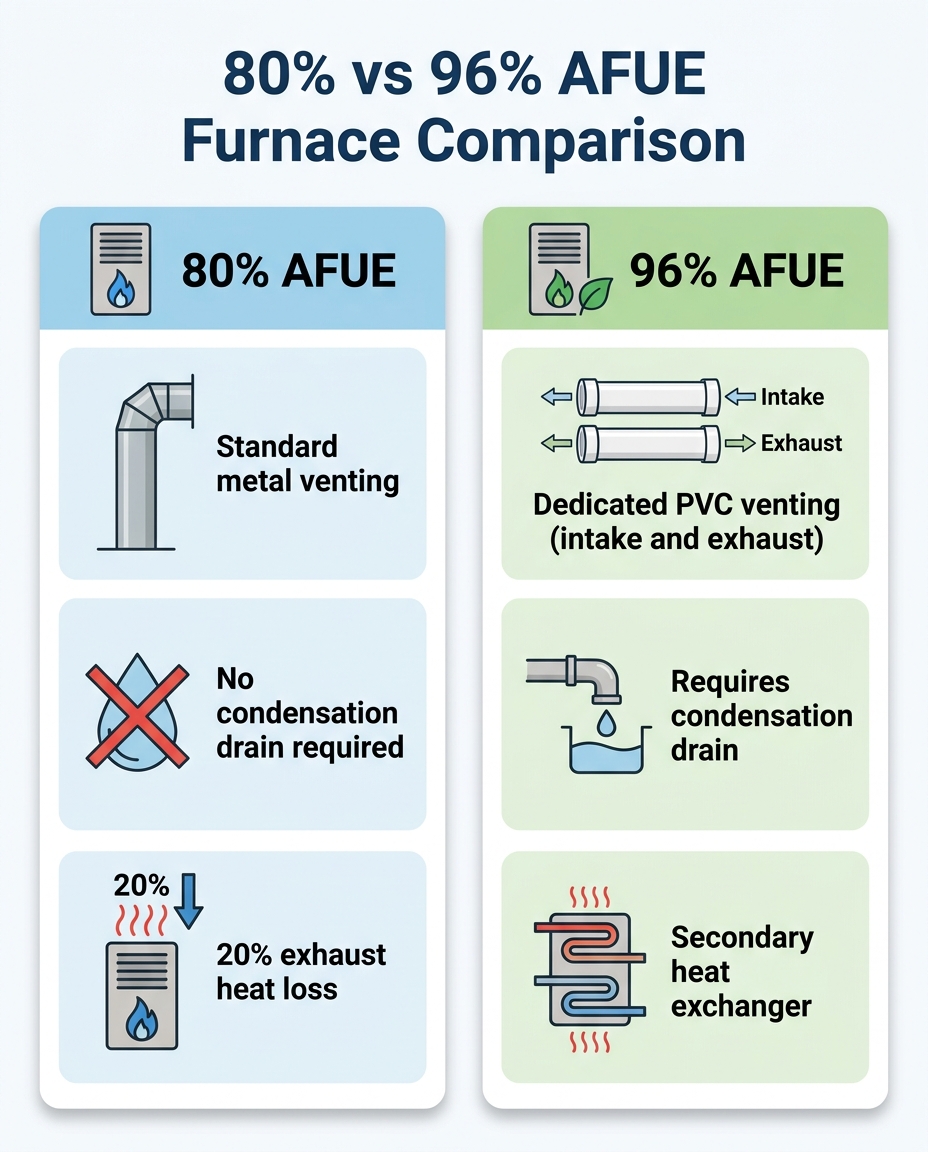
• Heat Exchanger Design — 80% AFUE Standard Furnace: Single primary heat exchanger — 96% AFUE Condensing Furnace: Primary and secondary heat exchangers
• Exhaust Temperature — 80% AFUE Standard Furnace: High heat, rises naturally — 96% AFUE Condensing Furnace: Low heat, requires mechanical fan assistance
• Venting Material — 80% AFUE Standard Furnace: Traditional metal flue or chimney — 96% AFUE Condensing Furnace: Dedicated PVC piping
• Drainage Requirement — 80% AFUE Standard Furnace: No floor drain needed — 96% AFUE Condensing Furnace: Requires floor drain or condensate pump
80% vs 96% AFUE Furnace Comparison
Venting Realities: Metal Flues vs. PVC Pipes
When our installation crews evaluate a Springfield home for a furnace upgrade, the most visible difference we point out between an 80% standard vs 96% condensing furnace venting requirement is the material used to move exhaust out of your house. Upgrading to a 96% system is never a simple drop-in replacement because the physical pathways for air must be entirely reconfigured.
1. Evaluating the Existing Metal Flue: An 80% AFUE furnace uses standard metal venting, often routed up through the roof or an existing masonry chimney. Because the exhaust gases are hot, they create a natural draft. If your home currently uses a metal flue, installing a new 80% unit can often utilize this same pathway, provided the flue is in safe, working condition and meets current building codes.
2. Routing New PVC Exhaust: A 96% AFUE furnace cannot use a metal chimney. The exhaust gases are so cool that they would condense inside a metal pipe, causing rapid rust and structural failure. Instead, high-efficiency units require dedicated PVC piping. This plastic pipe must be routed safely from the furnace directly outside, often through a side wall.
3. Establishing a Dedicated Air Intake: Many 96% units are installed as two-pipe systems. One PVC pipe blows the cool exhaust out, while a second PVC pipe pulls fresh combustion air in from the outside. This prevents the furnace from using the conditioned air inside your home for combustion, which further increases overall efficiency.
4. Addressing Structural Considerations: Routing two new PVC pipes through a finished basement, crawlspace, or tightly packed utility room requires careful planning. A professional technician must determine if there is a viable, code-compliant path to the exterior of the house without compromising structural joists or aesthetic finishes.
In our experience performing September pre-heating season prep for Midwest winters, one of the most overlooked factors we have to educate homeowners on is managing the physical water produced by a high-efficiency system. When the secondary heat exchanger in a 96% unit cools combustion gases to extract extra thermal energy, it produces liquid condensation as a byproduct. This liquid is not just plain water; it is mildly acidic and must be managed carefully to protect your home's infrastructure.
Because of this constant dripping during operation, a 96% furnace requires a dedicated floor drain or a mechanical condensate pump to move the liquid safely into your home's wastewater system. Standard 80% units do not produce liquid condensation, meaning they can operate perfectly fine in a dry utility closet without nearby plumbing access.
With summer temperatures far behind us, we have to weave in the reality of extended freezing periods in Springfield, IL. When temperatures plummet below zero, improper drain installation can lead to catastrophic system shutdowns—a pattern we see often when systems aren't installed by experienced professionals. If a condensate drain line is routed through an unconditioned space or improperly pitched, the slow trickle of acidic water can freeze solid. Once the drain line is blocked by ice, the furnace's internal safety sensors will detect the backup and shut the entire heating system down to prevent internal flooding. This leaves you without heat exactly when you need it most. Ensuring that drain lines are properly insulated, routed, and protected from freezing drafts is a critical part of a high-efficiency installation.
Weighing Efficiency Gains and Generic Tax Incentives
When our team helps you evaluate the long-term utility impact of your choice, it helps to look at how your equipment operates over a full season. September pre-heating season prep for Midwest winters is the ideal time to run these calculations. Because our region experiences long, sustained periods of freezing weather, heating cycles run frequently and for extended durations. These long heating cycles are what maximize the efficiency gains of a 96% AFUE unit.
Every time a high-efficiency condensing furnace runs, it converts more of your natural gas directly into usable heat for your living space. Over a long, harsh winter, this reduced gas consumption benefits both the environment and your overall utility usage. If you are choosing the right furnace for your home, the heavy workload of a local winter often makes the high-efficiency mechanics highly beneficial for daily comfort.
Additionally, upgrading to a high-efficiency condensing furnace often qualifies homeowners for generic federal tax credits or local utility rebate programs designed to encourage energy conservation. While standard 80% units rarely qualify for these incentives, a 96% model often meets the strict environmental criteria required by these programs. Because rebate availability and tax laws change frequently, we always advise readers to consult with a qualified tax professional or their local utility provider to verify current incentive eligibility before making a final decision.
Assessing Your Home's Infrastructure for an Upgrade
Before you commit to a specific AFUE rating, a thorough evaluation of your home's existing layout is necessary. As a multi-generational family-owned business, our team at Allied Plumbing Heating & Cooling provides honest recommendations based on actual home infrastructure rather than just pushing the highest-efficiency unit on the market. We recommend systems based entirely on the specific layout, available space, and heating demands of your individual property.
For example, when a local homeowner recently moved into a new house this fall and realized their heating system was struggling, our team conducted a thorough assessment. One of our reliable technicians performed the necessary parts replacement on the existing furnace to get it safely through the season, rather than immediately pushing a full replacement. When the time does come for a new installation, evaluating the physical space is the first step.
• Evaluate the existing flue: Determine if your home currently relies on a masonry chimney or a standard metal B-vent. If the existing metal flue is in excellent condition, an 80% unit might be the most logical choice.
• Check for PVC routing space: Look at the exterior walls near your utility room. A technician will need to verify if there is a clear, code-compliant path to run new PVC intake and exhaust pipes outside without obstruction.
• Locate the nearest drain: Identify where the nearest floor drain or utility sink is located. If there is no plumbing access nearby, a condensate pump will need to be factored into the installation plan for a 96% unit.
• Perform a pre-seasonal check: September is the perfect time to have a professional evaluate whether your aging 80% unit can safely survive another winter, or if the heat exchanger is showing signs of dangerous wear.
• Request a professional load calculation: Never guess at the size of the equipment. A professional technician will measure your home's square footage, window quality, and insulation levels to ensure the new system is perfectly sized for your specific needs.
If your infrastructure assessment reveals that a high-efficiency unit is a perfect fit, our team can handle every detail of your furnace installation in Chatham and the surrounding communities.
Frequently Asked Questions About Furnace Efficiency Upgrades
Is a 96% efficient furnace worth it?
A 96% efficient furnace is often worth the investment in regions with long, harsh winters where heating systems run constantly. Because it converts nearly all of the gas it consumes into usable heat, it significantly reduces energy waste over its lifespan. However, the true value depends on whether your home can easily accommodate the necessary PVC venting and condensation drains without massive structural renovations.
What is the difference between an 80% and 96% furnace?
The primary difference lies in how they handle heat extraction and exhaust. An 80% furnace uses a single heat exchanger and vents hot exhaust gases through a traditional metal flue. A 96% furnace uses a secondary heat exchanger to extract additional thermal energy, resulting in cool exhaust gases that must be vented through PVC pipes, along with liquid condensation that requires a floor drain.
Can I replace an 80 furnace with a 96?
You can replace an 80% furnace with a 96% model, but it is not a direct, plug-and-play swap. The installation team will need to abandon or cap the old metal flue and drill new pathways to run PVC intake and exhaust pipes to the exterior of your home. They will also need to establish a safe drainage solution for the acidic condensation produced by the new high-efficiency unit.
Does a 96% furnace need a drain?
Yes, a 96% furnace absolutely requires a drain. The secondary heat exchanger cools combustion gases to the point that they condense into a mildly acidic liquid. This liquid must flow continuously into a floor drain or be actively moved by a mechanical condensate pump to prevent the furnace from backing up and shutting down.
What is the difference in venting between an 80 and 96 furnace?
An 80% furnace relies on the natural upward draft of hot exhaust gases, allowing it to vent safely through a vertical metal pipe or lined chimney. A 96% furnace produces exhaust gases that are too cool to rise naturally, requiring a draft inducer fan to push the gases horizontally or vertically out of the house through dedicated PVC piping.
How does Midwest winter weather impact the efficiency of a condensing furnace?
Midwest winter weather maximizes the efficiency benefits of a condensing furnace because the system runs for longer, more frequent cycles. The longer the unit runs, the more opportunity the secondary heat exchanger has to capture latent heat that would otherwise be wasted. However, the extreme cold also means that condensation drain lines must be strictly protected against freezing to maintain reliable operation.
Make an Informed Heating Decision for Your Springfield Home
The choice between an 80% and 96% AFUE unit ultimately comes down to balancing your home's existing structural installation requirements with your long-term efficiency goals. While a high-efficiency condensing model captures more heat and reduces gas waste, it requires dedicated PVC venting and proper drainage solutions. Conversely, a standard 80% unit often integrates seamlessly with existing metal flues, making for a straightforward installation in older properties.
As part of your September pre-heating season prep for Midwest winters, acting early before the harsh weather arrives gives you the time to make an educated, unhurried decision. Do not wait until your current system fails on a freezing night. Schedule a professional evaluation today to assess your home's infrastructure, discuss generic tax incentives, and determine the exact heating solution that fits your unique needs.
Deciding Between an 80% and 96% AFUE Furnace for a Springfield Area Home
September 21, 2026
Before the Midwest winter hits, choosing a new heating system goes beyond the energy label. See how physical venting requirements impact your upgrade choice.
Before the Midwest winter hits, choosing a new heating system goes beyond the energy label. See how physical venting requirements impact your upgrade choice.
Why Falling Leaves and Acorns Are a Hidden Threat to Your Exterior Drain Cleanouts
September 18, 2026
During early fall yard prep, a cracked or missing exterior cleanout cap can act as a direct funnel for yard debris. Find out how this hidden vulnerability leads to severe main sewer line blockages.
During early fall yard prep, a cracked or missing exterior cleanout cap can act as a direct funnel for yard debris. Find out how this hidden vulnerability leads to severe main sewer line blockages.
Understanding the Role of the Circulator Pump in Your Hydronic Heating System
September 17, 2026
You turn on your boiler for the first brisk fall cold snap, but the radiators stay freezing. Discover why a dormant circulator pump is usually the culprit.
You turn on your boiler for the first brisk fall cold snap, but the radiators stay freezing. Discover why a dormant circulator pump is usually the culprit.