Camera Inspections: Seeing Exactly What Tree Roots Did to Your Sewer Line Over the Summer
Camera Inspections: Seeing Exactly What Tree Roots Did to Your Sewer Line Over the Summer
The Hidden Aftermath of a Dry Midwestern Summer
When early fall arrives and the intense midwestern heat finally breaks, scheduling Camera Inspections: Seeing Exactly What Tree Roots Did to Your Sewer Line Over the Summer is the single most effective way to prevent a catastrophic plumbing backup before the busy holiday hosting season begins. Mature tree roots aggressively infiltrate aging sewer lines during dry summer months, creating hidden blockages that sit silently underground. While your lawn might look perfectly normal as September rolls in, the plumbing infrastructure beneath it has likely spent the last three months under constant biological attack. At Allied Plumbing Heating & Cooling, we always advise proactively scheduling a sewer camera inspection right now to allow you to identify and clear that summer root damage before Thanksgiving guests put maximum stress on a compromised system.
For comprehensive plumbing solutions tailored to your home's unique needs, proactive diagnostics are always the best first step.
The transition into early fall often lulls homeowners into a false sense of security. The grass stops turning brown, the soil regains some moisture, and the immediate stress of summer drought fades. However, the damage inflicted beneath the surface does not reverse itself. Tree roots that breached your sewer pipes in July and August are now firmly established inside the warm, nutrient-rich environment of your plumbing system. They will continue to grow, expanding like a net across the diameter of the pipe, catching paper and debris with every flush.
Ignoring this unseen intrusion is a massive risk. As the weather cools and families spend more time indoors, indoor plumbing usage naturally increases. A partial root blockage that allowed water to slowly drain in September can easily turn into a total system failure by November. By utilizing a proactive camera inspection, you gain the most reliable, definitive diagnostic tool available, removing all the guesswork and allowing our technicians to show you the exact condition of your pipes without turning a single shovel of dirt.
Hydrotropism: Why Thirsty Roots Target Your Sewer Pipes
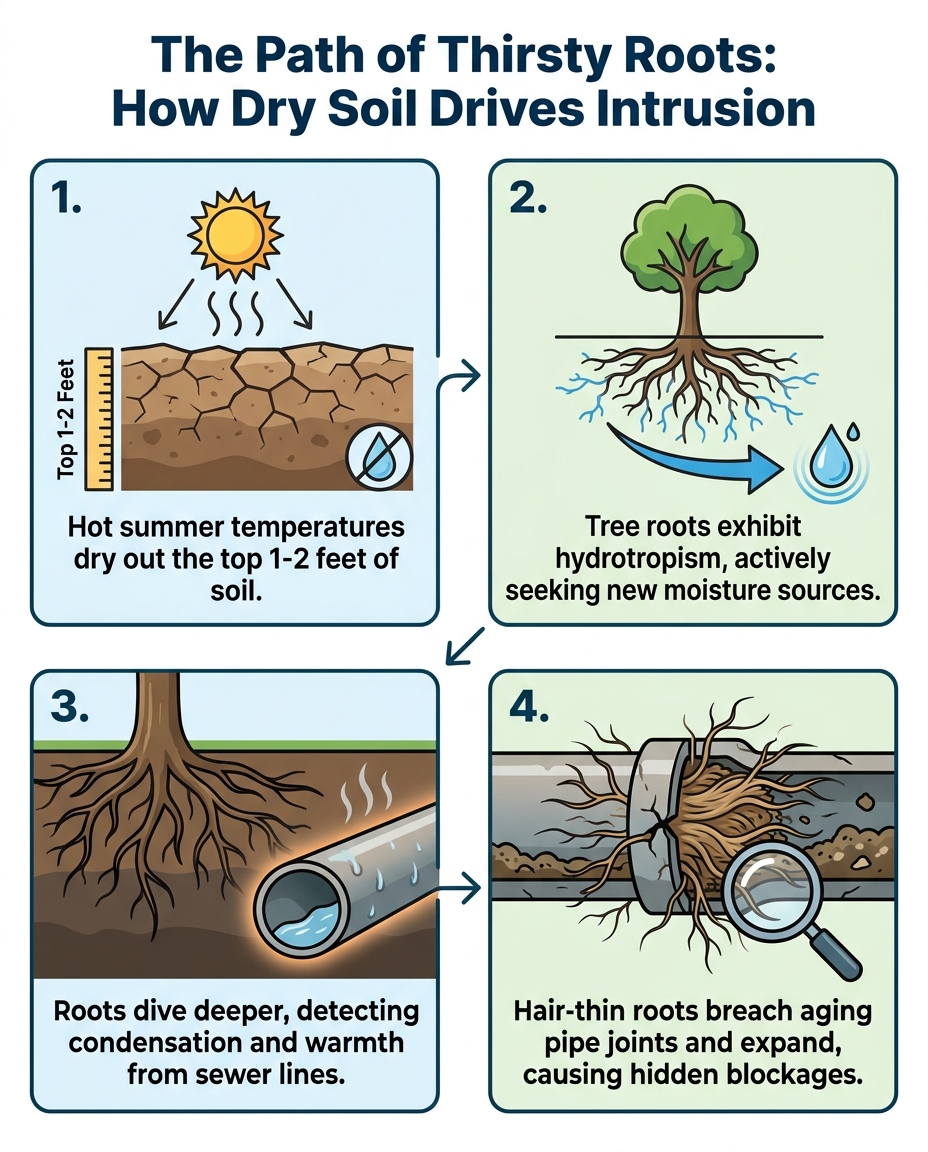
The Problem: Trees are incredibly resilient organisms, but prolonged dry spells threaten their survival. When the top layers of soil lose their moisture, trees must find an alternative water source to stay alive. They do this through a biological process called hydrotropism, which is the innate ability of roots to sense moisture gradients in the soil and actively grow toward them.
The Cause: As a local team, we see firsthand how Springfield's hot, dry summer spells aggressively dry out topsoil, forcing the roots of mature trees to dive deeper into the earth just to survive. As these roots push downward, they encounter the micro-environment surrounding your underground plumbing. Sewer lines are completely irresistible to a thirsty tree. They radiate warmth, produce exterior condensation, and carry a constant supply of nutrient-rich moisture. Even the smallest amount of vapor escaping from a microscopic crack or a degrading pipe joint acts like a beacon to a deeply buried root system.
The Solution: Understanding this biological drive is crucial to protecting your property. Once a root senses that moisture, it will exert immense pressure to access it. A hair-thin feeder root can slip through a microscopic fissure in a pipe joint. Once inside, it drinks, expands, and multiplies, eventually exerting enough outward pressure to crack the pipe wide open. This relentless biological mechanism is exactly how dry soil causes sewer lines to shift and belly, creating even more vulnerabilities for roots to exploit. A visual inspection is the only way to confirm if this process has already breached your defenses.
The Path of Thirsty Roots: How Dry Soil Drives Intrusion
Why Aging Infrastructure is Most Vulnerable to Root Damage
Not all homes carry the same level of risk when it comes to root intrusion. The materials used to construct your home's original plumbing dictate how easily a thirsty tree can break in. In Springfield's older neighborhoods with mature trees, the underground infrastructure is typically constructed from clay tile or cast iron. While these materials were the gold standard of their era, they possess inherent structural weaknesses that worsen over decades of use.
Clay pipes, for example, were laid in short segments. This means a single sewer line might have dozens of joints connecting the pieces. Over time, the mortar or seals used at these connections degrade, crumble, and wash away, leaving tiny gaps. Cast iron pipes suffer from a different aging process; they corrode and rust from the inside out, creating rough surfaces and structural thinning. When a hair-thin root finds one of these degraded joints or corroded weak points, it easily slips inside.
As a family-owned team at Allied Plumbing Heating & Cooling, we bring localized expertise that truly understands the specific plumbing challenges of Springfield's older, mature-tree neighborhoods. Over the years, our technicians have seen exactly how these legacy materials interact with shifting midwestern soils, frequently pulling massive root blockages out of century-old lines. To understand your home's risk profile, it helps to compare how different pipe materials hold up against root pressure over time.
• Clay Tile — Common Era of Installation: Pre-1980s — Vulnerability to Root Intrusion: Very High — Primary Point of Failure: Numerous joints degrade over time, creating easy entry points for feeder roots.
• Cast Iron — Common Era of Installation: Pre-1980s — Vulnerability to Root Intrusion: High — Primary Point of Failure: Corrosion creates weak spots and channels; joints separate as the heavy pipe settles.
• Orangeburg — Common Era of Installation: 1940s–1970s — Vulnerability to Root Intrusion: Extreme — Primary Point of Failure: Made of tar-paper, it crushes and disintegrates, offering zero resistance to roots.
• Modern PVC — Common Era of Installation: 1980s–Present — Vulnerability to Root Intrusion: Low — Primary Point of Failure: Fewer joints and watertight glues resist roots, though shifting soil can still cause breaks.
Even modern PVC pipes are not entirely immune. If severe summer drought causes the ground to shift significantly, PVC joints can crack or separate under the stress, instantly creating a new entry point for roots. Regardless of your home's age, visual verification is the only way to be certain your lines are secure.
What a High-Resolution Sewer Camera Actually Reveals
Diagnosing underground plumbing issues used to involve educated guesses and destructive exploratory digging. Today, modern diagnostic technology has completely transformed the process. A high-resolution sewer camera is a specialized piece of equipment designed to travel through the dark, wet, and cramped environment of your sewer line, sending a crystal-clear video feed back to a monitor above ground.
When you schedule professional plumbing services in early fall, our Allied technicians use this technology to provide definitive visual proof of your system's health. Here is exactly what the camera reveals during an inspection:
1. The Exact Location of the Blockage: The camera is mounted on a flexible, fiber-optic push rod that features a built-in radio transmitter. If the camera encounters a root mass, our technician uses a surface locator to pinpoint the exact depth and location of the camera head in your yard.
2. The Density and Type of Intrusion: Not all root blockages are the same. The bright LED lights and high-definition lens reveal whether you are dealing with a wispy, spiderweb-like intrusion of new feeder roots, or a dense, impenetrable wall of mature timber that has completely choked the pipe.
3. Secondary Structural Damage: Roots rarely just block a pipe; they actively destroy it. The camera reveals whether the expanding root mass has cracked the pipe walls, crushed a section of clay tile, or caused a joint to separate completely.
4. Overall Pipe Condition: Beyond roots, the camera shows the general health of your infrastructure, identifying bellies (sags holding standing water), grease buildup, or severe scale and corrosion in cast iron lines.
The greatest benefit of this technology is that it provides a definitive diagnosis without excavating your landscaping, driveway, or patio. You get hard evidence of what happened over the summer, allowing you to make informed decisions about maintenance before the system fails.
Early Warning Signs of Summer Root Intrusion
Tree roots do not typically cause an immediate, overnight backup. The process is gradual, acting like a slowly closing valve on your home's wastewater system. Because this growth accelerates during the dry summer months, the symptoms almost always begin to surface in September and early fall. Recognizing these subtle indicators early can save you from a catastrophic sewage backup later in the season.
In our experience servicing Springfield homes, if you notice any of the following symptoms, your system is likely struggling to push wastewater past a growing root mass:
• Multiple slow drains: If a single sink is slow, the issue is likely local to that fixture. If your shower, kitchen sink, and washing machine all drain sluggishly at the same time, the main sewer line is restricted.
• Gurgling sounds from fixtures: When roots block a pipe, water struggles to pass, creating air pockets. As water forces its way past the blockage, it displaces air, causing a distinct gurgling or bubbling sound in your toilets or shower drains.
• Foul sewage odors: A restricted pipe means waste sits in the line longer than it should. This stagnant waste produces sewer gases that can vent back up into your basement, bathrooms, or even out into your yard near the sewer main.
• Unexplained lush patches of grass: If one specific area of your lawn is significantly greener, taller, or faster-growing than the rest of the yard during late summer, it is likely being fertilized by a leaking sewer line beneath it.
• Frequent toilet backups: Toilets require a sudden, large volume of water to flush properly. If the main line is partially blocked by roots, it cannot handle this surge, causing the toilet to back up frequently even with normal use.
A critical warning: Never attempt to clear these symptoms using harsh chemical drain cleaners. Store-bought chemicals are entirely ineffective against thick, woody tree roots. Worse, these caustic chemicals sit trapped in the pipe behind the root mass, generating intense heat that can warp modern PVC or rapidly accelerate corrosion in older cast iron pipes. These symptoms always warrant professional visual verification.
Proactive Prevention vs. Holiday Plumbing Disasters
The Problem: As we transition out of summer and into the late fall and winter months, residential plumbing systems undergo a massive shift in usage. The upcoming holiday season—stretching from Thanksgiving through New Year's—acts as a severe stress test for your home's infrastructure. Increased cooking, extra laundry, and a house full of overnight guests mean your sewer line will be forced to handle double or triple its normal daily volume.
The Cause: If your system is already compromised by a partial root blockage that formed in July or August, it is operating at a reduced capacity. A pipe that is 40% blocked by roots might handle the daily routine of a two-person household just fine. But when ten family members arrive for a long weekend, that reduced capacity is quickly overwhelmed. The extra volume of water, combined with heavy food waste from the garbage disposal and increased toilet paper usage, hits the root mass and stops dead. The result is a total system backup where raw sewage has nowhere to go but back up through the lowest drains in your home.
The Solution: Our team highly recommends framing a camera inspection as routine seasonal preparation—much like scheduling a furnace tune-up before winter. It flips the script from reactive emergency response to proactive control. Discovering and clearing a root mass in early fall is a scheduled, controlled maintenance event. Waiting for the system to fail on Thanksgiving morning turns a simple maintenance task into a high-stress disaster.
The Cost of Waiting
Choosing to ignore the early warning signs of root intrusion carries significant risks that extend far beyond a simple plumbing bill. When a sewer line fails under the stress of holiday usage, the consequences are immediate and severe.
• Emergency off-hours dispatch: Plumbers are in high demand during the holidays. An emergency call on Thanksgiving Day or late on a weekend evening is stressful to coordinate and often disrupts your family's plans.
• Severe property damage: When a main line backs up, the wastewater enters through the lowest point in the house—typically a basement floor drain or a ground-floor shower. This can cause extensive water damage to finished basements, ruining flooring, drywall, and stored belongings.
• Disruption to hosting plans: A home without working plumbing cannot host guests. A severe backup can force you to cancel holiday gatherings, relocate guests to hotels, and spend your holiday managing a biohazard cleanup instead of enjoying time with family.
The Inspection Process and Next Steps
Many homeowners hesitate to schedule a camera inspection because they assume the process will be invasive, messy, or destructive to their property. In reality, modern sewer inspections are clean, highly controlled, and completely non-invasive. When you call our experienced Springfield area plumbers at Allied Plumbing Heating & Cooling, the entire process is designed to protect your home while providing maximum diagnostic clarity.
Our technician will typically access your sewer line through an existing cleanout. This is a capped pipe, usually located in your basement, crawlspace, or just outside your foundation, that provides direct access to the main sewer line. The flexible camera is fed into this cleanout, meaning no digging, no dismantling of interior plumbing, and no mess in your home.
As the camera travels down the pipe, you can often view the real-time video feed on the monitor alongside the technician. This transparency ensures you see exactly what we see. If the line is clear, you gain total peace of mind knowing your plumbing is ready for the heavy usage of the months ahead.
If the camera does reveal a root intrusion in Springfield's older neighborhoods with mature trees, our technicians will walk you through professional remediation options. For minor intrusions, mechanical augering (using a cutting blade to chop the roots) may be sufficient. For severe, dense root masses, hydro-jetting—which uses highly pressurized water to obliterate roots and scour the pipe walls clean—is often our recommended solution. Crucially, the camera is used again after the cleaning process to verify that the roots have been completely removed and to assess whether the pipe requires structural repair.
Frequently Asked Questions About Sewer Camera Inspections
Can a camera see tree roots in a sewer line?
Yes, a high-resolution sewer camera provides a crystal-clear view of tree roots inside a sewer line. The camera is equipped with bright LED lights and a self-leveling lens that illuminates the dark pipe, allowing the technician to see exactly where the roots have entered, how dense the blockage is, and whether the roots have caused secondary damage like cracking or pipe separation. This visual evidence takes all the guesswork out of diagnosing a slow drain.
How do you know if tree roots are in your sewer line?
The most common early indicators of tree roots in your sewer line are multiple slow drains occurring simultaneously, gurgling noises coming from your toilets or shower drains, and foul sewage odors in your basement or yard. You might also notice unusually lush, green patches of grass growing directly over your sewer line during dry periods. Because these symptoms worsen over time, they should be investigated professionally before a total backup occurs.
Why do tree roots grow into sewer pipes?
Tree roots grow into sewer pipes due to a biological process called hydrotropism, where roots actively seek out moisture and nutrients in the soil. During dry summer months, thirsty roots dive deeper into the ground and are attracted to the condensation, warmth, and constant water supply of an underground sewer line. If there is even a microscopic crack or a degraded joint in the pipe, the roots will force their way inside to access the water.
How long does a residential sewer camera inspection take?
A standard residential sewer camera inspection typically takes between 30 to 60 minutes to complete. The exact time depends on the length of your sewer line, the accessibility of your plumbing cleanout, and whether the camera encounters severe blockages that slow its progress. The process is entirely non-invasive, and the technician can usually provide you with a definitive diagnosis immediately upon finishing the video sweep.
Are older homes more susceptible to plumbing root intrusion?
Older homes are significantly more susceptible to root intrusion because their original plumbing infrastructure was often built using clay tile or cast iron pipes. Over decades of use, the joints in clay pipes degrade and crumble, while cast iron pipes suffer from internal corrosion and structural thinning. These aging, weakened materials provide easy entry points for aggressive tree roots, making regular visual inspections highly recommended for historic or established properties.
Secure Your Plumbing Before the Holiday Rush
Catching summer root growth early is the difference between a simple, scheduled maintenance appointment and a disastrous sewage backup on a holiday weekend. The dry conditions of the past few months have driven thirsty roots deeper into the ground, and if your home relies on aging infrastructure, those roots may have already breached your sewer lines. September and early fall represent the critical window to act before indoor plumbing usage spikes.
By scheduling a professional camera inspection with Allied Plumbing Heating & Cooling now, you gain a clear understanding of what hydrotropism has done beneath your lawn. You get to see exactly what is happening inside your pipes without anyone digging up your yard. Ensure your system is clear, secure, and fully prepared to handle the demands of the upcoming season, giving you the ultimate peace of mind when hosting family and friends.
Camera Inspections: Seeing Exactly What Tree Roots Did to Your Sewer Line Over the Summer
September 23, 2026
Tree roots aggressively infiltrate aging sewer lines during dry summers. A proactive early fall camera inspection catches this hidden damage before it causes catastrophic backups during holiday hosting.
Tree roots aggressively infiltrate aging sewer lines during dry summers. A proactive early fall camera inspection catches this hidden damage before it causes catastrophic backups during holiday hosting.
Why Leaving a Failing AC Unrepaired Over Winter Guarantees a Spring Replacement
September 22, 2026
Shutting off a struggling air conditioner for the winter doesn't stop the damage—it accelerates it. Unseen chemical reactions inside dormant lines turn minor leaks into total failures.
Shutting off a struggling air conditioner for the winter doesn't stop the damage—it accelerates it. Unseen chemical reactions inside dormant lines turn minor leaks into total failures.
Deciding Between an 80% and 96% AFUE Furnace for a Springfield Area Home
September 21, 2026
Before the Midwest winter hits, choosing a new heating system goes beyond the energy label. See how physical venting requirements impact your upgrade choice.
Before the Midwest winter hits, choosing a new heating system goes beyond the energy label. See how physical venting requirements impact your upgrade choice.