How Running Toilets Waste Water and Money — And What It's Costing You Right Now
How running toilets waste water and money is something most homeowners don't think about until they see a shockingly high water bill. A toilet that won't stop running can silently drain hundreds of gallons every single day — without a single visible drip on the floor.
Here's a quick breakdown of what a running toilet actually costs:
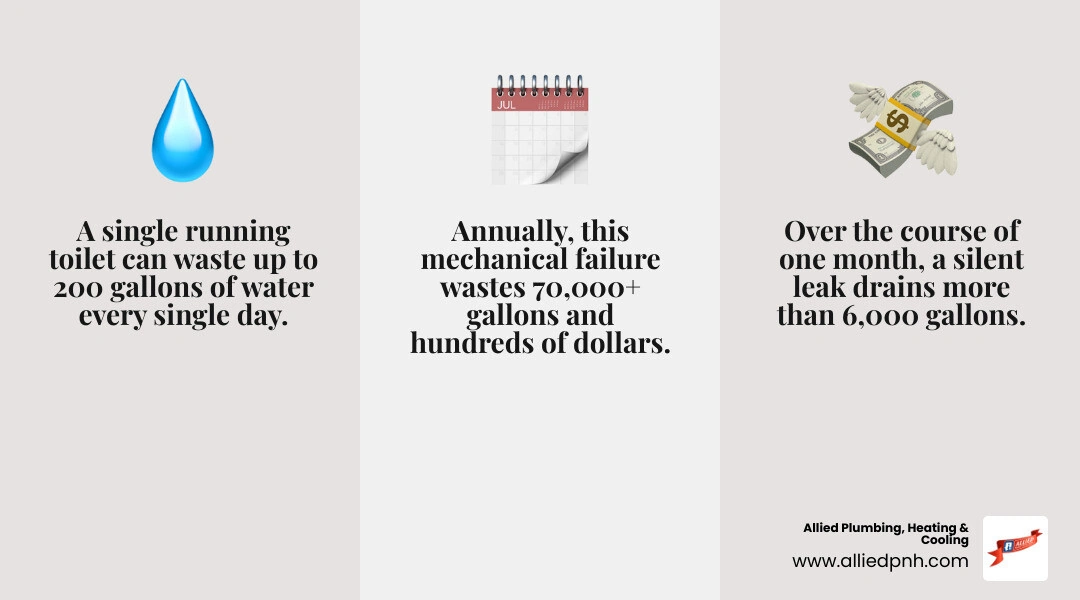
• Per day — Water Wasted: Up to 200 gallons — Potential Bill Impact: Adds up fast
• Per month — Water Wasted: 6,000+ gallons — Potential Bill Impact: Noticeably higher bill
• Per year — Water Wasted: 70,000+ gallons — Potential Bill Impact: Hundreds of dollars lost
That constant hissing or trickling sound from your bathroom isn't just annoying — it's your toilet working overtime, cycling water from the tank into the bowl around the clock. Unlike a dripping faucet you can see, a running toilet often goes unnoticed for weeks or even months.
In Springfield and surrounding areas, many homeowners only discover the problem when their water bill spikes without explanation. By that point, thousands of gallons have already gone straight down the drain.
The good news? Most running toilets are caused by a small number of fixable problems — and catching them early makes a real difference.
Understanding How Running Toilets Waste Water and Money
To understand how running toilets waste water and money, you first have to look at the sheer volume of water moving through the system. A typical modern toilet uses about 1.28 to 1.6 gallons per flush. However, a running toilet is like a faucet left wide open. Research shows that a medium-sized leak can waste 250 gallons of water every single day. Over a year, that adds up to more than 70,000 gallons.
To put that into perspective, that is enough water to fill a backyard swimming pool several times over—or the equivalent of running over 100 extra loads of laundry every month. This isn't just a drain on your wallet; it’s a massive environmental hit. Large-scale water waste puts unnecessary strain on our local municipal resources and the energy required to treat and pump that water.
Furthermore, ignoring a running toilet can lead to Signs of Hidden Water Leaks elsewhere. Because the fill valve is constantly working to top off the tank, the internal components of the toilet wear out much faster than they should. In some extreme cases, if your home has a minor clog or slow drain combined with a running toilet, the bowl can eventually overflow, leading to significant water damage in your bathroom.
How running toilets waste water and money through silent leaks
Not every leak announces itself with a loud hissing sound. Some of the most expensive leaks are "silent" ones. This happens when water slowly seeps from the tank into the bowl through a degraded flapper or a poorly seated valve.
We recommend a simple 15-minute diagnostic called the food coloring test:
1. Remove the lid from the toilet tank.
2. Drop about 10–15 drops of food coloring (any bright color will do) into the tank water.
3. Wait 15 to 20 minutes without flushing.
4. Check the water in the toilet bowl. If the color has seeped into the bowl, you have a leak.
This invisible drainage is one of the Most Common Plumbing Repairs and What Causes Them. Because you can't hear it, the toilet can run for months, quietly inflating your water and sewer bills until you finally notice the trend.
How running toilets waste water and money in Springfield homes
For our neighbors in Springfield, Rochester, and Chatham, the financial impact is localized but significant. Water rates include both the consumption of the water and the sewer fees associated with it. When your toilet runs, you are paying for that water twice: once to bring it into the home and once to send it down the sewer line.
Cumulative financial losses can reach hundreds of dollars annually. Beyond the bill, the constant flow of water can cause sediment build-up in your toilet's internal parts, leading to more frequent repairs. Regular maintenance is the best defense, which is why we often share Spring Plumbing Inspection Tips for Homeowners to help catch these issues before they become "bill-shock" moments.
Common Causes of a Constantly Running Toilet
If your toilet is running, it’s usually because one of the components inside the tank is failing to do its job. Here is How We Handle Common Plumbing Issues by identifying the culprit:
• The Flapper: This is the most common cause. The flapper is the rubber disk that seals the bottom of the tank. Over time, the rubber degrades, warps, or collects mineral deposits, preventing a tight seal.
• The Fill Valve: This component is responsible for refilling the tank after a flush. If the fill valve is faulty or has sediment build-up, it may never fully shut off, causing water to run continuously.
• Float Height: The float (either a ball or a "cup" on the fill valve) tells the water when to stop. If it's set too high, the water level will rise above the overflow tube and drain directly into the bowl.
• The Lift Chain: If the chain connecting the flush handle to the flapper is too long, it can get caught under the flapper. If it’s too short, it won't allow the flapper to close fully.
• High Water Pressure: If your home's water pressure exceeds 70 or 80 psi, it can overwhelm the fill valve, causing it to "leak" water into the tank even when it’s supposed to be closed.
Step-by-Step DIY Fixes for Common Toilet Leaks
Many running toilet issues are manageable DIY projects. Before you start, always find the water shut-off valve (usually located on the wall behind the toilet) and turn it clockwise to stop the flow of water.
1. Adjusting the FloatIf the water level is consistently pouring into the overflow tube, your float is likely set too high.
• For a ball float, gently bend the metal arm downward.
• For a modern cup-style float, slide the adjustment clip down the rod.
• The goal is to have the water stop about one inch below the top of the overflow tube.
2. Fixing the Lift ChainEnsure the chain has about half an inch of slack when the flapper is closed. If the chain is tangled or catching on other parts, unhook it and re-attach it to a different hole on the flush lever to provide a straight, clear path.
3. Replacing the FlapperThis is a 10-minute fix. Drain the tank by flushing, unhook the old flapper from the pegs on the overflow tube, and snap a new one into place. Pro tip: Bring your old flapper to the hardware store in Springfield or Chatham to ensure you get an exact match, as "universal" flappers don't fit every model.
• Flapper Replacement — Difficulty: Easy — Time Required: 10 Minutes — Tools Needed: None
• Chain Adjustment — Difficulty: Very Easy — Time Required: 5 Minutes — Tools Needed: Pliers (optional)
• Fill Valve Replacement — Difficulty: Moderate — Time Required: 30 Minutes — Tools Needed: Adjustable Wrench, Sponge
• Float Adjustment — Difficulty: Easy — Time Required: 5 Minutes — Tools Needed: Screwdriver (optional)
When to Call a Professional Plumber in Rochester or Chatham
While many issues are simple, some require the expertise of a professional. If you have replaced the flapper and the fill valve and the toilet still runs, the problem might be more complex.
You should call us for Plumbing Repair Springfield IL if you encounter the following:
• A Cracked Overflow Tube: If the actual plastic tube in the center of the tank is cracked, the entire flush valve assembly must be replaced, which involves removing the tank from the bowl.
• High Home Water Pressure: If you suspect your water pressure is too high (indicated by vibrating pipes or multiple leaking fixtures), we need to test the pressure and potentially install or replace a Pressure Reducing Valve (PRV).
• Persistent Hissing: This can indicate a pinhole leak in the fill valve or a problem with the supply line that could lead to a flood.
• Older Toilets: If your toilet is more than 20 years old, it may be more cost-effective to replace it with a modern, high-efficiency model rather than continuing to pour money into repairs.
Frequently Asked Questions about Running Toilets
Will a running toilet eventually stop on its own?
No. A running toilet is a mechanical failure. Whether it's a warped rubber flapper or a mineral-clogged fill valve, the problem will only worsen as the components continue to degrade. Ignoring it will lead to higher bills and potentially a complete mechanical failure that could cause an overflow.
Can toilet cleaning tablets cause my toilet to run?
Yes, and we generally recommend avoiding them. Many "drop-in" bleach or chlorine tablets stay in the tank water constantly. These harsh chemicals accelerate the degradation of the rubber flapper and the plastic components of the fill valve. If you want a clean toilet, it's better to use a bowl cleaner that doesn't sit in the tank water.
How often should I replace my toilet flapper?
As a rule of thumb, you should inspect your flapper every year and plan to replace it every five years. In areas with "harder" water, mineral deposits can cause the rubber to stiffen and lose its seal even sooner. Replacing it as part of your preventative maintenance is a very inexpensive way to avoid a $100+ water bill.
Conclusion
Understanding how running toilets waste water and money is the first step toward a more efficient home. By spending just a few minutes checking your toilet tank today, you could save yourself hundreds of dollars and thousands of gallons of water this year. Whether it's a quick DIY flapper swap or a simple float adjustment, these small actions have a big impact on your monthly budget and the environment.
If you’ve tried the DIY route and that "ghost flushing" or hissing sound just won't go away, don't wait for your next utility bill to arrive. Our team at Allied Plumbing, Heating & Cooling has been serving the Springfield, Rochester, and Chatham communities since 1977. We are a 3-generation business dedicated to providing reliable, expert service.
For fast, professional help, contact our Emergency Plumber Springfield IL or browse our full range of Plumbing Services. We’ll get your bathroom back in order so you can stop flushing your hard-earned money down the drain.