Why Faucets Drip and Leak Over Time — And What It's Costing You
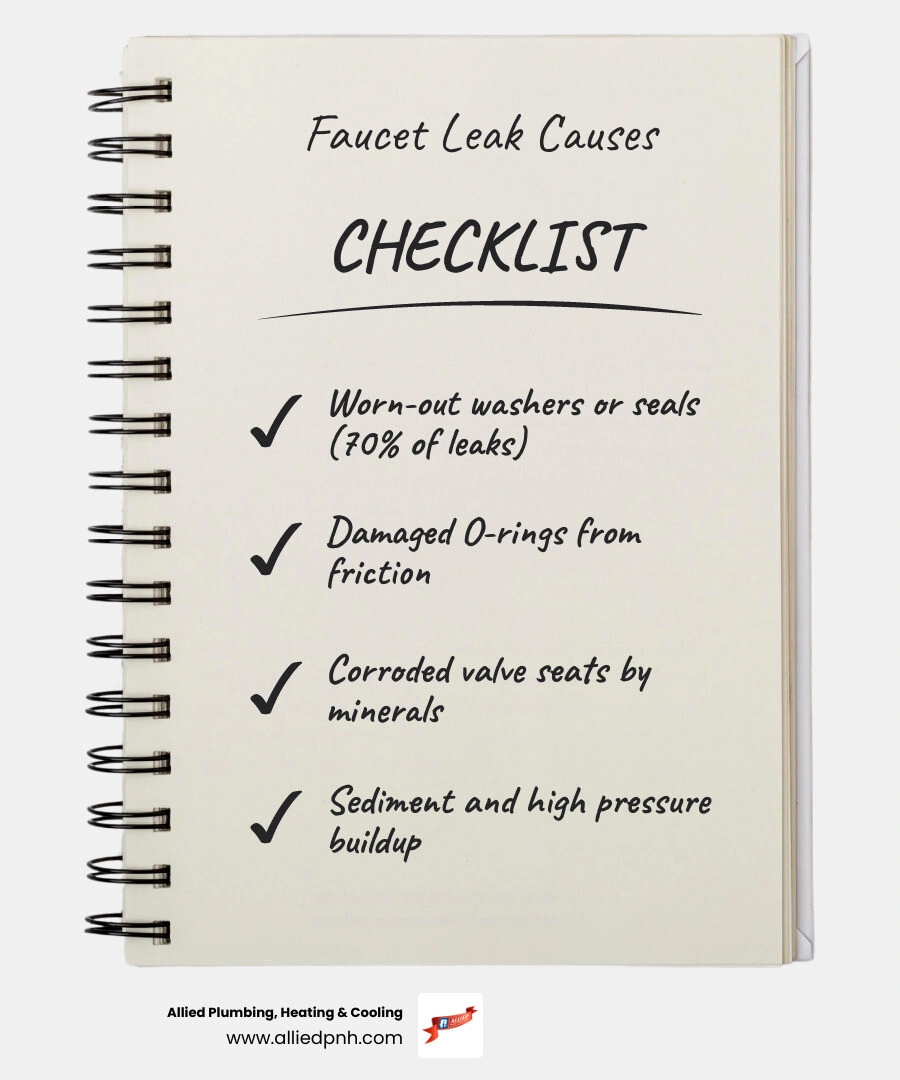
Why faucets drip and leak over time comes down to a handful of well-understood causes. Here's a quick breakdown:
• Worn-out washers or seals — the most common cause, responsible for roughly 70% of all faucet leaks
• Damaged O-rings — rubber rings around the handle stem that degrade from constant friction
• Corroded valve seats — mineral deposits from hard water eat away at the connection between the faucet and spout
• High water pressure — pressure above 80 psi forces water past seals and washers
• Loose or deteriorated cartridges — especially common in two-handle faucets
• Sediment and mineral buildup — accelerates wear on every internal component
That quiet drip in your Springfield kitchen might seem harmless. But a faucet leaking at just one drip per second wastes more than 3,000 gallons of water every year — enough to supply over 180 showers. Multiply that across the millions of leaking fixtures in American homes, and you start to understand why plumbing leaks account for nearly 1 trillion gallons of wasted water annually in the U.S.
The real problem is that most homeowners wait too long to act. In fact, about 60% of people brush off small leaks, assuming they won't cause serious damage. But those drips quietly drive up your water bill, wear down your plumbing, and — left unchecked — can lead to mold growth, structural damage, and costly repairs down the line.
Understanding why a faucet starts leaking is the first step to stopping it for good.
The Primary Culprits: Why Faucets Drip and Leak Over Time
When we visit homes in Springfield to address a nuisance drip, we find that the cause is rarely a mystery. Faucets are mechanical devices with moving parts that interact with water under pressure. Over time, that combination leads to inevitable degradation. To understand the science of the leak, you have to look at what is happening inside the fixture.
Every time you turn your faucet handle, internal components rub against one another to create or break a seal. This constant movement, combined with the chemical and physical properties of the water flowing through the pipes, creates a hostile environment for the small rubber and metal parts that keep the water at bay.
Mechanical wear: why faucets drip and leak over time
The most frequent offender in plumbing is the humble washer. In traditional compression faucets, a rubber washer is pressed against a metal valve seat to stop the flow of water. Research shows that worn-out washers are responsible for approximately 70% of all faucet leaks.
Why do they fail? It’s a process called friction-induced deterioration. Every time you tighten the handle, you are essentially squashing that rubber. Over years of use, the rubber loses its elasticity, becomes brittle, or develops small tears. This is why many people find themselves tightening the handle harder and harder just to stop the drip—a habit that actually accelerates the damage.
Beyond washers, loose internal parts can also play a role. Constant use can cause the packing nut or even the screws holding the handle together to vibrate loose. When these components aren't snug, the internal seals can't sit properly, allowing water to bypass them. For more details on the specific components that fail, you can read about the Most Common Plumbing Repairs and What Causes Them.
If you are currently dealing with a fixture that won't quit, our guide on How to Stop That Dripping Faucet offers practical insights into the first steps of mitigation.
External factors: why faucets drip and leak over time
Not every leak is caused by the user. Sometimes, the environment outside the faucet is to blame. Thermal expansion is a common scientific culprit. As water temperatures change, the metal and rubber components inside your faucet expand and contract. This "breathing" of the materials can eventually cause seals to shift or crack.
Furthermore, municipal pressure spikes can wreak havoc. If your local water utility performs maintenance or if there is a sudden change in the grid's demand, a surge of high-pressure water can slam into your home's plumbing. These spikes can force water through even the tiniest imperfections in a seal, turning a microscopic gap into a steady drip. We often see this manifest as intermittent dripping—where the faucet only leaks during certain times of the day. You can learn more about our approach to these nuances in How We Handle Common Plumbing Issues.
Environmental Factors: Pressure and Hard Water in Rochester
For our neighbors in Rochester, the local environment plays a significant role in the lifespan of plumbing fixtures. Two major factors stand out: water pressure and water chemistry.
The Hidden Danger of High Water Pressure
Many homeowners believe that higher water pressure is always better—it makes for a great shower, after all. However, from a plumbing perspective, high water pressure is a "silent killer." Most residential plumbing systems are designed to handle pressure between 40 and 60 psi. When water pressure exceeds 80 psi, it puts extreme stress on every joint, valve, and seal in the house.
Homes without valves to regulate water pressure experience over 60% more plumbing issues due to these pressure fluctuations. If your faucet only drips at night or when no other fixtures are running, it is a classic sign that your home's pressure is too high. High pressure forces water past the internal barriers of the faucet, leading to premature wear. To protect your home, it is vital to Identify and Fix Water Pressure Problems before they lead to a burst pipe.
The Role of Hard Water and Mineral Buildup
In many parts of central Illinois, hard water is a fact of life. Hard water contains high concentrations of minerals like calcium and magnesium. As water sits in your faucet or flows through the valve seat, these minerals settle and harden into "scale."
This mineral buildup acts like sandpaper. As you turn the faucet handle, the internal seals rub against this abrasive scale, causing them to tear or wear down much faster than they would in a soft-water environment. Even worse, minerals can accumulate on the valve seat itself. If the valve seat becomes pitted or corroded from mineral deposits, a new washer won't help because it no longer has a smooth surface to seal against. This is why we often recommend cleaning internal components with white vinegar during a repair to dissolve these stubborn deposits.
Identifying Your Fixture for Accurate Diagnosis in Chatham
If you live in Chatham and are ready to tackle a leak, the first step is knowing what kind of faucet you are looking at. You can't fix the problem if you don't know the mechanics. There are four main types of faucets, each with its own unique "weak points."
1. Compression Faucets
These are the oldest type and are usually identified by having two separate handles for hot and cold. They work by turning a screw-like handle that compresses a rubber washer against a valve seat.
• Common Failure: Worn-out rubber washers or a corroded valve seat.
2. Cartridge Faucets
These can be single or double-handled. Inside, a plastic or metal cartridge moves up and down or rotates to control water flow. Replacing the cartridge in two-handle faucets solves the dripping issue in more than 80% of cases.
• Common Failure: Worn O-rings on the cartridge or the cartridge itself becoming cracked.
3. Ball Faucets
Common in kitchens, these have a single handle that moves over a rounded, ball-shaped cap. The ball inside has chambers that align with the water inlets.
• Common Failure: These have many small parts, including springs and rubber "seats," which are prone to wearing out or becoming clogged with sediment.
4. Ceramic Disc Faucets
These are the "gold standard" of modern plumbing. They use two highly polished ceramic discs that slide over each other to block or allow water. Faucets with ceramic discs have a significantly lower failure rate, with less than a 5% chance of leaking compared to other types.
• Common Failure: While rare, the seals at the bottom of the disc assembly can fail, or a large piece of debris can get caught between the discs and crack them.
Faucet Comparison Table
• Compression — Primary Mechanism: Rubber Washer — Most Likely Leak Cause: Flattened/Torn Washer — Failure Rate: High
• Cartridge — Primary Mechanism: Cartridge Stem — Most Likely Leak Cause: Damaged O-Rings — Failure Rate: Moderate
• Ball — Primary Mechanism: Rotating Ball — Most Likely Leak Cause: Worn Springs/Seats — Failure Rate: Moderate
• Ceramic Disc — Primary Mechanism: Ceramic Plates — Most Likely Leak Cause: Bottom Gasket Failure — Failure Rate: Very Low (<5%)
If you’re unsure which type you have, a quick look under the sink or a call for Plumbing Repair Springfield IL can help you identify the right parts for the job.
Frequently Asked Questions about Leaky Faucets
How much water and money does a dripping faucet waste?
It is easy to ignore a slow drip, but the numbers are staggering. A single faucet leaking at a rate of one drip per second wastes over 3,000 gallons of water per year. To put that in perspective, that is enough water to run more than 180 showers.
Financially, this translates to roughly $100 in wasted water costs annually. While that might not seem like a fortune, it is essentially throwing money down the drain for a problem that often costs very little to fix. Furthermore, if the leak is on the hot water side, you are also paying to heat water that you never use, increasing your energy bill. Beyond the bill, constant moisture can lead to Emergency Plumbing Situations That Require Help, such as wood rot under the sink or mold growth in the cabinet.
Why do faucets seem to drip more at night?
Many of our customers in Springfield notice that their faucets are silent during the day but start a steady drip-drip-drip as soon as they head to bed. This isn't just your imagination; there are several scientific reasons for this:
1. Municipal Pressure Peaks: During the day, everyone in the city is using water. At night, demand drops significantly, which causes the pressure in the municipal lines to rise. This extra pressure can push water past a weakened faucet seal.
2. Thermal Contraction: As the house cools down at night, the materials in your plumbing slightly contract. This can open up tiny gaps in worn-out washers or O-rings.
3. Reduced Ambient Noise: During the day, the sounds of traffic, appliances, and conversation mask the sound of a drip. In the dead of night, that same drip sounds like a drum.
If your faucet is a "night-only" leaker, it is a strong indicator that you should have a professional check your home's water pressure regulator.
When should I call a professional for a faucet leak?
While many homeowners enjoy a DIY challenge, plumbing can be deceptively complex. Approximately 20% of homeowners who attempt a DIY faucet repair end up needing to call a professional after the project goes wrong.
You should call us if:
• The leak persists after you have replaced the obvious parts (washers or cartridges).
• You find extensive corrosion on the valve seat that requires specialized resurfacing tools.
• You can't identify the brand or model of the faucet to find replacement parts.
• The leak is under the sink, which could indicate a failed supply line or a cracked faucet body.
• You lack the correct tools. About 75% of homeowners do not have the specific wrenches or seat-removal tools required for a clean repair.
Attempting to force a stuck nut or using the wrong pliers can permanently scar the finish of your fixture or, worse, break the pipe inside the wall. When in doubt, reaching out to an Emergency Plumber Springfield IL can save you from a major flood.
Conclusion
Understanding why faucets drip and leak over time is the best way to protect your home from unnecessary waste and damage. Whether it is the mechanical wear of a rubber washer, the abrasive nature of hard water in Rochester, or high-pressure spikes in Chatham, every drip has a cause—and a solution.
At Allied Plumbing, Heating & Cooling, we have seen it all. As a 3-generation family business serving the Springfield area since 1977, we pride ourselves on providing reliable, expert service. We don't just fix the drip; we look at the health of your entire plumbing system to ensure the problem doesn't come back.
With our Daikin Comfort Promise and 24/7 emergency availability, you can rest easy knowing your home is in good hands. Don't let your money and water go down the drain. If you're tired of that persistent dripping sound, contact us today for professional Plumbing Services. We’re here to keep your home comfortable, efficient, and leak-free!