Why Preparing Your Cooling System for Summer Humidity Matters Before the Heat Peaks
Preparing your cooling system for summer humidity is one of the most important things you can do as a homeowner before Illinois summers arrive in full force. In Springfield, Rochester, and Chatham, the air gets thick and sticky fast — and your AC has to work much harder than just lowering the temperature. It has to pull moisture out of the air at the same time.
Here is a quick overview of the key steps to get your cooling system ready:
1. Replace your air filter — check it every 30 days during summer months
2. Clean the condensate drain line — flush monthly with white vinegar to prevent clogs and mold
3. Clear the outdoor condenser unit — maintain at least 2 feet of clearance around it
4. Set your thermostat fan to AUTO — not ON, to avoid re-evaporating moisture back into your home
5. Schedule a professional tune-up — before peak humidity hits, not after your system struggles
6. Monitor indoor humidity levels — target between 30% and 50% relative humidity
7. Consider supplemental dehumidification — if your AC alone cannot keep up
Most people think about cooling in terms of temperature. But humidity is where systems actually break down. High moisture levels force your AC to perform double duty — removing latent heat from water vapor before it can even begin lowering the air temperature. That extra load drives up energy bills, accelerates wear on components, and leaves your home feeling sticky even when the thermostat reads a comfortable number.
HVAC systems in humid climates log around 2,800 operating hours every year — more than double what systems in drier regions handle. That kind of demand adds up fast on a system that has not been properly prepared.
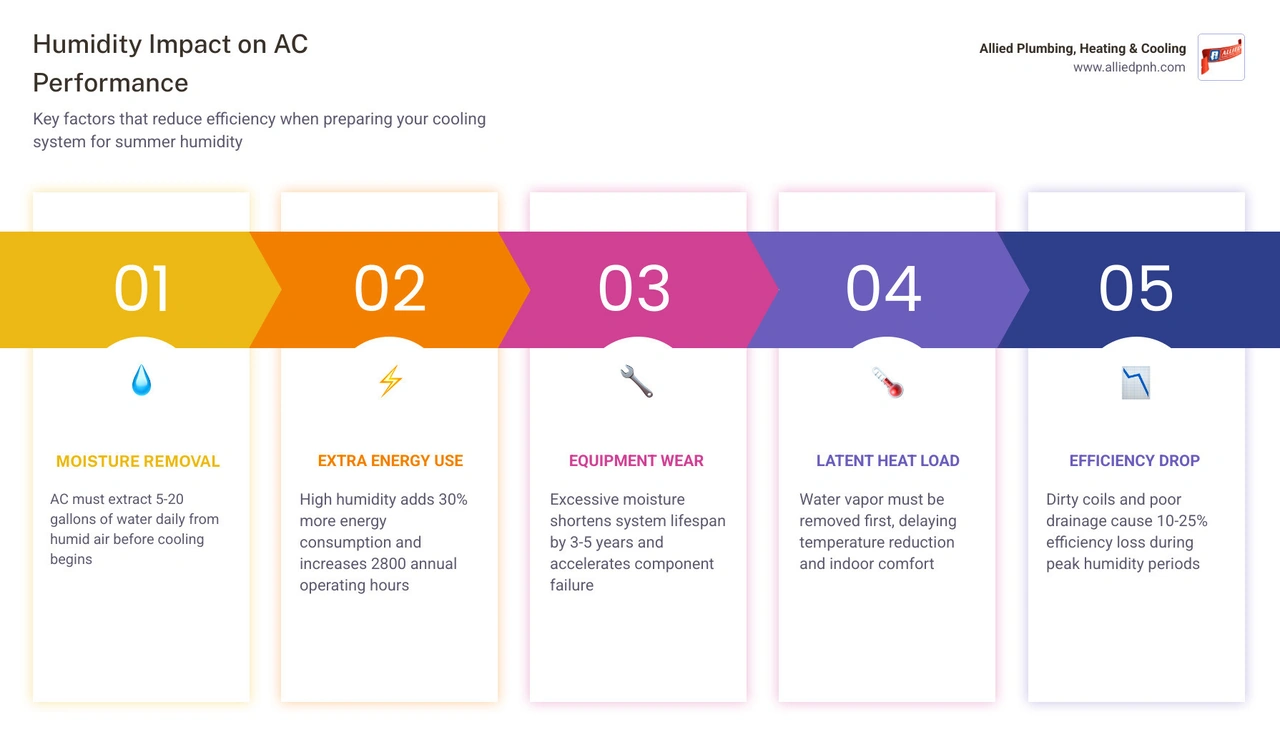
Why High Humidity is Your Air Conditioner's Greatest Enemy
To understand why preparing your cooling system for summer humidity is so critical, we have to look at the physics of how an air conditioner actually works. Many homeowners believe their AC simply blows cold air into their living spaces. In reality, an air conditioner is a heat and moisture removal machine. It extracts heat from your indoor air and transfers it outside, and as a natural byproduct of this refrigeration cycle, it condenses water vapor out of the air.
This brings us to the difference between sensible heat and latent heat:
• Sensible heat is the heat you can measure with a standard thermometer. When the temperature drops from 85°F to 75°F, your AC is removing sensible heat.
• Latent heat is the heat energy stored in water vapor. Before your air conditioner can lower the actual temperature of your home, it must first condense this airborne moisture onto its cold evaporator coils.
Because of this, high relative humidity forces your system to run much longer cycles just to make the air feel comfortable. In fact, a central AC system can pull 5 to 20 gallons of water out of indoor air every single day in highly humid climates.
When your AC is forced to run constantly to manage this latent heat load, the consequences to your system and your wallet are severe:
• Increased Energy Consumption: Neglected AC systems can use up to 30% more energy than well-maintained ones when forced to run in humid conditions.
• Accelerated Wear and Tear: Operating under a constant heavy moisture load causes components to degrade much faster. While a well-maintained AC system can extend equipment life by 3 to 5 years, a system constantly fighting humidity without proper care is highly susceptible to premature compressor failure or electrical breakdowns.
• Overworked Components: Capacitors, fan motors, and contactors are pushed to their absolute limits when system runtimes stretch from short, efficient cycles into hours-long marathons.
By taking the time to prepare your system, you ensure that the refrigeration cycle can run as efficiently as possible. Learn more about how a simple maintenance visit can protect your wallet by reading our guide on How a Tune-Up Improves Efficiency and Lowers Bills.
Essential Steps for Preparing Your Cooling System for Summer Humidity
Now that we know the "why," let’s dive into the "how." Preparing your cooling system for the heavy moisture loads of July 2026 requires a mix of proactive homeowner habits and professional expertise. Taking care of these tasks early in the season ensures your home remains a cool, dry sanctuary when the outdoor air feels like a warm, wet blanket.
First, let's look at the outdoor portion of your system. Your outdoor condenser unit is responsible for releasing all the heat that was extracted from inside your home. If this unit is dirty or crowded, it cannot shed heat effectively, which causes the indoor evaporator coil to struggle with moisture removal.
• Maintain Outdoor Clearance: Ensure there is at least 2 feet of clear space around your entire outdoor condenser unit. Trim back any bushes, tall grass, weeds, or overhanging branches.
• Clean the Condenser Fins: Dust, pollen, and cottonwood seeds can clog the delicate metal fins on your outdoor unit. You can gently rinse the fins with a garden hose (never use a pressure washer, as this will bend the fins and permanently restrict airflow).
• Flush the Condensate Drain Line: Because your AC removes gallons of water daily, your condensate drain line is constantly active. Warm, dark, wet pipes are the perfect breeding ground for algae, mold, and slime. If this line clogs, water will back up into your home, causing massive water damage or triggering your system's safety switch to shut down entirely. Flush your drain line monthly during the summer with a cup of distilled white vinegar to keep it clear.
For a complete breakdown of summer preparation steps, check out our comprehensive Summer AC Maintenance Checklist for Homeowners.
DIY Maintenance for Preparing Your Cooling System for Summer Humidity
If you are a homeowner in Rochester, IL, there are several highly effective DIY tasks you can perform to keep your system breathing easily through the muggy summer months. The single most important task is managing your air filters.
Airflow is the lifeblood of the dehumidification process. If airflow is restricted, your AC cannot move enough warm, moist indoor air across the cold evaporator coils. This leads to a massive drop in efficiency and can even cause your system to freeze up.
• Choose the Right Filter: We recommend using a MERV 8 to MERV 11 pleated air filter. These filters offer the perfect balance of capturing airborne allergens and dust without restricting the vital airflow your system needs. High MERV filters (MERV 13 and above) can actually act like a brick wall to your system's blower motor unless your HVAC system was specifically designed for them.
• Understand the Cost of Neglect: A clogged air filter reduces cooling capacity by up to 15%.
• The 30-Day Summer Rule: During peak humid months, check your air filter every 30 days. If you have pets, a large family, or live near dusty agricultural fields in Rochester, you will likely need to replace it monthly. At a bare minimum, never let a filter go longer than 90 days during the cooling season.
Keep your entire home running smoothly by reviewing our Spring HVAC and Plumbing Maintenance Checklist.
Professional Tune-Ups: Preparing Your Cooling System for Summer Humidity in Chatham
While DIY maintenance is incredibly helpful, some critical tasks require the specialized tools and training of a professional technician. If you live in Chatham, IL, scheduling a professional pre-summer tune-up is the ultimate insurance policy against mid-summer breakdowns.
During a professional inspection, a certified technician will dive deep into the components that directly impact your system's ability to pull moisture out of the air:
• Inspecting and Cleaning Evaporator Coils: Your indoor evaporator coil is where the actual magic of dehumidification happens. If these coils are coated in dust and grime, it creates an insulating barrier. Dirty coils in a humid environment can reduce cooling efficiency by 10% to 25%. Our technicians will carefully clean these coils to restore perfect heat and moisture transfer.
• Checking Refrigerant Charge: If your system is even slightly low on refrigerant, the temperature of the evaporator coil will drop too low. Instead of condensing water vapor and draining it away, the moisture will actually freeze on the coil, blocking airflow and causing the system to stop cooling entirely.
• Testing Electrical Connections and Capacitors: High humidity increases the workload on your electrical components. We test your capacitors (which act like batteries to start your motors) to ensure they aren't weakening. Replacing a weak capacitor in June prevents an emergency breakdown on a 95°F day in August.
To see exactly what our team does during a maintenance visit, read our detailed guide on the AC Tune-Up Checklist: What Your Technician Should Check.
Thermostat Settings and Fan Modes for Optimal Moisture Control
Many homeowners unknowingly make their indoor humidity worse simply by choosing the wrong thermostat settings. How you program your thermostat and run your system's fan has a massive impact on your home's relative humidity.
Let’s start with the most common mistake: setting the thermostat fan to "ON" instead of "AUTO."
• AUTO Mode — How It Works: The blower fan runs only when the system is actively cooling the air. — Impact on Humidity Control: Excellent. Allows condensed moisture on the coils to drip down into the drain line between cycles. — Energy Efficiency: High. Saves electricity by only running the fan motor when necessary.
• ON Mode — How It Works: The blower fan runs continuously, 24/7, even when the compressor is off. — Impact on Humidity Control: Poor. Blows air over the wet evaporator coil between cycles, re-evaporating moisture back into your home. — Energy Efficiency: Low. Constantly consumes electricity, leading to higher monthly utility bills.
When your AC cycle ends, the evaporator coil inside your indoor unit is dripping wet with the moisture it just extracted. If your fan is set to ON, the blower continues to push warm air across that wet coil. Instead of that water draining safely outside, it is blown right back into your living rooms, instantly raising your indoor relative humidity. Always keep your fan set to AUTO.
Optimizing Your Temperature Settings for Savings
Finding the sweet spot on your thermostat can keep you comfortable while protecting your wallet.
• The 72°F Baseline: While it might be tempting to crank the thermostat down to 68°F on a sticky afternoon, this forces your system into endless, inefficient cycles.
• The 3% Rule: Each degree you set your thermostat above 72°F saves approximately 3% on your cooling costs.
• Upgrade to a Smart Thermostat: Upgrading to a certified smart thermostat can save an average of 8% on cooling costs, which translates to roughly $150 to $250 annually. Smart thermostats can also be programmed to run "dehumidification profiles" if your system supports them, running longer, slower cycles to extract maximum moisture.
Set your home up for stress-free comfort by exploring our tips on AC Maintenance for Year-Round Comfort.
Warning Signs Your AC is Struggling with Summer Humidity
Even with the best preparation, extreme summer heatwaves can push an older or slightly worn system over the edge. As a homeowner, being able to recognize the early warning signs of a struggling AC can save you from a complete system failure.
Keep an eye (and a nose) out for these common red flags:
• Weak Airflow from Vents: If you feel only a gentle whisper of air coming from your supply registers, your system is in trouble. This is often caused by a severely clogged air filter or a blower motor that is beginning to fail.
• Frozen Evaporator Coils: If you notice ice forming on the copper refrigerant lines outside, or if your indoor unit is dripping water onto the floor, your evaporator coil has frozen. This happens when restricted airflow or low refrigerant prevents the coil from shedding its cold temperature, causing the condensed water vapor to freeze solid.
• Short Cycling: If your AC turns on, runs for 3 to 5 minutes, and then shuts back off, it is "short cycling." This prevents the system from ever running long enough to remove moisture, leaving your home cold but incredibly sticky.
• Musty Odors and Mold Growth: If your home smells like a damp basement when the AC turns on, mold or mildew is likely growing on your evaporator coil or inside your ductwork. This is a direct result of standing water that isn't draining properly.
• Standing Water Around the Indoor Unit: If you see water pooling around your furnace or indoor air handler, your condensate drain line is clogged. Fortunately, modern systems feature a safety float switch that will shut the system down before water overflows, but this still requires professional attention to clear the blockage.
If you notice any of these signs, don't wait for your system to stop blowing cool air entirely. Learn how taking action early can save you money by reading How an AC Tune-Up Prevents Costly Summer Breakdowns.
Advanced Upgrades to Combat High Indoor Humidity
If your home still feels damp and clammy despite regular maintenance, your standard air conditioner may simply be overwhelmed by the local climate. Standard single-stage AC units are designed primarily to control temperature, with humidity removal acting merely as a helpful byproduct.
If you want absolute control over your indoor climate, consider these advanced comfort upgrades:
• Whole-Home Dehumidifiers: These systems are installed directly into your existing ductwork. They work alongside your AC, pulling moisture out of the air before it is distributed throughout your home. This allows you to maintain a perfect 45% relative humidity level even on days when your AC doesn't need to run often.
• Variable-Speed HVAC Systems: Unlike traditional systems that are either 100% on or completely off, variable-speed systems (utilizing advanced inverter technology) can run continuously at lower speeds. This allows them to perform constant, ultra-efficient dehumidification. Variable-speed HVAC systems can lower indoor relative humidity by up to 10 points compared to standard single-stage systems.
• Ductless Mini-Splits: If you have a sunroom, a finished attic, or a bonus room that always feels hot and sticky, a ductless mini-split is the perfect localized solution. Since ductwork energy loss can account for more than 30% of energy consumption for air conditioning, going ductless is incredibly efficient and provides pinpoint humidity control.
• Passive Home Upgrades: Don't overlook your home's envelope. Replacing worn weatherstripping around doors and upgrading to energy-efficient windows prevents humid outdoor air from constantly leaking into your home, reducing the workload on your cooling system.
If you are ready to explore your options for professional installations and upgrades, check out our Air Conditioning Maintenance Springfield IL services.
Frequently Asked Questions About Summer Humidity and AC Performance
Why is my house still humid when the AC is running constantly?
If your air conditioner is running non-stop but your home still feels like a tropical rainforest, there are a few likely culprits:
1. An Oversized System: If your AC is too large for your home, it will cool the house incredibly fast and shut off. Because the cycles are so short (short cycling), the system never runs long enough to condense and drain away moisture.
2. Dirty Evaporator Coils: A thick layer of dust on your indoor coils prevents them from effectively absorbing moisture from the passing air.
3. Thermostat Fan Set to ON: As mentioned earlier, running your fan continuously re-evaporates water off the coils and blows it right back into your rooms.
How much water does a central AC remove from indoor air daily?
In a typical humid Illinois summer, a standard central air conditioner can pull anywhere from 5 to 20 gallons of water out of your indoor air every single day. This water collects on the evaporator coil, drips into a condensate pan, and is carried out of your home through the condensate drain line. This is why keeping that drain line clear is so vital to preventing indoor water damage!
Can I use an evaporative cooler in high-humidity climates?
No, you should avoid using evaporative coolers (often called "swamp coolers") in humid climates like Springfield, Rochester, and Chatham. Evaporative coolers work by blowing hot, dry air over water-saturated pads, cooling the air through evaporation.
If the outdoor relative humidity is already high, the air cannot absorb any more moisture, rendering the cooler completely ineffective. Using a swamp cooler in Illinois during July will simply turn your home into a hot, humid steam room. Stick to traditional refrigerant-based air conditioners or heat pumps.
Conclusion
Preparing your cooling system for summer humidity is the single best way to guarantee a comfortable, energy-efficient, and breakdown-free summer. By staying on top of simple DIY tasks like monthly filter checks and vinegar drain flushes, and partnering with trusted professionals for seasonal tune-ups, you can protect your equipment and keep your utility bills under control.
At Allied Plumbing, Heating & Cooling, we are a proud 3-generation family business that has been providing reliable, 24/7 plumbing, heating, and cooling services to our neighbors since 1977. We back up our work with the unmatched Daikin Comfort Promise, offering incredible 12-year warranties that give you absolute peace of mind.
Whether you are in Springfield, Rochester, or Chatham, IL, our team of friendly, highly trained experts is ready to help you humidity-proof your home.
Don't wait for the first sweltering, sticky heatwave to find out your system isn't up to the task. Schedule your air conditioning service with Allied Plumbing, Heating & Cooling today!