How Long Does an AC Unit Last in Illinois — and What Springfield Homeowners Need to Know
If you've been wondering how long does an AC unit last in Illinois, here's the short answer:
• Central Air Conditioner — Average Lifespan in Illinois: 10–17 years
• Ductless Mini-Split — Average Lifespan in Illinois: 15–20 years
• Heat Pump — Average Lifespan in Illinois: 10–15 years
• Window AC Unit — Average Lifespan in Illinois: 5–10 years
Most central air conditioners in Illinois last somewhere between 12 and 17 years under good conditions — but in Springfield's climate, with hot humid summers and harsh winters, real-world lifespans often land closer to 10 to 15 years.
That gap matters. A lot of homeowners don't think about their AC until it stops working — usually during a heat wave in July, when every HVAC company in town is slammed. The smarter move is knowing where your system stands before it fails, so you can plan the replacement on your terms, not in a panic.
This guide walks you through what affects how long your system lasts, the warning signs that replacement is coming, and how to squeeze more life out of the system you already have.
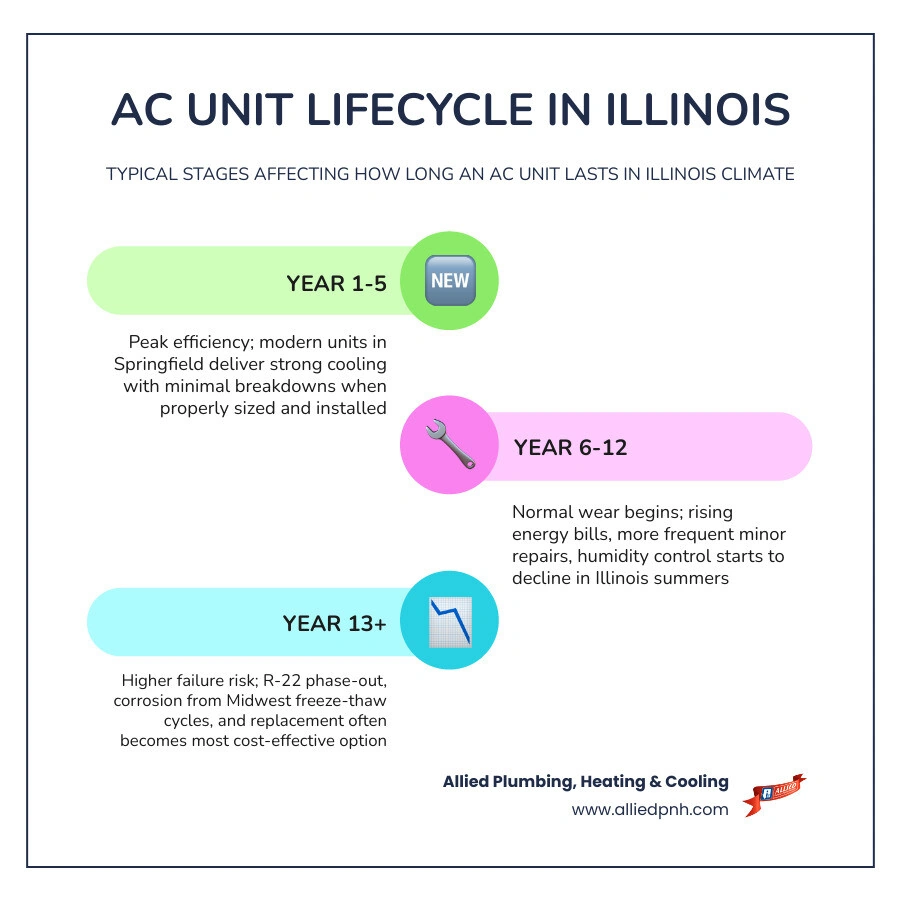
How Long Does an AC Unit Last in Illinois?
When we talk about the lifespan of an air conditioner in the Land of Lincoln, we have to look at the numbers through a local lens. While a manufacturer might tell you their unit is rated for 20 years, they are often thinking of "optimal conditions"—meaning a lab or a climate that doesn't swing from -10°F to 100°F like we do here.
In our experience serving the Springfield area since 1977, we’ve seen that how long does an AC unit last in Illinois depends heavily on the specific technology you’re using. Modern units are significantly more efficient than the ones installed 20 years ago, but they also contain more complex electronics that require steady hands to maintain.
If you are currently looking at a system that was installed back in 2010 or 2012, you are officially in the "yellow zone." It might be running fine today, but the efficiency is likely dropping by 5% to 10% every year. By the time a unit hits its 15th birthday in Illinois, it’s often running at half the efficiency it had on day one.
To help you plan, we’ve broken down the average lifespans by system type:
Average Lifespan Comparison Table
• Central Air Conditioning — Expected Lifespan: 12–17 Years — Best For: Standard homes with existing ductwork
• Air Source Heat Pumps — Expected Lifespan: 10–15 Years — Best For: Homes looking for all-electric heating/cooling
• Ductless Mini-Splits — Expected Lifespan: 15–20 Years — Best For: Room additions, garages, or older homes without ducts
• Geothermal Systems — Expected Lifespan: 20–25+ Years — Best For: Long-term homeowners wanting maximum efficiency
When it’s time to upgrade, How to Choose the Right AC System for Your Home becomes a critical resource. Choosing a system that matches your home’s specific footprint is the first step in ensuring it actually reaches that 17-year mark.
Factors Affecting System Longevity in Chatham
In Chatham, we often see a wide variety of home styles, from historic properties to brand-new builds. The "life expectancy" of your AC isn't just a number on a sticker; it's determined by how the system was treated from day one.
1. Installation QualityThis is the single most important factor. If a system is installed poorly—with leaky ducts, improper refrigerant levels, or shaky electrical connections—it’s going to work harder than it needs to. A "bad" installation can shave five years off the life of a unit before it even finishes its first summer.
2. Equipment SizingSize matters! If an AC unit is too large for your home, it will "short cycle," meaning it turns on and off rapidly. This puts immense strain on the compressor (the "heart" of the system). If it’s too small, it will run 24/7 trying to keep up, burning itself out prematurely. Understanding the difference between Single Stage vs Two Stage vs Variable Speed AC is vital here. Variable speed units often last longer because they can "cruise" at lower speeds rather than slamming on and off.
3. Usage PatternsDo you keep your thermostat at a steady 72°F all summer, or do you crank it down to 65°F the moment you get home from work? The harder you push the system, the faster the mechanical parts wear down.
How the Local Climate Affects How Long an AC Unit Lasts in Illinois
The Midwest is tough on machinery. In Springfield and Rochester, our AC units face a "double whammy" of environmental stressors.
• Humidity Levels: Illinois summers are famously "soupy." Your AC doesn't just cool the air; it removes moisture. When humidity is high, the evaporator coil has to work overtime to pull gallons of water out of the air. This constant moisture can lead to biological growth or corrosion on the coils if they aren't cleaned regularly.
• Freeze-Thaw Cycles: Even though your AC sits idle in the winter, the weather still affects it. The constant freezing and thawing of moisture around the outdoor unit can cause the metal casing to expand and contract, potentially loosening bolts or damaging the fins.
• Corrosive Elements and Road Salt: If you live near a main road in Rochester that gets heavily salted in the winter, that salt can become airborne as it dries. Salt is the enemy of aluminum and copper. Over time, it can eat away at the delicate fins on your outdoor condenser, reducing its ability to release heat.
Signs Your AC Unit Needs Replacement
Knowing how long does an AC unit last in Illinois is helpful, but your unit will usually tell you when it’s ready to retire. You just have to know how to listen.
Frequent Breakdowns
If you have our number on speed dial because your AC breaks down every other month, that’s a major red flag. One repair is a maintenance item; three repairs in two years is a pattern. We often tell homeowners to look for AC Repair Red Flags That Mean You Need a New System before they sink more money into a sinking ship.
Rising Energy Bills
Have you noticed your electric bill creeping up even though the utility rates haven't changed much? As AC units age, they become less efficient. They have to run longer and work harder to achieve the same cooling effect. If your bill is 20% higher than it was three summers ago, your unit is likely struggling.
The R-22 Refrigerant "Death Knell"
If your AC was built before 2010, there’s a good chance it uses R-22 refrigerant (often called Freon). The EPA officially banned the production and import of R-22 on January 1, 2020. While you can still have your unit serviced, the cost of "recycled" R-22 has skyrocketed. If your old unit has a refrigerant leak, the cost of the repair often approaches the cost of a down payment on a new, modern system.
Identifying When an AC Unit in Illinois Needs Replacement
Sometimes the signs aren't as obvious as a total breakdown. You might notice:
• Uneven Cooling: One bedroom is an ice box while the living room is a sauna. This often means the blower motor or the ductwork is failing to distribute air properly.
• Excessive Humidity: If your skin feels clammy indoors even when the AC is running, the system is no longer effectively dehumidifying.
• Unusual Noises: Grinding, squealing, or banging sounds usually indicate a failing motor or a loose belt.
• Poor Airflow: If you put your hand up to the vent and only feel a faint "ghost" of a breeze, your compressor or fan is on its last legs.
For a deeper dive into these symptoms, check out our guides on Signs It's Time for an AC Replacement and Signs Your Old AC Unit Needs Replacement.
When Repair Value No Longer Makes Sense
We use a simple rule of thumb called the $5,000 Rule.
Take the age of your equipment and multiply it by the estimated repair cost. If the total is more than $5,000, it’s usually time to replace. For example:
• A 12-year-old unit needing a $500 repair = $6,000 (Replace it!)
• An 8-year-old unit needing a $300 repair = $2,400 (Repair it!)
There is also the "50% Rule." If the cost of a single repair is more than 50% of the value of a new system, you are essentially throwing money away. We discuss this financial crossroads in detail here: When the Cost of AC Repair Exceeds the Value of Your System.
How to Extend the Life of Your Cooling System
Just because the average is 15 years doesn't mean you can't aim for 20. We’ve seen well-maintained units in Springfield reach two decades of service because the homeowners took care of the "little things."
The DIY Checklist
• Filter Changes: This is the #1 reason for AC failure. A dirty filter chokes the system, forcing the motor to work ten times harder. Change your filters every 1 to 3 months—especially if you have pets!
• Outdoor Unit Care: Keep your outdoor condenser clear. Weeds, tall grass, and "stuff" stored against the unit block airflow. Give it at least two feet of breathing room on all sides.
• Ductwork Integrity: Leaky ducts can waste 30% of your cooled air before it ever reaches your rooms. Having your ducts inspected and sealed can take a massive load off your AC unit.
Professional Maintenance and How Long an AC Unit Lasts in Illinois
While DIY care is great, there are things only a pro can do. We recommend a professional tune-up every spring. During these visits, we focus on:
1. Refrigerant Levels: Too much or too little refrigerant will kill a compressor.
2. Electrical Inspections: We tighten connections and check for frayed wires that could cause a fire or a short circuit.
3. Lubricating Moving Parts: Friction is the enemy of longevity. We make sure everything spins smoothly.
4. Coil Cleaning: We use specialized cleaners to remove the "Illinois grime" from your evaporator and condenser coils.
To stay on track, keep our Summer AC Maintenance Checklist for Homeowners handy. Regular AC Maintenance for Year-Round Comfort is the best insurance policy you can buy for your HVAC system.
Benefits of Upgrading to a Modern System
If you find that your unit is at the end of its life, don't despair. Modern technology has made massive leaps.
• Energy Savings: New units often use 30% to 50% less energy than units from the early 2000s.
• Smart Integration: Modern systems play nice with smart thermostats, allowing you to control your home’s climate from your phone and receive alerts before a problem becomes a crisis.
• Improved Air Quality: Modern filtration and humidity control make the air in your Springfield home cleaner and more breathable.
If you're ready to see what's available, look into Air Conditioning Springfield IL to explore high-efficiency options that fit our local climate.
Frequently Asked Questions about AC Longevity
Can an AC unit last 20 years in Rochester?
It is possible, but it's rare. To reach 20 years in Rochester, a unit needs a "perfect life": professional installation, annual maintenance without fail, monthly filter changes, and a bit of luck with the components. Usually, by year 20, even if the unit is "running," it is so inefficient that you are paying for a new unit anyway through your monthly electric bills.
Why do AC units fail faster in humid climates?
Humidity forces the system to run longer cycles to remove moisture. This increases the "on-time" of the compressor. Furthermore, the constant condensation on the indoor evaporator coil can lead to "pitting" corrosion if the coil isn't kept clean, eventually leading to refrigerant leaks.
Is it worth repairing a 15-year-old AC unit?
Generally, no. At 15 years, most units are at the end of their mechanical life. Even if you fix one part (like a fan motor), the compressor or the coils are likely to fail shortly after. It’s often better to put that repair money toward a new system with a fresh warranty.
Conclusion
At Allied Plumbing, Heating & Cooling, we understand that your home is your sanctuary. As a 3-generation family business serving Springfield, Rochester, and Chatham since 1977, we’ve seen every type of AC failure imaginable. We don't just want to sell you a box; we want to ensure you have lasting comfort.
That’s why we are proud to offer the Daikin Comfort Promise. When you choose us for your AC Installation Springfield IL, you aren't just getting a new unit; you're getting peace of mind with industry-leading 12-year warranties. We are here 24/7 to make sure your family stays cool, no matter how high the Illinois humidity climbs.
Don't wait for your AC to give up the ghost in the middle of a July heatwave. Whether you need a quick tune-up to extend your current unit's life or a full replacement, contact us for Expert Air Conditioning Services. We’ll help you make the best decision for your home, your budget, and your long-term comfort.