What Our Technicians Look for During a Heat Exchanger Crack Inspection
What Our Technicians Look for During a Heat Exchanger Crack Inspection
The Hidden Danger Lurking in Aging Furnaces This Fall
Your heating system might sound perfectly normal as it cycles on to beat the autumn chill, but behind that metal cabinet, you may have a hidden structural failure. If you are wondering exactly what our technicians at Allied Plumbing Heating & Cooling look for during a heat exchanger crack inspection, the answer involves tracking down microscopic, invisible threats before they have the chance to leak carbon monoxide into your living space. The heat exchanger is the single most critical safety barrier in your entire HVAC system. It is responsible for keeping toxic combustion gases completely separated from the clean, breathable air that gets pushed through your home's vents.
As the September pre-heating season arrives, our team frequently speaks with homeowners who mistakenly believe their furnace is ready for winter simply because it turns on. However, aging furnaces are prone to developing invisible micro-fractures along their internal metal curves. Because carbon monoxide is a colorless and odorless gas, these tiny stress fractures present a massive safety hazard that goes completely unnoticed by the naked eye. The decision point for homeowners is understanding the vast difference between a basic visual check you might do yourself and a comprehensive professional safety inspection designed to find these hidden flaws.
Why Heat Exchangers Crack: The Science of Metal Fatigue
The root cause of a failing heat exchanger almost always comes down to metal fatigue. Every time your thermostat calls for heat, the burners ignite and rapidly heat the metal heat exchanger. As the steel absorbs this intense heat, it physically expands. Once the heating cycle finishes and the burners shut off, the metal cools down and contracts back to its original size. This constant cycle of thermal expansion and contraction happens thousands of times per year.
In our many years of keeping Springfield, IL homes warm through harsh, sub-zero winters, we've seen firsthand how furnaces are forced to cycle continuously to keep homes comfortable. A pattern we see often is that this heavy, relentless workload drastically accelerates metal fatigue compared to systems operating in milder climates. Over years of this repetitive stress, the metal eventually loses its structural integrity, similar to bending a metal paperclip back and forth until it finally snaps.
The Role of Thermal Expansion
The physics of metal stress: Metal fundamentally changes shape under extreme temperature swings. Over a span of 10 to 15 years, the structural integrity of the steel diminishes. The areas that take the brunt of this stress are the tight curves, dimples, and bends in the heat exchanger's design. This is where the microscopic stress fractures first begin to form, long before they are visible to the naked eye.
Airflow Issues and Overheating
How neglected maintenance compounds the problem: While age and continuous winter operation cause natural wear and tear, restricted airflow severely accelerates the cracking process. When a furnace has a dirty air filter, blocked return vents, or a failing blower motor, the system cannot move enough cool air over the heat exchanger to keep its temperature regulated. The metal retains too much heat, expanding far beyond its intended design limits. Consistent filter changes are your first line of defense against this extreme overheating, but once the metal is compromised, the damage cannot be reversed.
Why the 'Flashlight Test' Fails to Protect Your Home
A pattern we see often in our local service calls is the misconception that a quick glance into the furnace cabinet with a flashlight is enough to declare the heating system safe for the winter. This basic "flashlight test" is fundamentally flawed and fails to protect your home from the real dangers of a cracked heat exchanger. The physical reality of metal fatigue means that these micro-fractures are incredibly deceptive.
When the furnace is turned off and the metal is cold, the steel contracts. This contraction tightly closes the hairline cracks, making them virtually invisible to a technician just peering in with a flashlight. The danger only reveals itself when the furnace heats up. As the metal expands during a heating cycle, those tiny hairline fractures open up wide enough to allow dangerous combustion gases to escape into the supply airstream. Because carbon monoxide cannot be seen or smelled, a visual-only check simply cannot confirm that the air in your home is safe to breathe.
In our experience, routine, thorough check-ups are the only way to catch these issues early. For example, during semi-annual clean and checks, one local homeowner had a minor gas leak detected in their new furnace during a follow-up check. The technician performed the routine follow-up check-ups after installation and identified the leak early, preventing potential safety issues from escalating. This level of thoroughness is exactly why a quick visual sweep is never enough.
Step 1: Specialized Camera Inspections for Hidden Curves
Because we regularly encounter hidden damage in older systems, our team utilizes advanced diagnostic equipment to find cracks that the naked eye cannot see. Allied's rigorous training and investment in advanced diagnostic cameras mean our technicians go far beyond standard visual checks to guarantee your family's safety. We pull back the curtain on the inspection process to show you exactly what is happening inside your system.
Here is how our specialized camera inspection works:
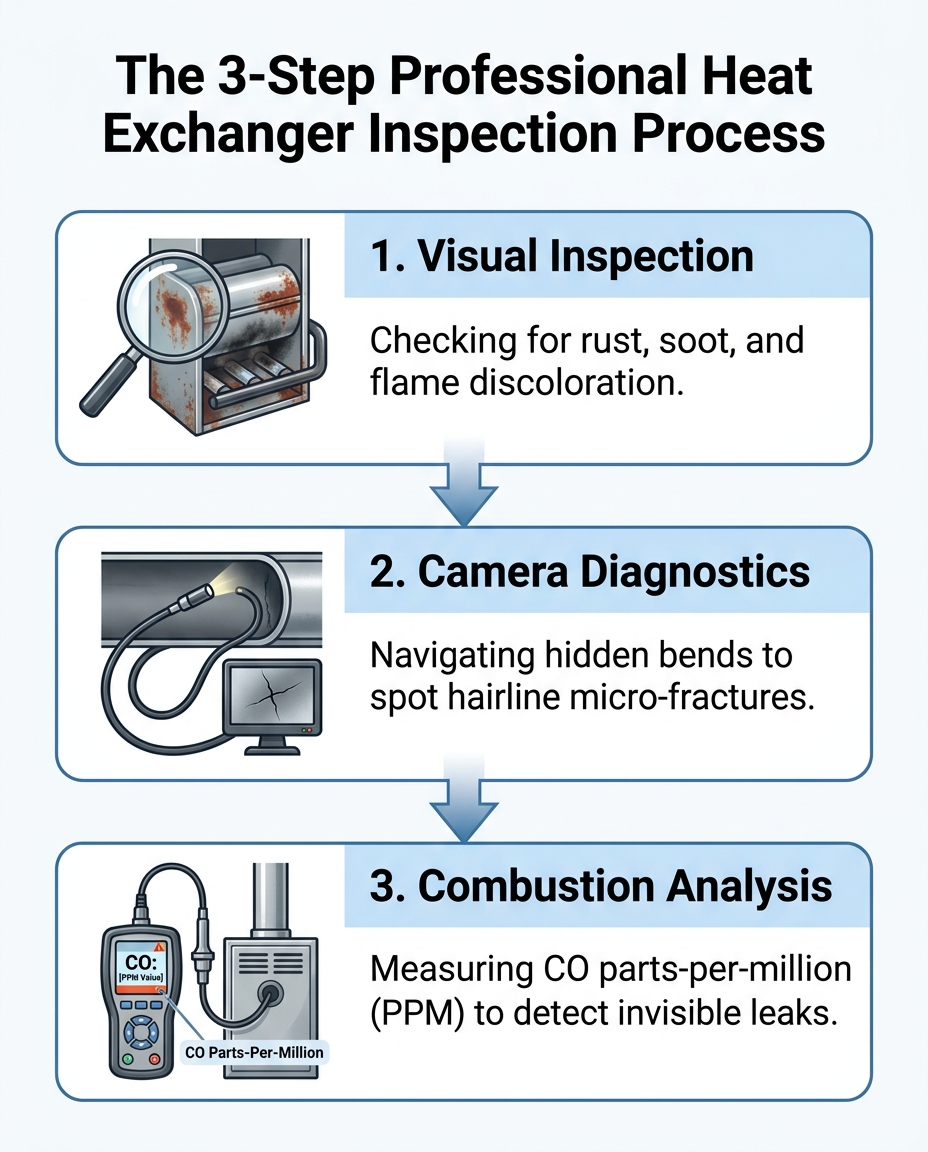
1. Deploying the Borescope: Technicians use flexible, high-resolution inspection cameras, known as borescopes, designed specifically for HVAC diagnostics. These tiny cameras are fed directly into the heat exchanger cells.
2. Navigating the Serpentine Bends: The flexible camera snakes through the complex, serpentine bends of the heat exchanger. These tight curves are where thermal stress is the highest and where cracks most commonly originate.
3. Hunting for Visual Evidence: The high-definition screen allows the technician to look for specific warning signs of metal failure. We look for rust trails, soot buildup outside the combustion chamber, and hairline stress marks that indicate a crack is forming.
4. Comprehensive Coverage: This technology allows our technicians to inspect the entire internal surface area of the component without having to physically dismantle the entire furnace, providing a highly accurate assessment of the metal's condition.
Step 2: Combustion Analysis and Detecting Invisible Threats
While a high-resolution camera is excellent for spotting structural damage, the most definitive way to prove whether a heat exchanger is actively leaking is through live performance testing. This brings us to the critical, highly technical step of measuring the exact gas levels in your home's airflow.
The combustion analyzer is the definitive tool for testing heat exchanger integrity under live operating conditions. This highly sensitive diagnostic tool measures the exact combustion analysis CO parts-per-million (PPM) in the supply airstream while the furnace is running. Understanding why regular furnace maintenance matters means understanding the value of this precise, data-driven diagnostic approach over the guesswork of outdated testing methods.
The live testing process follows a strict protocol:
• Establishing a Baseline: The technician inserts the analyzer probe into the supply ductwork before the blower fan turns on, establishing a baseline reading of the air currently in your home.
• Engaging the Blower: The furnace burners are ignited, and the blower fan engages, pushing air over the outside of the heat exchanger.
• Monitoring the Data: If the heat exchanger has a micro-fracture, the pressure from the blower fan will alter the burner flame, and combustion gases will be forced into the clean airstream.
• Identifying the Breach: A sudden spike in oxygen levels or an increase in the combustion analysis CO parts-per-million (PPM) reading on the analyzer is a scientifically proven indicator of a structural breach.
The 3-Step Professional Heat Exchanger Inspection Process
What Happens If We Find a Cracked Heat Exchanger?
When our technicians at Allied Plumbing Heating & Cooling discover a cracked heat exchanger, it is a serious situation, but we provide clear, reassuring guidance to help you navigate the next steps without panic. The immediate safety protocol is non-negotiable: a cracked heat exchanger cannot be patched, welded, or temporarily repaired. Because it deals with deadly carbon monoxide, the furnace must be safely shut down and disabled to protect your family.
Once the system is secured, we evaluate the furnace's age and warranty status to determine the most cost-effective path forward. Professional technicians will walk you through all the data, camera footage, and visual evidence so you can make an informed decision about your home's heating future.
Generally, homeowners have two viable solutions when facing this failure, and evaluating your options for furnace installation in Chatham or surrounding areas becomes a priority. We typically recommend replacing the entire unit over just the assembly for much older systems because it prevents chaining part failures down the line:
• Replacing the Heat Exchanger Assembly — Best Suited For: Newer furnaces (under 10 years old) where the heat exchanger part is still fully covered by the manufacturer's warranty. — Long-Term Outcome: Restores the current furnace to safe operating condition, though labor costs for the complex installation still apply.
• Replacing the Entire Furnace — Best Suited For: Aging furnaces (12+ years old) that are out of warranty, inefficient, and likely to experience other major component failures soon. — Long-Term Outcome: Provides a brand-new warranty, significantly higher energy efficiency, and total peace of mind for the next decade. (Note: Generic federal tax credits or utility rebates may also apply to qualifying high-efficiency installations; check with your utility provider).
The Value of Proactive Fall Inspections Before the Freeze
Timing is everything when it comes to furnace safety. Discovering a failing heat exchanger during the September pre-heating season is vastly preferable to dealing with a sudden breakdown in the middle of a January blizzard. Scheduling your comprehensive inspection early ensures that you have ample time to order replacement parts or plan for a new system installation without the immense stress of a freezing home.
We frequently hear from Springfield homeowners who routinely schedule their furnace and air conditioner servicing, noting that pre-seasonal checks provide prompt, courteous, and qualified service. Finding these maintenance checks to be well worth the investment, they were able to verify their system's safety long before the severe cold arrived. Thorough, professional maintenance is an investment in safety and reliability, not just a seasonal chore.
When you wait until the furnace fails completely, you are often forced into rushed decisions. If you suspect an issue mid-winter, you will need emergency furnace service to restore heat safely. By taking care of this during the September pre-heating season, you gain the peace of mind that comes from knowing your heating system has been scientifically verified as safe for the entire winter.
Ensure Your Home's Safety with a Professional Diagnostics Check
The hidden dangers of heat exchanger micro-fractures are simply too severe to leave to chance or a basic flashlight check. Carbon monoxide leaks require advanced technology to detect accurately, and your family's safety depends on a heating system that is structurally sound.
Do not wait until the first freezing night to find out if your aging furnace is compromised. We encourage you to schedule a comprehensive inspection today. By relying on a clear, behind-the-scenes look at the professional tools—like specialized cameras and combustion analyzers—used to guarantee your furnace is safe to operate all winter, you can prove the true value of a professional inspection over a basic DIY check. Contact our local team today to secure your peace of mind before the winter weather arrives.
Frequently Asked Questions
How do technicians test for a cracked heat exchanger?
Technicians use a combination of advanced diagnostic tools rather than just relying on their eyesight. They deploy high-resolution inspection cameras (borescopes) to navigate the hidden curves of the metal to look for hairline fractures and rust. Additionally, they use combustion analyzers to measure the exact gas levels in the airflow, detecting invisible leaks while the furnace is actively running.
Can a cracked heat exchanger leak carbon monoxide?
Yes, a cracked heat exchanger is the primary way carbon monoxide enters a home's living space. When the furnace heats up, the metal expands, causing microscopic stress fractures to open up. These open cracks allow toxic combustion gases to escape the sealed combustion chamber and mix with the clean air being blown through your ductwork.
What happens if my heat exchanger is cracked?
If a crack is discovered, the furnace must be immediately shut down and disabled for your safety. A cracked heat exchanger cannot be safely patched or repaired, meaning you will need to replace the component. Depending on the age and warranty status of your system, it is often more practical to replace the entire furnace.
Can a cracked heat exchanger be repaired?
No, a cracked heat exchanger cannot be welded, taped, or temporarily patched. Because it acts as the only barrier preventing deadly carbon monoxide from entering your home, industry safety standards dictate that the entire heat exchanger assembly must be replaced. Attempting to repair the crack is a severe safety hazard that will inevitably fail.
How much carbon monoxide does a cracked heat exchanger leak?
The amount of carbon monoxide leaked depends entirely on the size of the crack and the airflow dynamics of the specific furnace. Even microscopic hairline fractures can elevate CO levels in a home to unsafe concentrations over time. Professional technicians use combustion analyzers to measure these exact parts-per-million (PPM) readings to definitively identify a breach.
Why can't I just inspect my furnace's heat exchanger myself?
Inspecting a heat exchanger requires specialized training and expensive diagnostic equipment that homeowners do not possess. A basic visual check with a flashlight will miss cracks that close up when the metal is cold. Without a combustion analyzer and a flexible borescope camera, it is impossible to guarantee that the system is structurally sound and safe to operate.
What Our Technicians Look for During a Heat Exchanger Crack Inspection
September 30, 2026
Your aging furnace needs more than a quick visual check this fall. See how our high-tech diagnostic tools uncover hidden micro-fractures before they leak.
Your aging furnace needs more than a quick visual check this fall. See how our high-tech diagnostic tools uncover hidden micro-fractures before they leak.
Using a Ductless Mini-Split to Heat a Sunroom Addition Through an Illinois Winter
September 29, 2026
Glass-heavy sunrooms lose heat rapidly during freezing winters. A dedicated mini-split offers independent zone control to keep your addition warm without overtaxing your home's main furnace.
Glass-heavy sunrooms lose heat rapidly during freezing winters. A dedicated mini-split offers independent zone control to keep your addition warm without overtaxing your home's main furnace.
Checking Your Water Softener's Salt Bridge Before the Heavy Winter Usage Season
September 28, 2026
Summer humidity can fuse your softener salt into a solid dome, making the tank look full while your home suffers from hard water. We explain how to safely break a hidden salt bridge this fall.
Summer humidity can fuse your softener salt into a solid dome, making the tank look full while your home suffers from hard water. We explain how to safely break a hidden salt bridge this fall.