Checking Your Water Softener's Salt Bridge Before the Heavy Winter Usage Season
Checking Your Water Softener's Salt Bridge Before the Heavy Winter Usage Season
The Late Summer Illusion: Why Your Softener Tank Looks Full But Fails
As September ushers in cooler temperatures across the Midwest, checking your water softener's salt bridge before the heavy winter usage season should be at the top of your home maintenance checklist. Here at Allied Plumbing Heating & Cooling, we frequently hear from homeowners who step into their basements to begin fall preparations, expecting to simply top off the brine tank. A quick glance inside shows the salt level right near the brim. Everything looks perfectly normal, yet your shower feels completely different, and your dishes are coming out of the dishwasher covered in a chalky white film. This frustrating scenario is a classic seasonal illusion that our team sees year after year.
If you are already dealing with persistent hard water issues that standard troubleshooting cannot resolve, reaching out to our team for professional plumbing services is a reliable way to get your home's water quality back on track. However, before assuming your entire system has failed, it is crucial to understand what might be hiding just beneath the surface of that seemingly full tank.
The "aha" moment for many homeowners during the late summer / early fall transition is discovering that their brine tank is not actually full of usable salt. Instead, a solid, impenetrable dome of hardened salt has formed across the width of the tank. This crust creates a false floor. The salt you see on top is completely isolated from the water below, meaning your system is going through its motions without the essential sodium required to soften your water.
Diagnosing this issue safely and promptly is vital. As the colder months approach, indoor water usage typically spikes. Holiday cooking, hosting guests, and taking longer, hotter showers all demand a steady, reliable supply of soft water. Entering the winter season with a malfunctioning water softener guarantees scale buildup in your water heater and plumbing fixtures right when you rely on them the most.
• Salt level appears high and unchanging for weeks. — What Is Actually Happening: A hard crust is suspending the top layer of salt above the water. — The Result in Your Home: Unsoftened, mineral-heavy water entering your plumbing.
• System sounds like it is regenerating normally. — What Is Actually Happening: The control valve is cycling plain water over the resin beads. — The Result in Your Home: Scale buildup accelerates in your water heater.
• No error codes or flashing lights on the display. — What Is Actually Happening: The mechanical components are working, but the chemical process is starved. — The Result in Your Home: Soap fails to lather; skin feels excessively dry.
What Exactly is a Salt Bridge in a Brine Tank?
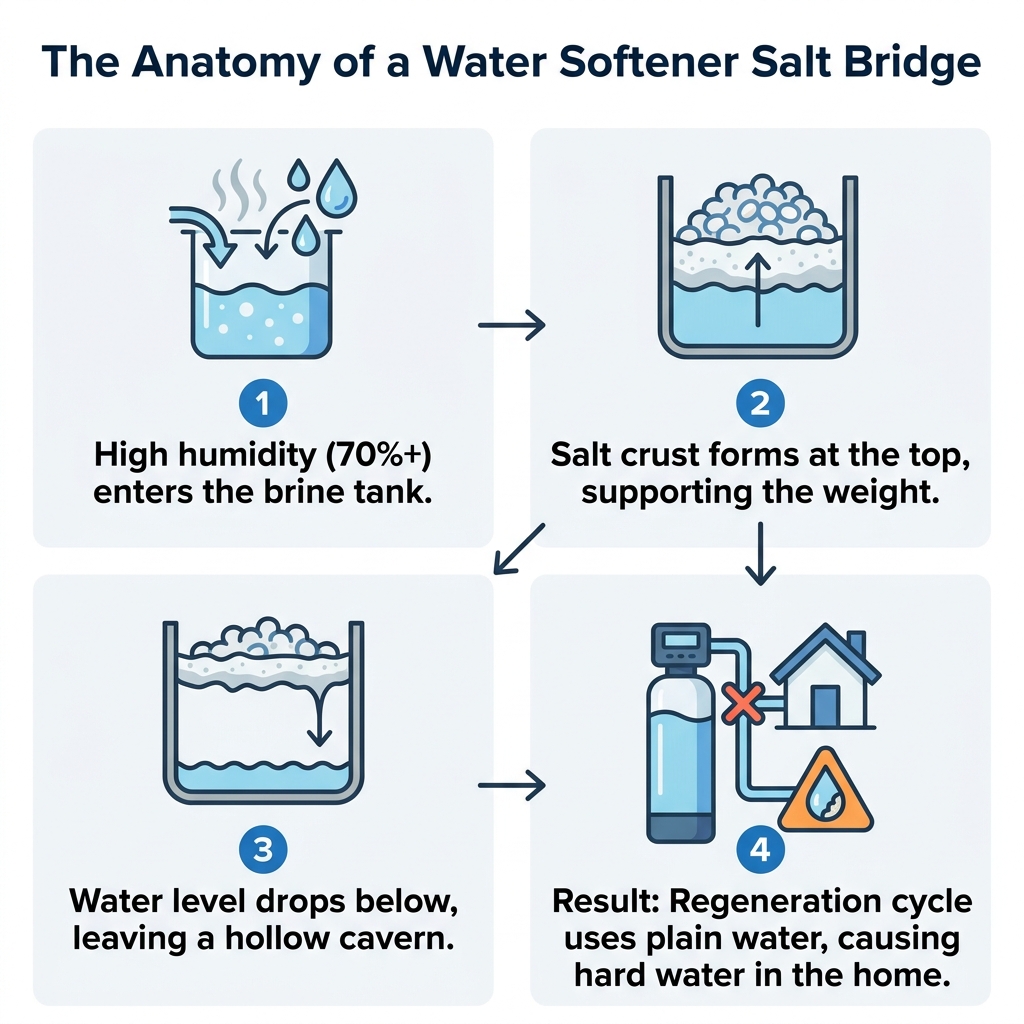
To understand why this happens, you have to look at the mechanics of how your system operates. A salt bridge is a hard, solidified crust of salt that forms horizontally across the inside of the brine tank. Under normal conditions, salt pellets rest at the bottom of the tank and slowly dissolve into the water, creating a heavy brine solution. This brine is what the system uses to clean the resin beads that actively remove calcium and magnesium from your household water.
When a bridge forms, it creates a total mechanical failure of this process. The crust physically prevents the loose salt resting on top from falling downward. Because the salt cannot reach the water, the water cannot become brine. Your system, unaware of the physical blockage in the adjacent tank, continues to run its scheduled regeneration cycles. It flushes the resin tank with plain, un-salted water, which does absolutely nothing to recharge the beads.
The immediate consequence is that your home is supplied with completely unsoftened water. As our plumbers at Allied Plumbing Heating & Cooling know well, if you live in Springfield IL, the local groundwater is notoriously heavy in minerals. Without a functioning softener, those minerals immediately begin attacking your fixtures and appliances. If clearing the physical blockage does not restore your water quality, scheduling professional plumbing maintenance with our crew is the necessary next step to ensure the control valve or resin bed hasn't suffered secondary damage.
The Hidden Hollow Space
The structural integrity of a salt bridge is surprisingly strong. As the crust forms and thickens, it anchors itself to the sides of the brine tank, easily supporting the weight of forty to eighty pounds of loose salt poured on top of it.
Beneath this crust, the system continues to draw water out during its regeneration cycles. Over time, the water level drops significantly below the hardened bridge, creating a large cavern of empty space. This is why a quick visual glance from the top is so deceiving. You are looking at the "roof" of the cavern, assuming it goes all the way to the floor. Until you physically test the depth, the hidden hollow space remains completely undetectable to the naked eye.
The Anatomy of a Water Softener Salt Bridge
How Lingering Midwestern Humidity Triggers the Crust
Salt bridges do not form randomly; they are the direct result of environmental conditions interacting with the salt in your tank. The primary catalyst for salt clumping and bridging is high humidity—specifically, ambient moisture levels consistently rising above 70 percent. Salt is highly hygroscopic, meaning it actively attracts and absorbs water molecules from the surrounding air.
During the late summer / early fall transition, September often features lingering high humidity. While the days might be getting shorter, the air holds onto significant moisture. When this warm, damp air seeps into a cool basement or garage where the water softener is located, condensation occurs inside the brine tank. The salt pellets absorb this airborne moisture, begin to sweat, and then fuse together as the temperatures fluctuate.
This climate-specific phenomenon explains why salt bridges are so common right before the heating season begins. Springfield's humid late summers specifically cause the salt to clump and crust over before the dry winter season hits. Once winter arrives and the furnace runs constantly, the ambient air in the basement becomes incredibly dry, which halts the formation of new bridges. But by then, the late-summer damage is already done.
Over our years of serving the community, the Allied Plumbing Heating & Cooling team has found that managing hard water in Sangamon County requires consistent, uninterrupted softener performance. The local water supply is rich in dissolved limestone, calcium, and magnesium. Because the transition into fall creates the perfect storm for humidity-induced salt bridges, checking your tank during this specific seasonal window is vital to protecting your home's plumbing infrastructure before the cold sets in.
Symptoms Your Home Has a Hidden Salt Bridge
Because a salt bridge hides in plain sight, you usually have to rely on secondary symptoms to confirm your suspicions. When the ion exchange process fails, the hard water returns to your taps almost immediately. If you live in Springfield IL, the signs of untreated groundwater will make themselves known within a few days of the bridge forming.
Watch for these distinct indicators that your water softener tank is full but not using salt:
• Noticeable drop in soap lathering: Hard water minerals react negatively with the fatty acids in soap. Instead of creating a rich, bubbly lather in the shower or sink, the soap creates a sticky, ineffective scum. You will find yourself using twice as much shampoo just to get your hair clean.
• Chalky spots on glassware: When unsoftened water evaporates in your dishwasher, it leaves behind the calcium and magnesium it was carrying. If your glasses and dishes are suddenly emerging with stubborn, cloudy white spots, your softener is likely bypassing its duties.
• Dry, itchy skin: As the weather cools down, skin naturally dries out. However, bathing in hard water accelerates this drastically. The mineral residue left on your skin clogs pores and strips away natural oils, making dry, itchy skin much more prominent during the fall transition.
• Stagnant salt levels: Under normal operation, a family of four will typically see their salt level drop noticeably over a month. If you check your tank and the salt line hasn't moved an inch in several weeks despite normal household water usage, a crust is almost certainly suspending the salt in place.
Catching these symptoms early prevents the hard water from causing more severe, long-term damage to your water heater's heating elements and your washing machine's internal components.
Safely Checking for and Breaking the Salt Crust
If you suspect a salt bridge based on the symptoms above, confirming and resolving the issue is a straightforward process. You do not need specialized tools, but you do need to exercise caution to avoid damaging the equipment. We always tell our customers that this is a safe, high-level maintenance task that any homeowner can perform during the late summer / early fall transition without attempting complex mechanical repairs.
1. Turn off the power or bypass the system: Before opening the tank or probing the salt, unplug the water softener from the wall outlet. Alternatively, turn the bypass valve on the plumbing lines to isolate the unit. This ensures safety and prevents the system from initiating a regeneration cycle while you are working.
2. Select a long, blunt object: A standard wooden broom handle, a mop handle, or a piece of PVC pipe works perfectly. The goal is to use something sturdy but smooth.
3. Gently probe the surface: Press the blunt end of your tool into the top layer of the salt. Feel for hard resistance an inch or two below the surface. If you encounter a solid layer that refuses to yield, apply slightly more downward pressure. If the tool suddenly breaks through and drops several inches into empty space, you have successfully located the hollow cavern.
4. Carefully chip away at the crust: Work your way around the edges of the tank, using gentle, controlled downward taps to break the crust into pieces. As you break the bridge, the loose salt resting on top will finally cascade down into the water below.
5. Scoop out large, hardened chunks: If the crust breaks into massive, solid boulders, do not force them down to the bottom. Use a plastic scoop or a small bucket to remove these oversized hardened chunks from the tank, as they will struggle to dissolve properly and could cause secondary blockages.
What Not to Do
While breaking a salt bridge is simple, aggressive tactics can lead to expensive mistakes. Never use sharp objects like ice picks, screwdrivers, or heavy metal crowbars. The brine tank is made of heavy-duty plastic or fiberglass, but striking the side walls with a sharp metal tool can easily puncture or crack the housing, requiring a complete tank replacement.
Furthermore, do not attempt to disassemble the control valve or the pressurized resin tank. As licensed professionals, we must warn that if breaking the salt bridge and initiating a manual regeneration cycle does not restore your soft water, the issue is mechanical. Leave internal valve repairs, resin bed replacements, and motor diagnostics to our experienced plumbing team.
Preventing Salt Bridges Before Winter Arrives
Once you have cleared the blockage and restored your soft water, the goal is to keep the system running flawlessly through the colder months. Proactive maintenance is the best defense against a recurring water softener salt crust. By adjusting your habits during the humid transition months, you can prevent the issue entirely.
• Keep the brine tank only half full: The most effective way to prevent bridging in September and October is to reduce the volume of salt in the tank. Keeping the tank only half full reduces the total weight pressing down and limits the amount of salt exposed to the humid air. You will need to refill it slightly more often, but the salt will flow freely.
• Invest in high-quality evaporated salt pellets: Not all salt is created equal. Rock salt contains high levels of dirt and insoluble impurities that encourage clumping. Solar salt is better, but it can still bridge. High-purity evaporated salt pellets are tightly compacted and specifically designed to resist moisture absorption and clumping, making them the best choice for humid environments.
• Manage the ambient humidity: Ensure the area around the water softener is well-ventilated. If your basement is excessively damp during the early fall, running a dehumidifier near the utility area will pull the moisture out of the air before the salt can absorb it.
• Schedule an inspection if problems persist: If you clear a bridge, use high-quality salt, and still find yourself dealing with hard water symptoms, the problem may lie deeper within the system. The control valve injector could be clogged, or the resin bed may be depleted.
When DIY troubleshooting reaches its limit, leaning on our local, family-owned expertise makes all the difference. Professionals who understand Sangamon County's specific hard water challenges know exactly how crucial reliable softening is before winter sets in. Having trusted Springfield area plumbers inspect the system ensures that your home is fully prepared for the heavy usage season ahead.
• Evaporated Pellets — Purity Level: 99.9% Purity — Risk of Bridging: Very Low — Best Use Case: Ideal for high-humidity basements and preventing crusts.
• Solar Salt Crystals — Purity Level: 99.6% Purity — Risk of Bridging: Moderate — Best Use Case: Good general use, but requires monitoring in early fall.
• Rock Salt — Purity Level: 98.0% Purity — Risk of Bridging: High — Best Use Case: Prone to clumping and leaving dirty residue; not recommended.
Frequently Asked Questions
Why is my water softener full of salt but my water is hard? This usually indicates that a salt bridge has formed inside the brine tank. A solid crust of salt creates a false floor, preventing the salt on top from dropping into the water below. Because the water cannot absorb the salt to create brine, the system regenerates with plain water, leaving your home with hard water despite the tank looking full.
What causes a salt bridge in a water softener? High ambient humidity is the primary cause of a salt bridge. When moisture levels in the air exceed 70 percent—common during the late summer and early fall—the salt absorbs the moisture, clumps together, and hardens into a solid dome. Using low-quality rock salt or overfilling the tank also significantly increases the chances of a bridge forming.
How do I get rid of a salt bridge in my water softener? You can safely remove a salt bridge by gently poking the crust with a long, blunt object like a wooden broom handle. Once you feel the hard resistance, carefully tap downward to break the crust apart, allowing the loose salt to fall into the water. Always avoid using sharp metal tools that could puncture the sides of the plastic or fiberglass tank.
How often should you check your water softener salt level? You should check your water softener's salt level at least once a month. During highly humid transition months like September, it is wise to check it every two weeks to ensure a crust isn't forming. Keeping a regular eye on the tank helps you catch bridging early before hard water damages your appliances.
Can a salt bridge permanently damage my water softener system? The salt bridge itself will not permanently damage the brine tank if it is removed carefully. However, allowing the system to run for months without functioning soft water will cause severe scale buildup inside the resin tank, the control valve, and your home's water heater. Promptly clearing the bridge protects the lifespan of your entire plumbing system.
Restoring Your Soft Water for the Season Ahead
Discovering that a hidden salt bridge is the culprit behind your hard water provides a satisfying "aha" moment, especially when you realize it is an easy fix rather than a catastrophic failure. By taking a few minutes to check the tank with a broom handle and adjusting your salt levels for the humid transition weather, you can protect your plumbing from scale buildup. Don't let a simple crust of salt ruin your home's water quality. If you have cleared the tank but your water still feels harsh, schedule your professional inspection with Allied Plumbing Heating & Cooling today to ensure your system is fully prepared before the winter chill sets in.
Checking Your Water Softener's Salt Bridge Before the Heavy Winter Usage Season
September 28, 2026
Summer humidity can fuse your softener salt into a solid dome, making the tank look full while your home suffers from hard water. We explain how to safely break a hidden salt bridge this fall.
Summer humidity can fuse your softener salt into a solid dome, making the tank look full while your home suffers from hard water. We explain how to safely break a hidden salt bridge this fall.
Why Adding a Whole-Home Humidifier Prevents Dry Skin and Warped Hardwood Floors in Winter
September 25, 2026
Gas furnaces strip natural moisture from your home, causing painful static shocks and shrinking woodwork. Adding a bypass humidifier this fall proactively counteracts severe winter dryness.
Gas furnaces strip natural moisture from your home, causing painful static shocks and shrinking woodwork. Adding a bypass humidifier this fall proactively counteracts severe winter dryness.
Hyper-Heating Technology: How Modern Mini-Splits Produce Heat Even at Negative 13 Degrees
September 24, 2026
Don't let outdated myths leave you freezing this winter. We break down the exact inverter technology that allows ductless systems to reliably heat your home in sub-zero temperatures.
Don't let outdated myths leave you freezing this winter. We break down the exact inverter technology that allows ductless systems to reliably heat your home in sub-zero temperatures.