Using a Ductless Mini-Split to Heat a Sunroom Addition Through an Illinois Winter
Using a Ductless Mini-Split to Heat a Sunroom Addition Through an Illinois Winter
The Challenge of Keeping a Glass-Heavy Room Warm When Temperatures Drop
Using a ductless mini-split to heat a sunroom addition through an Illinois winter is the most reliable way to keep your glass-heavy rooms comfortable when temperatures plummet. At Allied Plumbing Heating & Cooling, we frequently see homeowners invest significant time and energy into creating a beautiful new space, only to find that the moment the first hard freeze hits, the room becomes too cold to use. That strange, persistent chill isn't just uncomfortable; it severely limits how you use your home for nearly half the year.
If you are evaluating different heating systems for your home, understanding how to properly condition an addition is the first step toward lasting comfort.
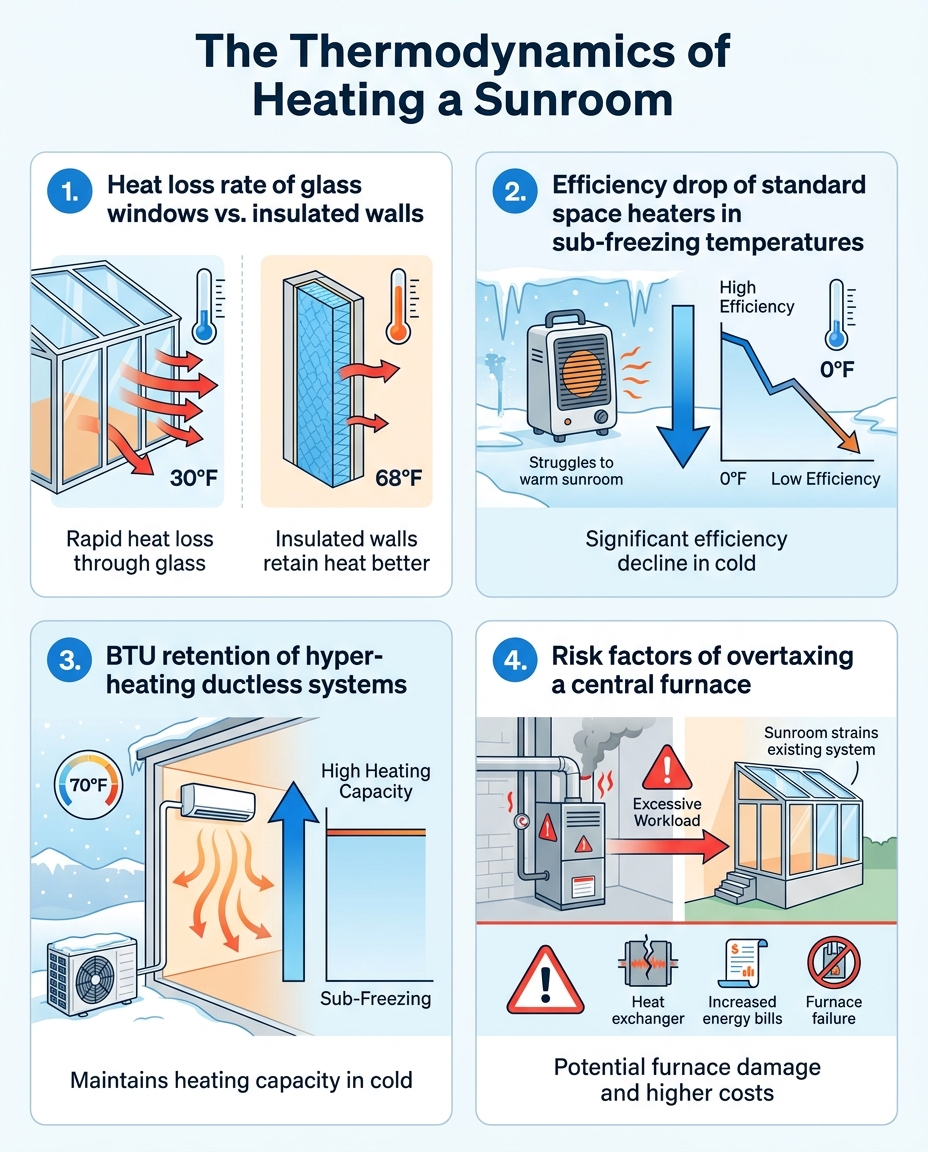
The core issue lies in the basic thermodynamics of your home. Standard double-pane windows, even high-quality ones, lose heat at a significantly faster rate than insulated walls. While a standard wall might have an R-value (a measure of thermal resistance) of 13 to 21, standard windows often sit around an R-value of 2. This massive difference means that the freezing Springfield winters quickly penetrate standard double-pane sunroom windows, pulling the warmth right out of the room.
This dynamic creates a frustrating decision point for many homeowners. You want to add reliable, consistent heat to the space, but you want to do it without relying on unsafe, temporary space heaters or tearing up your existing walls to run new ductwork. Planning your September early-fall prep strategy is the best way to address this dilemma. By evaluating your heating options before the severe cold arrives, you prevent a mid-winter scramble for comfort and ensure your beautiful addition remains a functional part of your home year-round.
Why Extending Central Ductwork to a Sunroom is a Costly Mistake
When looking for a permanent heating solution, a pattern we see often in our Springfield service calls is the instinct to simply tie the new room into the existing central HVAC system. However, for glass-heavy spaces, our team strongly advises against this because it is almost always a costly mistake. Your central furnace was carefully sized based on the original square footage, layout, and insulation values of your main house. It was never designed to handle the extreme heat loss of a sunroom.
Tying a glass-heavy addition into the central system throws off the thermal balance of your entire home. Because the sunroom loses heat so rapidly, the thermostat—usually located in a well-insulated interior hallway—never gets an accurate read on how cold the addition actually is. If you move the thermostat to the sunroom, the furnace will run continuously to keep the glass room warm, effectively roasting your main living room in the process. Relying on local Springfield HVAC expertise to perform precise load calculations protects your main furnace from this dangerous imbalance.
If you are looking for professional heating services, it is critical to consult experts who understand the unique demands of Springfield IL home additions.
The Risk of Overworking Your Primary Furnace
Forcing an existing furnace to push air into a poorly insulated space places severe, often fatal, strain on the blower motor and heat exchanger. The system is forced to run far past its intended duty cycle.
• Continuous runtime: When the furnace never shuts off, the blower motor overheats, leading to premature wear and tear on critical mechanical components.
• Higher utility bills: You pay significantly more in energy costs, yet see very little comfort improvement in the actual addition.
• Emergency breakdowns: The harder a furnace works, the more likely it is to fail completely.
One Springfield homeowner experienced a total furnace failure on a bitter 20-degree night after trying to heat a sunroom this way. Our Allied technicians were dispatched to the freezing house, thoroughly explained the underlying problem—which often traces back to an overworked system—and quickly turned a bad situation around by restoring heat. Protecting your primary equipment by keeping it separate from your sunroom is the best way to avoid these late-night emergencies.
The Thermodynamics of Heating a Sunroom
The Inefficiency and Safety Risks of Space Heaters
Realizing that extending ductwork is a bad idea, we often see homeowners turn to the hardware store for a quick DIY alternative: portable space heaters. While a space heater might work perfectly fine for taking the chill out of a room on a mild 50-degree day, it completely fails when Springfield temperatures drop into the teens.
Standard electric space heaters operate on 120-volt household circuits, meaning they are universally limited in their BTU output. They simply cannot produce enough heat to outpace the rapid, continuous heat loss occurring through multiple large panes of glass. This results in "spot-heating," where the two feet directly in front of the heater are boiling hot, while the rest of the room remains freezing cold.
Beyond the lack of comfort, relying on portable heaters in Springfield IL home additions introduces serious safety and financial concerns.
• Fire safety hazards: Running high-draw portable heaters continuously places immense stress on your home's electrical wiring and outlets, significantly increasing the risk of an electrical fire.
• Tripped breakers: Because these units draw maximum amperage, running a vacuum or a television on the same circuit will frequently trip your breakers.
• Hidden electrical costs: Electric resistance heating is one of the most expensive ways to generate heat. Running multiple space heaters 24/7 causes a massive, hidden spike in your monthly utility costs.
Ultimately, a space heater is a temporary bandage for a permanent architectural challenge. To truly reclaim your sunroom, we recommend a solution designed specifically for the space.
How a Dedicated Ductless Mini-Split Solves the Sunroom Dilemma
The definitive technical solution for independent zone control in glass-heavy rooms is a dedicated ductless mini-split heat pump. Unlike central furnaces that rely on a sprawling network of ductwork, a mini-split delivers targeted BTU capacity directly into the space that needs it most.
A ductless system operates entirely independently from your home's central HVAC system. It consists of an outdoor compressor unit connected to a sleek indoor air handler via a small conduit. Because it doesn't share ductwork or a thermostat with the rest of the house, it provides true independent zone control. You can keep your sunroom at a cozy 70 degrees while leaving your main house thermostat set to a cooler, energy-saving temperature.
Modern heat pump technology is incredibly efficient. Instead of burning fuel to create heat, the system extracts existing ambient heat from the outdoor air, compresses it to a higher temperature, and releases it inside. This process of heat transfer uses a fraction of the electricity required by traditional resistance space heaters. Additionally, homeowners have incredible aesthetic flexibility, choosing between wall-mounted, floor-mounted, or flush ceiling-cassette indoor air handlers to match their sunroom's design.
Hyper-Heating Technology for Sub-Zero Performance
Older heat pumps used to lose efficiency when temperatures approached freezing, but modern engineering has completely changed the landscape. If you want to understand how modern mini-splits produce heat even at negative 13 degrees, you have to look at hyper-heating inverter technology.
• Extreme cold performance: Hyper-heating models use advanced flash-injection compressors that thrive in extreme cold, maintaining 100% heating capacity even when the thermometer drops below zero.
• Uninterrupted comfort: This technology ensures your sunroom remains completely usable and comfortable, even during the harshest January freezes.
Year-Round Comfort: Transitioning from Winter Heat to Summer Cooling
One of the greatest advantages of installing a ductless mini-split heat pump is that it is not just a winter solution. The exact same system that keeps your sunroom toasty in December will reverse its operation to provide robust, high-efficiency cooling in July, maximizing your investment across every season.
Illinois is famous for its extreme temperature swings, moving rapidly from sub-zero winters to hot, humid, and sticky summers. Sunrooms face a unique challenge during the warmer months known as the "greenhouse effect." Sunlight pours through the large glass panes, trapping radiant heat inside the room and pushing temperatures well above the rest of the house. Dedicated cooling for this space is just as critical as dedicated heating.
During the summer, the mini-split acts as a powerful air conditioner, extracting the trapped heat from the sunroom and pumping it outside. If you ever need comprehensive air conditioning services, you will appreciate how effectively a ductless system handles heavy thermal loads. Furthermore, these systems offer incredible dehumidification benefits. Running the unit in "dry mode" pulls excess moisture out of the thick Midwestern summer air, preventing the room from feeling clammy and protecting your furniture from humidity damage.
Installation Timing: Why Early Fall is the Critical Prep Window
Knowing that a ductless system is the right choice is only half the battle; scheduling the installation at the right time is equally important. Waiting until the first major freeze hits is a frustrating experience because, as our dispatch team knows all too well, HVAC schedules book up rapidly once the cold weather arrives.
Executing your September early-fall prep is a strategy we always recommend at Allied Plumbing Heating & Cooling. Early fall offers the ideal weather for our technicians to perform non-rushed, precise installations. We can properly size the unit, run the necessary electrical conduit, and test the system's performance without battling snow, ice, or emergency no-heat calls from other customers.
Getting your system installed in early fall also provides incredible peace of mind. Sunrooms are fantastic spaces for hosting family gatherings and entertaining guests during the holiday season. Having the system fully tested, calibrated, and ready to go before Thanksgiving ensures that your extra square footage is warm, welcoming, and ready for guests exactly when you need it most.
Frequently Asked Questions About Heating Sunrooms
Can a mini split heat a sunroom in winter?
Yes, a ductless mini-split is highly effective at heating a sunroom during the winter. Modern systems utilize advanced inverter technology to extract heat from the outside air, even when temperatures drop well below freezing. Because they operate independently from your main central air system, they provide targeted warmth exactly where you need it. This ensures your glass-heavy addition stays comfortable without overheating the rest of your house.
How do you heat a 3 season room in the winter?
The most efficient way to heat a three-season room in the winter is by installing a dedicated ductless heat pump. While some homeowners try to use portable electric heaters, these units consume excessive electricity and pose significant fire hazards during continuous use. A permanent ductless system provides safe, consistent, and energy-efficient warmth. It also handles the rapid heat loss that occurs through large glass windows much better than alternative methods.
Why shouldn't I extend my ductwork to my sunroom?
Extending your existing ductwork into a sunroom throws off the thermal balance of your entire home. Your central furnace was specifically sized for the original square footage and insulation levels of your house. Forcing it to push air into a poorly insulated, glass-heavy addition places severe strain on the blower motor and heat exchanger. This often results in a freezing sunroom, an uncomfortably hot living room, and premature furnace breakdowns.
Is a mini split worth it for a sunroom?
Installing a mini-split is absolutely worth the investment if you want to use your sunroom year-round. It transforms a seasonal space into a comfortable, permanent part of your home, effectively increasing your usable living area. Beyond winter heating, these systems also provide powerful air conditioning and dehumidification during hot, humid summers. The energy savings over time compared to running inefficient space heaters makes it a smart long-term choice.
Can you put a mini split in an uninsulated room?
You can install a mini-split in an uninsulated room, but the system must be carefully sized to account for the rapid heat loss. An HVAC professional will perform a specific load calculation to determine the exact BTU requirement for the space. Because uninsulated walls and large windows offer very little thermal resistance, the unit will need a higher capacity than it would for a standard, well-insulated bedroom of the same size.
How many BTUs does a mini-split need for a glass-heavy room?
The exact BTU requirement for a glass-heavy room depends on the total square footage, ceiling height, and the specific thermal properties of the windows. A standard room might require 20 BTUs per square foot, but a sunroom with multiple exterior glass walls often requires significantly more to maintain a comfortable temperature. Relying on experts in Springfield IL home additions to perform a precise Manual J load calculation ensures you install a system that can handle severe winter weather without short-cycling.
Secure Your Winter Comfort with the Right Supplemental Heating Strategy
A dedicated ductless mini-split heat pump is the safest, most efficient, and most reliable way to enjoy a sunroom during a harsh Illinois winter. By bypassing your home's central ductwork, you protect your primary furnace from overworking while gaining precise, independent temperature control over your glass-heavy space.
Proper sizing and meticulous load calculations are paramount to ensuring the system performs flawlessly when the temperatures plummet. Do not let your beautiful addition sit empty and freezing for half the year. Schedule an expert evaluation with our team to determine the exact unit needed for your specific layout, and reclaim your sunroom so you can enjoy it comfortably, regardless of the weather outside.
Using a Ductless Mini-Split to Heat a Sunroom Addition Through an Illinois Winter
September 29, 2026
Glass-heavy sunrooms lose heat rapidly during freezing winters. A dedicated mini-split offers independent zone control to keep your addition warm without overtaxing your home's main furnace.
Glass-heavy sunrooms lose heat rapidly during freezing winters. A dedicated mini-split offers independent zone control to keep your addition warm without overtaxing your home's main furnace.
Checking Your Water Softener's Salt Bridge Before the Heavy Winter Usage Season
September 28, 2026
Summer humidity can fuse your softener salt into a solid dome, making the tank look full while your home suffers from hard water. We explain how to safely break a hidden salt bridge this fall.
Summer humidity can fuse your softener salt into a solid dome, making the tank look full while your home suffers from hard water. We explain how to safely break a hidden salt bridge this fall.
Why Adding a Whole-Home Humidifier Prevents Dry Skin and Warped Hardwood Floors in Winter
September 25, 2026
Gas furnaces strip natural moisture from your home, causing painful static shocks and shrinking woodwork. Adding a bypass humidifier this fall proactively counteracts severe winter dryness.
Gas furnaces strip natural moisture from your home, causing painful static shocks and shrinking woodwork. Adding a bypass humidifier this fall proactively counteracts severe winter dryness.