Why Cheap Pleated Filters from the Hardware Store Might Be Choking Your Blower Motor
Why Cheap Pleated Filters from the Hardware Store Might Be Choking Your Blower Motor
The Myth of the 'Better' Filter: Are You Accidentally Suffocating Your HVAC System?
Buying the highest-rated, most expensive air filter at the store seems like the responsible choice for your home, but there is a hidden catch. The truth about why cheap pleated filters from the hardware store might be choking your blower motor often surprises homeowners. You stand in the aisle, looking at packaging that promises to eliminate every microscopic particle, assuming that a higher "allergen rating" means a better environment for your family. However, for a standard residential system in Springfield IL, sliding one of these ultra-dense filters into a standard one-inch slot is often the equivalent of placing a piece of heavy cardboard directly over your return vent.
If you are already noticing poor airflow or weak cooling, reaching out for professional Air Conditioning support is the best first step.
The concrete problem boils down to restrictive airflow. When a filter is too dense, it forces the entire system to work significantly harder just to pull in enough air to function. This leads to poor cooling performance, uneven temperatures across your rooms, and severe mechanical strain on the equipment itself. The decision point for most homeowners comes down to balancing the desire for pristine indoor air quality with the strict manufacturer airflow requirements designed to keep standard equipment running safely.
Many homeowners do not realize that their HVAC system was engineered to move a very specific volume of air per minute. When you introduce a barrier that the system was never designed to overcome, the results are rarely better air quality. Instead, the outcome is usually a stressed system that struggles to keep you comfortable.
The Mechanics of Airflow: How High-MERV 1-Inch Pleated Retail Filters Restrict Your System
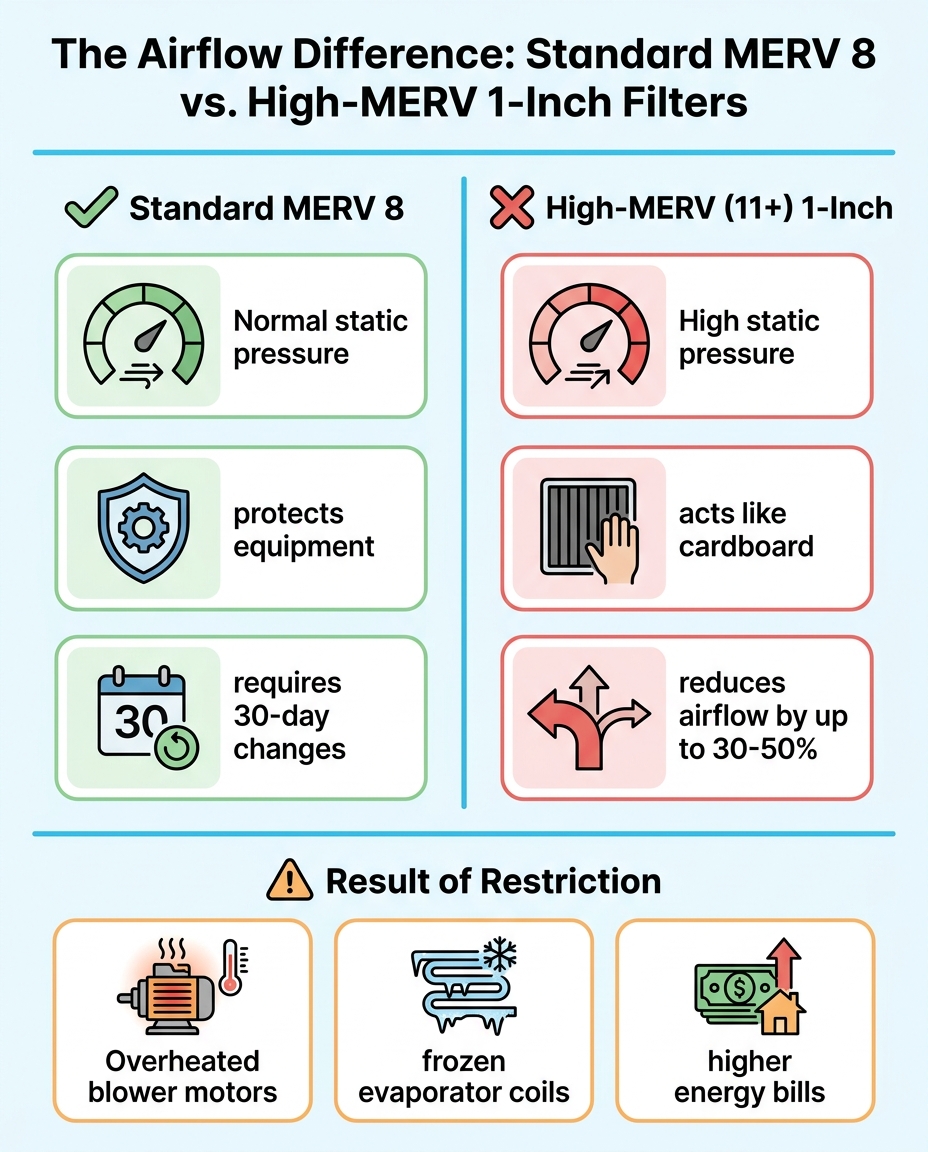
To understand why dense filters cause so much trouble, you have to look at the concept of static pressure. In simple terms, static pressure is the resistance the blower motor must overcome to circulate air throughout your home. Think of it like trying to breathe through a wide snorkel versus a tiny coffee stirrer. When you install high-MERV 1-inch pleated retail filters, you are essentially swapping the snorkel for the coffee stirrer.
These dense filters (typically rated MERV 11 or higher) significantly increase the pressure drop across the return duct. In many standard residential setups, this intense restriction can reduce overall airflow by 30 to 50 percent. When this happens, the blower motor reacts predictably: it strains.
For standard motors, the restriction causes them to run hotter and draw more electrical current as they fight against the dense filter media. The deep irony of this situation is that a blower motor working significantly harder actually moves substantially less air through the home. You end up paying higher utility bills for a system that delivers weaker airflow to your living spaces. If your system is already showing signs of strain, scheduling professional AC maintenance and repair can help diagnose the exact cause before a total breakdown occurs.
Understanding Static Pressure and Blower Strain
Every HVAC system is calibrated at the factory for a specific volume of airflow, usually measured in cubic feet per minute (CFM). The ductwork, the size of the unit, and the blower motor are all matched to work together in harmony.
• Baseline resistance: Adding a dense filter fundamentally changes the system's baseline resistance, throwing the entire calibration off balance.
• Motor compensation: Modern variable-speed motors will actually ramp up their RPMs to try and overcome the blockage, masking the problem while wearing themselves out internally.
• Premature wear: Prolonged strain leads to premature mechanical wear, degraded bearings, and eventually, a failed blower motor that requires professional replacement.
The Late-Summer Threat: Why Blowers Overheat and Evaporator Coils Freeze
The danger of restricted airflow compounds rapidly depending on the time of year and the weather outside. The cooling process inside your air conditioner relies on a delicate balance of temperature and airflow. The indoor evaporator coil gets extremely cold as refrigerant expands inside it. It relies on a constant, steady flow of warm indoor air blowing across its surface to absorb heat and prevent the natural condensation on the coil from freezing solid.
With Springfield's hot, humid August climate, your system demands maximum airflow to properly dehumidify the home. The humid air creates excessive condensation on the coil. When restrictive filters choke the airflow, that necessary warm air never reaches the coil. The coil drops below the freezing point, and the condensation rapidly turns into a layer of frost.
This creates a cascading timeline of failure, especially during late August peak cooling demand when the system is running in long, continuous cycles:
1. The initial freeze: Frost begins to form on the bottom of the evaporator coil because there is not enough warm air passing over it to keep the temperature above freezing.
2. The total blockage: As the system continues to run, the frost thickens into a solid block of ice. This ice acts as a secondary, impenetrable filter, completely blocking whatever little airflow was left.
3. The overheating motor: The blower motor, now trying to push air through both a dense filter and a solid block of ice, overheats and potentially trips its internal thermal overload switch.
4. The compressor risk: Outside, the compressor risks "liquid slugging"—a fatal condition where liquid refrigerant returns to the compressor instead of vapor, potentially destroying the most expensive component in your entire system.
Restricted airflow is consistently one of the leading causes of premature system failure, and it is almost entirely preventable.
Hardware Store Marketing vs. Real HVAC Specifications
There is a massive disconnect between what retail packaging claims and what HVAC professionals actually recommend for standard systems. When you walk down the filter aisle, you are bombarded with marketing terms like "maximum allergen removal," "premium micro-particle defense," and "hospital-grade filtration." These sound fantastic, but they completely ignore actual ASHRAE and Department of Energy airflow guidelines for residential equipment.
Historically, standard 1-inch filter slots were designed primarily to protect the equipment itself from large debris—like pet hair, dust bunnies, and carpet fibers—not to purify the air you breathe. The slot is simply too narrow to accommodate a filter that is both highly dense and highly breathable. To achieve high filtration in a 1-inch space, manufacturers have to pack the synthetic fibers incredibly tight, which inherently destroys airflow.
If you want to understand the best AC filter options for Illinois homes, you have to look past the marketing hype and focus on your system's actual static pressure limits. Upgrading to a MERV 11 or 13 in a standard 1-inch slot usually requires professional system modifications to handle the pressure drop safely.
• MERV Rating (11+) — Retail Marketing Claims: Catches microscopic allergens and bacteria. — HVAC Engineering Reality: Creates a massive pressure drop that chokes standard blowers.
• Thickness (1-Inch) — Retail Marketing Claims: Fits any standard return grille perfectly. — HVAC Engineering Reality: Lacks the surface area needed to support high-MERV density safely.
• Lifespan — Retail Marketing Claims: Lasts up to 90 days without replacement. — HVAC Engineering Reality: Often clogs in 30 days during peak usage, worsening restriction.
• Overall Goal — Retail Marketing Claims: Purify the home's indoor air quality. — HVAC Engineering Reality: Protect the indoor coil and blower motor from large debris.
The Airflow Difference: Standard MERV 8 vs. High-MERV 1-Inch Filters
Red Flags: Signs Your Blower Motor is Struggling to Breathe
Homeowners often miss the early warning signs of restricted airflow until the system shuts down completely. If you recently installed a dense retail filter, or if you are deep into the late August peak cooling demand, you need to know what a struggling system looks and sounds like. Catching these symptoms early can save you from a major mechanical failure.
Here are the primary red flags that your blower motor is suffocating:
• Constant running without cooling: The system runs continuously, but the house simply isn't reaching the temperature set on the thermostat.
• Weak supply airflow: When you place your hand over the supply registers in your rooms, the air barely trickles out instead of blowing forcefully.
• Unusual indoor noises: You hear a loud humming, a strained whining, or a surging sound coming directly from the indoor air handler or furnace cabinet.
• Visible ice buildup: You spot frost or solid ice forming on the indoor evaporator coil, or on the thick copper refrigerant line running to the outside unit.
• Filter distortion: When you check the return vent, the filter is visually bowing, bending, or getting sucked inward toward the blower motor due to the intense vacuum effect.
If you notice any of these signs, the immediate first step is to turn the system off completely to let any potential ice melt, and remove the restrictive filter.
Better Alternatives for Cleaner Air Without the Mechanical Strain
You do not have to choose between protecting your HVAC equipment and breathing clean air. There are safe, highly effective solutions for homeowners who want to improve their indoor environment without destroying their blower motor in the process. The key is understanding that true air quality improvements require a holistic approach, not just cramming a thicker high-MERV 1-inch pleated retail filter into a standard slot.
For standard 1-inch filter grilles, the safest route is to use standard MERV 8 filters. These provide excellent protection for the equipment while maintaining the necessary airflow. The tradeoff is that they need to be changed more frequently—every 30 days during peak usage—to prevent dust buildup from creating its own airflow restriction.
If you want serious filtration, the best mechanical upgrade is a 4-inch or 5-inch media filter cabinet. Installed directly into the ductwork by a professional, these deep-pleated cabinets offer high MERV ratings (often MERV 11 to 16) but with vastly more surface area. Because the filter is so deep, the air has much more room to pass through, maintaining proper airflow while capturing microscopic particles.
Additionally, exploring supplemental indoor air quality solutions like standalone HEPA air purifiers or whole-home active purification systems (such as UV lights or ionization units) allows you to clean the air actively without relying on choking the return duct.
Protecting Your Entire System Year-Round
Airflow restrictions are not just a summer problem. While frozen coils are the most common symptom in August, poor airflow impacts your system's health throughout the entire year. During the winter months, a choked blower motor causes the furnace's heat exchanger to overheat. When the heat exchanger gets too hot, it trips internal safety limits, causing the furnace to short-cycle and eventually leading to dangerous cracks in the metal.
A typical pattern we see often involves new homeowners scheduling heating and air conditioning checks after moving into a new property. For instance, when one of our technicians performed a reliable system evaluation for a Springfield IL customer we've provided great service to for decades, the very first thing checked was the static pressure and the filter setup. Ensuring the system can actually breathe is the foundation of HVAC longevity.
Routine checkups ensure that the static pressure remains within manufacturer limits and that the blower motor is drawing the correct electrical amperage. A professional can measure the actual pressure drop across your filter and recommend the exact MERV rating your specific ductwork can handle safely. Staying proactive with professional heating services and cooling maintenance ensures your equipment survives the extremes of every season.
Frequently Asked Questions
Can a pleated filter ruin my AC? Yes, an overly dense pleated filter can cause severe damage to your air conditioner. If the filter restricts airflow too much, it forces the blower motor to overwork and can cause the indoor evaporator coil to freeze solid, potentially damaging the compressor.
Why is my AC freezing up in the summer? Your AC freezes when there is not enough warm indoor air blowing across the cold evaporator coil. This lack of airflow is most commonly caused by a clogged or overly restrictive air filter, which traps the cold air inside the system until condensation turns to ice.
What MERV rating should I use for a 1-inch filter? For standard 1-inch filter slots, a MERV 8 rating is generally the safest maximum choice. This rating provides a good balance of catching common household dust and debris while allowing the blower motor to pull enough air to function efficiently.
Are cheap pleated air filters bad for HVAC? It depends on their density rather than just their price. Highly dense, cheap pleated filters that boast maximum allergen removal often act like a wall against airflow, which is terrible for your HVAC system's mechanical health and efficiency.
How often should I change a standard MERV 8 filter during peak summer usage? During peak cooling months when your system runs constantly, you should check and replace a standard 1-inch MERV 8 filter every 30 days. Waiting longer allows dust to build up, which slowly chokes the system and reduces cooling power.
Protecting your HVAC system means giving it the airflow it needs to survive the toughest weather. If you are tired of dealing with weak airflow, frozen coils, or a system that never seems to turn off, it is time to look past the hardware store aisle. Let our team help you find the right filtration balance so you can enjoy a comfortable, reliable home without the constant mechanical strain.
Hyper-Heating Technology: How Modern Mini-Splits Produce Heat Even at Negative 13 Degrees
September 24, 2026
Don't let outdated myths leave you freezing this winter. We break down the exact inverter technology that allows ductless systems to reliably heat your home in sub-zero temperatures.
Don't let outdated myths leave you freezing this winter. We break down the exact inverter technology that allows ductless systems to reliably heat your home in sub-zero temperatures.
Camera Inspections: Seeing Exactly What Tree Roots Did to Your Sewer Line Over the Summer
September 23, 2026
Tree roots aggressively infiltrate aging sewer lines during dry summers. A proactive early fall camera inspection catches this hidden damage before it causes catastrophic backups during holiday hosting.
Tree roots aggressively infiltrate aging sewer lines during dry summers. A proactive early fall camera inspection catches this hidden damage before it causes catastrophic backups during holiday hosting.
Why Leaving a Failing AC Unrepaired Over Winter Guarantees a Spring Replacement
September 22, 2026
Shutting off a struggling air conditioner for the winter doesn't stop the damage—it accelerates it. Unseen chemical reactions inside dormant lines turn minor leaks into total failures.
Shutting off a struggling air conditioner for the winter doesn't stop the damage—it accelerates it. Unseen chemical reactions inside dormant lines turn minor leaks into total failures.