Understanding the Role of the Circulator Pump in Your Hydronic Heating System
Understanding the Role of the Circulator Pump in Your Hydronic Heating System
The Frustration of a Firing Boiler but a Freezing Home
Understanding the Role of the Circulator Pump in Your Hydronic Heating System is essential when you flip the thermostat to "heat" during that first brisk September pre-heating season cold snap, only to hear the boiler rumble to life while your rooms stay freezing. The burners ignite, the metal warms, and everything sounds exactly as it should in the basement. But an hour later, your baseboards or cast-iron radiators are completely cold to the touch.
This is one of the most common and confusing scenarios homeowners face during the early fall in the Midwest. At Allied Plumbing Heating & Cooling, our team fields countless calls every September from Springfield residents who panic and assume their entire boiler has suffered a catastrophic failure. However, heat generation means absolutely nothing without heat distribution. If the boiler is hot but the rooms are cold, the issue is almost certainly a failure in the delivery mechanism.
If you are struggling to get your radiators warm, ensuring your heating systems are distributing water correctly is step one. To understand why your home isn't getting warm, you have to look past the flames and focus on the mechanical component responsible for moving that thermal energy from the basement to your living room: the circulator pump.
The Mechanical Heart: What a Circulator Pump Does in Your Hydronic System
To diagnose why your radiators are cold, you first need to understand the fundamental mechanics of a closed-loop hydronic system. In a forced-air furnace, a large blower motor pushes heated air through ductwork. In a boiler system, water acts as the thermal transfer fluid, and the circulator pump acts as the heart of the operation.
The circulator pump is a specialized, electrically powered water pump mounted directly to the piping near your boiler. Its sole responsibility is to move heated water out of the boiler's heat exchanger, push it through the network of pipes and radiators throughout your home, and pull the cooled water back into the boiler to be reheated. Because this is a "closed-loop" system, the water is never consumed or drained; the exact same water is continuously recirculated.
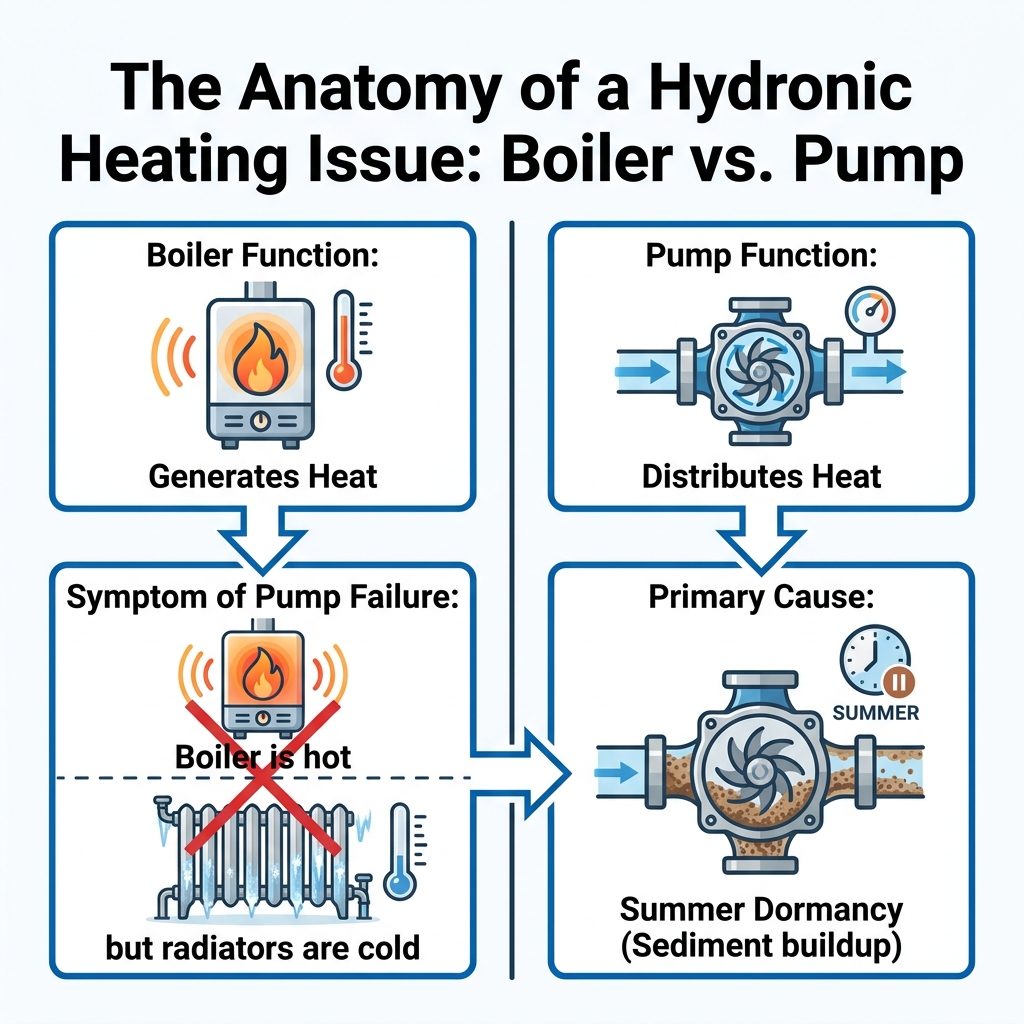
It is critical to differentiate the pump's job from the boiler's job. The boiler is the generator—it creates the heat. The pump is the distributor. If the generator works but the distributor fails, the thermal energy remains trapped in the basement.
Modern circulator pumps consist of three main components:
• The Electric Motor: The power source that spins the internal mechanisms, driven by the electrical call from your thermostat.
• The Impeller: A wheel with curved vanes inside the pump housing that physically moves the water.
• The Volute Casing: The outer metal shell that contains the water and channels it into the piping system under pressure.
How Centrifugal Force Moves Hot Water
Unlike a positive displacement pump that scoops and pushes water, a hydronic circulator pump relies entirely on centrifugal force. As the electric motor spins the impeller at high speeds, water is drawn into the center (the eye) of the impeller. The curved vanes then fling the water outward against the volute casing.
This rapid outward movement creates a pressure differential. The high pressure at the outer edge of the casing forces the hot water out into the supply pipes, while the resulting low pressure at the center of the impeller pulls new, cooler return water into the pump. This continuous centrifugal action creates the pressure needed to overcome the natural friction of the pipes and the gravitational weight of pushing water up to the second or third floor of a home. Without this consistent, pressurized flow, the water would simply sit stagnant in the boiler, eventually causing the system to overheat and shut down on a safety limit.
The Anatomy of a Hydronic Heating Issue: Boiler vs. Pump
The Summer Dormancy Trap: Why Pumps Seize Before Fall
If your boiler was working perfectly when you shut it down in May, why would the pump suddenly fail when you turn it back on in September? The answer lies in a phenomenon known in the HVAC industry as "summer dormancy." Months of total inactivity are actually harder on hydronic components than the daily wear and tear of winter operation.
In a closed-loop system, the water circulating through your pipes isn't pure. Over time, it collects microscopic particles of rust, dissolved minerals, and a dark, sludgy substance called magnetite, which is created when dissolved oxygen reacts with ferrous metals. During the winter, the pump runs frequently, keeping this debris suspended in the flowing water. But during the summer dormancy period, the water sits entirely stagnant for four to five months.
Older Springfield IL homes with traditional radiant heating systems and thick cast-iron pipes are particularly susceptible to this sediment buildup if the system hasn't been flushed recently. In our years of servicing these local systems, our technicians often see that as the water sits still, the heavy magnetite and mineral sludge slowly settle to the lowest points in the system—which often happens to be right inside the volute casing of the circulator pump.
This sludge packs tightly around the pump's impeller. When that first cold snap hits and your thermostat finally calls for heat, the boiler fires up and sends electrical voltage to the pump motor. The motor attempts to spin, but the impeller is physically locked in place by the hardened sediment. This is known as a "seized" pump. The motor hums, the boiler generates heat, but the water cannot move. Fortunately, isolating the issue to a seized pump means you likely only need targeted boiler repair for that specific component, rather than facing the massive expense of replacing the entire boiler unit.
Key Symptoms of a Failing or Seized Circulator Pump
Because hydronic systems are complex, a lack of heat can stem from multiple sources. It is important to accurately diagnose the specific signs that point to a pump issue rather than a generalized boiler failure or an airlock in the piping. If you suspect your pump is the culprit, look for these distinct symptoms:
1. The Hot Boiler / Cold Pipe Divide: The most definitive sign of a seized pump is a sharp temperature contrast. If you carefully place your hand near the boiler's outer jacket, it will feel hot. However, if you feel the supply pipe leading away from the pump toward the house, it will be room temperature or cold. The heat is trapped at the source.
2. Unusual Motor Noises: A healthy circulator pump operates with a very quiet, smooth hum. If the impeller is seized, you will likely hear a louder, strained buzzing or vibrating noise. This is the sound of the electrical motor receiving power and trying to turn against a locked shaft. Conversely, a loud grinding noise indicates the pump is running, but the internal bearings have shattered.
3. Casing Temperatures: If the motor is trying to turn a stuck impeller, it will draw excessive electrical current and generate its own heat. The outer casing of the pump motor may become dangerously hot to the touch, even if the pipes around it are cold.
4. Weeping Flanges: The pump is connected to the piping via bolted flanges with rubber or composite gaskets. If the pump is vibrating violently due to failing bearings, or if the system pressure spikes because the water isn't moving, these seals can fail, resulting in small puddles of water pooling directly beneath the pump.
Differentiating Common Hydronic Issues:
• Boiler hot, all radiators cold, pump humming loudly — Likely Cause: Seized Circulator Pump — System Area: Distribution
• Boiler cold, burners will not ignite at all — Likely Cause: Bad Thermocouple / Gas Valve / Igniter — System Area: Generation
• Bottom of radiator is hot, top is completely cold — Likely Cause: Air Trapped in the Lines — System Area: Radiator / Bleeder Valve
• Boiler keeps shutting off, pressure gauge reads zero — Likely Cause: Water Leak / Defective Fill Valve — System Area: Water Supply
If your symptoms align more with pressure drops than circulation failures, you may be dealing with low pressure issues in your home boiler system rather than a seized impeller.
The Dangers of DIY Troubleshooting on Hydronic Pumps
When faced with a cold house, it is tempting to search for quick fixes online. Many internet videos suggest manually unseizing a stuck pump by removing the silver bleed screw on the faceplate and forcing the internal shaft to turn with a flathead screwdriver. We strictly advise against attempting this or any other DIY repair on hydronic components.
The hazards of DIY pump repair are severe:
• Scalding Hazards: Hydronic systems operate with water heated to between 160°F and 180°F, held under 12 to 20 PSI of pressure. Loosening the wrong screw or cracking a brittle seal can release a jet of scalding water and pressurized steam, causing immediate and severe burns.
• Electrical Dangers: Circulator pumps are wired directly into your home's electrical system, typically drawing 120 volts. Water and live electricity are a lethal combination. Opening the pump casing without properly verifying that the breaker and internal relays are entirely de-energized poses a massive shock risk.
• Mechanical Destruction: Modern high-efficiency pumps often use delicate ceramic shafts rather than solid steel. Forcing a severely seized impeller with a screwdriver can instantly shatter the ceramic shaft or strip the motor's internal gearing. What might have been a simple professional unseizing procedure instantly becomes a requirement for a brand-new, expensive pump replacement.
• Warranty Voidance: Almost all boiler and pump manufacturers stipulate that opening the pump casing or breaking the factory seals by anyone other than a licensed professional will immediately void the equipment's warranty.
How Proactive Pre-Season Maintenance Prevents Sudden Failures
The best way to handle a seized circulator pump is to prevent it from happening in the first place. This requires shifting from a reactive mindset to a proactive one. Catching a struggling pump in early autumn prevents emergency no-heat situations in the dead of winter, when technicians are busiest and temperatures are dangerously low.
One local homeowner recently scheduled our Allied team for routine fall maintenance, and during these pre-seasonal checks, our technician caught a seizing pump before it failed completely. Because they received prompt, qualified service, their system was ready to go long before the deep freeze arrived. With our extensive experience performing prompt, qualified checks on traditional boiler systems in the Springfield area, we know exactly what to look for before a system fails.
During a professional fall tune-up, a qualified technician goes far beyond just turning the thermostat up to see if the boiler fires. To ensure the pump is healthy, a professional will:
• Measure Electrical Draw: Using a multimeter, the technician checks the amperage the pump motor is pulling. A motor that is pulling too many amps is straining against sediment or failing bearings, indicating it is nearing the end of its life.
• Acoustic Diagnostics: Professionals use specialized stethoscopes to listen to the internal bearings. A slight rattle that a homeowner might not notice can tell a technician that the bearings are worn and the pump is off-balance.
• Check System Valves and Pressure: The technician verifies that the expansion tank is properly pressurized, the pressure-reducing valve is feeding water correctly, and the isolation valves around the pump are functional.
• Bleed Air and Check Water Quality: Purging trapped air from the radiators ensures the pump doesn't have to fight against airlocks, and assessing the water quality helps determine if the system needs a chemical flush to remove the magnetite that causes summer seizing.
Routine, qualified servicing extends the life of the entire boiler system. If you want to ensure your hydronic loop is clear and your pump is ready for the workload, having a professional evaluate your system alongside your broader plumbing services and home maintenance is the most secure approach.
Frequently Asked Questions About Boiler Circulator Pumps
Why is my boiler running but radiators are cold?
This is the classic symptom of a seized or failed circulator pump. The boiler is successfully heating the water in the firebox, but the pump cannot push that thermal energy through the pipes to your radiators. The heat remains trapped in the basement, causing the boiler to eventually shut off on its high-limit safety switch while the rest of the house stays freezing.
What does a circulator pump do on a boiler?
It acts as the heart of a hydronic system, using an electrically driven impeller to push hot water from the boiler through the heating loop and pull cooler water back to be reheated. Without this centrifugal force, the heavy water cannot overcome pipe friction and gravity to reach the upper floors of your home.
How do you know if your circulator pump is seized?
Signs include a hot boiler with cold supply pipes, a low humming or buzzing noise from the pump motor trying to turn against a locked shaft, or the pump casing being unusually hot to the touch. You may also notice small puddles of water beneath the pump if the vibration has compromised the flange seals.
Can a boiler run without a circulator pump?
While older gravity-fed systems existed decades ago, modern hydronic boilers require a functional circulator pump to distribute heat safely. Without a working pump, the modern boiler will quickly overheat the stagnant water inside its heat exchanger, causing internal safety mechanisms to shut the entire system down to prevent boiling and pressure explosions.
How long does a boiler circulator pump last?
With proper water quality and routine professional maintenance, a high-quality circulator pump can last 10 to 15 years. However, heavy sediment buildup, poor water quality, and the effects of summer dormancy can drastically shorten this lifespan by causing the internal bearings to wear out prematurely or the impeller to seize.
Ensuring Reliable Heat for the Midwest Winter
Recognizing a pump issue early saves you the immense panic of assuming your entire boiler has failed during that critical September pre-heating season test. Understanding that heat generation and heat distribution are two separate mechanical processes allows you to accurately communicate the symptoms to a professional.
Because hydronic systems involve scalding water, high pressure, and live electricity, professional diagnostics are mandatory to safely unseize, repair, or replace the component. If your boiler is roaring to life but your radiators remain stubbornly cold, do not wait for the true winter freeze to arrive. Schedule a comprehensive system diagnostic today to ensure your home's mechanical heart is pumping strong all season long.
Understanding the Role of the Circulator Pump in Your Hydronic Heating System
September 17, 2026
You turn on your boiler for the first brisk fall cold snap, but the radiators stay freezing. Discover why a dormant circulator pump is usually the culprit.
You turn on your boiler for the first brisk fall cold snap, but the radiators stay freezing. Discover why a dormant circulator pump is usually the culprit.
Where to Place Carbon Monoxide Detectors Relative to Your Gas Furnace and Bedrooms
September 16, 2026
Finding the exact wall height and distance for a new CO alarm is a critical decision point. See the precise measurements needed to maximize early warning and prevent false alarms this fall.
Finding the exact wall height and distance for a new CO alarm is a critical decision point. See the precise measurements needed to maximize early warning and prevent false alarms this fall.
Upgrading to a High-Recovery Water Heater for Families with Overlapping Morning Showers
September 15, 2026
A bigger tank isn't always the answer to morning hot water shortages. We break down why recovery speed matters more than gallon capacity when back-to-back showers drain your system.
A bigger tank isn't always the answer to morning hot water shortages. We break down why recovery speed matters more than gallon capacity when back-to-back showers drain your system.