Upgrading to a High-Recovery Water Heater for Families with Overlapping Morning Showers
Upgrading to a High-Recovery Water Heater for Families with Overlapping Morning Showers
The Myth of the Bigger Tank: Solving the Morning Hot Water Shortage
Bigger is not always better when solving a household plumbing bottleneck. In our experience working with local homeowners, if you are researching upgrading to a high-recovery water heater for families with overlapping morning showers, you have likely encountered the common myth that simply buying a tank with a larger gallon capacity is the only solution. The reality is far more nuanced. When multiple family members need to get ready for work and school at the exact same time, a massive tank of hot water will still eventually run out if the system cannot reheat the incoming cold water fast enough.
Instead of focusing entirely on storage volume, homeowners need to look at recovery speed. The true metric that determines morning comfort is how quickly the burner can transfer heat to the water inside the tank. Choosing between a high-recovery vs standard atmospheric vent model often makes a much bigger difference in your daily routine than jumping from a 50-gallon to a 75-gallon tank. Upgrading your equipment requires a strategic approach to both plumbing services and overall system design. For reliable water heater installation and plumbing repair, understanding the mechanics behind these systems is the first step toward ending the frustration of cold morning showers.
Understanding First-Hour Rating (FHR) for Peak Demands
To truly understand why your hot water runs out during the morning rush, you need to look at the First-Hour Rating (FHR). This is the single most important metric on a water heater's Energy Guide label. The FHR measures the total number of gallons of hot water the heater can supply in one hour, starting with a fully heated tank. It combines the physical storage capacity of the tank with the unit's recovery rate.
The Math Behind the Morning Rush
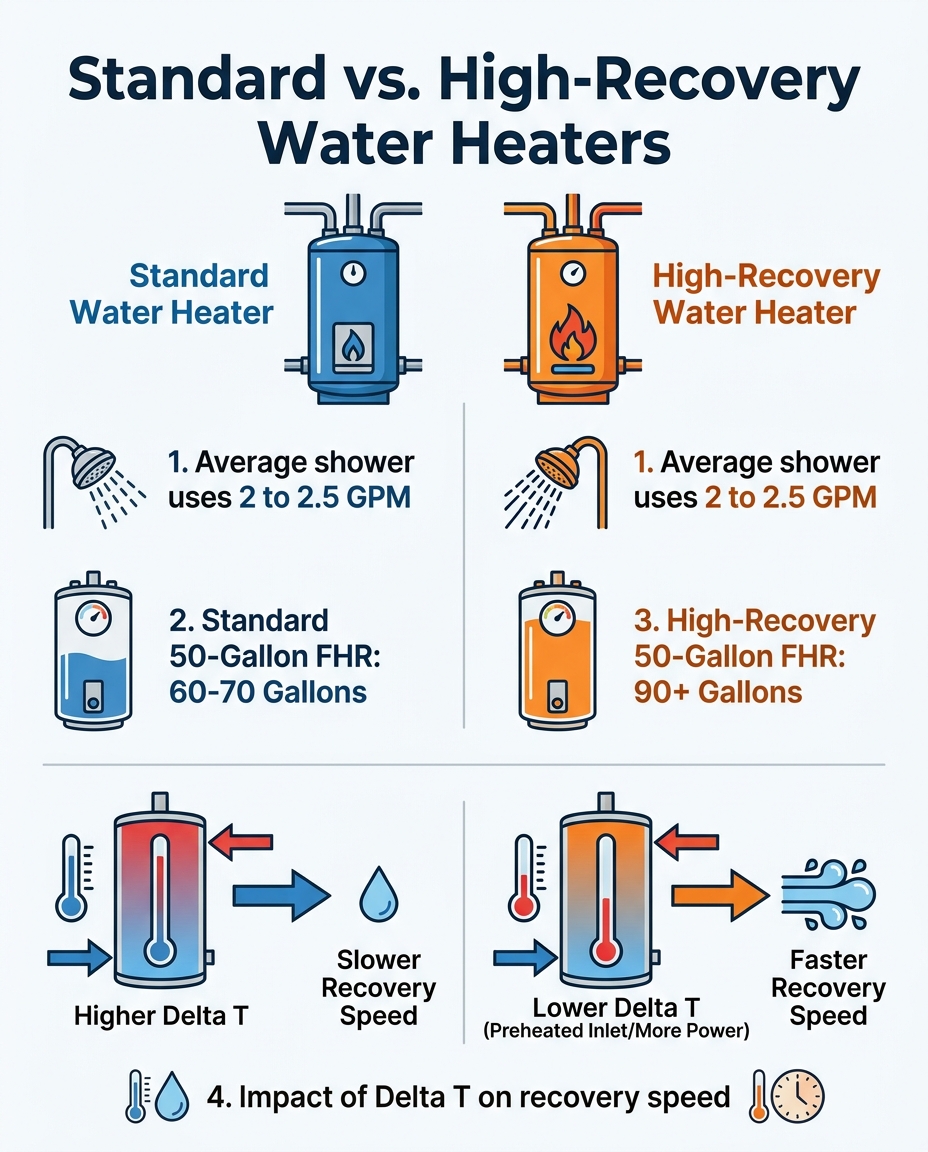
The average modern showerhead uses between 2 and 2.5 gallons of water per minute. If a family member takes a 10-minute shower, they are consuming up to 25 gallons of hot water. When you have two or three people taking back-to-back or overlapping showers in different bathrooms, the demand spikes dramatically. Within a 30-minute window, your household might demand 50 to 75 gallons of hot water.
Why Standard Tanks Fall Behind: A standard 50-gallon water heater typically has an FHR of about 60 to 70 gallons. If your family uses 60 gallons in the first 45 minutes of the morning, the tank is effectively depleted. The burner will kick on, but standard recovery rates are relatively slow. The last person to step into the shower will be met with lukewarm or entirely cold water.
How High-Recovery Models Keep Up: High-recovery water heaters are specifically engineered to bridge this gap. A high-recovery 50-gallon model can boast an FHR exceeding 90 gallons. Even though the physical tank size is exactly the same as the standard model, the enhanced recovery rate means the system is reheating water almost as fast as it is being drawn out. This allows the unit to sustain overlapping showers and heavy demand without requiring the massive physical footprint of an oversized 75-gallon or 80-gallon commercial-style tank.
The Role of BTU Input in Faster Water Heating
The secret behind a high-recovery water heater's impressive performance lies in its British Thermal Unit (BTU) input. BTUs measure the amount of energy required to heat one pound of water by one degree Fahrenheit. In the context of gas water heaters, the BTU rating tells you how much heat energy the gas burner at the bottom of the tank can generate.
How Burner Power Changes the Equation
Standard atmospheric vent water heaters are built for average, staggered household usage. A typical 50-gallon standard gas water heater might feature a burner with an input of 38,000 to 40,000 BTUs. This is perfectly adequate for a household where showers are spaced hours apart. However, when the tank is drained rapidly, a 40,000 BTU burner takes considerable time to bring 50 gallons of cold replacement water back up to the set temperature of 120 degrees.
High-recovery models utilize significantly more powerful gas burners. A high-recovery unit might feature an input of 50,000 BTUs or more. This increased thermal power allows for much faster heat transfer through the flue baffle and into the water.
• Faster turnaround: The higher BTU input means the tank spends significantly less time recovering between showers.
• Sustained delivery: Because the burner is pushing more heat into the water while the shower is currently running, the temperature drop inside the tank is less severe.
• Efficiency considerations: While a higher BTU burner consumes gas at a faster rate while it is firing, it often runs for shorter durations because it reaches the target temperature much quicker than a standard burner struggling to catch up.
How Incoming Water Temperatures Affect Recovery (Delta T)
Water heater performance is not static; it changes based on the environment and the season. To understand why overlapping morning showers become suddenly unbearable at certain times of the year, you must understand the concept of Delta T, or temperature rise.
Defining Delta T
Delta T is the difference between the temperature of the cold groundwater entering your house and the desired output temperature of your water heater (usually set around 120 degrees Fahrenheit). If the incoming water is 60 degrees, your water heater must achieve a Delta T of 60 degrees.
The Seasonal Impact on Your Water Heater
Local climate plays a massive role in this equation. Springfield IL winter groundwater temperatures can drop deep into the 40s. At Allied Plumbing Heating & Cooling, our team typically sees a spike in "no hot water" calls right as the early fall transition occurs and municipal water temperatures begin to plummet. If the incoming water drops to 45 degrees, your water heater now has to work much harder to achieve a Delta T of 75 degrees.
The compounding effect: Because the water is significantly colder, the burner must run much longer to heat it. This drastically slows down the recovery rate. A standard tank that barely kept up with your morning routine in July will completely fail to keep up by November. This seasonal shift is exactly why high-recovery models become essential for back-to-back showers during the colder months. The extra BTU power is necessary to overcome the severe temperature drop of the incoming winter groundwater.
Side-by-Side Comparison: Standard vs. High-Recovery Water Heaters
Evaluating your options means looking closely at the technical specifications of each system. The table below breaks down the core differences between a standard atmospheric vent model and a high-recovery unit to help clarify which system fits your household's daily routine.
• Average BTU Input — Standard Atmospheric Vent: 38,000 - 40,000 BTUs — High-Recovery Model: 50,000+ BTUs
• Recovery Speed — Standard Atmospheric Vent: Average (struggles with consecutive showers) — High-Recovery Model: Fast (reheats rapidly during continuous use)
• Ideal Household Routine — Standard Atmospheric Vent: Staggered showers, spaced out usage — High-Recovery Model: Overlapping morning showers, high simultaneous demand
• Venting Requirements — Standard Atmospheric Vent: Standard B-vent (natural draft) — High-Recovery Model: May require upsized venting or specific configurations due to higher BTUs
When comparing a high-recovery vs standard atmospheric vent unit, the defining factor is how you use your water. If your family routine involves a frantic morning rush where multiple bathrooms are in use simultaneously, the high-recovery model is engineered for exactly that scenario. For homeowners exploring even more advanced options to solve continuous demand, a tankless vs tank water heater comparison is often the next logical step in the research process.
Standard vs. High-Recovery Water Heaters
Why Professional Sizing and Installation Matter
Upgrading your water heating equipment is never a simple hardware swap. Moving to a higher BTU model requires a comprehensive evaluation of your home's existing plumbing and gas infrastructure. This is why professional sizing and installation are absolutely critical for safety, code compliance, and optimal performance.
Evaluating Infrastructure for Upgrades
Because high-recovery models utilize more powerful burners, they consume gas at a higher rate while firing. When our plumbers evaluate a home for a high-recovery upgrade, we always verify that your existing gas line diameter is sufficient to supply the required volume of fuel without starving other gas appliances in the home. Additionally, higher BTU outputs produce hotter exhaust gases. The existing venting system must be inspected to ensure it can safely draft the exhaust out of the home without backdrafting carbon monoxide into your living space.
Real Solutions for Local Homes
Accurately calculating a household's peak morning demand before selecting a unit prevents the frustration of under-sizing or the wasted energy of over-sizing. Our team recently worked with a Springfield homeowner who reached out when they needed a water heater replaced due to consistent morning shortages. A professional assessment by our technicians determined the precise sizing required for their daily routine, and the old unit was successfully replaced with a system capable of handling the load. As a local family-owned business, Allied Plumbing Heating & Cooling understands the daily routines and hot water demands of Springfield households, ensuring the right fit for every family across the Springfield service area. During an upgrade assessment, professionals can also inspect related mechanical systems ahead of colder weather, ensuring your entire home is prepared for the season.
Frequently Asked Questions About Water Heater Recovery
What does first hour rating mean on a water heater?
The First-Hour Rating (FHR) measures the total volume of hot water a fully heated tank can deliver in exactly one hour. It combines the physical capacity of the tank with the unit's recovery rate. A higher FHR means the unit can sustain heavier usage without running out of hot water.
Why does my hot water run out so fast in the morning?
Overlapping showers demand more gallons per minute than a standard tank's burner can reheat. As you drain hot water, incoming cold groundwater dilutes the remaining hot water, dropping the overall temperature inside the tank. If the burner cannot keep up with this dilution, the water turns cold quickly.
Is a 50-gallon water heater enough for a family of 4?
It depends entirely on the household's routine. In our experience, if all four family members shower consecutively in the morning, a standard 50-gallon tank will likely run out of hot water. However, a high-recovery 50-gallon model or a properly sized tankless unit is much better suited to handle those overlapping demands.
What is the difference between a standard and high-recovery water heater?
The primary difference is the power of the gas burner. High-recovery models feature higher BTU inputs, allowing them to transfer heat to the water much faster. This results in a significantly higher First-Hour Rating, even if the physical tank size remains exactly the same.
How can I increase the recovery rate of my current water heater?
Flushing sediment buildup from the bottom of the tank can slightly improve efficiency by removing the insulating layer between the burner and the water. However, the fundamental recovery rate is strictly limited by the unit's factory BTU input. For significant improvements in recovery speed, an equipment upgrade is usually required.
Secure Your Morning Comfort with a High-Recovery Upgrade
A clear, technical understanding of recovery rates empowers homeowners to choose the right solution for their daily routines. You do not have to endure cold morning showers or schedule your family's morning around a struggling plumbing system. By evaluating your equipment upgrade options before winter arrives, you can ensure consistent comfort. Reach out to discuss your options and explore our comprehensive heating services to keep your entire home comfortable year-round.
Upgrading to a High-Recovery Water Heater for Families with Overlapping Morning Showers
September 15, 2026
A bigger tank isn't always the answer to morning hot water shortages. We break down why recovery speed matters more than gallon capacity when back-to-back showers drain your system.
A bigger tank isn't always the answer to morning hot water shortages. We break down why recovery speed matters more than gallon capacity when back-to-back showers drain your system.
Diagnosing a Furnace Flame Sensor That Shuts the System Down After Three Seconds
September 15, 2026
Turning on your heat only to watch the burners die instantly is a frustrating fall surprise. We explain why this three-second safety lockout happens to protect your home.
Turning on your heat only to watch the burners die instantly is a frustrating fall surprise. We explain why this three-second safety lockout happens to protect your home.
Locating Drafty Areas in Your Basement That Threaten Exposed Water Lines
September 15, 2026
Early fall is the ideal time to find hidden air leaks around rim joists and basement windows. Map out structural vulnerabilities now to prevent frozen pipes in January.
Early fall is the ideal time to find hidden air leaks around rim joists and basement windows. Map out structural vulnerabilities now to prevent frozen pipes in January.