Why How Proper AC Installation Affects Long-Term Performance Starts With the First Day
Understanding how proper AC installation affects long-term performance can save Springfield homeowners years of frustration, high energy bills, and unexpected repair calls. The quality of your installation — not just the brand of equipment you buy — is what determines how well your system runs five, ten, or even twenty years from now.
Here's a quick look at how proper installation impacts your AC system long-term:
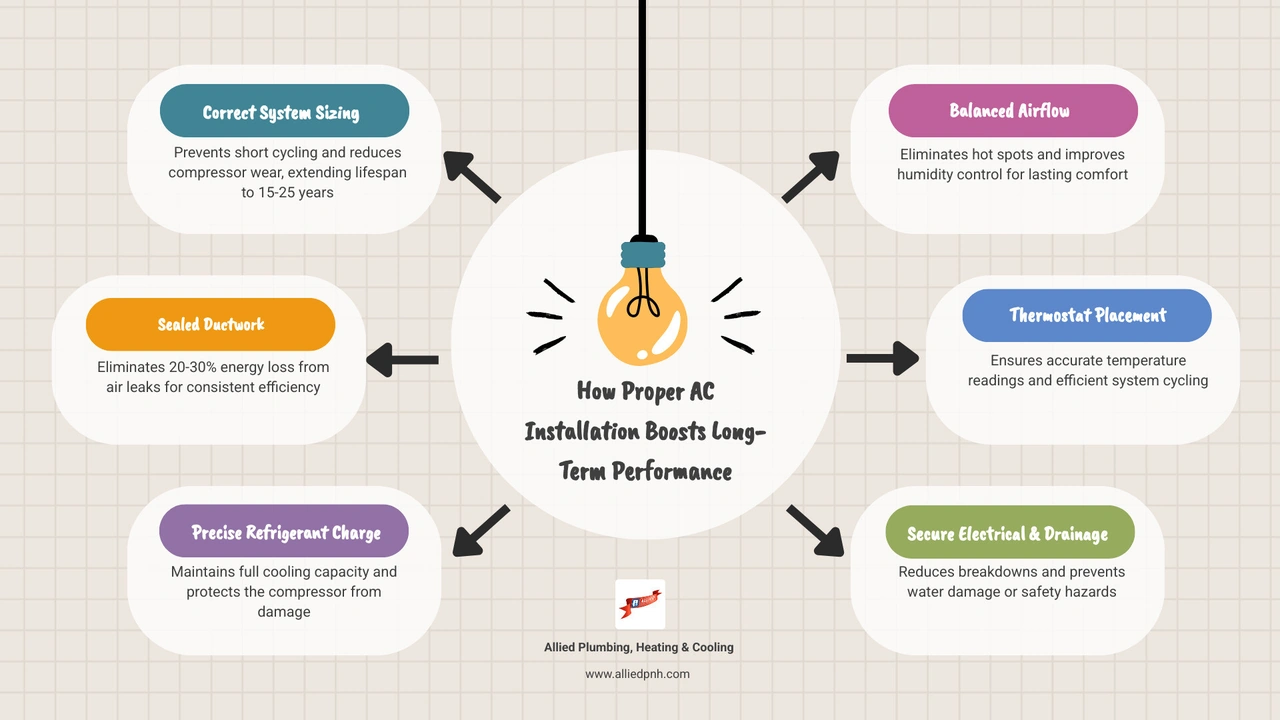
• Correct system sizing — Long-Term Impact: Prevents short cycling, reduces wear, extends lifespan to 15-25 years
• Sealed, properly designed ductwork — Long-Term Impact: Avoids 20-30% efficiency loss from air leaks
• Precise refrigerant charge — Long-Term Impact: Protects the compressor, maintains full cooling capacity
• Balanced airflow and thermostat placement — Long-Term Impact: Eliminates hot spots, improves humidity control
• Secure electrical connections and drainage — Long-Term Impact: Reduces breakdowns, prevents water damage and safety hazards
Most homeowners spend a lot of time comparing AC brands and efficiency ratings before buying a new system. That makes sense. But what often gets overlooked is this: even a top-rated unit from a trusted manufacturer will underperform — or fail early — if the installation isn't done right.
Think of it this way. A high-performance engine dropped into the wrong vehicle and wired with loose connections won't last long, no matter how good the engine is. Your air conditioner works the same way.
Poor installation can cut a system's lifespan from a potential 15-25 years down to less than 10. It can quietly drain your energy budget every single month. And it can leave you dealing with uneven temperatures, humidity problems, and repair calls that feel like they never end.
The good news? When installation is done correctly from day one, these problems are largely avoidable.
Why Proper AC Installation Matters From Day One
When we talk about long-term reliability, we are really talking about the health of the system's most expensive components. At Allied Plumbing, Heating & Cooling, we’ve seen how the "first day" of an AC’s life dictates the next two decades. If the foundation is shaky, the rest of the house will eventually feel it.
Proper installation ensures that your unit operates exactly as the manufacturer intended. This means achieving the published SEER (Seasonal Energy Efficiency Ratio) ratings you paid for. Without a professional setup, a high-efficiency 18 SEER unit might actually perform like a much cheaper, less efficient model, wasting your investment.
How proper AC installation affects long term performance in everyday use
In your day-to-day life, the quality of installation shows up in your comfort levels. Have you ever been in a home where the living room is an ice box but the bedrooms feel like a sauna? That is often a symptom of poor installation, specifically regarding airflow balance and system calibration.
When a system is properly installed, it manages humidity effectively and maintains a steady temperature throughout the house. How proper AC installation affects long term performance is most visible in the lack of "drama." You shouldn't hear loud thumping when the unit kicks on, and you shouldn't see your lights flicker. A smooth startup and consistent runtime are signs that the wear and tear on the motor and compressor are being kept to a minimum.
Why a new AC can still underperform after a poor install
It’s a common misconception that a brand-new unit is a "plug-and-play" appliance. In reality, an AC system is a complex network of electrical, mechanical, and plumbing connections. If the drainage isn't pitched correctly, you’ll end up with water damage or mold. If the thermostat is placed in a drafty hallway or direct sunlight, it will misread the temperature, causing the system to work harder than necessary.
Setup errors like these lead to "micro-strains." These are small issues that don't break the machine today but cause it to fail five years early. By focusing on precision calibration from the start, we ensure those future repairs never have a chance to begin.
Correct Sizing Is the Foundation of Efficiency and Lifespan
One of the most critical steps in any installation is determining the correct size of the unit. In the HVAC world, bigger is definitely not always better.
To get this right, we use a Manual J load calculation. This isn't a "rule of thumb" based on square footage alone. It’s a detailed assessment that considers your home's layout, the quality of your insulation, the number and type of windows you have, and even which way your house faces the Springfield sun.
For more details on this process, check out A Guide to New AC Installation and How to Choose the Right AC System for Your Home.
How proper AC installation affects long term performance through accurate sizing
How proper AC installation affects long term performance is perhaps most evident in the "cycle length." A correctly sized unit will run long enough to remove humidity from the air but not so long that it wastes electricity.
In our Springfield climate, humidity control is just as important as temperature control. If a unit is sized correctly, it will pull the moisture out of the air during its normal cooling cycle. This keeps your home feeling crisp and prevents that "sticky" feeling that often leads people to turn their thermostats even lower, further straining the system.
What happens when an AC system is too large or too small
• Oversized Units: If a system is too powerful for the space, it will engage in "short cycling." It turns on, blasts the house with cold air, and turns off before it can ever remove humidity. This constant stopping and starting is incredibly hard on the compressor—the "heart" of your AC. It’s like driving a car in stop-and-go traffic for 15 years; eventually, the engine just gives up.
• Undersized Units: If the unit is too small, it will run almost non-stop during a hot Rochester summer. This leads to massive energy bills and causes the components to wear out much faster than they should. Constant operation leads to overheated motors and premature mechanical failure.
Ductwork, Airflow, and Thermostat Setup Shape Performance Over Time
You can have the best outdoor condenser in the world, but if your ductwork is leaky or poorly designed, that cool air will never reach your family.
Industry statistics show that leaky or improperly installed ductwork can cause a 20-30% loss of cooling efficiency. That means nearly a third of the money you spend on your electric bill is cooling your attic or the spaces between your walls rather than your living room.
Learn more about our Professional AC Installation Services and how we handle Choosing the Right AC for a Springfield Home.
Why duct design and sealing protect efficiency for years
Properly sealed ductwork ensures that 100% of the air your AC cools actually makes it into your home. Over time, unsealed ducts can pull in attic dust, allergens, and insulation fibers. This doesn't just hurt your lungs; it gunks up the internal coils of your AC.
When coils get dirty because of leaky ducts, the system has to work twice as hard to transfer heat. By ensuring the ductwork is tight and balanced from day one, we protect the internal components from unnecessary strain and keep your energy bills low for the next two decades.
How airflow and thermostat placement affect comfort and indoor air quality
Airflow balance is about more than just comfort; it's about health. Improperly connected vents or poor filtration setups can circulate pollutants throughout your home. During installation, we ensure the "return air" (the air being pulled back into the system) is sufficient. If the system can't "breathe," it will struggle, leading to frozen coils and weak airflow.
Additionally, thermostat placement is a "silent" performance killer. We make sure your thermostat is in a central location, away from heat-producing appliances or sunny windows. This ensures the system only runs when it actually needs to, preserving its lifespan.
Refrigerant Charge, Electrical Connections, and Drainage Prevent Future Breakdowns
The technical "guts" of the installation — the refrigerant lines and electrical wiring — are where many DIY or cut-rate installations fail.
Why precise refrigerant charging is essential for efficient cooling
Refrigerant doesn't get "used up" like gasoline in a car; it circulates in a closed loop. However, the amount of refrigerant in that loop must be precise. We use advanced tools to measure "superheat" and "subcooling" to ensure the charge meets the manufacturer's exact factory specifications.
• Undercharged: Leads to frozen evaporator coils and can cause the compressor to overheat and fail.
• Overcharged: Creates high pressure that can literally break the internal seals of the compressor.
Getting this right on day one is the difference between a system that lasts 20 years and one that needs a new compressor in year seven. For more on why professional help is vital here, see AC Installation: Why Hire Us for Your Home.
How proper electrical and drainage setup improves system reliability
Springfield and Chatham homes often experience high humidity, which means your AC produces a lot of "condensate" (water). If the drainage system isn't installed with a proper slope or a secondary safety switch, that water can back up. This leads to mold, rust, and even catastrophic water damage to your ceiling or floors.
On the electrical side, loose connections are a major cause of "mystery" breakdowns. Micro-vibrations from the unit running can loosen poorly secured wires, leading to tripped breakers or burnt-out capacitors. We double-check every connection to ensure the voltage is stable, protecting the sensitive electronics in modern high-efficiency systems.
Springfield Area Factors That Influence Installation Quality
Living in Springfield means our HVAC systems have to be "tough." We deal with swinging temperatures, high summer humidity, and a fair amount of agricultural dust. These regional factors must be considered during installation.
• High Summer Humidity — Installation Consideration: Precision Drainage & Sizing — Long-Term Performance Impact: Prevents mold and "clammy" indoor air
• Agricultural/Pollen Dust — Installation Consideration: High-Efficiency Filtration Setup — Long-Term Performance Impact: Keeps coils clean and prevents airflow drops
• Attic Heat (130°F+) — Installation Consideration: Duct Insulation & Sealing — Long-Term Performance Impact: Prevents "thermal gain" and keeps bills low
• Local Building Codes — Installation Consideration: Permit & Compliance Checks — Long-Term Performance Impact: Ensures safety and protects home resale value
What homeowners in Springfield, Rochester, and Chatham should consider
If you live in an older home in Rochester or Chatham, your ductwork might not have been designed for modern high-pressure AC units. Installing a new, powerful AC on old, restrictive ducts is a recipe for a short system life. We always evaluate the existing infrastructure to make sure it can handle the new equipment.
Also, consider the timing. As we move into May 2026, the peak cooling season is almost here. Scheduling your installation during the spring allows for a more relaxed, thorough setup before the 90-degree days arrive. Check out When to Schedule Your AC Installation for Summer and Why Spring is the Best Time for System Tune-Ups.
Warning signs your current AC may have been installed incorrectly
If you notice any of the following, your current system might be suffering from poor installation:
• High Utility Bills: Significantly higher than your neighbors with similar-sized homes.
• Uneven Temperatures: One room is always five degrees warmer than the rest.
• Short Cycling: The unit turns on and off every few minutes.
• Noisy Startup: Loud "clunks" or "whistling" sounds from the vents.
• Water Near the Unit: Signs of leakage or rust around the indoor air handler.
Frequently Asked Questions About How Proper AC Installation Affects Long Term Performance
How long can a properly installed AC system last?
With a professional installation and regular maintenance, a modern AC system can last between 15 and 25 years. Poor installation often cuts this in half, leading to replacement in as little as 8 to 10 years.
Does proper installation really improve indoor air quality?
Yes! By sealing the ducts and ensuring the filtration system is airtight, we prevent dust, pollen, and attic insulation from being sucked into your breathing air. Proper humidity control also prevents the growth of mold and mildew inside your ductwork.
How do I protect performance after installation?
The best way to protect your investment is through annual tune-ups and regular filter changes. A clean system is a happy system. We recommend checking your filters every 30 to 90 days, especially if you have pets. For more tips, see our AC Maintenance for Year-Round Comfort and the Summer AC Maintenance Checklist for Homeowners.
Conclusion: Set Your Home Up for Decades of Comfort
At the end of the day, an air conditioner is one of the biggest investments you’ll make in your home. How proper AC installation affects long term performance shouldn't be a mystery—it’s the difference between a system you can forget about and one that demands your attention (and your wallet) every summer.
At Allied Plumbing, Heating & Cooling, we’ve been serving the Springfield, Rochester, and Chatham communities since 1977. As a 3-generation family business, we take pride in doing things the right way the first time. We stand behind our work with the Daikin Comfort Promise and 12-year warranties, giving you the peace of mind that your "golden years" of cooling are secured from day one.
Ready to ensure your home stays cool for the next 20 years? More info about ac installation services is just a click away. Let us help you set up a system that performs efficiently, reliably, and affordably for the long haul.