Scheduling Your Furnace Tune-Up in August to Beat the September Rush
Scheduling Your Furnace Tune-Up in August to Beat the September Rush
The Late-Summer Heating Dilemma: Why Think About Your Furnace Now?
The back-to-school transition is underway, the afternoon heat is still bearing down, and scheduling your furnace tune-up in August to beat the September rush is probably the last thing on your mind. With air conditioners still running on overdrive, shifting your focus to home heating feels premature for most homeowners. However, delaying this necessary preparation until the first sudden cold snap is a gamble that frequently ends in frustration. When you need comprehensive heating services, it is always better to act before the weather forces your hand. If you want to bypass the seasonal chaos, schedule your heating maintenance today.
It is entirely normal to ignore your heating system while you are still wearing shorts and running the cooling system. The human brain naturally prioritizes immediate comfort over future planning. But waiting until you actually need heat to turn on the furnace often leads to discovering a failed component right when every other homeowner in the area is making the exact same discovery. What should be a routine check turns into a stressful waiting game.
The Psychology of Delaying Maintenance
During the late-summer August to back-to-school transition, family schedules are packed. Between buying school supplies, wrapping up summer vacations, and managing the lingering heat, calling an HVAC technician feels like a low priority. Most people operate on a reactive basis with their home comfort systems—if it is not currently broken and the house is comfortable, they do not think about it.
But booking early is a strategic logistical move rather than just another chore on your to-do list. By getting ahead of the curve, you are effectively reserving your spot in line before the line even forms. This proactive approach unlocks a variety of hidden advantages regarding parts availability, flexible scheduling, and overall system safety as we transition into fall.
Navigating Midwest Weather: The Sudden Shift to Fall
The transition from summer to fall in the Midwest is rarely a gentle, predictable slope. Instead, it is a sudden drop that catches thousands of residents off guard every single year. One week you are managing high humidity, and the next, you are reaching for heavy blankets.
In our years of serving Springfield IL and surrounding Sangamon County, our team at Allied Plumbing Heating & Cooling frequently sees a familiar pattern: we experience typical August high temperatures in the 80s, only to face sudden, unpredictable September or October drops into the 40s and 50s overnight. This rapid transition leaves a very short window for proactive maintenance. If you wait for the weather to change before you test your heating system, you are already behind schedule.
The 48-Hour Emergency Surge
When that first regional freeze hits, the local HVAC industry experiences a massive, synchronized event known as the 48-hour emergency surge. Our dispatch team knows this drill all too well. Here is exactly what we see happening locally during those first two days of unexpectedly cold weather:
• The initial startup: Thousands of homeowners walk over to their thermostats and flip the switch from "cool" to "heat" for the first time in six months.
• The silent failures: A significant percentage of those furnaces will fail to ignite due to dusty sensors, worn ignitors, or locked blower motors.
• The dispatch bottleneck: Local dispatch boards fill up within hours. What would normally be a same-day or next-day appointment suddenly gets pushed out for days or even a week.
• The triage process: Technicians are forced to prioritize vulnerable residents and complete system failures, meaning minor repairs get bumped further down the list.
Understanding this dynamic is the key to avoiding it. By taking action while the weather is still warm, you guarantee that your system is ready before the regional surge ever begins.
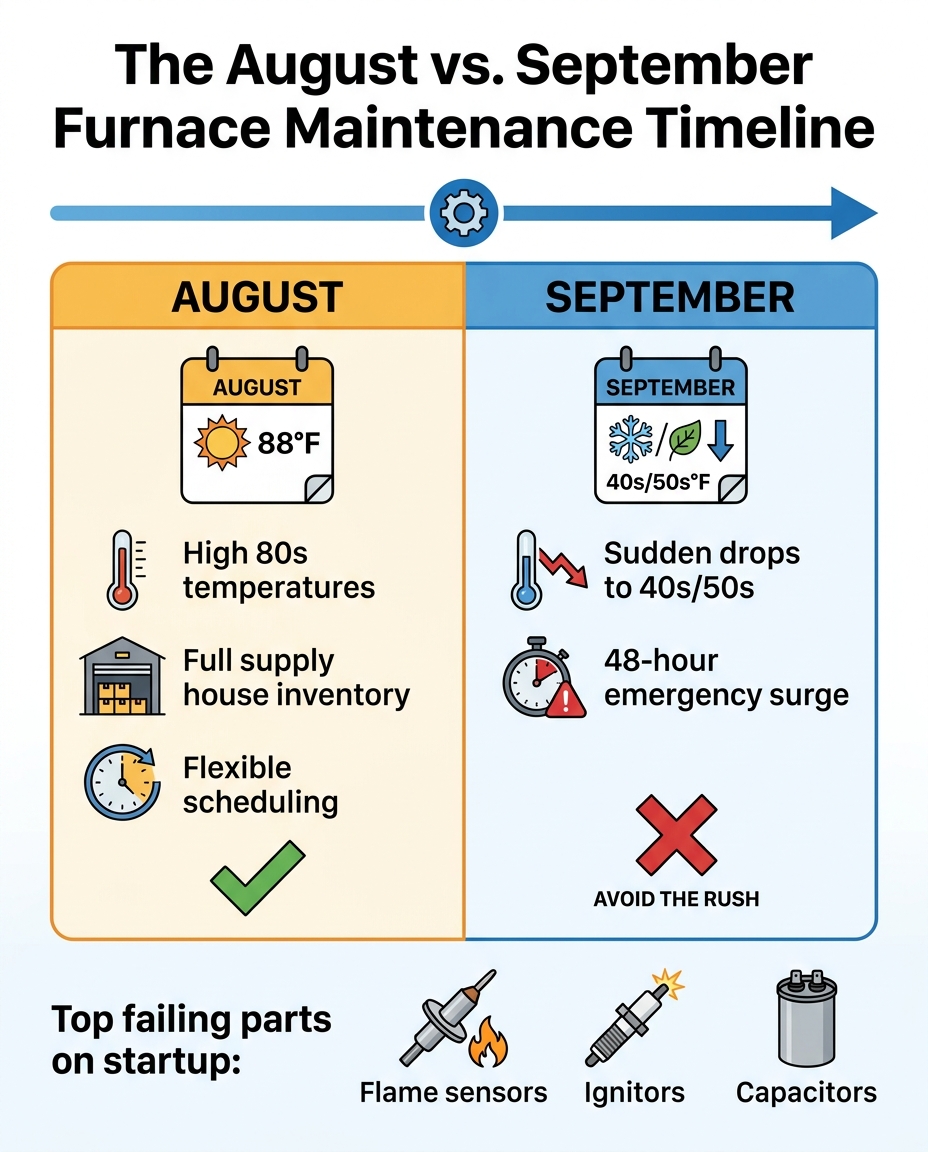
• Late August (80s) — Homeowner Action: Proactive tune-up scheduled — HVAC Industry Reality: Open schedules, fully stocked supply houses
• First October Freeze (40s) — Homeowner Action: Emergency no-heat calls — HVAC Industry Reality: Dispatch boards overwhelmed, parts shortages begin
The August vs. September Furnace Maintenance Timeline
The Hidden Supply Chain Bottleneck
Beyond our busy technicians, there is a hidden mechanical and logistical reality that makes late-summer preparation incredibly valuable: the local supply chain. HVAC systems are complex machines, and after sitting dormant for half the year, certain components are highly susceptible to failure upon initial startup.
The components our technicians most commonly see fail include flame sensors, ignitors, and capacitors. Flame sensors can develop a thin layer of oxidation or dust during the summer months. When the furnace tries to light, the dirty sensor fails to detect the flame, causing the system to shut down for safety. Ignitors can become brittle and crack due to thermal shock, while capacitors can lose their ability to hold a charge after long periods of inactivity.
Why Common Parts Disappear Fast
Regional HVAC supply houses and distributors operate on strict inventory cycles. They stock everyday components based on projected demand. During the late-summer August to back-to-school transition, these warehouses are fully stocked with heating parts in anticipation of the upcoming season.
However, when the sudden surge in emergency requests hits, that inventory drains rapidly. A local supply house might carry fifty replacement ignitors for a specific brand of furnace. During the 48-hour emergency surge, we routinely see requests for eighty of those exact ignitors. The sudden spike in demand depletes stock of everyday components almost instantly.
The consequence of waiting:
If your system breaks down during this peak-season stockout, you are not just waiting for an available technician; you are waiting for a part to be shipped from out of state. This hidden supply chain bottleneck leaves homes without heat for extended periods. August maintenance bypasses this problem entirely because any necessary parts are easily sourced from fully stocked local shelves.
Proactive Safety: Catching Hidden Hazards Before You Need Heat
Comfort is a high priority, but safety is the ultimate reason heating systems require routine attention. A furnace is a controlled fire inside your home, and operating it safely requires every component to function exactly as designed. Catching hidden hazards before you actually need heat is a major benefit of acting early.
After months of inactivity, it is critical to inspect the heat exchanger and all gas connections. The heat exchanger is the metal shield that separates the combustion exhaust from the breathable air circulating through your home. Over time, the constant expansion and contraction from heating and cooling can cause microscopic cracks. If a cracked heat exchanger goes unnoticed, it can introduce dangerous carbon monoxide into your living spaces.
Routine checks detect these minor issues before they become dangerous winter emergencies. For instance, one of our long-time Springfield customers has prioritized regular furnace and air conditioner maintenance with our team for the past five years. By having our technicians perform consistent servicing and necessary parts replacement every fall, they avoid unexpected breakdowns and rely confidently on preventive care to keep their home safe and comfortable. This level of thoroughness ensures the system operates safely and efficiently.
What We Look For During a Safety Inspection
A true safety inspection goes far beyond just changing the air filter. When you invest in professional furnace cleaning and maintenance, our technicians perform a rigorous evaluation:
• Burner inspection: Ensuring a clean, blue flame for proper combustion and maximum efficiency.
• Venting verification: Checking the flue and exhaust pipes for blockages, rust, or improper drafting.
• Electrical connections: Tightening wires and testing voltage to prevent shorts and electrical fires.
• Gas pressure testing: Verifying that the manifold pressure matches the manufacturer specifications to prevent overheating.
• Safety limit switches: Testing the high-limit switch and rollout switches to confirm they will shut the system down if it overheats.
Connecting these safety checks to the overall longevity of the heating system is simple: a clean, safely operating furnace doesn't have to work as hard, which means its internal components will last significantly longer.
Securing Your Preferred Appointment Time
Logistics play a huge role in home maintenance. Between work, school drop-offs, and daily errands, finding a two-hour window to meet an HVAC technician can be challenging. Booking during the late-summer window allows you to choose convenient times that actually fit your schedule.
Contrast this with the limited availability and forced scheduling during the peak fall rush. When the dispatch board is overflowing with emergency calls, you lose the luxury of choice. You might be offered an appointment in the middle of a workday, forcing you to take time off, or you might be squeezed into a late-evening slot when you would rather be relaxing with your family. Acting during the late-summer August to back-to-school transition puts you in control of your calendar.
Furthermore, early scheduling allows technicians to perform highly detailed work without the pressure of an emergency backlog. Just last year, during a routine late-summer clean and check, one of our technicians discovered a minor gas leak on a system. Because the homeowner had prioritized regular check-ups with us, the technician had the unhurried time to thoroughly inspect the unit, identify the faint leak, and resolve the hazard before it escalated.
At Allied Plumbing Heating & Cooling, we view ourselves as proactive guardians of the community. We prefer neighbor-first planning, where our team can take our time, answer your questions, and ensure your system is perfect. This stands in stark contrast to the impersonal, rushed service that often plagues the industry during peak season, where technicians are pressured to rush through calls to hit daily quotas. If you are wondering why regular furnace maintenance matters, having the time to do the job right is a primary reason. Reiterate the value of getting this task checked off the list early—it frees up your mental energy for everything else autumn brings.
Strategic Advantages of an August Tune-Up
Taking action before the weather turns provides measurable benefits that go far beyond basic comfort. If you are weighing whether to call now or wait until October, consider these strategic advantages of an early tune-up:
• Securing rare parts before supply houses empty out: By identifying a weak ignitor or failing capacitor in August, your technician can pull the replacement part from a fully stocked local warehouse, avoiding the inevitable peak-season backorders.
• Beating the back-to-school scheduling rush: Late summer offers the most flexible appointment windows of the year. You can pick a morning or afternoon slot that aligns perfectly with your existing routine, rather than rearranging your life for an emergency visit.
• Ensuring immediate readiness for sudden, unpredictable cold snaps: When temperatures in Central Illinois plummet from 85 degrees to 45 degrees overnight, you can confidently turn on your thermostat knowing the system will respond safely and effectively.
• Preventing minor wear and tear from turning into major breakdowns: A loose belt or a dusty flame sensor is a quick, inexpensive fix during a scheduled visit. If ignored until the system is running heavily, these minor issues can cause catastrophic motor failures.
• Maximizing energy efficiency before the first utility bill arrives: A clean, well-lubricated furnace uses significantly less gas or electricity to heat your home. Getting it tuned up early means your system operates at peak efficiency from the very first day of the season.
Frequently Asked Questions
Why schedule furnace maintenance in summer?
Scheduling in the summer guarantees you beat the fall rush and secure an appointment time that fits your busy life. It also ensures that any necessary replacement parts are readily available at local supply houses before the seasonal demand drains their inventory. Proactive summer maintenance means your home is immediately ready for the first unexpected cold snap.
What parts break most often on a furnace when turned on?
Flame sensors, hot surface ignitors, and capacitors are the most common components to fail upon initial startup. Flame sensors often accumulate dust during the summer, which prevents them from detecting the burner flame and causes the system to shut down. Ignitors can crack from thermal shock, while capacitors may lose their charge after sitting dormant.
When is the HVAC busy season in the Midwest?
The Midwest HVAC busy season typically kicks off during the first major temperature drop in September or October, creating a massive 48-hour emergency surge. Dispatch boards fill up instantly as thousands of homeowners turn on their heating systems simultaneously. This rush usually lasts through the first few weeks of consistent freezing temperatures.
Do I really need a furnace tune up every year?
Yes, annual tune-ups are strongly recommended by all major equipment manufacturers to maintain safety and efficiency. A furnace is a combustion appliance, and yearly inspections are necessary to ensure there are no gas leaks, carbon monoxide risks, or cracked heat exchangers. Regular maintenance also protects your warranty status.
How early can I schedule fall HVAC maintenance?
You can schedule your fall maintenance as early as August. Late summer is actually the ideal window because local technicians have more flexible availability before the heating season officially begins. Getting it done in August means you can check it off your list before the busy back-to-school transition takes over your calendar.
What happens if I don't service my furnace before winter?
Skipping service increases the likelihood of a sudden breakdown on the coldest day of the year. Dust buildup can cause the system to overheat and shut down, while ignored mechanical wear can lead to expensive motor failures. Most importantly, bypassing annual service means you miss critical safety checks for gas leaks and carbon monoxide exposure.
Understanding the hidden logistical advantages of booking your tune-up early empowers you to take control of your home comfort. By securing parts and appointment times now, you completely avoid the stress of the impending heating rush. Do not wait for the first freezing night to test your system—take action today to ensure a warm, safe home all season long.
What Our Technicians Look for During a Heat Exchanger Crack Inspection
September 30, 2026
Your aging furnace needs more than a quick visual check this fall. See how our high-tech diagnostic tools uncover hidden micro-fractures before they leak.
Your aging furnace needs more than a quick visual check this fall. See how our high-tech diagnostic tools uncover hidden micro-fractures before they leak.
Using a Ductless Mini-Split to Heat a Sunroom Addition Through an Illinois Winter
September 29, 2026
Glass-heavy sunrooms lose heat rapidly during freezing winters. A dedicated mini-split offers independent zone control to keep your addition warm without overtaxing your home's main furnace.
Glass-heavy sunrooms lose heat rapidly during freezing winters. A dedicated mini-split offers independent zone control to keep your addition warm without overtaxing your home's main furnace.