What SEER2 Rating Should I Look For in a New AC or Heat Pump?
If you're wondering what SEER2 rating should I look for when replacing your air conditioner or heat pump in Springfield, you're not alone — and the answer depends on a few key factors. Here's a quick breakdown to get you oriented fast:
Quick Answer by Situation:
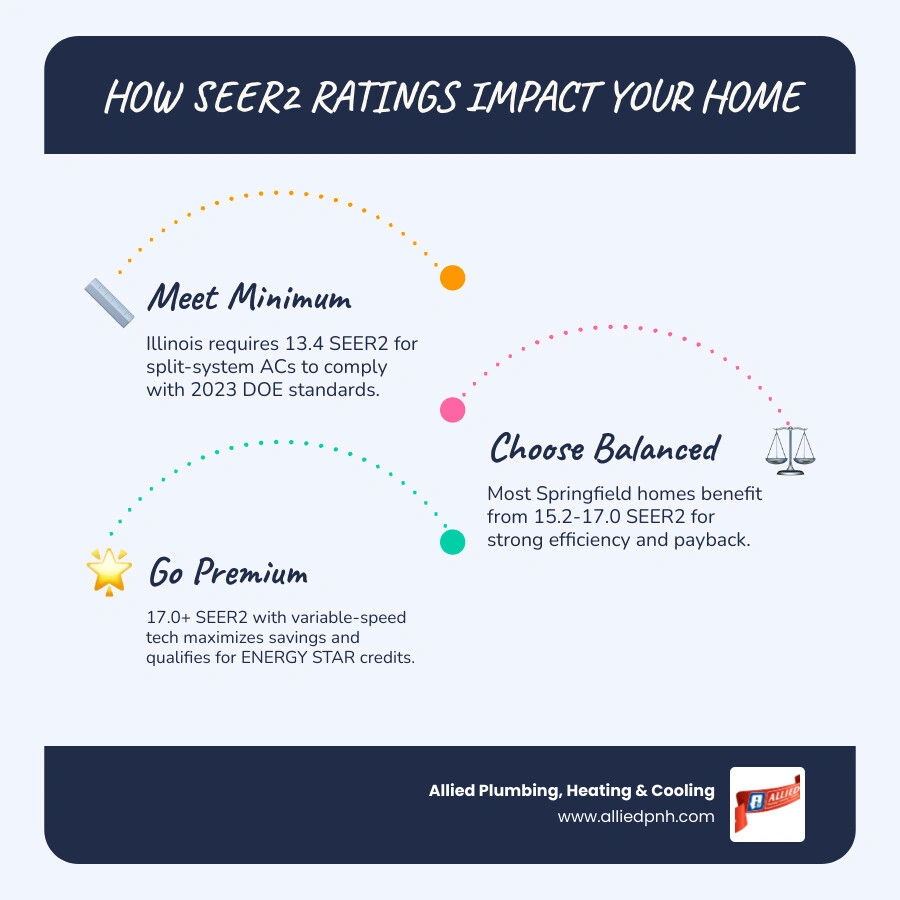
• Budget-focused, mild summers — Recommended SEER2: 13.4 - 15.1 SEER2 — Why: Meets minimum standards, lower upfront cost
• Most Springfield homeowners — Recommended SEER2: 15.2 - 17.0 SEER2 — Why: Best balance of savings and cost
• Long-term ownership, hot summers — Recommended SEER2: 17.0+ SEER2 — Why: Maximum efficiency, qualifies for tax credits
• Heat pump (all regions) — Recommended SEER2: 14.3 SEER2 minimum — Why: Federal requirement nationwide
• Seeking ENERGY STAR certification — Recommended SEER2: 17.0+ SEER2 with EER2 ≥ 12 — Why: Qualifies for rebates and incentives
The short version: in Springfield, Rochester, and Chatham, the legal minimum for a new split-system central air conditioner is 13.4 SEER2. But meeting the minimum and choosing the right rating for your home are two very different things.
SEER2 became the mandatory efficiency standard for all new residential air conditioners and heat pumps on January 1, 2023. It replaced the older SEER rating system with a stricter test that better reflects how your equipment actually performs once it's installed in your home — not just in a lab. The result is a number that looks slightly lower than what you may have seen on older equipment, even though the underlying performance is the same or better.
For most homeowners in Springfield, Rochester, and Chatham, the goal isn't simply to buy the highest-rated unit on the shelf. It's to find the efficiency level that matches your climate, your usage habits, your home's ductwork, and how long you plan to stay in the house. A system that's well-matched and professionally installed at 16 SEER2 will often outperform a poorly installed 20 SEER2 unit — every single time.
This guide walks you through everything you need to know to make a confident, informed decision.
Key what seer2 rating should i look for vocabulary:
• how to choose the right ac system for your home
• single stage vs two stage vs variable speed ac
• choosing the right ac for a midwest home
Understanding SEER2 vs. Traditional SEER
To understand what efficiency rating is best for your home, we first need to look at how the industry measures cooling power. For decades, the Seasonal Energy Efficiency Ratio (SEER) was the standard. But as HVAC technology evolved, the Department of Energy realized that old laboratory testing didn't match real-world operating conditions.
This discrepancy led to the creation of the M1 testing procedure and the official launch of SEER2. If you are shopping for a system in Springfield, Rochester, or Chatham, understanding this shift is crucial to ensuring you don't accidentally compare apples to oranges.
To dive deeper into how local weather impacts these system requirements, check out our guide on Choosing the Right AC for a Midwest Home.
What is a SEER2 Rating?
SEER2 stands for Seasonal Energy Efficiency Ratio 2. It is a mathematical formula that calculates the total cooling output of an air conditioner or heat pump during its normal annual usage period, divided by the total electric energy input (in watt-hours) consumed during that same period.
Essentially, it acts like the "miles per gallon" (MPG) rating for your home’s cooling system. A higher SEER2 rating means the system is more efficient at converting electricity into cold air, which directly translates to lower energy consumption and reduced utility bills.
Why SEER2 Ratings Look Lower Than Old SEER
If you compare a system manufactured in 2022 with one built today, you might notice that the newer model has a slightly lower rating on paper, even if it is technically more efficient. This is because the SEER2 testing protocols are significantly more demanding.
The old SEER test evaluated equipment under an external static pressure of only 0.1 inches of water column (in. w.c.). However, once a system is connected to real ductwork, a dirty air filter, and indoor registers in a typical home, the actual static pressure is much higher. To account for this, the SEER2 test increases the required external static pressure by a factor of five, utilizing a 0.5 in. w.c. standard.
Because of this more realistic, high-pressure testing environment, SEER2 ratings are approximately 4.5% to 4.7% lower than traditional SEER ratings for the exact same physical equipment. For example:
• A legacy 14 SEER unit is roughly equivalent to a 13.4 SEER2 unit today.
• A legacy 16 SEER unit translates to roughly 15.2 SEER2.
• A legacy 18 SEER unit converts to roughly 17.2 SEER2.
What SEER2 Rating Should I Look For?
When determining what SEER2 rating should I look for, it helps to view the options in three distinct tiers: Standard, High, and Premium efficiency.
• Standard Efficiency — SEER2 Range: 13.4 - 15.1 — Best Suited For: Budget-conscious upgrades; rental properties; homes with low annual cooling hours. — Compressor Technology: Single-stage
• High Efficiency — SEER2 Range: 15.2 - 16.9 — Best Suited For: The "sweet spot" for most homeowners in Springfield and Rochester seeking balanced savings. — Compressor Technology: Two-stage or entry-level variable-speed
• Premium Efficiency — SEER2 Range: 17.0+ — Best Suited For: Homeowners seeking maximum monthly savings, whisper-quiet performance, and superior dehumidification. — Compressor Technology: Variable-speed (Inverter)
Choosing the right tier is a balance between the upfront equipment investment and the long-term payback period. In our local climate zones, where we experience hot, humid summers but relatively short cooling seasons compared to the deep South, finding the right middle ground is often the smartest financial move.
Standard vs. High-Efficiency: What SEER2 Rating Should I Look For My Home?
Standard-efficiency systems (13.4 to 15.1 SEER2) typically rely on single-stage compressors. These systems operate like a light switch: they are either 100% on or completely off. While they successfully keep your home cool and meet all federal environmental guidelines, they cycle on and off frequently, which can lead to slight temperature swings and higher energy spikes.
High-efficiency systems (15.2 to 17.0 SEER2) usually feature two-stage compressors. These can run at a lower speed (typically around 65% capacity) for mild days and step up to 100% capacity only when a severe heatwave rolls through Chatham or Springfield.
Upgrading from a standard 14 SEER baseline to a 16 SEER system provides approximately a 14% efficiency improvement. An 18 SEER2 unit is about 20% more energy-efficient than a 14 SEER2 unit. This extra efficiency reduces wear and tear on your system and provides much better humidity control. To learn more about how compressor stages affect your comfort, read our detailed breakdown of Single Stage vs Two Stage vs Variable Speed AC.
Premium Systems: What SEER2 Rating Should I Look For Maximum Savings?
If your goal is maximum monthly utility savings and unparalleled indoor comfort, a premium system (17.0+ SEER2) is the way to go. These systems utilize variable-speed inverter technology, allowing the compressor to adjust its output incrementally anywhere from 30% to 100% capacity.
Because they run almost continuously at ultra-low, energy-saving speeds, premium systems excel at removing moisture from the air. This superior dehumidification means you can often set your thermostat a couple of degrees higher while feeling just as comfortable.
Going all the way to a 20 SEER2 system can reduce energy consumption dramatically:
• A 20 SEER2 unit is about 43% more efficient than a 14 SEER2 unit.
• Upgrading from an old, legacy 10 SEER system to a modern 20 SEER2 system can cut your cooling-related electricity consumption by roughly 50%.
• Moving from a standard 14 SEER system to a 20 SEER2 system can result in energy savings of 30% or more.
Premium efficiency is also highly common in ductless mini-split systems, which naturally achieve incredibly high SEER2 ratings (often exceeding 22 to 25 SEER2) because they avoid the energy losses associated with ductwork. If you are weighing your options for an older home, you can read our comparison of Central Air vs Mini Split for Older Homes and explore the financial differences in our Mini Split vs Central AC Cost Comparison.
Regional Minimums and Regulatory Requirements
The U.S. Department of Energy divides the country into three distinct regulatory regions: the North, the Southeast, and the Southwest. Because cooling demands vary wildly across these regions, the minimum standards for installation are different depending on where you live.
Northern Region Standards
Springfield, Rochester, and Chatham sit firmly within the Northern region. In our area, the legal minimum standards are as follows:
• Split-system air conditioners: Must meet a minimum of 13.4 SEER2 (which is equivalent to the old 14 SEER standard).
• Split-system heat pumps: Must meet a minimum of 14.3 SEER2 (and 7.5 HSPF2 for heating efficiency) nationwide. This is a federal blanket standard that applies nationwide, including in Springfield, Rochester, and Chatham.
• Single packaged units (AC): Must meet a minimum of 13.4 SEER2.
• Packaged heat pumps: Must meet a minimum of 13.4 SEER2 (and 6.7 HSPF2).
While southern states have strict "date of installation" rules that prohibit installing older inventory that doesn't meet their 14.3 SEER2 AC minimums, homeowners in Springfield, Rochester, and Chatham only need to ensure their newly purchased equipment meets the Northern 13.4 SEER2 baseline.
Refrigerant Transitions and System Efficiency
As we navigate 2026, the HVAC industry is also undergoing a major environmental transition. Older systems relied on R-410A refrigerant, which is being phased out in favor of low global warming potential (GWP) alternatives like R-454B and R-32.
These new refrigerants are not only better for the planet, but they also possess superior heat transfer properties, helping modern systems achieve their high SEER2 targets more easily. If you want to stay ahead of these changes, we highly recommend reading our resources on R410A vs R454B Refrigerant What You Need to Know and How to Prepare for the Shift to Low GWP Refrigerants.
Real-World Factors That Influence Actual Efficiency
It is important to remember that the SEER2 rating printed on the yellow EnergyGuide label is a laboratory estimate. In the real world, your system's actual efficiency is heavily dictated by your home's infrastructure and the quality of the installation.
• Sizing and Manual J Calculations: A system that is too large will "short-cycle," turning on and off rapidly. This prevents it from ever reaching its peak operating efficiency and leaves your home humid. We always perform a detailed Manual J load calculation to size your system perfectly.
• Ductwork Quality: Leaky, uninsulated ducts can lose up to 30% of your system's conditioned air before it ever reaches your living spaces. Sealing and insulating your ducts often provides a better return on investment than simply buying a higher SEER2 tier.
• Paired Equipment: To achieve its rated SEER2 efficiency, your outdoor condenser must be matched with a compatible indoor evaporator coil and blower motor. Mixing and matching mismatched brands or older indoor components will severely degrade your actual efficiency.
• Preventative Maintenance: Dirt on your outdoor condenser coils or a clogged indoor air filter forces your system to work much harder, dragging a high-efficiency system down to standard-efficiency performance.
To keep your system running like new year-round, check out our AC Maintenance for Year-Round Comfort guide and use our handy Summer AC Maintenance Checklist for Homeowners.
Frequently Asked Questions About SEER2 Ratings
What is the minimum SEER2 rating required in Springfield, Rochester, and Chatham for 2026?
For residential split-system central air conditioners, the minimum required rating in Springfield, Rochester, and Chatham is 13.4 SEER2. For split-system heat pumps, the nationwide minimum is 14.3 SEER2.
Does a higher SEER2 rating qualify for federal tax credits?
Yes! Under the Inflation Reduction Act, high-efficiency cooling systems qualify for substantial federal tax credits. To qualify for heat pump rebates and tax credits, a split ducted heat pump must have a SEER2 rating of at least 16.0. Packaged heat pumps must have a SEER2 of at least 15.2 to qualify.
Will a higher SEER2 system cool my home faster?
No. SEER2 measures energy efficiency (how much electricity is used), not cooling capacity or speed. A 3-ton system rated at 14 SEER2 and a 3-ton system rated at 20 SEER2 have the exact same cooling capacity; however, the 20 SEER2 system will use significantly less electricity to get the job done.
Conclusion
When deciding what SEER2 rating should I look for, there is no single "correct" answer. The ideal system is one that fits your personal comfort goals, budget, and long-term plans for your home. For some, a reliable 14.3 SEER2 system is perfect. For others, a premium 18+ SEER2 variable-speed system is the ultimate upgrade for quiet comfort and low utility bills.
At Allied Plumbing, Heating & Cooling, we have been helping our neighbors in Springfield, Rochester, and Chatham stay comfortable since 1977. As a three-generation family business, we take pride in our workmanship and back our installations with the Daikin Comfort Promise and outstanding 12-year warranties.
If you are ready to explore your options and find the perfect, energy-efficient system for your home, contact us today for a professional consultation. Discover how we can maximize your comfort by visiting our Allied Air Conditioning Services page.