Why a Simple Tune-Up Could Be the Easiest Way to Cut Your Energy Bills
Understanding how a tune up improves efficiency and lowers bills starts with one straightforward fact: your HVAC system is likely the single largest energy expense in your home — and when it hasn't been serviced, it works harder than it needs to just to keep up.
Here's a quick summary of what a professional tune-up does for your home:
• Restores lost efficiency — regular maintenance can recover up to 15% of efficiency your system has gradually lost
• Reduces monthly energy costs — most homeowners see a 5% to 15% drop in their utility bills after a tune-up
• Prevents major breakdowns — up to 95% of unexpected HVAC failures are preventable with routine maintenance
• Extends equipment life — a well-maintained system can last 15 to 20 years, while a neglected one often fails in 8 to 12 years
• Protects your warranty — most manufacturers require documented annual professional maintenance to keep coverage valid
The problem is that efficiency loss happens slowly and quietly. There's no warning light on your furnace or air conditioner telling you it's working 20% harder than it should. Instead, you just notice your bills creeping up month after month — without any obvious reason why.
A neglected HVAC system can use 10% to 25% more energy than a well-maintained one. For Springfield, Rochester, and Chatham homeowners who rely on their systems through both hot summers and cold winters, that wasted energy adds up fast.
A professional tune-up fixes that — and this guide walks you through exactly how.
Basic how a tune up improves efficiency and lowers bills terms:
• ac tune up checklist what your technician should check
• ac tune up guide for illinois homeowners
• how an ac tune up prevents costly summer breakdowns
What is an HVAC Tune-Up and What Does It Include?
Think of an HVAC tune-up as a comprehensive physical for your home's climate control system. Just as you wouldn’t drive your car for 50,000 miles without an oil change and expect the engine to run smoothly, you shouldn't expect your heating and cooling system to run flawlessly year after year without professional attention.
A professional HVAC tune-up is a meticulous process of inspection, cleaning, and calibration designed to restore your system as close to its original factory specifications as possible. Utilizing a detailed ac tune up checklist what your technician should check, our technicians perform a series of vital tasks that ensure every mechanical and electrical component is operating in perfect harmony.
Here is what a comprehensive professional tune-up actually includes:
• Professional Inspection: We examine the entire system for signs of wear and tear, including checking the integrity of the heat exchanger, inspecting the blower assembly, and verifying that all safety controls are fully operational.
• Deep Coil Cleaning: Dust and dirt are the natural enemies of HVAC efficiency. We clean both the indoor evaporator coil and the outdoor condenser coil. When dirt builds up on these coils, it acts like an insulating blanket, preventing effective heat transfer. Cleaning dirty coils and filters can reduce compressor runtime by up to 15%.
• Refrigerant Level Verification: An improper refrigerant charge can increase energy use by 5% to 15% and put immense strain on your compressor. We measure the refrigerant levels with precision gauges to ensure there are no leaks and that the charge is exactly where the manufacturer intended.
• Electrical Connections and Diagnostics: Loose electrical connections create resistance, which increases your electricity consumption and poses a fire hazard. We tighten all electrical terminals, measure voltage and current on motors, and inspect capacitors for signs of swelling or failure.
• Condensate Drain Clearing: Your air conditioner doesn't just cool your home; it also dehumidifies it. The moisture collected must drain away safely. We inspect and clear the condensate drain line to prevent water damage and microbial growth.
• Thermostat Calibration: We test your thermostat to ensure its sensors are reading the room temperature accurately. If a thermostat is off, your system will run longer than necessary, wasting energy and driving up bills.
By systematically addressing these components, a professional tune-up transforms your HVAC system from a struggling, dust-clogged machine back into a highly efficient, smooth-running comfort system.
How a Tune Up Improves Efficiency and Lowers Bills
To truly appreciate how a tune up improves efficiency and lowers bills, it helps to look at the numbers. The physics of heating and cooling rely entirely on smooth airflow, efficient heat transfer, and minimized mechanical friction. When any of these factors are compromised, energy consumption skyrockets.
The table below illustrates the stark contrast between an HVAC system that receives regular professional care and one that is left to accumulate dust, wear, and mechanical strain:
• Energy Consumption — Well-Maintained HVAC System: 100% (Baseline Efficiency) — Neglected HVAC System: 115% to 130% (Wasted Energy)
• Average Equipment Lifespan — Well-Maintained HVAC System: 15 to 20 Years — Neglected HVAC System: 8 to 12 Years
• Unexpected Breakdown Risk — Well-Maintained HVAC System: Under 5% Annually — Neglected HVAC System: Up to 95% Over Its Lifetime
• Operational Efficiency Level — Well-Maintained HVAC System: 95% to 100% of Original SEER/AFUE — Neglected HVAC System: 70% to 85% of Original SEER/AFUE
• System Runtime to Reach Temp — Well-Maintained HVAC System: Optimized and Shorter — Neglected HVAC System: Extended (Runs 30-45 mins longer daily)
• Startup Phase Energy Waste — Well-Maintained HVAC System: Minimal (Smooth, calibrated start) — Neglected HVAC System: High (Frequent short-cycling draws massive current)
Without regular maintenance, an HVAC system loses roughly 5% to 10% of its operating efficiency every single year. This means a high-efficiency system can quickly degrade to the performance level of a much older, cheaper model simply due to lack of maintenance. The compressor has to run longer to move the same amount of heat, and the blower motor must draw more electrical current to push air through restricted pathways. Let's look closer at the specific mechanical reasons behind this efficiency loss.
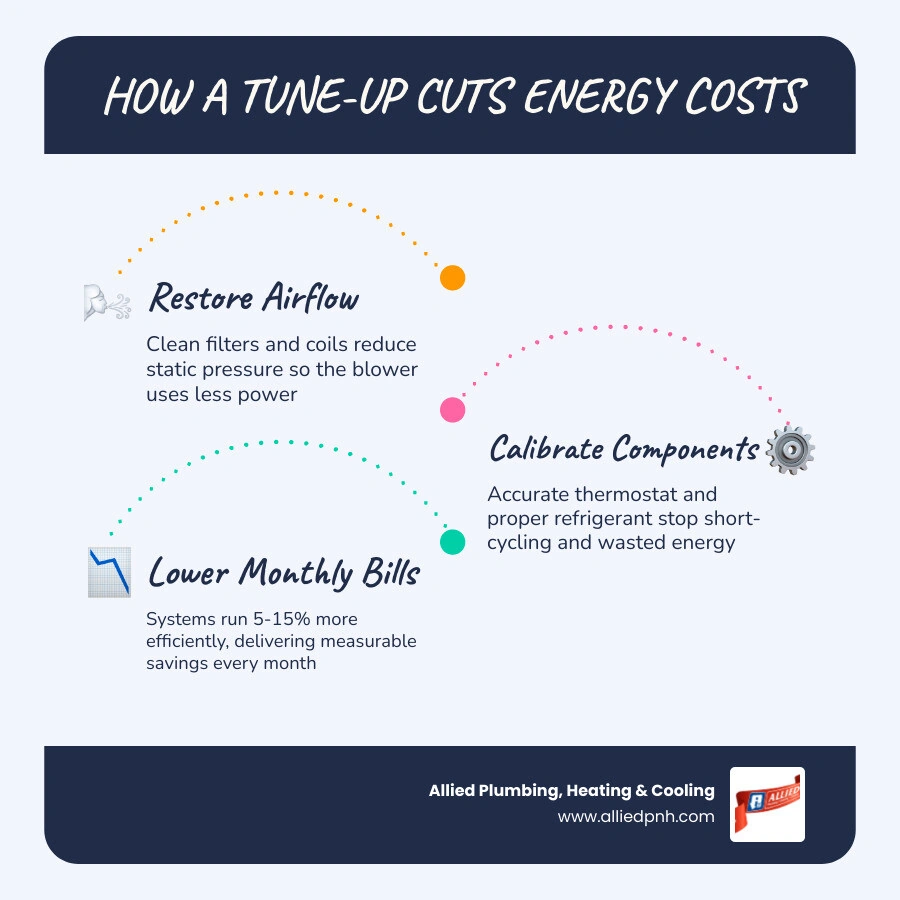
How a Tune Up Improves Efficiency and Lowers Bills by Restoring Airflow
Airflow is the lifeblood of your heating and cooling system. For your home to reach your desired temperature, a specific volume of air must move across your system's coils and through your ductwork every minute. When that airflow is restricted, your system has to run much longer to achieve the same level of comfort.
According to our comprehensive ac tune up guide for illinois homeowners, restricted airflow is one of the most common causes of high utility bills in Rochester homes. This restriction is usually caused by a combination of clogged air filters, dust buildup on the blower wheel blades, and dirty coils.
When dust accumulates on the curved blades of a blower fan, it changes the aerodynamics of the wheel. The fan can no longer push the required volume of air, causing static pressure within the system to rise. This forces the blower motor to work significantly harder, increasing friction, generating excess heat, and drawing more electricity.
During a professional tune-up, we clean the blower assembly, replace or clean the air filters, and clear any obstructions. By reducing static pressure and eliminating friction, we restore unrestricted airflow. The system can then distribute conditioned air quickly and evenly, allowing it to shut off sooner and keep your monthly energy bills low.
How a Tune Up Improves Efficiency and Lowers Bills through Component Calibration
While clean components keep air moving, precise calibration ensures that your system only runs when it absolutely needs to. Thermostat calibration is a major factor here. A thermostat reading that is off by just 2 degrees can add 30 to 45 minutes of unnecessary runtime to your system every single day. Over the course of a hot summer in Chatham, those extra minutes translate to hundreds of kilowatt-hours of wasted electricity.
Another critical calibration step is testing the system's electrical controls, particularly the capacitors and contactors. Capacitors act like temporary batteries that provide the starting torque your compressor and fan motors need to spin up. If a capacitor's electrical output drops below its rated capacity, the motor will struggle to start, drawing an exceptionally high startup current for a longer period.
Because starting an HVAC motor consumes the highest electrical current of any phase of operation, frequent "short-cycling" — where a miscalibrated thermostat or failing component causes the system to turn on and off rapidly — is incredibly expensive. Proper calibration of safety switches, thermostats, and electrical components ensures your system runs in steady, efficient cycles rather than costly, high-current bursts.
The Long-Term Financial and Equipment Benefits of Regular Maintenance
While the immediate reduction in your monthly utility bill is incredibly satisfying, the long-term financial benefits of regular maintenance are even more impactful. Investing in preventative care is the single most effective way to protect your budget from sudden, expensive home service emergencies.
As detailed in our guide on why regular furnace maintenance matters, routine service directly prevents the premature death of your heating and cooling equipment. A well-maintained system can easily last 15 to 20 years. Conversely, a neglected system often suffers a catastrophic failure between years 8 and 12. Replacing an entire HVAC system years ahead of schedule is a major expense that can be avoided with simple, proactive maintenance.
Furthermore, regular maintenance is almost always a strict requirement to keep your equipment's warranty valid. Nearly every major HVAC manufacturer requires documented proof of annual professional maintenance to honor warranty claims. If a major component like your compressor or heat exchanger fails in year six, but you cannot provide service records showing the system was maintained annually, the manufacturer may deny your claim.
Finally, routine tune-ups prevent up to 95% of unexpected breakdowns. During a tune-up, our technicians can identify and replace a worn belt, a failing capacitor, or a slightly leaking valve before it causes a complete system shutdown on the hottest weekend of July or the coldest night of January. Catching a small issue early prevents a domino effect where a cheap, worn-out part causes a highly expensive component to overheat and fail.
Safety, Comfort, and Indoor Air Quality Enhancements
Beyond the financial savings, professional HVAC tune-ups provide invaluable peace of mind by ensuring your home remains safe, comfortable, and healthy. Your heating and cooling system plays a massive role in the quality of the air your family breathes every single day.
During our annual furnace check, safety is our absolute highest priority. For homes with gas furnaces, we carefully inspect the heat exchanger for any microscopic cracks or structural weaknesses. A cracked heat exchanger is a severe safety hazard, as it can allow deadly carbon monoxide gas to leak directly into your home's air supply. We also test safety shut-off controls, inspect gas line connections, and verify proper venting to ensure your heating system operates safely all winter long.
Indoor air quality is also significantly improved during a tune-up. As your system circulates air, dust, pollen, pet dander, and other allergens naturally build up inside the ductwork, blower assembly, and coils. If moisture is present, dirty coils can also become a breeding ground for mold and bacteria.
By deeply cleaning these components, we prevent these contaminants from being blown back into your living spaces. This is especially beneficial for family members who suffer from asthma or seasonal allergies.
Additionally, a well-tuned air conditioner is much better at managing indoor humidity. By reaching its optimal operating temperature quickly and maintaining steady run times, the system can condense and remove moisture from the air far more effectively, preventing that sticky, humid feeling indoors and protecting your home from mold growth.
When to Schedule Your Tune-Up and Signs You Are Overdue
Timing is everything when it comes to HVAC maintenance. To get the absolute most out of your service, we highly recommend scheduling your tune-ups during the "shoulder seasons" — spring for your air conditioner and fall for your furnace.
According to our guide on the best time of year to schedule your ac tune up, scheduling your service in March, April, or May ensures your system is fully prepared to handle the intense summer heat before you ever turn it on. It also allows you to beat the peak-season rush when technicians are busy responding to emergency no-cool calls. The same logic applies to scheduling furnace maintenance in September or October.
If you aren't sure whether your system is overdue for a professional visit, keep an eye out for these common warning signs:
• Unexplained Utility Bill Spikes: If your monthly energy bills are 15% to 20% higher than they were during the same month last year, but your usage habits haven't changed, your system is losing efficiency rapidly.
• Weak or Uneven Airflow: If you notice that some rooms feel like a sauna while others are freezing, or if the air blowing from your vents feels weak, your system is struggling with restricted airflow. Refer to our summer ac maintenance checklist for homeowners to check basic issues, but schedule a professional tune-up to address internal restrictions.
• Frequent Short-Cycling: If your air conditioner or furnace turns on, runs for just a couple of minutes, shuts off, and then turns back on shortly after, it is short-cycling. This wastes massive amounts of electricity and puts extreme wear on the compressor.
• Unusual Noises: Squealing, grinding, rattling, or banging noises are clear indicators that a belt is slipping, a bearing is failing, or a mechanical component has come loose. Ignoring these sounds can lead to a sudden and costly breakdown.
Frequently Asked Questions about HVAC Efficiency
How often should I schedule an HVAC tune-up in Springfield?
For homes in Springfield and the surrounding areas, we recommend scheduling professional HVAC maintenance twice a year: once in the spring for your air conditioning system and once in the fall for your heating system.
If you use our spring hvac and plumbing maintenance checklist, you can easily keep your home's systems in great shape. If you have a heat pump that provides both heating and cooling year-round, it still requires two professional checks annually because the system is working hard through every season without a break.
Can a homeowner perform a full HVAC tune-up themselves?
While we highly encourage homeowners to handle basic maintenance tasks — such as replacing air filters every 30 to 90 days, keeping the outdoor condenser unit clear of weeds and debris, and ensuring indoor vents are unblocked — a full HVAC tune-up must be performed by a professional.
A comprehensive tune-up requires specialized diagnostic tools, such as manifold gauges to check refrigerant levels, multimeters to test electrical current, and combustion analyzers to verify furnace safety. Furthermore, handling chemical refrigerants requires EPA certification, and attempting to service high-voltage electrical circuits or gas lines poses severe safety hazards. Leaving the deep maintenance to professionals also ensures your manufacturer warranty remains fully protected.
Will a professional tune-up really lower my monthly utility bills?
Yes, absolutely! On average, homeowners see a 5% to 15% reduction in their monthly energy costs immediately following a professional tune-up. If your system has been neglected for several years, the savings can be even more dramatic, reaching up to 30%.
As explained in our article on how an ac tune up prevents costly summer breakdowns, the restored airflow, cleaned coils, and calibrated components allow your system to reach your target temperature much faster. This directly reduces system runtime, saving you significant money on your monthly energy bills. In many cases, the seasonal utility savings will completely offset the cost of the tune-up itself.
Conclusion
At Allied Plumbing, Heating & Cooling, we have been helping homeowners throughout Springfield, Rochester, and Chatham stay comfortable while keeping their energy bills low since 1977. As a third-generation, family-owned business, we take immense pride in delivering reliable, high-quality service that our neighbors have trusted for nearly fifty years.
When you partner with us for your seasonal maintenance, you get the peace of mind that comes with our experienced technicians and our commitment to customer satisfaction. We are proud to offer the Daikin Comfort Promise, featuring industry-leading 12-year warranties that ensure your home's comfort systems remain efficient, reliable, and worry-free for years to come.
Don't let a dirty, uncalibrated HVAC system quietly drain your wallet this season. Schedule your professional AC maintenance with Allied Plumbing, Heating & Cooling today and start enjoying a more efficient, comfortable, and affordable home!