Why an AC Tune-Up Is Your Best Defense Against Costly Summer Breakdowns
How an AC tune-up prevents costly summer breakdowns comes down to one simple idea: small problems caught in spring cost far less than emergency repairs in July.
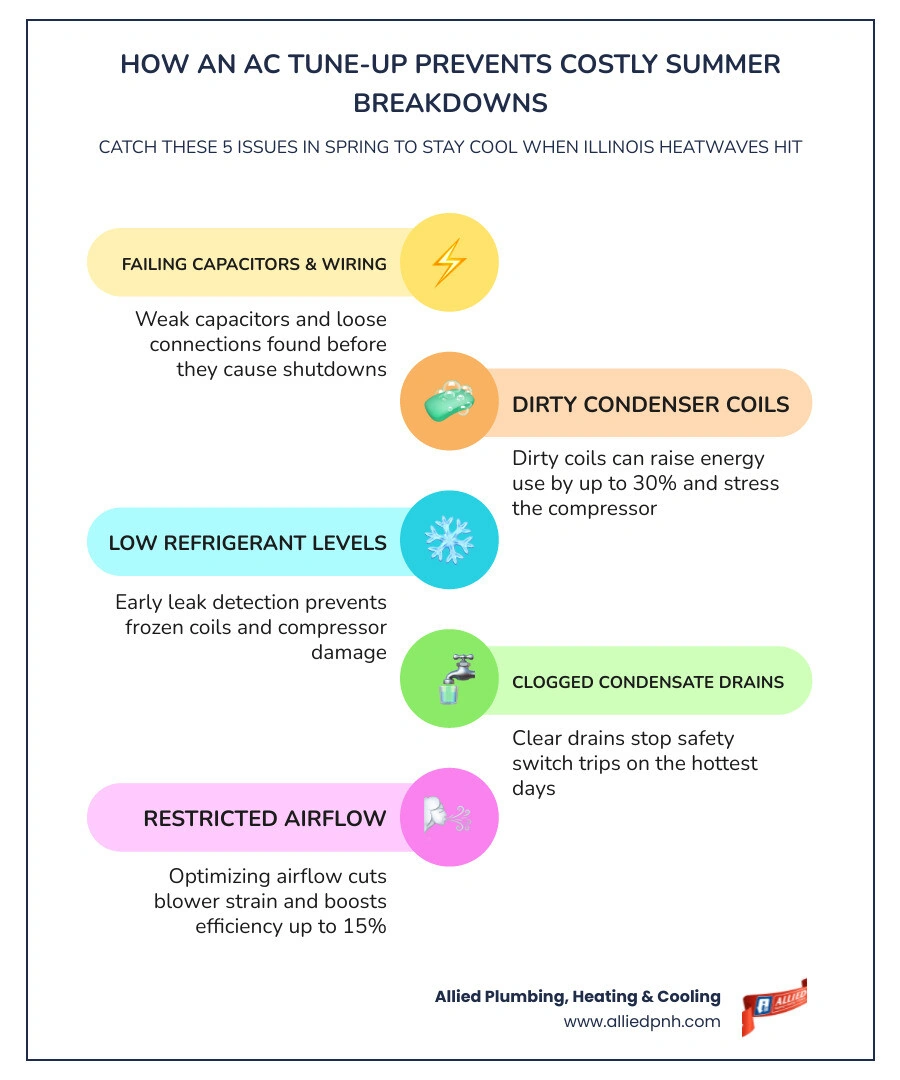
Here is a quick look at how a tune-up protects your home this summer:
• Catches failing parts early — weak capacitors, worn contactors, and loose wiring are found before they cause a full shutdown
• Cleans dirty coils — dirty condenser coils alone can increase energy use by up to 30%, driving bills higher and stressing the compressor
• Checks refrigerant levels — low refrigerant always signals a leak; finding it early prevents frozen coils and compressor damage
• Clears condensate drains — a clogged drain line can trip a safety switch and shut your system down on the hottest day of the year
• Optimizes airflow — restricted airflow puts extra strain on the blower motor and can cut system efficiency by up to 15%
Up to 80% of costly HVAC repairs trace directly back to skipped routine maintenance. And those failures rarely happen on a mild afternoon — they happen during the first sustained stretch of 100°F heat, exactly when every HVAC company in Springfield, Rochester, and Chatham is already booked solid.
Scheduling a professional tune-up in spring is the single most reliable way to make sure your air conditioner is ready before that heat arrives.
Quick how an ac tune up prevents costly summer breakdowns definitions:
• ac tune up checklist what your technician should check
• ac tune up guide for illinois homeowners
• best time of year to schedule your ac tune up
Change 1: Schedule a Professional Spring Inspection
When spring arrives in Springfield, Rochester, and Chatham, we all welcome the blooming flowers and warmer breezes. However, it is also the absolute best time to think about your home comfort systems. Scheduling a professional spring inspection is the first and most critical change you can make to ensure your home remains a cool haven all summer long.
A professional spring inspection is a proactive strategy. It allows us to examine your system under controlled conditions before the sweltering heat waves hit Springfield, Rochester, and Chatham. During a routine check, a qualified technician does not just glance at your unit; they perform a deep, comprehensive review of the physical and electrical health of your system. This includes inspecting all electrical connections, testing safety controls, and calibrating the thermostat to make sure it is not adding unnecessary runtime to your system.
Electrical connections naturally loosen over time. Think of it like a jar lid that slowly backs off due to constant vibration. As your AC cycles on and off, the subtle vibrations can loosen internal wiring. Additionally, thermal cycling—the physical expansion and contraction of wires as they heat up and cool down—creates resistance. Increased electrical resistance generates heat, which can melt wire insulation, damage control boards, and lead to sudden system failures.
Technicians will also look closely at key components like capacitors and contactors. They will test capacitor microfarads to ensure they are within the manufacturer's specified range and inspect contactors for pitting. Pitting is a form of electrical wear where the metal contacts become scarred and uneven, which can cause them to stick or fail to make a clean connection. Catching these electrical issues early is a cornerstone of the AC Tune-Up Guide for Illinois Homeowners.
How an AC Tune Up Prevents Costly Summer Breakdowns by Catching Small Issues
To understand how an AC tune-up prevents costly summer breakdowns, we have to look at the mechanical cascade of failures. Air conditioners are highly integrated machines. When one small, inexpensive part begins to fail, it forces other, much more expensive parts to work twice as hard to compensate. This extra strain eventually leads to a catastrophic breakdown of the entire system.
Take the run capacitor, for example. The capacitor acts like a high-powered battery that gives your AC motors the electrical "kick" they need to start and run smoothly. Over time, heat and electrical stress degrade the capacitor's ability to hold a charge. If a technician measures the capacitor's microfarads during a spring tune-up and finds it is operating below 80% of its rated capacity, they can replace it in minutes. If left unaddressed, a weak capacitor forces the fan motor or the compressor to draw excess amperage. This extra electrical draw causes the motor windings to overheat, eventually burning out the compressor entirely. Replacing a capacitor is a simple, minor task; replacing a locked-up compressor is a major, highly stressful project that can leave you without cool air for days.
Refrigerant leaks are another classic example of a small issue that triggers a massive failure. Your air conditioning system is a closed loop, meaning it should never naturally run out of refrigerant. If the refrigerant level is low, it means there is a leak somewhere in the copper lines or coils.
When refrigerant levels drop even slightly, the pressure inside the evaporator coil decreases. This drop in pressure causes the temperature of the coil to fall below freezing, turning the condensation on the coil into solid ice. A frozen evaporator coil completely blocks airflow, causing the system to run continuously without actually cooling your home. This continuous operation under high pressure can cause liquid refrigerant to flood back into the compressor, destroying it. By checking the refrigerant charge against manufacturer specifications during a spring visit, we can identify microscopic leaks, repair them, and recharge the system before any damage occurs. For a detailed breakdown of what else is evaluated, refer to our AC Tune-Up Checklist: What Your Technician Should Check.
Change 2: Maintain Clean Air Filters and Vents
The second major change you can make to protect your home comfort is establishing a strict routine for maintaining clean air filters and vents. It is easy to forget about the air filter tucked away in your basement or utility closet, but this simple piece of pleated material has a massive impact on your air conditioner's performance, efficiency, and lifespan.
Air filters should be checked monthly and replaced every one to three months, depending on your household. If you have pets, allergies, or a dusty environment, you will need to replace them more frequently.
When choosing a filter, pay close attention to the MERV (Minimum Efficiency Reporting Value) rating. For most residential systems in Springfield, Rochester, and Chatham, we recommend filters with a MERV rating between 8 and 12. These filters provide an excellent balance, capturing pollen, pet dander, and mold spores without restricting airflow. Avoid ultra-high MERV filters unless your system has been specifically modified to handle them, as they can restrict airflow just as much as a dirty filter.
When an air filter becomes clogged with dust, pet hair, and debris, it acts like a wall blocking the air trying to enter your system. This restriction creates high static pressure within your ductwork. Static pressure is the resistance to airflow within the system, and when it rises too high, it is the ultimate silent killer of blower motors. The blower fan has to work significantly harder to pull air through the clogged filter, drawing more electricity and running hotter than designed. Over time, this constant strain degrades the motor bearings and electrical windings, leading to a premature blower motor failure in the middle of a hot summer week. You can find more practical maintenance tips in our Summer AC Maintenance Checklist for Homeowners.
How an AC Tune Up Prevents Costly Summer Breakdowns through Airflow Optimization
Airflow is the lifeblood of your air conditioning system. Your AC does not actually "create" cold; rather, it removes heat from your indoor air and transfers it outside. For this heat exchange process to work efficiently, a specific volume of air must constantly pass over the indoor evaporator coil.
When airflow is restricted due to a dirty filter, blocked vents, or dusty blower wheels, the heat transfer process breaks down. The cold refrigerant inside the evaporator coil cannot absorb enough heat from your home's air. As a result, the coil temperature plummets, causing moisture in the air to freeze on the metal fins.
A professional tune-up optimizes airflow from start to finish. Our technicians inspect the entire duct system to ensure there are no major leaks. In a typical home, up to 20% to 30% of conditioned air can be lost through loose duct connections, unsealed seams, or tears in flexible ductwork. This means you are paying to cool your attic or crawlspace instead of your living room!
By sealing those duct leaks, cleaning the blower assembly, and verifying that all supply and return vents are completely unblocked by furniture or drapes, we restore the system's airflow to factory specifications. This optimization dramatically improves energy efficiency, lowers monthly utility bills, and prevents the system from running longer than necessary. If your system is running constantly but your rooms still feel warm, it is worth exploring Why AC Is Running But Not Cooling Your Home.
Change 3: Clear the Area Around Your Outdoor Condenser
The third quick change takes place outside your home. Many homeowners put a lot of effort into landscaping, planting beautiful flowers, shrubs, and ivy around their homes. While this looks fantastic, placing plants too close to your outdoor condenser unit can choke your air conditioner and lead to a sudden breakdown.
Your outdoor condenser unit is responsible for releasing the heat that was absorbed from inside your home. To do this effectively, the large fan on top of the unit pulls outdoor air through the metal condenser coils on the sides, carrying the heat away into the surrounding atmosphere.
For this process to work, the condenser unit needs plenty of breathing room. We recommend maintaining a clear, two-foot (24-inch) perimeter around all sides of the outdoor unit. This means cutting back overgrown bushes, trimming low-hanging tree branches, pulling weeds, and ensuring that tall grass or decorative plantings do not block the air intake. Additionally, keep a clear space of at least four to five feet above the unit so the hot air blowing out of the top can escape freely without recirculating back down.
When the area around the condenser is crowded, the unit cannot release heat efficiently. The compressor has to work under much higher head pressures and temperatures to force the heat out of the refrigerant. This extra heat increases electrical resistance, drawing more power and putting extreme thermal stress on the compressor's internal valves and seals.
Furthermore, outdoor coils quickly become coated in dirt, lawn clippings, cottonwood seeds, and autumn leaves. This layer of debris acts like an insulating blanket, trapping heat inside the coils. In fact, dirty condenser coils can increase your system's energy consumption by up to 30% because the compressor has to run significantly longer to achieve the same level of indoor cooling. During a professional tune-up, we carefully rinse the condenser coils from the inside out using specialized, safe cleaning techniques to restore perfect heat transfer. To keep your system running beautifully all year long, check out our guide on AC Maintenance for Year-Round Comfort.
How an AC Tune Up Prevents Costly Summer Breakdowns
When we compare preventative maintenance to reactive repairs, the financial and emotional differences are night and day. Reactive repair means waiting for the system to break down before calling for help. This usually happens on a weekend, holiday, or during a record-breaking heatwave when local service schedules are packed. You are left dealing with a hot, sticky home, potential emergency service fees, and the stress of a major, unexpected repair bill.
Preventative maintenance, on the other hand, puts you in complete control. By scheduling a tune-up in the spring, you can choose an appointment time that fits your schedule. Technicians have the time to thoroughly inspect every component, clean the system, and make minor adjustments that prevent future breakdowns.
Regular maintenance also directly extends the overall lifespan of your air conditioner. A system that is neglected year after year typically lasts only 7 to 10 years and suffers from declining efficiency and frequent breakdowns. A well-maintained system can easily last 15 to 20 years, providing reliable, energy-efficient comfort throughout its life.
Another critical benefit of regular professional tune-ups is protecting your manufacturer's warranty. Many homeowners do not realize that almost all major HVAC brands require documented annual professional maintenance to keep the parts warranty valid. If your system experiences a major component failure—such as a compressor or evaporator coil—and you cannot provide proof of annual professional service, the manufacturer may deny your warranty claim, leaving you to cover the full cost of the replacement parts.
To illustrate the clear difference between taking care of your system and letting it run neglected, let's look at how they compare across key categories:
• Risk of Summer Breakdown — Tuned-Up AC System: Extremely Low (Up to 80% fewer breakdowns) — Neglected AC System: High (Most failures occur during peak heat)
• Energy Efficiency — Tuned-Up AC System: Restored to peak factory specifications — Neglected AC System: Drops by roughly 5% every single year
• Monthly Utility Bills — Tuned-Up AC System: Optimized and kept as low as possible — Neglected AC System: Can drive bills 15% to 25% higher
• System Lifespan — Tuned-Up AC System: 15 to 20 years of reliable operation — Neglected AC System: Often fails prematurely around 7 to 10 years
• Manufacturer Warranty — Tuned-Up AC System: Fully protected with service documentation — Neglected AC System: Risk of being voided due to lack of maintenance
• Airflow & Comfort — Tuned-Up AC System: Strong, even cooling throughout the home — Neglected AC System: Weak airflow, hot spots, and high humidity
• Condensate Drain Safety — Tuned-Up AC System: Clear lines prevent water and mold damage — Neglected AC System: Clogs can cause water damage and system shutoff
By looking at the comparison, it is clear that investing in a pre-season tune-up is a smart financial move. It saves you money on monthly utilities, protects your expensive equipment, and gives you invaluable peace of mind when the summer heat arrives. To make sure you get your system serviced at the perfect time, check out our advice on the Best Time of Year to Schedule Your AC Tune-Up.
Frequently Asked Questions about AC Maintenance
We hear many great questions from homeowners in Springfield, Rochester, and Chatham about how to best care for their cooling systems. Here are some of the most common questions, along with our professional advice.
How often should I schedule an AC tune-up?
You should schedule a professional AC tune-up once a year, ideally in the spring before you turn the system on for the season. This annual schedule ensures that any dust or debris that accumulated over the fall and winter is thoroughly cleaned out, and that all electrical and mechanical parts are tested before they are put under daily summer stress.
If your system is older (over 10 years old), or if you live in an exceptionally dusty area or have multiple indoor pets, you may benefit from bi-annual checks. Older systems naturally have more wear and tear, and keeping a close eye on their electrical components can help you get several more years of reliable service out of them. If you are starting to wonder if your older unit is reaching the end of its road, look over the Signs Your Old AC Unit Needs Replacement.
Can I perform my own AC tune-up?
While there are several excellent maintenance tasks that homeowners can and should do themselves, a complete AC tune-up requires professional expertise, specialized tools, and safety certifications.
As a homeowner, you can easily handle these tasks:
• Replacing your air filters every 1 to 3 months.
• Clearing weeds, leaves, and debris away from the outdoor condenser unit.
• Gently rinsing the outside of the condenser coils with a garden hose (never use a pressure washer, as it can bend the delicate aluminum fins).
• Ensuring that indoor supply and return vents are clean and unblocked.
However, a professional tune-up goes much deeper. Technicians use specialized diagnostic equipment, such as manifold gauges to check refrigerant pressures, microfarad meters to test capacitors, and megohmmeters to evaluate motor insulation.
Additionally, handling refrigerants requires an EPA Section 608 certification by federal law. If refrigerant levels are low, a professional must locate and repair the leak safely. Working around high-voltage electrical connections and sensitive control boards also poses significant safety risks that are best left to licensed, experienced professionals.
What is the difference between an AC tune-up and a full HVAC tune-up?
The main difference lies in the scope of the systems being serviced. An AC tune-up focuses specifically on your home's cooling components. This includes the outdoor condenser unit, the compressor, the indoor evaporator coil, the condensate drain system, and the refrigerant lines. This service is typically scheduled in the spring.
A full HVAC tune-up, or a seasonal maintenance plan, covers both your heating and cooling systems over the course of the year. This means scheduling a cooling-focused visit in the spring and a heating-focused visit in the early fall. The fall visit focuses on your furnace or heating system, inspecting the heat exchanger for dangerous cracks, cleaning the burners, testing the ignition system, and checking safety controls to ensure your home stays warm and safe all winter.
Maintaining both systems is the best way to ensure year-round comfort and avoid unexpected emergencies. If you are trying to decide whether to repair or replace an aging system, our guide on When the Cost of AC Repair Exceeds the Value of Your System can help you make an informed decision.
Conclusion
Your air conditioning system is one of the most significant investments in your home. Taking care of it with regular maintenance is the key to enjoying a cool, stress-free summer. By making these three quick changes—scheduling a professional spring inspection, keeping your filters and vents clean, and clearing the area around your outdoor condenser—you can prevent unexpected breakdowns, lower your energy bills, and keep your system running smoothly for years to come.
At Allied Plumbing, Heating & Cooling, we have been helping families stay comfortable since 1977. As a third-generation, family-owned business, we pride ourselves on delivering exceptional customer satisfaction and reliable service. We are proud to offer the Daikin Comfort Promise, featuring industry-leading 12-year parts and unit replacement warranties that give you ultimate peace of mind.
Whether you are in Springfield, Rochester, or Chatham, our team is available 24/7 to handle any heating, cooling, or plumbing needs.
Do not wait for the first major summer heatwave to find out if your air conditioner is up to the challenge. Schedule your professional AC maintenance in Springfield today and let our family take care of yours!