Is a Tankless Water Heater Worth It in Springfield, Rochester, and Chatham?
Is a tankless water heater worth it? For most homeowners in Springfield, Rochester, and Chatham, the answer depends on a few key factors:
Quick Answer: When Tankless IS Worth It
• You have 3 or more people in your household
• You plan to stay in your home for 15 or more years
• You want endless hot water without running out
• Space savings matter to you
• You're doing new construction or a major renovation
Quick Answer: When Tankless May NOT Be Worth It
• You have 1-2 people with low hot water demand
• You're on a tight budget and plan to move soon
• Your home needs significant gas line or electrical upgrades
• You have hard water and no water softener
Heating water is the second-highest utility cost in the average U.S. home, right behind heating and cooling. So when a water heater starts failing — and nearly 90% of replacements happen during an emergency — homeowners are suddenly forced to make a big decision fast.
The promise of tankless technology is compelling: endless hot water, a smaller footprint, and real energy savings. But the reality is more nuanced. Switching from a traditional storage tank to an on-demand system involves upfront costs, potential infrastructure upgrades, and a payback period that can stretch over a decade or more.
This guide cuts through the noise and gives you the real numbers, the honest trade-offs, and a clear framework for deciding whether going tankless makes sense for your home in Springfield, Rochester, or Chatham.
How Tankless Technology Works vs. Traditional Tanks
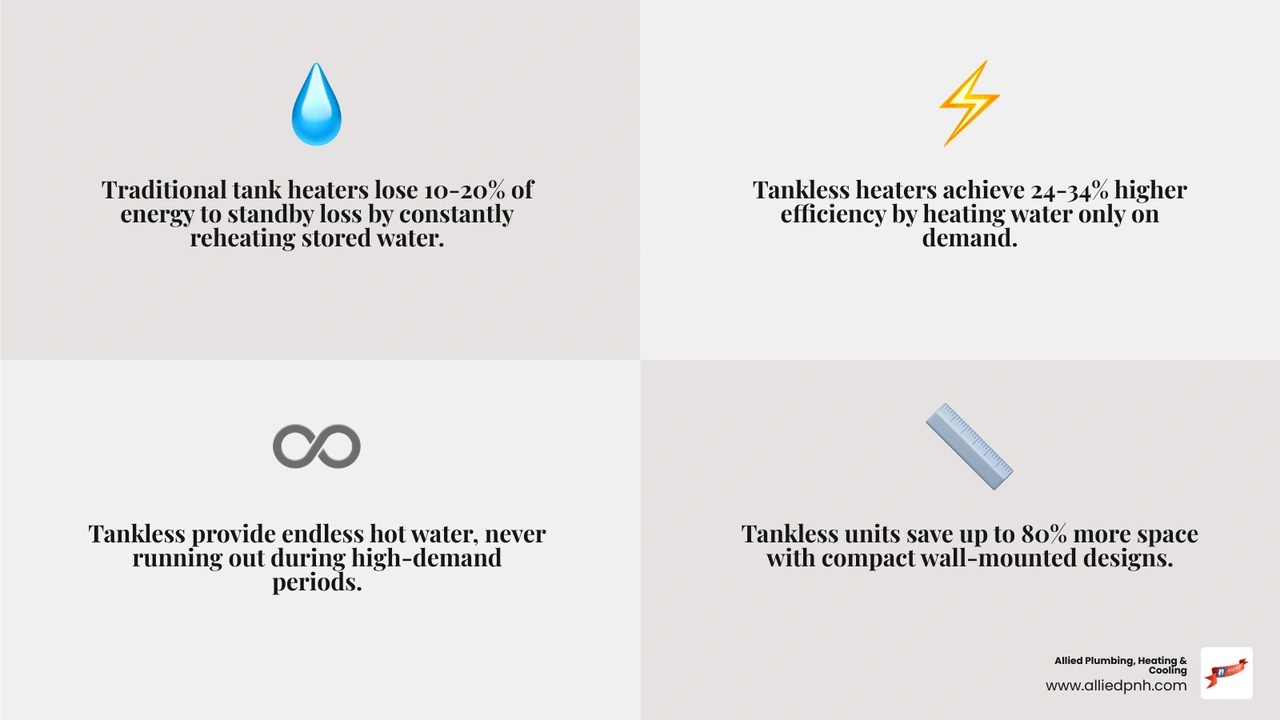
To understand if the investment makes sense, we first need to look at what’s happening behind your utility room door. Traditional water heaters are essentially large, insulated kettles. They keep 20 to 80 gallons of water hot 24/7, regardless of whether you’re sleeping, at work, or on vacation at Lake Springfield. This leads to something called "standby loss"—energy wasted just to keep that water sitting there at 120 degrees.
Tankless water heaters, often called "demand-type" or "instantaneous" heaters, work differently. When you turn on a hot water tap in your Rochester kitchen, a flow sensor detects the movement of water. This triggers a powerful burner (gas) or an electric element to activate. The cold water travels through a heat exchanger, which transfers heat to the water instantly.
Because there is no tank, there is no standby loss. You only pay to heat the water you actually use. However, this "on-demand" nature means the unit has to be incredibly powerful to jump from 50 degrees to 120 degrees in seconds. For a deeper look at the variety of systems available, check out our guide on the different types of water heaters.
If you're curious about the technical specs of these units, our tankless water heater complete guide breaks down the internal components that make this magic happen.
Is a tankless water heater worth it for your home's efficiency?
Efficiency is the primary "hook" for tankless systems, and the data from the Department of Energy (DOE) is quite clear. For homes in Chatham or Springfield that use a moderate amount of hot water (about 41 gallons or less per day), tankless systems can be 24% to 34% more energy efficient than traditional tanks.
Even in busier households using around 86 gallons a day, you can still see an 8% to 14% efficiency gain. In real-world numbers, this translates to annual savings of roughly $108 for gas models and $44 for electric ones. While that might not seem like a fortune each year, it adds up over the 20-year lifespan of the unit.
The "worth" of this efficiency often depends on your environmental goals. If you are looking to reduce your carbon footprint in Sangamon County, switching to a high-efficiency condensing gas model (which can reach 99% fuel-to-heat conversion) is a massive step forward. You can read more about the advantages switching to tankless water heaters to see how these efficiency gains impact your long-term utility outlook.

Pros and Cons: Evaluating the Tankless Investment
Deciding if a tankless water heater is worth it requires weighing the lifestyle benefits against the logistical hurdles.
• Hot Water Supply — Tankless Water Heater: Endless (on-demand) — Traditional Tank: Limited (by tank size)
• Lifespan — Tankless Water Heater: 20+ Years — Traditional Tank: 10–15 Years
• Space Required — Tankless Water Heater: Minimal (wall-mounted) — Traditional Tank: 9–12 Square Feet
• Upfront Investment — Tankless Water Heater: Higher — Traditional Tank: Lower
• Energy Efficiency — Tankless Water Heater: High (No standby loss) — Traditional Tank: Lower (Constant reheating)
• Maintenance — Tankless Water Heater: Annual flushing required — Traditional Tank: Minimal
The Pros
• Endless Hot Water: You can be the fourth person in the shower and the water will be just as hot as it was for the first.
• Space-Saving: These units are about the size of a carry-on suitcase. In a tight Rochester utility closet or a finished Springfield basement, freeing up 10 square feet of floor space is a big win.
• Reduced Leak Risk: Without 50 gallons of water sitting in a tank that can eventually rust through, the risk of a catastrophic flood in your home is significantly lower.
The Cons
• Flow Rate Limits: While the water is endless, it isn't "infinite" in volume. If you try to run two showers, the dishwasher, and the laundry at once, the unit may struggle to keep up.
• The "Cold Water Sandwich": If you turn the water off and right back on, you might get a brief burst of cold water that was sitting in the pipes between heating cycles.
• Infrastructure Needs: Many older homes in our area require upgrades to gas lines or electrical panels to handle the high power draw of a tankless unit.
For a full breakdown of these trade-offs, our tankless water heater benefits guide offers more detail.
Sizing and Installation Considerations in Rochester and Chatham
Sizing a tankless unit is more complex than just picking a "50-gallon" tank. We have to look at Gallons Per Minute (GPM) and your "temperature rise."
In Central Illinois, our groundwater temperature can drop significantly in the winter. If the water coming into your home is 40°F in January, and you want it to be 120°F at the tap, your heater has to work much harder than it would in a warmer climate. This means a unit rated for 7 GPM in Florida might only provide 4 GPM in Springfield during a cold snap.
Furthermore, roughly 60% of tankless installations require infrastructure upgrades. This could include:
1. Gas Line Upgrades: Tankless units need a lot of fuel quickly, often requiring a larger diameter pipe.
2. Venting: Gas models usually need specialized stainless steel or PVC venting that goes out through a side wall rather than up through the roof.
3. Electrical: Electric models often require a significant upgrade to your home's electrical panel (sometimes up to 200 amps just for the heater).
Because of these complexities, professional installation is non-negotiable. Our tankless water heater installation guide athens il provides context for the local requirements in the Springfield area.
Longevity and Maintenance Requirements
One of the strongest arguments for "worth" is longevity. A well-maintained tankless unit can last 20 to 25 years, nearly double the 10-to-15-year life of a standard tank. Since traditional tanks are essentially "disposable" appliances once they start to leak, the tankless unit's ability to have individual parts replaced makes it a much better long-term resident of your home.
However, that longevity is tied directly to maintenance.
Is a tankless water heater worth it when considering maintenance?
In Springfield, Rochester, and Chatham, we often deal with hard water. Hard water is the "silent killer" of tankless systems. Mineral scale (calcium and magnesium) builds up on the heat exchanger, acting like an insulator that makes the unit work harder and eventually causes it to fail.
To protect your investment, annual flushing (descaling) is required. This involves circulating a food-grade vinegar solution through the unit for about an hour to dissolve the scale. If you have a water softener, you might be able to extend the time between flushes, but it’s still a vital part of the tankless water heater maintenance guide.
Without this care, a unit that should last 20 years might only last 10. You can learn more about the how long does a tankless water heater last based on different maintenance schedules.
Making the Final Decision for Your Household
So, how do you decide? It often comes down to the payback period. Because the upfront investment is higher than a traditional tank, you have to look at how long it takes for the energy savings to "pay you back."
For gas-to-gas conversions, the payback period typically ranges from 22 to 27 years. For electric-to-electric, it’s often 12 to 20 years. If you plan to move in five years, you likely won't recoup the financial investment through energy savings alone—though the "endless hot water" might help with your home's resale value!
Determining if a tankless water heater is worth it for large families
For large families in Chatham or Rochester, the "worth" isn't just about dollars; it's about peace of mind. If your household has four or five people trying to get ready in the morning, the value of never running out of hot water is immense.
In very large homes, we sometimes recommend installing two units in parallel or using "point-of-use" units for distant bathrooms. This ensures that even with two showers and a dishwasher running, no one gets a cold surprise. If you're looking for the top-tier options, our list of the best tankless water heater models can help you narrow down your search.
Frequently Asked Questions about Tankless Systems
Can a tankless unit handle two showers at once?
Yes, provided it is sized correctly for our Central Illinois climate. A high-output gas unit (typically 8 to 10 GPM) can usually handle two moderate-flow showers simultaneously. However, if you have high-flow "rain" showerheads, you'll need to account for that extra demand during the sizing process.
How long do tankless water heaters really last?
The 20-year reality is very achievable with proper care. Unlike tank heaters, which are usually replaced entirely when one part fails, tankless units are designed with replaceable components. This modularity is a key part of their is a tankless water heater worth the investment calculation.
Does hard water affect performance?
Absolutely. Scale accumulation reduces the efficiency of the heat exchanger, meaning the unit has to burn more fuel to reach the same temperature. In our area, we strongly recommend a water softener to accompany any tankless installation to ensure you get the full efficiency benefits.
Conclusion
At Allied Plumbing, Heating & Cooling, we’ve been serving the Springfield, Rochester, and Chatham communities since 1977. As a three-generation family business, we’ve seen water heater technology evolve from simple tanks to the high-tech, high-efficiency tankless systems of today.
Is a tankless water heater worth it? If you value space, longevity, and a never-ending supply of hot water—and you plan to stay in your home for the long haul—it is a fantastic investment. If you're looking for the lowest possible upfront cost or you have a very small household, a traditional high-efficiency tank might still be your best bet.
We’re here to help you do the math. With our Daikin Comfort Promise and 12-year warranties, we ensure that whatever system you choose, you’ll have reliability and peace of mind for years to come.
Ready to see if your home is a good candidate for an upgrade? Schedule your tankless water heater consultation in Springfield with Allied Plumbing, Heating & Cooling today!