Is Switching From a Tank to a Tankless Water Heater Right for You?
Switching from tank to tankless what to know comes down to a handful of key factors: your home's gas line and electrical capacity, your household's peak hot water demand, your budget for upfront installation, and whether you plan to stay in your home long enough to recoup the investment.
Here's a quick summary before we dig in:
• Your water heater's age matters - If your tank is 8 years or older, now is the right time to plan ahead
• Infrastructure upgrades are often required - Gas lines, venting, and electrical circuits frequently need updating
• Proper sizing is critical - An undersized unit will leave you with lukewarm water during peak demand
• Annual maintenance is non-negotiable - Especially in areas with hard water like Springfield and Chatham, IL
• Long-term savings are real - Tankless units last 20-25 years versus 8-12 for tanks, and use significantly less energy
• Professional installation is essential - Gas, venting, and electrical work must meet local code requirements
If you own a home in Springfield, Rochester, or Chatham, IL and your tank water heater is aging, running out of hot water, or simply taking up space you'd rather reclaim, switching to a tankless system is worth a serious look. Traditional storage tank water heaters keep 40 to 80 gallons of water hot around the clock — even at 3 AM when nobody's using it. That constant reheating quietly drains energy and money every single day.
Tankless water heaters flip that model entirely. They heat water only when you turn on a faucet, which is why the U.S. Department of Energy estimates they can be 24-34% more energy-efficient for homes using 41 gallons or less per day. But here's the part most homeowners don't expect: the switch involves a lot more than swapping one appliance for another. Gas lines, venting systems, electrical circuits, and local permits all come into the picture — and getting any one of them wrong leads to frustrating (and expensive) problems down the road.
This guide walks you through everything you need to plan a successful tankless conversion, from understanding how these systems work to sizing them correctly for Illinois winters.
Understanding the Mechanics: Tank vs. Tankless
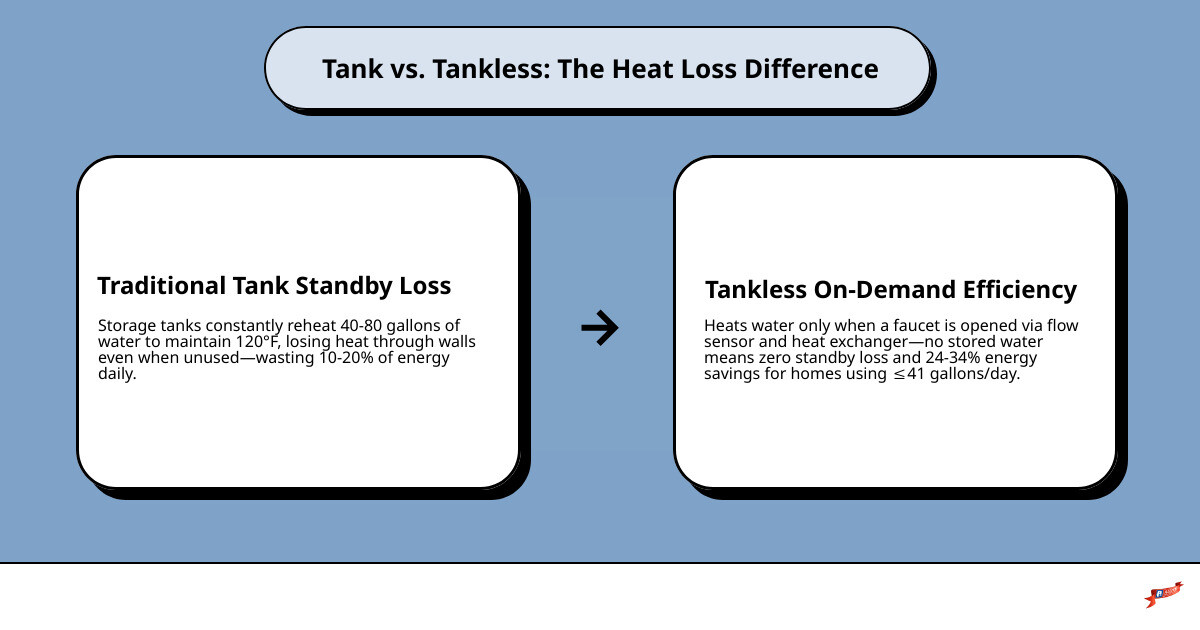
To understand why so many families in Rochester and Springfield are making the switch, we have to look at the "how." A traditional tank is essentially a giant kettle that never stops boiling. It uses a burner or element to keep a large volume of water at a set temperature (usually 120°F). Even when you are at work or asleep, the tank is losing heat through its walls—a phenomenon known as standby loss.
A tankless unit, or on-demand heater, stays dormant until you crack open a hot water tap. This action triggers a flow sensor, which ignites a high-powered burner. Cold water travels through a copper or stainless steel heat exchanger, which flash-heats the water to your desired temperature in seconds. Because there is no storage tank, there is no standby loss. For a deeper dive into the technical specs, check out our Tankless Water Heater Complete Guide.
The Core Differences in Water Delivery
The experience of using hot water changes when you go tankless. With a tank, you have a "thermal reserve." You can turn on three showers at once, and they will all be hot—until the tank runs dry. Then, you face the "recovery time," which is the 20 to 40 minutes it takes for the tank to heat a fresh batch of cold water.
Tankless units are flow-activated. They provide an endless stream of hot water, meaning you can take a shower for two hours and never run out. However, they have a limit on how many gallons they can heat at once. If you try to run too many appliances simultaneously, the unit might struggle to keep up with the flow, resulting in a temperature drop. Understanding these Advantages Switching to Tankless Water Heaters helps you set realistic expectations for your household.
Switching from tank to tankless what to know about efficiency
In May 2026, energy efficiency is more than just a buzzword; it’s a standard. Modern tankless units boast a Uniform Energy Factor (UEF) of up to 0.96, compared to roughly 0.60 to 0.70 for standard tanks. This means 96% of the energy used goes directly into heating your water.
For a household in Chatham using a typical amount of hot water, this efficiency can lead to a 60% reduction in energy costs compared to an old electric tank. While the initial setup is a bigger project, many homeowners find that Is a Tankless Water Heater Worth the Investment when they factor in the 20-year lifespan and lower monthly bills.
Switching from tank to tankless what to know about infrastructure
Converting to tankless isn't just an appliance swap; it’s an infrastructure upgrade. Because a tankless unit has to heat water from 45°F to 120°F in a matter of seconds, it requires a massive "burst" of energy. This creates four primary structural consequences: a demand spike in fuel, higher venting velocity, new electrical needs, and condensate management.
If you are planning a Tankless Water Heater Installation Springfield IL Guide, we recommend starting with an assessment of your current utility lines. Most older homes in our area were built to support the 30,000 to 50,000 BTU demand of a tank, not the 199,000 BTU demand of a whole-home tankless system.
Gas Line and Venting Requirements
One of the most common hurdles in Springfield is the gas line diameter. A traditional tank usually runs on a 1/2-inch gas line. A high-powered tankless unit often requires a 3/4-inch or even a 1-inch gas line to provide enough fuel for that 199,000 BTU/hr draw. Without this upgrade, your heater may underperform or "starve" your furnace of gas during the winter.
Venting is the second major change. Traditional tanks often vent through a shared masonry chimney. Tankless units, especially high-efficiency condensing models, produce exhaust that is much cooler but highly acidic. This requires specialized PVC or stainless steel venting that usually exits through a side wall rather than the roof. You can find more details on our Tankless Water Heaters Springfield IL service page.
Electrical and Condensate Management
Even though we’re usually talking about gas units, they still need electricity. A tankless heater requires a dedicated 120V circuit to power the computer board, ignition, and internal fans.
Furthermore, high-efficiency "condensing" units produce an acidic liquid byproduct as they squeeze every bit of heat out of the exhaust. This condensate has a pH level between 3 and 5. We install condensate neutralizers to treat this liquid before it enters your Rochester home’s drainage system, preventing it from eating away at your pipes.
Sizing Your System for Endless Hot Water
Sizing a tankless unit is nothing like sizing a tank. You don't look at "gallons," you look at Gallons Per Minute (GPM) and Temperature Rise. To find the Best Tankless Water Heater for your home, you have to imagine your "worst-case scenario"—like running the dishwasher, a load of laundry, and a shower all at the same time.
• Standard Showerhead — Typical GPM Requirement: 2.5 GPM
• Kitchen Faucet — Typical GPM Requirement: 1.5 - 2.0 GPM
• Bathroom Sink — Typical GPM Requirement: 0.5 - 1.0 GPM
• Dishwasher — Typical GPM Requirement: 1.0 - 2.0 GPM
• Washing Machine — Typical GPM Requirement: 2.0 GPM
Switching from tank to tankless what to know about peak demand
If you have a large family in Chatham, peak demand is your biggest concern. If your simultaneous usage adds up to 7 GPM, but your tankless unit is only rated for 5 GPM at a high temperature rise, someone is going to get a cold surprise in the shower. This is why we calculate your fixture count and flow rate limits before recommending a unit. Our Tankless Water Heater Benefits Guide highlights how proper sizing ensures that "endless hot water" promise actually holds true.
Climate Considerations for Illinois Homeowners
In Springfield and Rochester, our groundwater gets very cold in the winter—sometimes dipping into the 40s. To get that water up to a comfortable 120°F, the heater has to achieve a "degree rise" of about 75 to 80 degrees. The harder a heater has to work to raise the temperature, the lower its GPM output becomes. A unit that provides 9 GPM in Florida might only provide 5 GPM during an Illinois January. We always size systems based on these local winter lows.
Long-Term Maintenance and Efficiency Expectations
A tankless water heater is a precision machine. While a traditional tank might last 8 to 12 years before the bottom rusts out and floods your basement, a tankless unit can easily last 20 to 25 years. However, that longevity depends entirely on how you treat it. You can read more about this in our article on How Long Does a Tankless Water Heater Last.
Managing Hard Water in Springfield and Chatham
The biggest enemy of a tankless heater in Central Illinois is hard water. When water is heated, minerals like calcium and magnesium solidify and stick to the heat exchanger. This is called "scale." Because the passages in a tankless unit are so small, even a thin layer of scale can act as an insulator, making the unit work harder and eventually causing it to overheat and fail.
We often recommend a scale inhibitor or a water softener for our clients in Springfield and Chatham to protect their investment. Addressing Sediment Buildup in Tankless Water Heater early is the best way to avoid expensive repairs.
Professional Maintenance Requirements
Annual maintenance is non-negotiable. Once a year, a professional should flush the unit with a descaling solution to clear out mineral deposits. We also inspect the fan motor, clean the flow sensor (which can get "blinded" by debris), and check the venting for any obstructions like bird nests. Following a Tankless Water Heater Maintenance Guide keeps your warranty valid and your energy bills low.
Is a Tankless Conversion Right for Your Home?
So, should you "ditch the tank"? For many, the answer is a resounding yes. Beyond the energy savings, there is the benefit of space reclamation. Tankless units are about the size of a suitcase and mount on the wall, which can free up an entire closet or a corner of your basement in Springfield. Plus, since they don't store water, you eliminate the risk of a 50-gallon tank bursting and causing thousands in flood damage.
In 2026, there are also significant tax credits and utility rebates available for high-efficiency upgrades. If you're a business owner, our Tankless Water Heater Repair Commercial Guide Springfield IL explains how these benefits scale up for larger properties.
Ideal Candidates for Tankless Systems
You are a perfect candidate for a tankless switch if:
• You have a large family that constantly runs out of hot water.
• You have a massive soaking tub or hot tub that drains a standard tank instantly.
• You want to reclaim floor space for a remodel.
• You plan on staying in your home for at least 5 to 10 years to see the return on investment.
When to Stick with a Traditional Tank
Tankless isn't for everyone. We might suggest staying with a traditional tank if:
• You live alone and use very little hot water, making the efficiency gains negligible.
• Your home requires massive, cost-prohibitive electrical or gas line upgrades.
• You are planning to sell the home in the next year and won't benefit from the long-term savings.
Frequently Asked Questions about Tankless Conversions
How long does the installation process take?
A standard tank-to-tankless conversion usually takes a full day (8 to 10 hours). This includes removing the old tank, upgrading the gas line, running new venting, and mounting the new unit.
Will I have hot water during a power outage?
Standard gas tankless units require electricity to operate the ignition and computer board. However, many models can be plugged into a small battery backup or portable generator to keep the hot water flowing during a storm.
Are there rebates available for Springfield residents in 2026?
Yes! Many local utility providers and federal programs offer incentives for switching to high-UEF appliances. We stay up-to-date on these programs to help our customers save as much as possible.
Conclusion
Switching to a tankless water heater is one of the smartest upgrades you can make for your home's comfort and efficiency. At Allied Plumbing, Heating & Cooling, we’ve been serving the Springfield, Rochester, and Chatham communities for three generations. As a family-owned business since 1977, we take pride in our "Daikin Comfort Promise," offering 12-year warranties that give you total peace of mind.
Whether you're tired of cold showers or looking to lower your carbon footprint, our expert team is here to ensure your conversion is done safely, legally, and perfectly sized for your needs.
Ready to make the switch? Schedule your tankless water heater consultation in Springfield, IL today and experience the luxury of endless hot water.