Why What Homeowners Should Know About Repiping Could Save Your Home
What homeowners should know about repiping comes down to a few key points:
• What it is: Repiping means replacing all or most of the water supply pipes in your home with new, modern materials.
• When you need it: Aging pipes (especially galvanized steel, polybutylene, or lead) that cause rust-colored water, low pressure, frequent leaks, or odd tastes are strong signs.
• Best materials: PEX and copper are today's top choices — both durable, safe, and long-lasting.
• How long it takes: Most homes are repiped in 1 to 5 days, depending on size and complexity.
• The payoff: Better water quality, stronger pressure, fewer repairs, and higher home value.
Your home's plumbing works quietly in the background — until it doesn't. For many older homes, the pipes hidden inside walls and under floors are slowly failing. Galvanized steel corrodes from the inside out. Polybutylene cracks under pressure. Lead pipes pose real health risks. When those problems compound over years, no amount of patching fixes the root cause.
Repiping is the solution that addresses the whole system — not just the symptom. It's one of the most impactful upgrades a homeowner can make, and yet it's one of the least understood. Many homeowners only consider it after a serious leak or a failed inspection. The good news? When you know what to look for and what to expect, the process is far less intimidating than it sounds.
This guide walks you through everything — from the warning signs your pipes are failing, to material choices, timelines, and what life looks like during and after the project.
What Homeowners Should Know About Repiping Their Springfield IL Property
When we talk about Repiping Springfield IL, we are usually looking at the aging infrastructure that defines many of our beautiful, historic neighborhoods. If your home was built several decades ago, it likely contains plumbing materials that have simply reached the end of their natural lifespan.
What homeowners should know about repiping begins with identifying what is actually behind your walls. In many older properties across central Illinois, we find three primary culprits:
1. Galvanized Steel: Common in homes built between the 1930s and 1970s, these pipes are notorious for "dezincification." Over time, the protective zinc coating wears off, leading to internal rust and corrosion that chokes off water flow.
2. Polybutylene: Often called the "ticking time bomb" of plumbing, this flexible gray plastic was used heavily in the 1980s and 90s. It reacts poorly to water treatment chemicals, becoming brittle and prone to sudden, catastrophic failure.
3. Lead Pipes: Found in very old homes (pre-1920s), lead is a significant health hazard. If your home still has lead service lines or interior piping, replacement isn't just a maintenance choice; it's a safety priority.
System replacement involves removing these outdated water lines and replacing them with pressurized supply lines made of modern, durable materials. This ensures your home’s infrastructure is ready for the next 50 to 100 years.
Red Flags: When to Replace Your Home's Plumbing
Understanding what homeowners should know about repiping means learning to "listen" to your house. Your plumbing system rarely fails without giving you a few warning shots first. If you notice a strange metallic taste in your morning glass of water or hear a "banging" sound (water hammer) when you turn off the tap, your pipes are trying to tell you something.
Other common red flags include:
• Mineral Deposits: Visible crusty buildup around pipe joints or faucets.
• Fluctuating Temperatures: That sudden "scald" in the shower when someone flushes a toilet is often caused by corroded pipes that can't balance pressure properly.
• Visible Corrosion: If you have access to a basement or crawlspace, look for blue-green stains (on copper) or rust (on steel).
If these issues sound familiar, it may be time to consult a professional about Repiping Springfield IL to prevent a major emergency down the road.
What homeowners should know about repiping for better water quality
One of the most immediate benefits of a repipe is the transformation of your water quality. Old galvanized pipes don't just leak; they flake. Inside the pipe, layers of rust and sediment build up over decades. When you turn on the faucet, this debris can end up in your drinking water, your bathtub, and even your laundry.
If you’ve noticed discolored, "tea-colored," or rusty water—especially after the water has been sitting for a few hours—it’s a sign of internal pipe decay. What homeowners should know about repiping is that it removes these contaminants at the source, ensuring your family has access to clean, clear, and safe water for drinking and bathing.
What homeowners should know about repiping to stop frequent leaks
Are you on a first-name basis with your local plumber because of constant "spot repairs"? While fixing a single pinhole leak is manageable, it is often a symptom of a systemic failure. Pinhole leaks in copper or cracks in polybutylene usually mean the entire run of pipe is thinning or becoming brittle.
Slab leaks—leaks occurring under your home's concrete foundation—are particularly dangerous and expensive to fix individually. What homeowners should know about repiping is that a full system replacement stops the cycle of water damage and mold growth. By replacing the pressurized lines, you eliminate the risk of hidden moisture that can rot your subfloors and compromise your home’s structural integrity.
PEX vs. Copper: Choosing the Best Material
Choosing the right material is a big part of what homeowners should know about repiping. Today, the industry standard has shifted toward two main contenders: Copper and PEX (cross-linked polyethylene).
• Lifespan — Copper (Type L): 50–100 Years — PEX-A (Flexible Tubing): 40–50+ Years
• Corrosion Resistance — Copper (Type L): High (but sensitive to acidic water) — PEX-A (Flexible Tubing): Total (Immune to scale/corrosion)
• Freeze Resistance — Copper (Type L): Rigid (Can burst) — PEX-A (Flexible Tubing): Flexible (Expands/contracts)
• Installation — Copper (Type L): Labor-intensive (Soldering/Joints) — PEX-A (Flexible Tubing): Faster (Fewer fittings/Flexible)
• Cost — Copper (Type L): Premium — PEX-A (Flexible Tubing): Economical
• Special Properties — Copper (Type L): Naturally antimicrobial — PEX-A (Flexible Tubing): Quiet water flow (No water hammer)
What homeowners should know about repiping with modern materials
When we perform a repipe, we focus on durability and flexibility.
Copper remains a favorite for many because of its long-standing track record. It is naturally resistant to bacteria and can withstand high temperatures and UV exposure. However, it is rigid, which means we have to cut more "access points" in your walls to install it.
PEX, specifically PEX-A, has revolutionized the industry. Because it is flexible, we can often "fish" it through walls much like electrical wiring, which means fewer holes in your drywall. It’s also highly resistant to the freezing temperatures we experience in central Illinois; because the material can expand, it is much less likely to burst during a cold snap. Choosing modern materials is a long-term investment that pays off in both reliability and peace of mind.
The Step-by-Step Repiping Process and Managing Disruptions
Many people worry that a repipe means their home will be a construction zone for weeks. What homeowners should know about repiping is that a professional team can complete the project with surprisingly little disruption to your daily life.
Here is how we typically handle the journey:
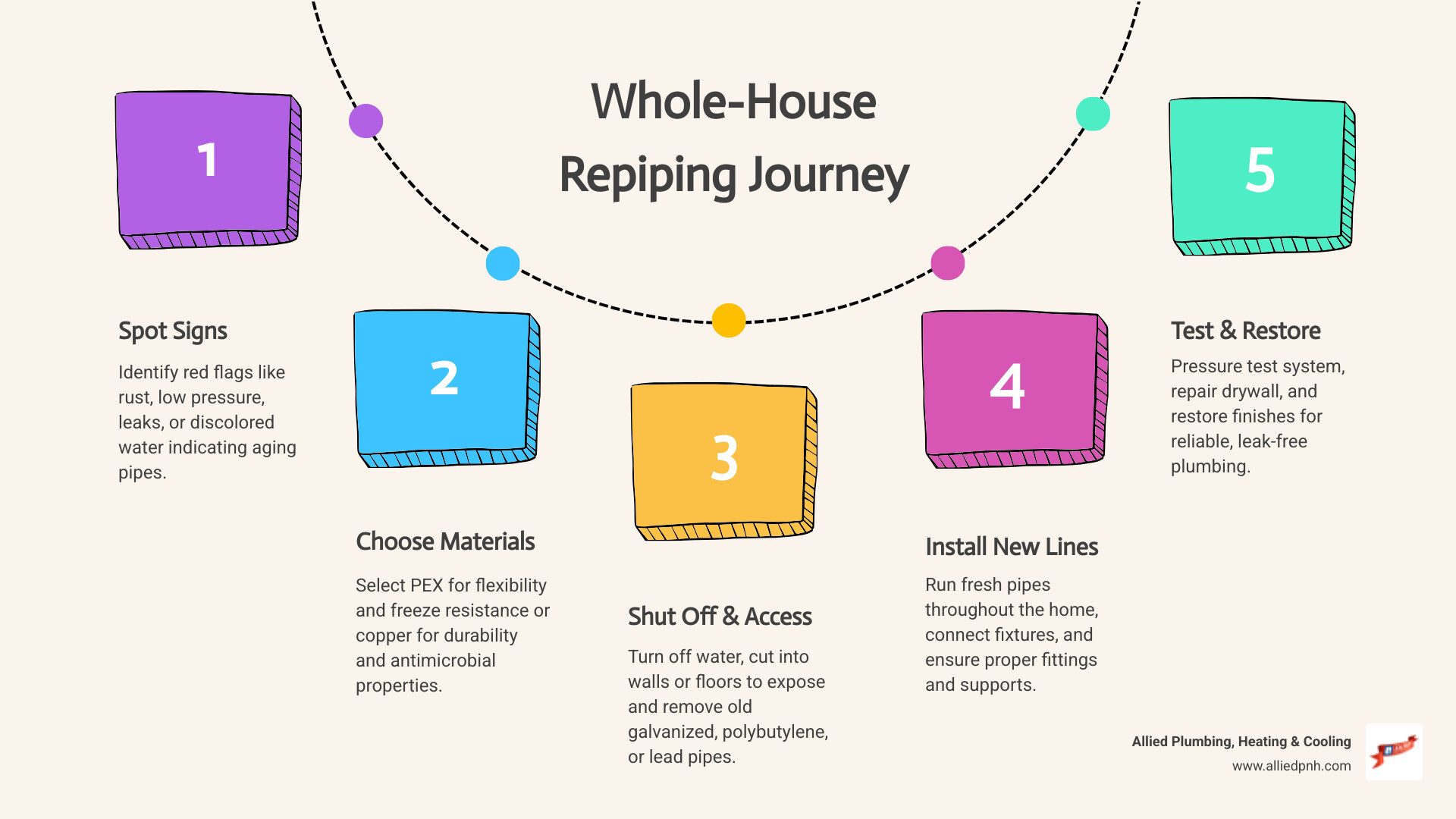
1. Inspection and Planning: We map out the existing lines and determine the most efficient routes for the new ones. This includes securing all necessary municipal permits.
2. Preparation: We protect your floors and furniture. We then create small, strategic drywall access points to reach the old pipes.
3. The "Switch": We install the new lines (PEX or copper). The water is typically only shut off during the day while we work and is often turned back on in the evening so you can use your facilities.
4. Pressure Testing: Before we close anything up, we perform rigorous testing to ensure every connection is watertight and the system meets all local codes.
5. Wall Restoration: Once the plumbing is inspected, the "messy" part begins—patching the drywall and textures to make it look like we were never there.
Most projects for a standard two-bath home are completed in 3 to 5 days, with the actual plumbing work often taking just 1 or 2 of those days.
Frequently Asked Questions about Repiping
How long does a typical repiping project take?
For a small, one-bath home, the process can often be finished in 1 to 2 days. For an average two-bath home, expect 3 to 5 days. Larger, complex, or multi-story homes may take up to a week. This timeline includes the plumbing installation, inspections, and drywall patching.
Do I need to move out of my home during the process?
No, you typically do not need to move out. We work in "zones" to ensure you have access to at least one functional bathroom or kitchen area as much as possible. While the water will be shut off during work hours, we prioritize restoring service each evening.
Does repiping address issues with my home's drain lines?
Generally, a standard repipe focuses on the pressurized supply lines (the water coming into your fixtures). Drain line replacement (the water going out) is a separate process. However, during a repipe, we often update shut-off valves and connections to your water heater, which improves the overall health of your plumbing system.
Conclusion
Repiping is more than just a repair; it’s a total game changer for the safety, comfort, and value of your home. By moving away from aging galvanized or lead pipes and embracing modern solutions like PEX or copper, you’re protecting your property from the inside out.
At Allied Plumbing, Heating & Cooling, we’ve been serving our neighbors in Springfield, Chatham, Rochester, and the surrounding areas since 1977. As a 3rd generation family business, we understand the unique needs of central Illinois homes. We take pride in our 24/7 service and our commitment to the Daikin Comfort Promise, ensuring that every job we do provides you with long-term reliability.
Don't wait for a major leak to ruin your day. If you're ready to upgrade your home's "circulatory system," contact us today to learn more about Repiping Springfield IL. We’re here to give you the peace of mind that comes with a job done right.