Identifying Older Galvanized Pipes in Historic Chatham Homes Before Winter Hits
Identifying Older Galvanized Pipes in Historic Chatham Homes Before Winter Hits
Protecting Your Historic Plumbing As Freezing Temperatures Approach
Identifying older galvanized pipes in historic Chatham homes before winter hits is one of the most critical steps you can take to protect your property this October. Here at Allied Plumbing Heating & Cooling, we know that the crisp autumn air in Central Illinois serves as a stark reminder that freezing temperatures are just weeks away. While the architectural charm and unique character of owning a historic home in our region are undeniable, the aging infrastructure hidden behind those beautiful plaster walls often tells a different story. As the seasons change and temperatures begin their downward slide, a hidden danger lurks inside older plumbing systems. Taking proactive steps right now, during the October pre-winter freeze window, is the best way to prevent a catastrophic plumbing emergency later in the season. Before the ground freezes solid and the deep chill sets in, an immediate assessment of your home's water lines is absolutely necessary to ensure they can withstand the coming thermal stress.
If you need professional assistance evaluating your system, securing expert plumbing services now ensures your historic property remains safe and functional throughout the coldest months of the year.
The Hidden Vulnerability in Pre-1960s Construction
To understand why your home might be at risk, you have to look at the materials used when it was built. Pre-1960s construction relied heavily on galvanized steel plumbing. At the time, builders favored this material because the zinc coating applied to the steel was supposed to prevent rust and corrosion. However, decades of constant exposure to water chemistry inevitably break down that protective barrier. Once the zinc deteriorates, the bare steel underneath begins to oxidize rapidly.
According to InterNACHI life expectancy charts, galvanized steel pipes typically last between 40 to 50 years. In our years of servicing historic Springfield and Chatham properties, our team routinely finds that any original pipes remaining in mid-century or older homes are now well past their intended operational lifespan. The most deceptive part of this aging process is that the exterior of the pipe may look perfectly fine to the naked eye, while the interior is severely compromised and slowly choking off your water supply. Ignoring this hidden decay often forces homeowners to schedule emergency burst pipe repair once the system finally gives out under pressure.
The Lifespan of Galvanized Steel
Understanding the historical context of mid-20th-century plumbing materials helps explain why this is such a widespread issue. The zinc coating breaks down unevenly, meaning some sections of your plumbing may fail long before others. Here is a quick look at how galvanized steel compares to other common materials found in older homes:
• Galvanized Steel — Typical Installation Era: Pre-1960s — Average Lifespan: 40 - 50 Years — Primary Failure Mode: Internal rust and flow restriction
• Copper Piping — Typical Installation Era: 1960s - Present — Average Lifespan: 50+ Years — Primary Failure Mode: Pinhole leaks from acidic water
• Cast Iron (Drains) — Typical Installation Era: Pre-1970s — Average Lifespan: 50 - 75 Years — Primary Failure Mode: Channeling and structural collapse
How Internal Rust Accelerates Winter Pipe Failures
The physical degradation of galvanized pipes directly increases the risk of freezing and bursting. This happens through a process called tuberculation. Tuberculation is the buildup of internal rust and mineral deposits that severely restricts water flow. Instead of a smooth, open cylinder, the inside of a corroded pipe looks like a rocky cavern. This internal constriction creates uneven surfaces and drastically reduces the volume of water the pipe can hold.
A pattern we see often on emergency winter calls in Central Illinois is that this restricted water flow becomes a major liability when rapid temperature drops occur. A smaller volume of water loses its heat much faster than a full, steady current. The uneven, rusty surfaces provide the perfect catching points for ice crystals to form. As the restricted water turns into a sudden ice blockage, the physics of your plumbing system change dramatically.
The Threat of Tuberculation
Most homeowners assume that the ice expanding is what breaks the pipe. The truth is actually about pressure. When water freezes, it expands by about nine percent. If a pipe is already narrowed by tuberculation, that expanding ice acts like a piston. It pushes the remaining liquid water toward a closed faucet. Because water cannot be compressed, the pressure between the ice blockage and the closed faucet spikes rapidly. It is this massive pressure spike—often exceeding thousands of pounds per square inch—that ultimately causes the pipe to rupture. In the October pre-winter freeze window, addressing tuberculation is your best defense against this chain reaction.
Safe, Non-Invasive Signs of Galvanized Pipe Corrosion
You do not need to tear into your walls to figure out if your pipes are failing. Our technicians always recommend actionable, safe ways to identify failing pipes without resorting to destructive DIY exploration. Because historic homes often feature fragile original plaster and custom woodwork, non-invasive checks are always the best starting point.
Rusty or Discolored Water
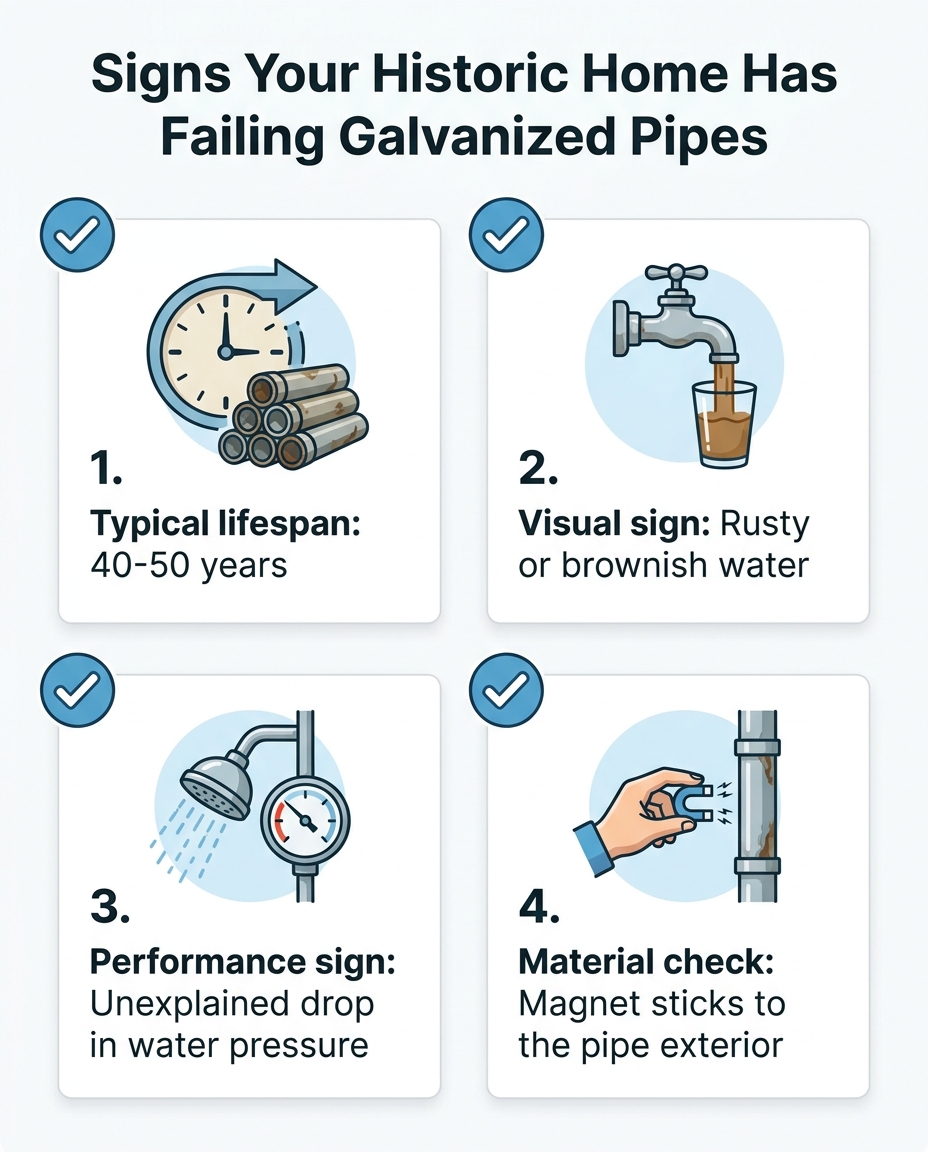
The morning check: Look for rusty or brownish discoloration in your water, especially when turning on a tap after it has sat unused overnight. If the water runs brown for a few seconds and then clears up, you are seeing oxidation from the inside of your pipes. It is important to differentiate between water heater rust (which only shows up when you run the hot water) and pipe rust (which appears on both the hot and cold sides).
Unexplained Drops in Water Pressure
The flow test: A noticeable drop in water pressure across the house is a primary symptom of internal pipe constriction. Test the pressure by turning on multiple fixtures at once. If turning on the kitchen sink causes the bathroom shower to slow to a trickle, your system is struggling to deliver adequate volume through narrowed pipes.
1. Check the water color: Run the cold water first thing in the morning and watch for a brown or reddish tint.
2. Test multiple fixtures: Turn on a shower and a sink simultaneously to observe any drastic pressure drops.
3. Perform the magnetic test: Take a standard refrigerator magnet and hold it against an exposed water line in your basement or crawlspace. If the magnet sticks firmly to the pipe, it is galvanized steel. Magnets will not stick to copper or plastic piping.
4. Avoid DIY dismantling: As licensed professionals, we cannot stress this enough—never attempt to take apart aging plumbing fixtures yourself. Brittle, aging pipes can easily shatter, and corroded threads will strip, turning a simple check into an immediate flood.
Just as you might schedule routine backflow testing in Chatham to ensure your water quality remains high, you should regularly monitor your fixtures for these physical signs of internal decay.
Signs Your Historic Home Has Failing Galvanized Pipes
Why October is the Critical Window for Local Homeowners
Timing is everything when it comes to maintaining a historic property. At Allied Plumbing Heating & Cooling, we consider October the ideal time for a comprehensive plumbing assessment. The weather is still mild enough that the ground has not frozen, making any necessary exterior or crawlspace work much easier to complete. Waiting until November or December often means dealing with emergency repairs rather than preventative maintenance.
When the first hard freeze hits Historic Chatham, local professionals are instantly flooded with emergency calls. By scheduling your evaluation now, you secure the value of having a trusted professional evaluate your entire system's winter readiness without the stress of a looming snowstorm. Routine seasonal checkups help catch vulnerabilities—like severe tuberculation or weakened pipe joints—before they become property-damaging leaks.
Beating the November Rush
If you discover that your system is indeed heavily corroded, finding out in October gives you the breathing room to make smart decisions. You have time to review your options, plan a budget, and consider repiping your older home in a controlled, methodical way. Once the deep winter sets in, your options narrow strictly to emergency damage control.
Preserving Your Home with Professional Local Expertise
Working on a home built fifty, eighty, or a hundred years ago requires a completely different approach than servicing a modern subdivision build. The delicate nature of inspecting and updating plumbing in historic homes means you cannot simply cut holes in walls indiscriminately. Preserving original plaster, custom millwork, and vintage fixtures is just as important as fixing the plumbing behind them.
A professional pre-winter inspection focuses heavily on non-invasive diagnostic tools. Technicians use specialized cameras, pressure gauges, and thermal imaging to assess the health of your system without causing unnecessary damage to your home. As a local, family-owned business, our team at Allied Plumbing Heating & Cooling has extensive firsthand experience safely updating historic homes in the Chatham and Springfield areas. We understand the unique architectural quirks of these classic properties and know exactly how to navigate their hidden spaces.
Phased Modernization for Classic Properties
Complex plumbing updates require licensed, experienced hands. However, discovering that your galvanized pipes are failing does not always mean you have to gut the entire house tomorrow. A professional can outline the long-term benefits of planning a strategic, phased modernization of your aging plumbing. By tackling the most vulnerable sections first—such as exposed runs in unheated crawlspaces—you can drastically reduce your winter risk while planning for a full update down the road.
Frequently Asked Questions About Galvanized Plumbing in Winter
How do I know if my galvanized pipes are bad?
The most common indicators are rusty or brown water when you first turn on the tap and a noticeable drop in overall water pressure. You might also see visible rust forming on the outside of exposed pipe joints in your basement. If your home was built before 1960 and still has its original plumbing, it is highly likely the pipes have reached the end of their lifespan.
At what temperature do galvanized pipes freeze?
Water inside any pipe begins to freeze when the ambient temperature around the pipe drops below 20 degrees Fahrenheit for an extended period. However, because internal rust restricts water flow and reduces the volume of water inside a galvanized pipe, they can freeze faster than clean copper or PEX lines under the exact same conditions.
Why do old pipes burst in the winter?
Old pipes burst because freezing water expands by about nine percent, creating an intense pressure spike between the ice blockage and a closed faucet. Galvanized pipes are especially prone to bursting because decades of internal corrosion weaken the steel walls. When the pressure spikes, the compromised metal simply cannot hold the force.
Can you clear rust out of galvanized pipes?
No, you cannot safely or effectively clear severe rust out of old galvanized pipes. The corrosion is chemically bonded to the steel, and attempting to flush or scrape it out will likely puncture the weakened pipe walls. The only permanent solution for heavily tuberculated galvanized plumbing is replacement.
Is a plumbing inspection necessary every fall for older homes?
Yes, an annual fall inspection is highly recommended for homes built prior to the 1960s. Because older materials degrade predictably over time, a yearly check allows professionals to monitor the progression of corrosion. Catching a severe restriction in October prevents a catastrophic pipe burst in December.
Schedule Your Pre-Winter Plumbing Inspection Today: Identifying Older Galvanized Pipes in Historic Chatham Homes Before Winter Hits
Leaving compromised pipes unchecked as the temperatures drop is a risk your property cannot afford. Identifying older galvanized pipes in historic Chatham homes before winter hits guarantees that you stay ahead of the freezing weather and avoid the chaos of an emergency rupture. Secure your peace of mind by taking action while the October weather is still on your side. Contact your local experts at Allied Plumbing Heating & Cooling today to schedule a thorough, non-invasive plumbing assessment, and ensure your historic home remains warm, dry, and protected all winter long.
Identifying Older Galvanized Pipes in Historic Chatham Homes Before Winter Hits
October 10, 2026
Freezing temperatures put immense stress on pre-1960s plumbing. Spotting hidden internal corrosion early helps you decide if a drop in water pressure warrants a professional inspection.
Freezing temperatures put immense stress on pre-1960s plumbing. Spotting hidden internal corrosion early helps you decide if a drop in water pressure warrants a professional inspection.
Standard vs Modulating Gas Valves for Consistent Heating in Two-Story Homes
October 9, 2026
Extreme temperature differences between floors often come down to your furnace's gas valve. See how a modulating system balances airflow to eliminate hot and cold zones.
Extreme temperature differences between floors often come down to your furnace's gas valve. See how a modulating system balances airflow to eliminate hot and cold zones.
Why Your Furnace Blower Keeps Running After the Burners Shut Off
October 8, 2026
That cool breeze from your vents after a heating cycle isn't always a malfunction. Understand how the fan limit switch actively protects your heat exchanger from cracking.
That cool breeze from your vents after a heating cycle isn't always a malfunction. Understand how the fan limit switch actively protects your heat exchanger from cracking.