The Hidden Impact of Closed Bedroom Doors on Your Central Air Return Vents
The Hidden Impact of Closed Bedroom Doors on Your Central Air Return Vents
The Late-Summer Cooling Struggle: When a Clean Filter Isn't Enough
As the hottest days of the year begin to fade, you might be surprised to learn about the hidden impact of closed bedroom doors on your central air return vents. The late August back-to-school transition brings new daily routines, shifting family schedules, and suddenly, an air conditioner that runs non-stop or freezes up completely. You check the thermostat, and it reads higher than your setting. You change the air filter, but the house still feels warm and sticky. If you need immediate professional help to restore your home's comfort, you can always rely on our expert air conditioning services.
Many homeowners immediately assume the worst when their system struggles during the late summer heat. You might think you have a massive refrigerant leak or a burned-out compressor. However, the true culprit is often a simple, behavioral airflow bottleneck that forces your system to work twice as hard. Understanding how everyday habits affect your HVAC system can save you from unnecessary panic and help you keep your equipment running smoothly.
Common Misdiagnoses for a Struggling AC
When an air conditioner fails to cool the house, our technicians at Allied Plumbing Heating & Cooling often arrive to find homeowners jumping to mechanical conclusions. Based on the countless service calls we run across Springfield during late summer, here are a few common assumptions that often mask a deeper airflow issue:
• Low refrigerant levels: While a leak can cause freezing, it is not the only reason an evaporator coil turns to ice.
• A failing blower motor: A motor that sounds like it is struggling might just be fighting against severe pressure imbalances in the house.
• An undersized system: If your AC cooled perfectly in June but struggles in late August, the size of the unit is likely not the problem.
The real "aha!" moment comes when you realize that changing family habits can inadvertently choke your cooling system. By learning a little bit about home airflow physics, you can resolve these bottlenecks and get your system back on track.
The Physics of Home Airflow: Supply vs. Central Returns
To understand why a simple interior door causes so much trouble, you have to look at how your home breathes. A central HVAC system operates on a closed-loop principle. It pushes conditioned air into your living spaces and pulls the exact same amount of warm air back in to be cooled again. This delicate balance relies on static pressure. If the pressure is unbalanced, the entire system suffers.
In our years of servicing older and mid-century Springfield IL homes, our team frequently encounters central hallway returns designed with a single, large intake grille rather than individual return vents in every room. This design relies entirely on open pathways. The blower motor is calibrated to pull a specific volume of air, measured in cubic feet per minute (CFM), through that central hallway vent. When the pathway is clear, the system stays perfectly balanced.
The Two Halves of Your Airflow System
Understanding the difference between the two main types of vents in your home is the first step toward better airflow management. If you are looking to improve your overall indoor environment, balancing these vents is just as important as exploring dedicated indoor air quality solutions.
• Supply Registers — Primary Function: Blows cold, conditioned air into the room. — Typical Location: Floor, ceiling, or high on walls in every room. — Air Pressure Effect: Pressurizes the space (adds air).
• Central Return Grilles — Primary Function: Pulls warm, stale air back to the HVAC unit. — Typical Location: Central hallways, stairwells, or main living areas. — Air Pressure Effect: Depressurizes the space (removes air).
When a system is perfectly balanced, the supply registers push air into a room, and that air naturally drifts out into the hallway to be sucked back into the central return grille. The blower motor does not have to strain, and the static pressure remains neutral. However, this delicate balance is easily disrupted by everyday household barriers.
The Back-to-School Bottleneck: Pressurized Rooms and Starved Vents
The August back-to-school transition is a prime time for airflow issues to surface. As school starts, teenagers spend more consecutive hours in closed bedrooms studying, gaming, or simply seeking privacy. This behavioral shift creates a massive disruption in how air moves through your house.
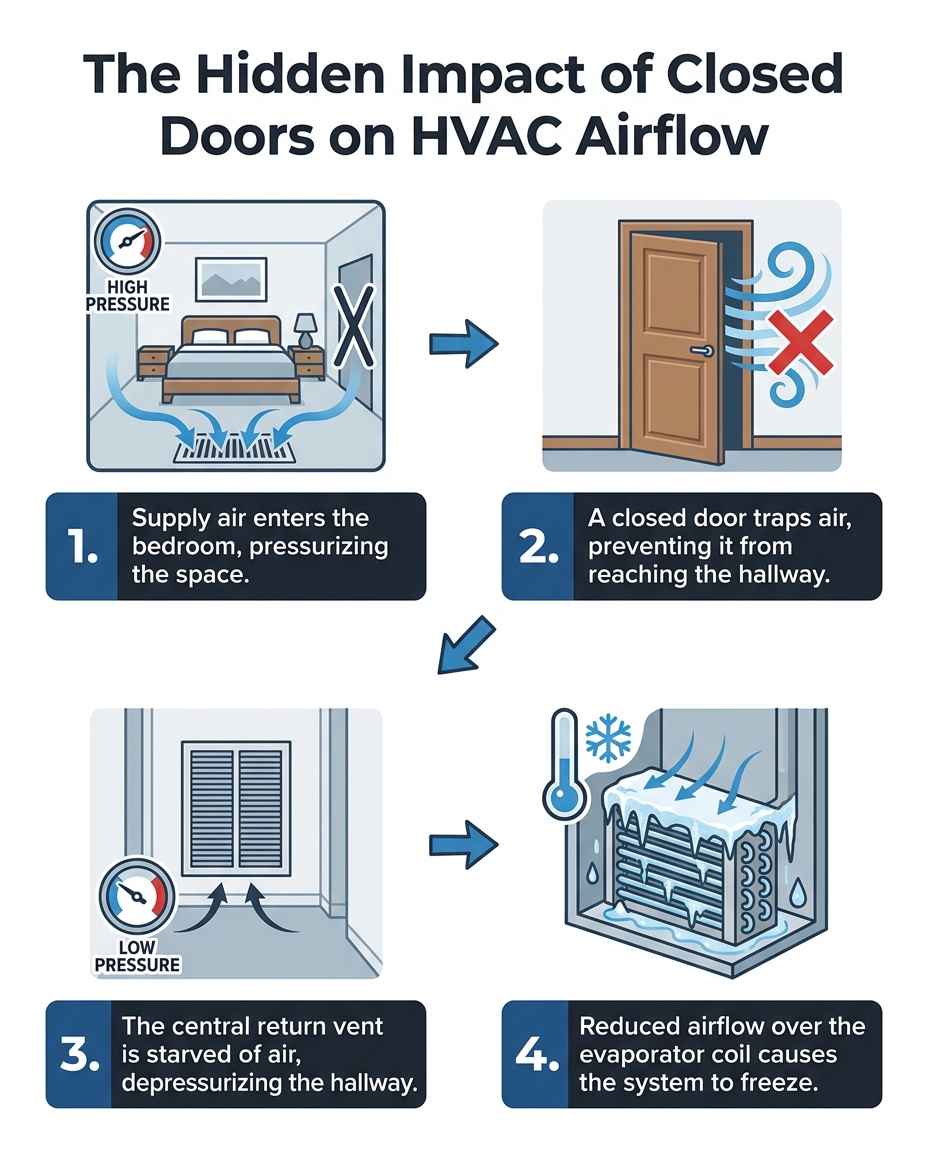
When a bedroom door is shut, the supply register continues to pump cold air into the room. Because the air has no easy path back to the hallway, it becomes trapped. This creates a pressurization effect. The bedroom becomes a high-pressure zone, like a balloon being slowly inflated. The air pushes against the walls, windows, and the closed door, trying to find a way out.
The Starved Hallway Effect
While the closed bedroom is experiencing high positive pressure, the central hallway is experiencing the exact opposite. The large central return grille is still trying to pull its required CFM of air, but a significant portion of the house's air is now locked behind closed doors. This creates a depressurization effect in the hallway.
The central return is effectively starved. The blower motor begins to work much harder, straining against the negative pressure to pull whatever air it can find. This imbalance forces the motor to run hotter and consume more electricity, all while moving significantly less air through the system. The house feels uncomfortable, the system runs continuously, and the stage is perfectly set for a major cooling failure.
The Hidden Impact of Closed Doors on HVAC Airflow
The Perfect Storm: Restricted Airflow Meets High Humidity
Starving the central return does more than just strain the blower motor; it actively changes the temperature dynamics inside the indoor HVAC unit. To understand how a closed door leads to a block of ice, you have to look at the evaporator coil. This coil sits inside your ductwork and is filled with highly chilled liquid refrigerant.
Under normal conditions, a steady stream of warm return air flows over this coil. The heat from the air transfers into the refrigerant, and the newly cooled air is blown back into the house. But when bedroom doors are closed and the return air volume (CFM) drops, there is simply not enough warm air passing over the coil to keep the refrigerant warm.
How Condensation Turns to Ice
Without enough warm air to absorb the cooling energy, the temperature of the refrigerant inside the coil drops rapidly below freezing. This is where the local climate plays a major role. Our technicians regularly see how Springfield's hot and highly humid late summers create excess condensation on evaporator coils, meaning there is an abundance of moisture present inside the unit.
When the coil drops below freezing, that excess condensation rapidly turns to ice. The ice builds up, further blocking the airflow, which causes the coil to get even colder. It is a vicious cycle that quickly results in a completely frozen system. This is fundamentally a physics problem caused by a behavioral bottleneck, not necessarily a broken part. If you want to understand the deeper mechanics of this process, you can read more about why your AC is freezing up during hot weather.
Diagnosing the Issue: Mechanical Failure or Family Habit?
When you notice your air conditioner struggling, running constantly, or failing to cool the house, your first step is to determine whether you are dealing with a behavioral airflow bottleneck or a true mechanical failure. Before you pick up the phone, take a few minutes to walk through a basic diagnostic check.
If you live in one of the many Springfield IL homes with central hallway returns, paying attention to interior doors is the most crucial part of this process. Follow these steps to narrow down the problem:
1. Check the thermostat and filter: Verify that the thermostat is set correctly to "cool" and "auto." Then, pull out your air filter. If it is caked in dust, replace it immediately, as a dirty filter restricts airflow just as severely as a closed door.
2. Walk the house to check interior doors: Look at every room in the house. Are the bedroom doors shut? Are bathroom doors closed? If multiple doors are closed while the AC is running, you have likely found your airflow bottleneck.
3. Safely thaw the system: If you suspect the coil is frozen (often indicated by ice on the copper refrigerant lines outside or a lack of air coming from the vents), turn the cooling function off at the thermostat. Turn the fan setting from "auto" to "on." This blows unchilled air over the coil to melt the ice safely.
4. Monitor for recurring freezing: Once the system thaws, leave all interior doors open and turn the cooling back on. If the system cools normally and does not freeze again, the closed doors were the culprit.
If the system thaws, the filter is clean, and all doors are left wide open, but the system freezes up again, it is time to suspect a mechanical issue like a refrigerant leak or a failing blower motor. Remember, you should never attempt DIY refrigerant handling or mechanical repairs. Always call a licensed professional for internal system diagnostics.
Practical Airflow Solutions That Respect Privacy
Telling a teenager they must keep their bedroom door wide open at all times is rarely a successful strategy. As a local, family-owned provider, our team at Allied Plumbing Heating & Cooling understands real-world family dynamics. We've helped countless Springfield families find practical, family-friendly compromises that balance the HVAC system's need for airflow with a family's need for closed doors.
Fortunately, there are several ways to restore static pressure balance and prevent future freeze-ups without sacrificing privacy. These solutions range from simple daily habits to minor HVAC modifications that permanently solve the problem for Springfield IL homes with central hallway returns.
Behavioral and Mechanical Fixes
You do not always need a major ductwork overhaul to fix a pressurized room. Consider implementing these straightforward solutions:
• Crack the door slightly: The easiest behavioral fix is keeping bedroom doors cracked open just a few inches. Even a small gap is often enough to allow trapped air to escape back into the hallway and reach the central return.
• Undercut the doors: Ensure there is a sufficient gap between the bottom of the bedroom door and the flooring. Trimming the bottom of the door to create a one-inch gap promotes passive airflow even when the door is firmly latched.
• Install transfer grilles: A transfer grille is a simple vent installed directly through the wall above the bedroom door. It allows air to pass freely from the bedroom to the hallway while blocking sightlines and dampening sound.
• Utilize jumper ducts: A jumper duct is a short piece of flexible ductwork installed in the attic that connects a ceiling grille in the bedroom to a ceiling grille in the hallway. This creates a dedicated, soundproof pathway for return air.
By making these small adjustments, you ensure that supply air can always find its way back to the central return vent, keeping the static pressure balanced and the evaporator coil warm enough to prevent freezing.
Preparing for the Next Season: The Value of Routine Maintenance
Opening interior doors solves the immediate behavioral bottleneck, but a system that has been repeatedly freezing up may have suffered hidden wear and tear. When an evaporator coil freezes, the blower motor has to strain incredibly hard against the restricted airflow. Over time, this extra strain can degrade the motor's components and shorten its lifespan.
As the August back-to-school transition signals the winding down of the cooling season, it is the perfect time to have a professional verify that your airflow is balanced and your system hasn't sustained hidden damage. A thorough inspection ensures that your blower motor is pulling the correct CFM and that your static pressure is within safe limits.
Transitioning to Cold Weather Prep
This late-summer check is also the ideal time to transition into pre-season preparations for the upcoming colder months. Your furnace relies on the exact same blower motor and return ducts as your air conditioner. If closed doors are starving your AC now, they will starve your furnace later, leading to overheating and cracked heat exchangers.
A pattern we see often during these late-summer tune-ups is that preventative care pays off. One local homeowner recently noted to our team that scheduling prompt, pre-seasonal checks for their furnace and AC over the past nine years has consistently proven to be a worthwhile investment for system longevity. Routine seasonal checks ensure both comfort and safety. If you want to make sure your home is ready for the temperature drop, explore our comprehensive heating services today.
Frequently Asked Questions
Does closing bedroom doors ruin your AC?
Closing bedroom doors does not instantly ruin your AC, but it forces the system to work much harder than necessary. When doors are closed, the central return vent is starved of air, which increases static pressure and strains the blower motor. Over time, this continuous strain can lead to premature motor failure and frozen evaporator coils.
Should bedroom doors be open or closed for optimal central air?
For optimal central air performance, bedroom doors should generally be kept open or at least cracked. Open doors allow the conditioned supply air to flow freely back to the central return grille in the hallway. If privacy is a must, undercutting the doors or installing transfer grilles can help maintain proper airflow while the doors are shut.
How does closing doors affect central air return vents?
Closing interior doors traps air inside the bedrooms, preventing it from reaching the central return vents located in the main hallways. This creates a depressurization effect around the return vent, meaning the system cannot pull in enough warm air to keep the cooling cycle balanced. As a result, the HVAC unit moves less air while consuming more energy.
Why do AC coils freeze when vents are closed or blocked?
AC coils freeze when vents are closed because the volume of warm return air passing over the cold evaporator coil drops significantly. Without enough heat from the return air to absorb the cooling energy, the liquid refrigerant inside the coil drops below freezing. Any humidity or condensation on the coil then rapidly turns into a solid block of ice.
Can a dirty air filter cause the exact same freezing problem as a closed door?
Yes, a severely dirty air filter can cause the exact same freezing problem as a closed bedroom door. Both issues create a massive restriction in return airflow, starving the system of the warm air it needs to function properly. Checking and replacing your air filter regularly is just as important as keeping interior pathways open.
A Simple Fix for Better Comfort
Understanding the basic physics of your home's airflow provides an "aha!" moment that can save you from unnecessary panic. Often, the best fix for a struggling AC is a free, behavioral adjustment like cracking a bedroom door. If you need a professional to verify your system's health, schedule a thorough check-up before the next season begins.
Why Falling Leaves and Acorns Are a Hidden Threat to Your Exterior Drain Cleanouts
September 18, 2026
During early fall yard prep, a cracked or missing exterior cleanout cap can act as a direct funnel for yard debris. Find out how this hidden vulnerability leads to severe main sewer line blockages.
During early fall yard prep, a cracked or missing exterior cleanout cap can act as a direct funnel for yard debris. Find out how this hidden vulnerability leads to severe main sewer line blockages.
Understanding the Role of the Circulator Pump in Your Hydronic Heating System
September 17, 2026
You turn on your boiler for the first brisk fall cold snap, but the radiators stay freezing. Discover why a dormant circulator pump is usually the culprit.
You turn on your boiler for the first brisk fall cold snap, but the radiators stay freezing. Discover why a dormant circulator pump is usually the culprit.
Where to Place Carbon Monoxide Detectors Relative to Your Gas Furnace and Bedrooms
September 16, 2026
Finding the exact wall height and distance for a new CO alarm is a critical decision point. See the precise measurements needed to maximize early warning and prevent false alarms this fall.
Finding the exact wall height and distance for a new CO alarm is a critical decision point. See the precise measurements needed to maximize early warning and prevent false alarms this fall.