Locating Drafty Areas in Your Basement That Threaten Exposed Water Lines
Locating Drafty Areas in Your Basement That Threaten Exposed Water Lines
The September Window: Why Early Fall is the Ultimate Draft Detection Season
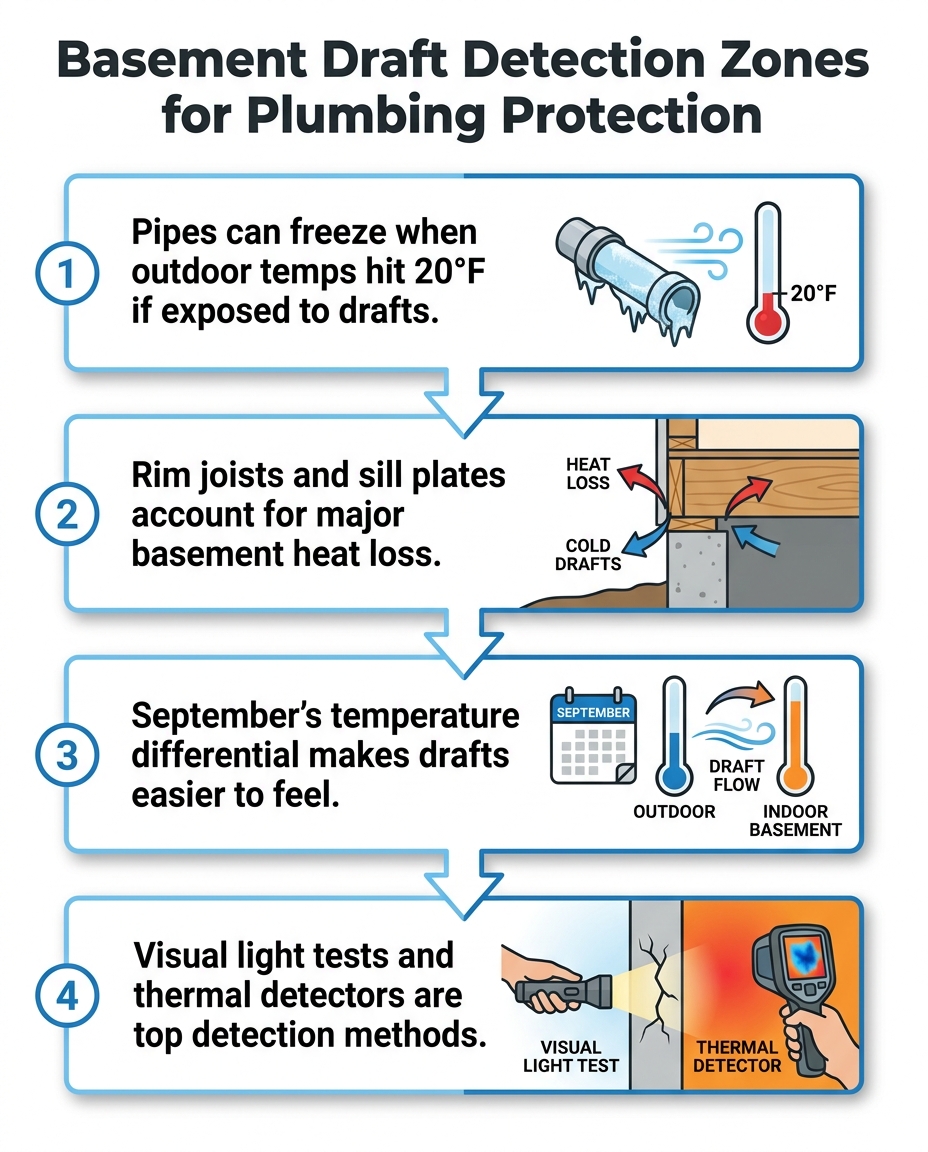
The first crisp mornings of early fall are a welcome relief from the summer heat, but they also signal a closing window for homeowners: locating drafty areas in your basement that threaten exposed water lines is a critical September priority before severe weather arrives. When the outdoor temperature begins to drop noticeably below your indoor thermostat setting, your home experiences a widening temperature differential. This natural shift creates a unique opportunity during the September pre-heating season. Invisible air leaks that go completely unnoticed during the humid summer months suddenly become distinct, easily traceable currents of cool air.
Many homeowners wait until the dead of winter to think about their plumbing infrastructure. By then, unsealed rim joists and compromised basement windows are already allowing freezing drafts to hit exposed copper pipes directly. This reactive approach forces you into a high-stress decision point when a pipe is already frozen solid or actively leaking. Proactively hunting for these hidden drafts in early fall gives you the time and the ideal conditions to map out your home's structural vulnerabilities. If you wait until January, you might find yourself needing professional burst pipe repair instead of simple preventative maintenance.
The early detection advantage:
• Clear temperature contrast: Mild indoor heating against cool outdoor autumn air makes drafts obvious to the touch.
• Pre-emergency timing: Identifying gaps now allows for proper sealing before the ground freezes solid.
• Easier physical access: Moving storage boxes and inspecting foundation walls is much easier before holiday decorations and winter gear clutter the basement.
Understanding exactly how your home breathes during this transitional season is the foundation of winter plumbing safety. The goal right now is strictly detection—finding the invisible pathways that cold air takes to reach your vital water lines.
The Hidden Physics of Basement Heat Loss and Localized Freezing
It is a common misconception that if your basement feels generally warm, your pipes are safe from freezing. The reality of thermal dynamics in unfinished spaces is much more complex. Pipes located in unheated or drafty interior spaces can easily freeze when outdoor temperatures drop below 20 degrees Fahrenheit, regardless of what the thermostat on your main floor reads. This happens because of micro-climates—small, isolated pockets of extreme temperature that form along the perimeter of your foundation.
When a gap exists in your home's exterior envelope, a concentrated draft acts like a laser beam of cold air. This continuous stream drops the localized temperature directly around a copper pipe far below the room's average ambient temperature. You might walk to the center of your basement and feel a comfortable 60 degrees, completely unaware that a pipe running along the exterior wall is currently sitting in a 25-degree cross breeze. When our team provides professional plumbing services, we always emphasize that understanding this heat loss yourself is the first step toward comprehensive protection.
The severe freeze-thaw cycles of Midwest winters exacerbate foundation settling, creating new gaps by January if they are not caught in the fall. As the ground expands and contracts, it pulls wood framing away from concrete, breaking old seals and opening new wind tunnels.
Understanding Micro-Climates in Unfinished Spaces
To truly protect your home, you have to stop looking at your basement as a single temperature zone. The perimeter of your basement interacts directly with the freezing soil and frigid outdoor air. Thermostats located on the main floor only measure the air returning to the HVAC system from central hallways—they have no way of measuring the temperature of the air trapped between a floor joist and a concrete wall where your water lines live.
• Center Room (Near Furnace) — Typical Ambient Temperature: 65°F - 70°F — Vulnerability Level: Low risk for frozen pipes
• Exterior Wall Perimeter — Typical Ambient Temperature: 40°F - 50°F — Vulnerability Level: High risk during deep freezes
• Unsealed Rim Joist Cavity — Typical Ambient Temperature: 20°F - 35°F — Vulnerability Level: Extreme risk for direct pipe freezing
Finding the draft is the first critical step in winter plumbing preparation. Once you understand that cold air pools in specific, structural zones, you know exactly where to begin your inspection.
Primary Suspects: Rim Joists, Sill Plates, and Foundation Settling
When hunting for the drafts that threaten your exposed water lines, you must look directly at the structural transition points of your home. The most notorious culprits for heat loss and air intrusion are the rim joists and sill plates. The sill plate is the horizontal wood board that sits directly on top of your concrete foundation. The rim joist is the perimeter board that rests on the sill plate, capping off the floor joists of the level above. Together, these components form the crucial seam between your home's masonry and its wooden skeleton.
In older homes, especially around Springfield IL, these transition points are highly susceptible to degradation. Over decades, foundations naturally settle. This settling pulls the rigid wood framing away from the concrete, breaking down the original mortar, fiberglass insulation, or caulking that once sealed the gap. In our decades of serving older Springfield homes, our team at Allied Plumbing Heating & Cooling has seen firsthand how these perimeter gaps act as invisible wind tunnels during the winter.
What makes this settling so dangerous for your plumbing is that exposed water pipes frequently run parallel to these exact high-risk structural zones. Builders often route copper lines tucked up against the rim joist to keep them out of the way of basement living spaces. If you want to learn more about the broader impact of this regional soil movement, you can read about how underground pipes shift and crack in Midwest winters.
The Sill Plate Connection
Visually inspecting the sill plate requires a keen eye and a bit of patience. You are looking for areas where the mortar has turned to dust or where old fiberglass insulation has turned black. Black fiberglass insulation is a massive red flag: fiberglass acts as a filter, and when it turns dark, it means dirty outside air has been blowing through it for years.
Key areas to inspect along the foundation:
• Corners and joints: Settling forces often pull corners apart more aggressively than straight walls.
• Behind existing fiberglass: Gently pull back old, loose insulation to check the raw wood-to-concrete connection.
• Visible daylight: If you turn off the basement lights during the day and see a sliver of sunlight at the top of the concrete wall, you have a major draft.
Tracking Airflow: Methods for Detecting Invisible Drafts
Knowing where to look is only half the battle; knowing how to physically detect the airflow is what separates a quick glance from a thorough September pre-heating season inspection. The goal here is strictly detection and mapping. You want to identify every vulnerability before the weather turns hostile, without attempting complex plumbing reroutes or unsafe sealing methods yourself.
1. The Hand Test Method: Choose a cool, breezy evening in early fall when the temperature drops into the 50s outside but your home is still reasonably warm. Slowly run your bare hand about two inches away from the rim joist, sill plate, and pipe entry points. Human skin is highly sensitive to temperature differentials, and you will easily feel the distinct chill of a targeted draft cutting through the ambient basement air.
2. The Smoke Pencil or Incense Test: If the hand test is inconclusive, you can use a harmless smoke source to make the airflow visible. Turn off your furnace and any basement fans to ensure the air is still. Light a stick of incense or a specialized smoke pencil and hold it near the suspected gaps along the foundation. If the thin trail of smoke suddenly blows sideways or dissipates rapidly, you have found an active air leak.
3. Thermal Leak Detectors: For a more data-driven approach, inexpensive infrared thermometers or thermal leak detectors can scan the foundation walls. These point-and-shoot devices use a color-coded light (usually blue for cold, red for warm) to show you exactly where the surface temperature drops. Point the laser at the wall behind an exposed water line; if the temperature plummets by 10 or 15 degrees in one specific spot, a draft is chilling that structural cavity.
Conducting a Nighttime Light Test
One of the most effective, foolproof methods for finding structural gaps requires a partner and a strong flashlight. Wait until it is completely dark outside. Have one person go down into the basement and turn off every single light, allowing their eyes to adjust to the pitch black. The second person walks around the exterior perimeter of the house, shining a high-lumen flashlight directly at the seam where the foundation meets the siding.
The person inside the basement carefully watches the sill plate and rim joist areas. If any light pierces through the darkness, you have found a direct path to the outdoors. Map out these identified gaps with a piece of painter's tape or a notebook so they can be reviewed for professional mitigation later.
Basement Draft Detection Zones for Plumbing Protection
Secondary Vulnerabilities: Basement Windows and Utility Penetrations
While the foundation perimeter is the primary suspect, secondary vulnerabilities often act as the silent accomplices in winter plumbing failures. When our technicians are called out for emergency winter freeze repairs, a pattern we see often is that cracked basement window panes, deteriorated glazing putty, and warped wooden or metal frames serve as major sources of freezing air. Because these windows are often installed near the ceiling of the basement, the cold air they let in travels directly along the ceiling joists—the exact path of least resistance where your copper water lines are usually suspended.
Utility penetrations are another massive blind spot for homeowners. Every time a hole is drilled through your home's exterior to accommodate a modern convenience, a potential draft is created. Over the years, the exterior caulking or expanding foam used to seal these holes shrinks, cracks, and falls away.
Critical utility penetrations to inspect include:
• Dryer vent exhausts: Check the perimeter of the metal pipe where it exits the foundation.
• Gas line entries: Inspect the masonry sealing around the main gas line entering the basement.
• Electrical conduits: Look for gaps around the main electrical service panel wiring.
• Outdoor faucet lines: Ensure the space around the pipe leading to your exterior hose bib is tightly sealed.
Air from these secondary sources does not just drop to the floor; it rolls across the basement ceiling, directly hitting any exposed plumbing in its path. Documenting these areas thoroughly during your fall inspection is essential for comprehensive winterization.
Whole-Basement Climate Control: Aligning Heating and Plumbing Prep
Draft detection and plumbing safety do not exist in a vacuum; they are intimately connected to your home's overall ambient temperature and heating system health. A well-maintained heating system acts as your home's primary defense mechanism, helping to counteract minor basement drafts by maintaining a stable, warm baseline temperature throughout the lower levels. If your furnace is struggling, short-cycling, or failing to push adequate heat into the basement, even a small draft can tip the scales and cause a pipe to freeze.
This is why a pre-seasonal fall check for your furnace is just as critical as hunting for drafts during the September pre-heating season. Ensuring your furnace is ready requires reliable heating services before the deep freeze sets in. When our technicians perform routine pre-seasonal furnace tune-ups in the fall, we always emphasize to Springfield homeowners that establishing this reliable baseline heat is well worth the investment, as it directly protects the home's lower levels from freezing.
Proactive seasonal maintenance ensures your home's infrastructure is ready to fight off severe cold fronts. Position your whole-home climate health as a multi-system approach: sealed structural drafts combined with a reliable, efficient heating system. When both systems work in harmony, the risk of localized freezing plummets dramatically.
Moving from Detection to Professional Mitigation
Once you have successfully mapped out the drafty areas in your basement, you face a critical transition: moving from DIY detection to professional plumbing protection. It is vital to clarify the line between simple weatherstripping and situations that require professional plumbing insulation or rerouting.
The problem: Homeowners often attempt to fix major structural drafts or insulate complex pipe networks on their own, using improper materials or techniques. The cause: A misunderstanding of how moisture and cold air interact inside enclosed wall cavities. Incorrectly insulating pipes can actually trap condensation against the copper, accelerating corrosion, or leave tiny gaps that funnel cold air directly onto a specific joint. The solution: We recommend relying on professional mitigation. Our team frequently has to repair corroded pipes caused by improper DIY insulation that trapped moisture, which is why professional expertise is so crucial to ensure the structural envelope is sealed correctly and the pipes are insulated with the proper R-value materials.
Ignoring major structural drafts is not an option, as they can lead to rapid freezing and catastrophic water damage within hours of a temperature drop. Addressing these vulnerabilities in the fall prevents chaotic, high-stress situations in mid-winter. Ignoring these warning signs can quickly escalate into emergency plumbing situations that disrupt your life and damage your property.
Securing Your Home's Infrastructure Before the Deep Freeze
Taking the time during the September pre-heating season to thoroughly inspect your basement provides invaluable peace of mind. Knowing exactly which parts of the basement to inspect—from the rim joists and sill plates to the aging basement windows—puts you in control of your home's winter readiness.
Early fall detection remains the most reliable, low-stress way to prevent winter water damage. By locating the invisible drafts that threaten your exposed water lines now, you eliminate the micro-climates that cause localized freezing. At Allied Plumbing Heating & Cooling, we encourage you to explore our professional assessment options to ensure your exposed water lines are fully protected, properly insulated, and ready to withstand whatever the winter weather brings.
Frequently Asked Questions
How do I find drafts in my basement? Start by conducting a hand test around the perimeter of your basement on a cool, breezy evening. You can also use a smoke pencil to watch for horizontal air movement near the sill plates, or perform a nighttime light test with a flashlight to spot structural gaps shining through the foundation.
At what temperature do exposed basement pipes freeze? Exposed pipes in unheated or drafty interior spaces can begin to freeze when outdoor temperatures drop below 20 degrees Fahrenheit. However, if a severe draft is blowing directly on the pipe, localized freezing can occur even if the rest of the basement feels warmer.
How do you find hidden air leaks? Hidden air leaks are best found using a thermal leak detector or an infrared thermometer. By scanning the walls and ceiling joists, these tools reveal sudden drops in surface temperature, indicating a hidden draft pulling cold air into the structural cavity.
Should exposed water pipes in the basement be covered? Yes, covering exposed water pipes with appropriate foam or fiberglass pipe insulation adds a crucial layer of protection against freezing. It is important that the insulation is sized correctly and sealed at the seams to prevent cold air from slipping underneath.
Why is early fall the best time to check for basement drafts? Early fall offers a unique temperature differential where the indoor air is warm and the outdoor air is cool, making drafts easy to feel without the immediate danger of pipes freezing. It also gives you ample time to arrange for professional sealing or plumbing insulation before winter storms arrive.
Can foundation settling cause new drafts around plumbing lines? Absolutely. As a home's foundation settles and goes through annual freeze-thaw cycles, the wood framing can pull away from the concrete, breaking old seals. This movement frequently opens new gaps near the rim joists where plumbing lines are commonly routed.
Locating Drafty Areas in Your Basement That Threaten Exposed Water Lines
September 11, 2026
Early fall is the ideal time to find hidden air leaks around rim joists and basement windows. Map out structural vulnerabilities now to prevent frozen pipes in January.
Early fall is the ideal time to find hidden air leaks around rim joists and basement windows. Map out structural vulnerabilities now to prevent frozen pipes in January.
The Debate on Covering Your Outdoor AC Condenser During a Midwest Winter
September 10, 2026
Wrapping your AC unit before freezing temperatures hit seems like a responsible choice. See why heavy covers actually trap rust-causing moisture and attract mice, and what to use instead.
Wrapping your AC unit before freezing temperatures hit seems like a responsible choice. See why heavy covers actually trap rust-causing moisture and attract mice, and what to use instead.
Programming Your Smart Thermostat for Illinois' Unpredictable 40-Degree Temperature Swings
September 9, 2026
When 80-degree afternoons drop to 40-degree nights, your AC and furnace often end up fighting each other. Adjusting your temperature deadbands prevents this expensive overlap during the fall transition.
When 80-degree afternoons drop to 40-degree nights, your AC and furnace often end up fighting each other. Adjusting your temperature deadbands prevents this expensive overlap during the fall transition.