Supplementing a Struggling Central AC with a Single-Zone Mini-Split in the Master Bedroom
Supplementing a Struggling Central AC with a Single-Zone Mini-Split in the Master Bedroom
Why Is Your Master Bedroom Sweltering While the Downstairs Freezes?
Are you wondering if supplementing a struggling central AC with a single-zone mini-split in the master bedroom is the best way to finally get a good night's sleep? You are certainly not alone. Every year, as the late-summer August heat sets in, homeowners in two-story houses face a frustrating battle with their thermostats. You turn the temperature down hoping to cool off the upstairs, only to find the main floor feeling like a refrigerator while the master bedroom remains uncomfortably warm. This extreme temperature imbalance is one of the most common complaints in multi-level homes.
Running your primary air conditioning system constantly without feeling any relief upstairs is more than just an annoyance; it is a massive drain on your energy efficiency and puts unnecessary wear and tear on your equipment. The constant cycling forces your central unit to work overtime, yet the results never quite reach the rooms where you need them most. If you are exploring air conditioning solutions, you are likely facing a critical decision point: do you attempt to modify or completely replace your existing whole-house system, or do you adopt a targeted hybrid approach?
Understanding why this imbalance happens is the first step toward fixing it. The issue usually has less to do with a broken air conditioner and much more to do with the physical limitations of moving conditioned air throughout a large, multi-story home. By evaluating the actual root causes of the problem, you can make an informed decision that prioritizes both your sleep comfort and your home's overall energy efficiency.
The Physics of Upper-Floor Cooling and Ductwork Limitations
To understand why your master bedroom stays hot during the intense late-summer August heat, you have to look at the basic physics of airflow and thermal dynamics within your home. The struggle is rarely a sign that your central AC is failing completely; rather, it is a symptom of the immense workload placed on the system by natural forces and architectural design.
The Reality of Thermal Stratification
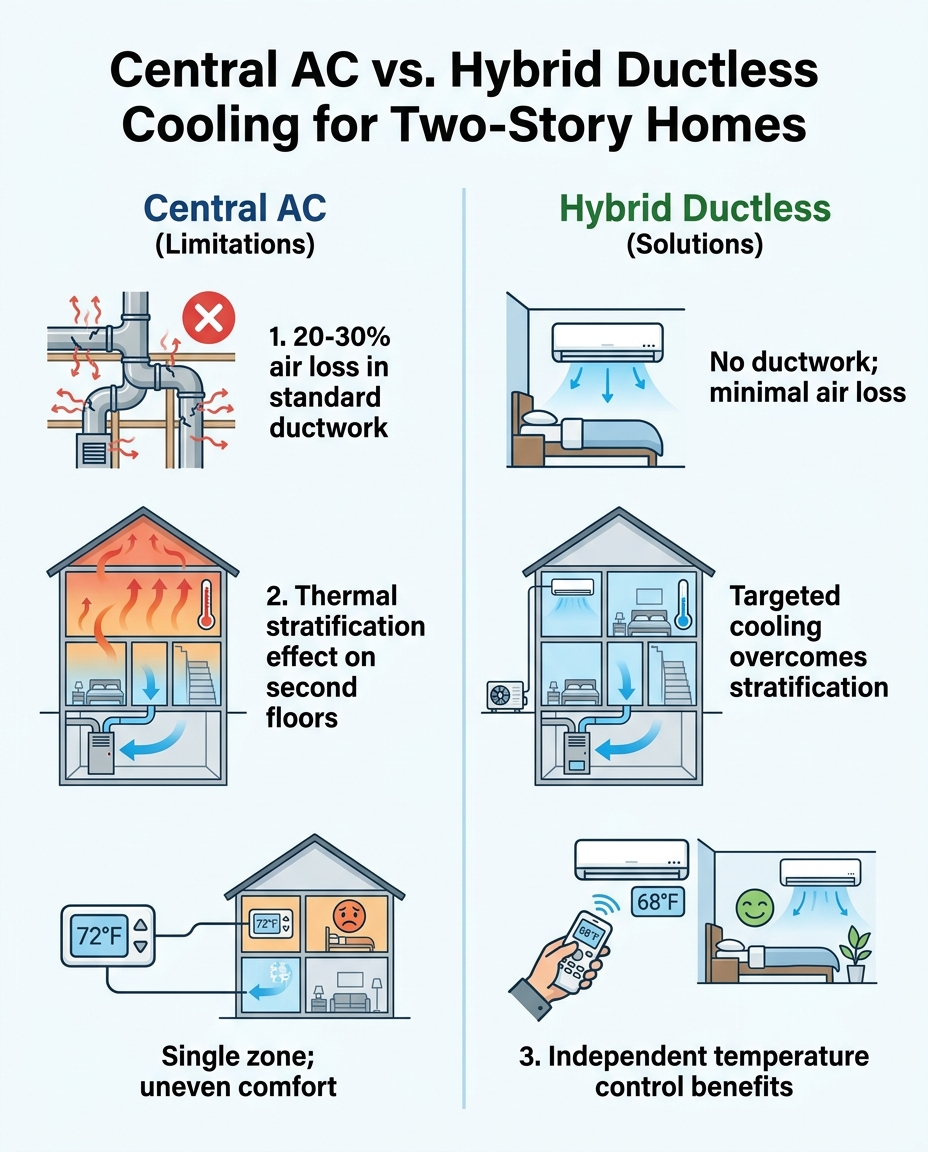
Heat naturally rises. This scientific principle, known as thermal stratification, means that the second floor of your home will always carry a higher cooling burden than the first floor. As the sun beats down on your roof all afternoon, radiant heat transfers into your attic and presses down on your upper ceilings. At the same time, the warm air generated inside your home naturally drifts up the stairwell. By the time evening arrives, your master bedroom has absorbed a massive amount of heat that your central AC now has to combat.
Ductwork Distance and Air Loss
Central air conditioning relies on a network of ducts to deliver cold air. The longer the distance the air has to travel, the weaker the airflow becomes by the time it reaches the vent. Upstairs bedrooms are typically located at the furthest points from the basement or ground-level blower motor.
• Friction and static pressure: As air travels through long, winding duct runs, it loses velocity due to friction against the duct walls.
• Energy waste: According to the U.S. Department of Energy, duct systems can lose 20 to 30 percent of the air moving through them due to leaks, small holes, and poor connections.
• Reduced delivery: That 30 percent loss disproportionately affects the furthest rooms, leaving your upstairs vents barely trickling out cold air.
The Impact of Local Climate
The regional climate plays a massive role in how these physical limitations feel inside the house. Hot, humid Springfield, IL summers significantly increase the sensible heat load trapped in second-story rooms. High humidity makes the air feel heavier and warmer because it slows down the natural evaporation of moisture from your skin. When your central AC struggles to push enough air upstairs, it also fails to run long enough in those specific rooms to properly dehumidify the space, leaving the master bedroom feeling sticky, stagnant, and completely uncomfortable.
The Dilemma: Should You Replace a Functioning Central AC?
When faced with a hot upstairs bedroom, many homeowners assume they need to tear out their entire central air system and upgrade to a larger unit. However, replacing a functioning central AC just because one room is hot is often an unnecessary and highly inefficient reaction. Before making a massive investment, it is critical to evaluate the lifespan, current performance, and overall design of your existing equipment.
Evaluating Your Current System
If your central air conditioner is less than 10 to 12 years old, routinely maintained, and does a fantastic job keeping the main floor comfortable, the unit itself is likely functioning exactly as designed. The problem is distribution, not generation. Pushing an aging but otherwise functional system to its absolute limits just to cool a single room upstairs will only accelerate its decline. Forcing the unit to run non-stop shortens the life of the compressor and blower motor, turning a targeted comfort issue into a whole-home breakdown.
The Overcooling Effect
One of the biggest drawbacks of trying to cool a second-story bedroom with a single-zone central system is the overcooling effect on the first floor. Because the thermostat is usually located downstairs, it reads the ambient temperature of the main level. To get the upstairs down to a comfortable 68 degrees for sleeping, you might have to set the downstairs thermostat to 62 degrees. This forces your family to wear sweaters in the living room while the system burns through massive amounts of electricity.
Introducing the Hybrid Strategy
Instead of overhauling the ductwork or upsizing a central unit—which often fails to solve the root problem of thermal stratification anyway—a hybrid approach offers a much smarter alternative. By leaving the central AC in place to manage the bulk of the house and adding a single-zone ductless mini-split to handle the specific load of the master bedroom, you solve the problem at its source. If you are weighing these two paths, reviewing a cost comparison of mini-splits versus central AC can help clarify the long-term value of keeping your functional central unit while upgrading your sleep comfort.
How a Hybrid Approach Solves the Master Bedroom Problem
Running two different cooling systems simultaneously might sound counterintuitive at first, but a hybrid cooling strategy is actually one of the most efficient ways to manage a two-story home. By adding a single-zone ductless mini-split directly into the master bedroom, you bypass the leaky ductwork and the long travel distances entirely. This targeted approach delivers cold air exactly where it is generated, offering a host of specific benefits that a traditional central system simply cannot match.
Here is how a hybrid approach directly solves upper-floor cooling struggles:
• Independent thermostat control: A ductless unit comes with its own thermostat, allowing you to customize your sleeping temperature precisely without freezing out the rest of the house or fighting over the main floor settings.
• Inverter-driven efficiency: Modern ductless heat pumps utilize inverter-driven compressors. Instead of turning on and off at full blast, they adjust their speed continuously—much like the accelerator pedal in a car—using only the exact amount of energy needed to maintain the room's temperature.
• Alleviates central system strain: By taking the heavy lifting of the second floor off the shoulders of your primary central AC, the main unit can cycle normally. This significantly reduces wear and tear, potentially extending the lifespan of your existing equipment.
• Dedicated humidity removal: Because the ductless air handler is located right in the room, it continuously draws moisture out of the stagnant upstairs air, providing dedicated humidity control that makes the bedroom feel crisp and comfortable.
• No ductwork losses: Since the air is cooled and delivered directly into the room from the wall-mounted unit, you experience zero percent air loss, bypassing the 20 to 30 percent waste associated with traditional duct systems.
This hybrid setup allows your central system to do what it does best—maintain baseline comfort across the broad open spaces of your home—while the targeted unit handles the intense, specific demands of your sleeping environment.
Side-by-Side Comparison: Upgrading Central AC vs. Adding a Ductless Unit
When deciding how to handle an uncomfortably warm master bedroom, looking at an objective side-by-side comparison is the best way to understand the scope of each solution. Upgrading or retrofitting a central system involves a very different process than installing a targeted single-zone ductless mini-split. By breaking down the differences in installation, energy use, and comfort, you can see which path aligns best with your home's needs.
• Installation Intrusiveness — Upgrading/Modifying Central AC: Often requires tearing into walls or ceilings to enlarge ductwork, add return vents, or install mechanical zoning dampers. — Adding a Single-Zone Mini-Split: Requires only a small, three-inch hole in an exterior wall to connect the indoor air handler to the outdoor line set.
• Energy Consumption — Upgrading/Modifying Central AC: Cools the entire house just to lower the temperature in one specific room, wasting massive amounts of electricity. — Adding a Single-Zone Mini-Split: Cools only the single occupied room, utilizing high-efficiency inverter technology to minimize power draw.
• Project Timeline — Upgrading/Modifying Central AC: Extensive retrofitting can take several days of messy construction, drywall repair, and system downtime. — Adding a Single-Zone Mini-Split: Straightforward installation that is typically completed by a professional team in a single day with minimal disruption.
• Comfort Precision — Upgrading/Modifying Central AC: Relies on a shared thermostat, meaning the downstairs will always be significantly colder than the upstairs. — Adding a Single-Zone Mini-Split: Provides dedicated zone control, allowing you to set the exact temperature you want for sleeping.
As the comparison shows, attempting to force a whole-home system to solve a localized problem usually results in higher energy waste and more intrusive construction. If you are exploring high-quality HVAC products, a ductless system offers a remarkably precise alternative that respects the structural integrity of your home while delivering immediate relief.
Central AC vs. Hybrid Ductless Cooling for Two-Story Homes
Evaluating Your Home for a Targeted Cooling Solution
If you are tired of waking up sweating and are ready to consider a single-zone ductless mini-split, the next step is evaluating your home to see what an installation would look like. While ductless systems are incredibly versatile, a professional assessment is still required to ensure optimal placement and performance. Our approach is always customer-first—we prefer recommending a targeted, highly effective solution rather than immediately pushing for an expensive, full central system replacement when it isn't truly necessary.
1. Assessing Wall Space in the Master Bedroom
The indoor air handler needs to be mounted high on a wall to effectively distribute cold air across the room. A technician will look for an exterior wall with enough clearance from the ceiling and away from direct obstructions like tall wardrobes or heavy window treatments. The unit needs clear airflow to read the room's temperature accurately and push conditioned air evenly across the space.
2. Finding an Optimal Outdoor Location
The outdoor compressor for a ductless system is remarkably compact, often taking up less than half the footprint of a traditional central AC condenser. However, it still needs a dedicated spot. Ideally, it should be placed on a solid pad or mounted on a bracket directly outside the master bedroom to keep the line sets as short as possible. The location must offer adequate airflow and be easily accessible for future maintenance.
3. Checking Electrical Panel Capacity
Ductless heat pumps are highly efficient, but they do require a dedicated circuit. A professional will inspect your home's main electrical panel to ensure it can handle the minimal additional load. In most modern homes, this is a non-issue, but older homes might require a minor panel update to safely accommodate the new breaker.
4. Exploring Energy Incentives
Because modern inverter-driven heat pumps are incredibly energy efficient, they often qualify for various incentive programs. While availability varies by year and region, generally applicable energy rebates or federal tax credits for high-efficiency heat pumps are frequently available to homeowners who upgrade. A knowledgeable professional can point you toward current programs and help you explore flexible financing options that make this targeted comfort upgrade highly accessible.
Making the Right Choice for Your Sleep Comfort
You do not have to suffer through hot nights, nor do you have to replace a perfectly working central system just to cool down one room. Adding a single-zone ductless mini-split to your master bedroom is a smart, targeted strategy that respects your home's existing infrastructure while directly solving the problem of upper-floor heat. By taking the strain off your main air conditioner, you gain absolute control over your sleeping environment and improve your overall energy efficiency.
If you are ready to stop fighting your thermostat and finally experience consistent, customized comfort upstairs, it is time to get a professional assessment of your cooling needs. Reach out to schedule an inspection and explore professional AC installation services designed to give you the perfect night's sleep.
Frequently Asked Questions
Will a mini split help cool my upstairs bedroom?
Yes, a mini-split is highly effective at cooling upstairs bedrooms. Because it delivers conditioned air directly into the room without relying on long, leaky ductwork, it easily overcomes the natural heat that rises to the second floor. It provides strong, consistent airflow exactly where you need it most.
Can you use a mini split and central air at the same time?
Absolutely. Running both systems simultaneously is the foundation of a hybrid cooling strategy. The central air handles the broad baseline temperature of the main house, while the mini-split manages the heavy, specific cooling load of the upstairs bedroom, allowing both systems to operate efficiently.
Is a mini split worth it for one room?
For a master bedroom that stays persistently hot, a single-zone unit is absolutely worth the investment. It prevents you from wasting energy overcooling the entire house just to make one room comfortable, and it provides independent temperature control that significantly improves your sleep quality.
How intrusive is the installation for a master bedroom mini-split?
The installation is remarkably straightforward and non-intrusive. It typically requires only a small, three-inch hole drilled through an exterior wall to connect the indoor air handler to the outdoor compressor, with most installations completed by professionals in a single day.
Does a ductless unit help with high upstairs humidity?
Yes, ductless systems provide excellent dedicated humidity removal. Because the unit is sized specifically for the bedroom and runs on variable speeds, it continuously cycles air over its cold evaporator coils, pulling excess moisture out of the stagnant upstairs air and draining it outside.
Why Adding a Whole-Home Humidifier Prevents Dry Skin and Warped Hardwood Floors in Winter
September 25, 2026
Gas furnaces strip natural moisture from your home, causing painful static shocks and shrinking woodwork. Adding a bypass humidifier this fall proactively counteracts severe winter dryness.
Gas furnaces strip natural moisture from your home, causing painful static shocks and shrinking woodwork. Adding a bypass humidifier this fall proactively counteracts severe winter dryness.
Hyper-Heating Technology: How Modern Mini-Splits Produce Heat Even at Negative 13 Degrees
September 24, 2026
Don't let outdated myths leave you freezing this winter. We break down the exact inverter technology that allows ductless systems to reliably heat your home in sub-zero temperatures.
Don't let outdated myths leave you freezing this winter. We break down the exact inverter technology that allows ductless systems to reliably heat your home in sub-zero temperatures.
Camera Inspections: Seeing Exactly What Tree Roots Did to Your Sewer Line Over the Summer
September 23, 2026
Tree roots aggressively infiltrate aging sewer lines during dry summers. A proactive early fall camera inspection catches this hidden damage before it causes catastrophic backups during holiday hosting.
Tree roots aggressively infiltrate aging sewer lines during dry summers. A proactive early fall camera inspection catches this hidden damage before it causes catastrophic backups during holiday hosting.