Sizing a Tankless Gas Line: Why Your Existing Pipe Might Be Too Small for an Upgrade
Sizing a Tankless Gas Line: Why Your Existing Pipe Might Be Too Small for an Upgrade
The Hidden Roadblock to Unlimited Hot Water
You are finally ready to ditch that bulky storage tank, but figuring out sizing a tankless gas line: why your existing pipe might be too small for an upgrade is an unexpected roadblock most homeowners never see coming. You purchase a sleek, modern unit expecting a quick installation, only to find out that the infrastructure hidden behind your walls cannot safely support it. The existing gas pipe, which quietly and reliably fueled your old traditional water heater for decades, is suddenly deemed completely inadequate for the new system.
This discovery usually leads to a critical decision point: understanding why upgrading your gas line is a non-negotiable requirement for both safety and performance. A modern on-demand system can easily trigger a massive 199,000 BTU/h demand spike the moment you turn on a hot water faucet. Your older pipes simply were not built to handle that kind of fuel surge. To navigate this transition smoothly, we recommend scheduling an evaluation for professional plumbing services before purchasing your new equipment.
In this guide, we will break down the physics behind gas flow, explain why your current pipes max out, and show you exactly why a larger diameter is necessary. We will focus purely on the educational "why" behind the science, leaving the complex sizing calculations and installations exactly where they belong—in the hands of licensed professionals.
Understanding Gas Line Physics: Volume vs. Pressure
To understand why your existing pipe is too small, you first need to understand how natural gas moves through your home. Most homeowners assume that if gas reaches the appliance, everything is fine. However, gas delivery relies on two entirely different measurements: pressure and volume.
The Difference Between Pressure and Volume
Gas pressure is measured in "water column" (WC) inches. This is the force pushing the gas from your utility meter through the pipes and into your home. Think of this as the municipal water pressure pushing water to your house. In most residential systems, the gas pressure remains relatively constant throughout the entire property.
Gas volume, on the other hand, is measured in British Thermal Units (BTUs) per hour. This is the actual physical amount of gas that can travel through a pipe at any given moment. While the pressure pushing the gas might be steady, the volume of gas that can physically fit through the pipe is strictly limited by the pipe's inside diameter.
The Garden Hose Analogy
A simple way to visualize this: Imagine you have a standard garden hose attached to a spigot. If you turn the spigot all the way on, you get a steady, predictable stream of water. The pressure is fine, and the volume is enough to water your flowers.
Now, imagine trying to put out a house fire with that same garden hose. Even if you increase the water pressure at the source, the narrow diameter of the hose physically restricts how much water can flow out at once. To get the massive volume of water needed to extinguish a fire, you have to upgrade to a wide fire hose. The same principle applies to natural gas.
When an appliance demands more gas volume than the pipe's diameter can physically supply, a dangerous condition called "gas starvation" occurs. The appliance is effectively gasping for fuel it cannot reach, leading to performance failures, system lockouts, and safety hazards.
Why Older Home Infrastructure Defaults to Half-Inch Pipes
If tankless systems require so much fuel, why were homes built with such small gas lines in the first place? The answer lies in the history of residential plumbing and the appliances that were standard at the time your home was constructed.
Mid-Century Plumbing Standards
Mid-century and late-20th-century plumbing standards were designed around appliances that had relatively low, steady fuel requirements. Traditional tank water heaters are essentially large, insulated kettles. They use a small burner to slowly heat 40 or 50 gallons of water over an extended period. Because they sip gas slowly, a standard 1/2-inch gas line is perfectly adequate to supply the required volume.
Through our multi-generational experience serving the area, we understand the specific gas line layouts and limitations found in older Springfield homes. In many of these properties, plumbers utilized a "branch" layout. A single, larger main gas trunk line enters the basement, and smaller 1/2-inch branch lines split off to feed individual appliances.
The Problem with Shared Trunk Lines
The bottleneck effect: In these older branch layouts, multiple appliances often share the same supply path. Your furnace, your gas kitchen stove, and your water heater might all be pulling fuel from the same localized pipe network.
When you replace a low-demand tank with a high-demand on-demand unit, you drastically alter the simultaneous load on that shared network. The existing 1/2-inch branch line cannot support the new unit, and if the main trunk line is also undersized, the new heater will starve other appliances of gas when it fires up. Retrofitting these older homes requires a licensed professional to carefully calculate the entire system's simultaneous BTU load to ensure every appliance gets the fuel it needs.
The Staggering Difference in BTU Requirements
To truly grasp why a pipe upgrade is necessary, you have to look at the staggering mathematical difference in fuel consumption between old and new technology. The gap is not small—it is a massive leap in required volume.
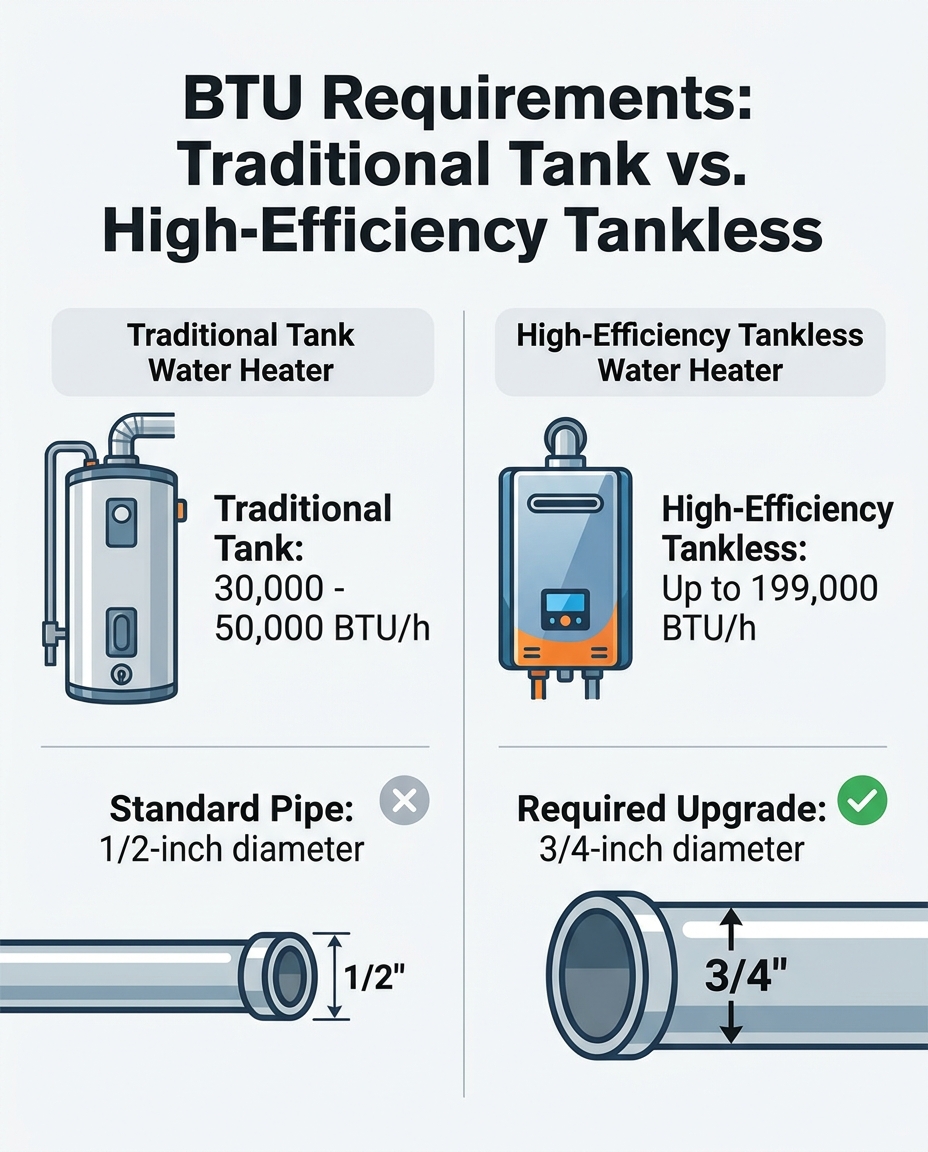
A traditional storage tank heater typically uses between 30,000 and 50,000 BTUs per hour. It runs frequently, but it never draws a massive amount of fuel at one time. In stark contrast, a high-efficiency on-demand unit sits completely idle until you open a hot water tap. At that exact second, the unit must instantly flash-heat cold groundwater to your desired temperature. To achieve this instant heating, the unit triggers a massive demand spike, often requiring up to 199,000 BTUs per hour.
This sudden surge in fuel requirement is exactly why a standard 1/2-inch line maxes out well below capacity. The mathematical reality dictates that a 1/2-inch to 3/4-inch pipe diameter transition is almost always required to ensure safe, consistent operation. If you are researching what to know before switching to a tankless water heater, this infrastructure upgrade should be at the top of your list.
Comparing the Workloads
• Maximum BTU/h Demand — Traditional Tank Water Heater: 30,000 - 50,000 BTUs — High-Efficiency Tankless Unit: Up to 199,000 BTUs
• Firing Pattern — Traditional Tank Water Heater: Slow, steady heating over hours — High-Efficiency Tankless Unit: Instant, massive surge on demand
• Typical Required Pipe Size — Traditional Tank Water Heater: 1/2-inch diameter — High-Efficiency Tankless Unit: 3/4-inch diameter (or larger)
• Peak Load Behavior — Traditional Tank Water Heater: Draws fuel at a constant, low rate — High-Efficiency Tankless Unit: Pulls maximum available volume instantly
The Math Behind the Upgrade
Plumbing codes do not leave gas line sizing to guesswork. The International Fuel Gas Code (IFGC) dictates strict pipe sizing regulations based on the total BTU load of the appliance and the exact physical distance from the gas meter to the unit. The longer the pipe run, the less volume it can deliver at the end of the line due to friction.
Because these calculations involve complex variables—including equivalent lengths for every elbow, tee, and valve in the piping system—they must be performed by a licensed professional. Attempting to guess the correct pipe size violates safety regulations and puts your home at risk.
BTU Requirements: Traditional Tank vs. High-Efficiency Tankless
How Late Summer Routines Test Your Gas Supply
The technical BTU requirements of your new unit do not exist in a vacuum; they are directly tested by your family's real-world daily routines. One of the most stressful periods for your plumbing infrastructure occurs as the seasons shift and household schedules align.
Consider the late summer back-to-school hot water demand. During the relaxed months of early summer, showers are staggered, and hot water usage is spread out throughout the day. But as the school year begins, household routines become highly concentrated. Suddenly, at 6:30 a.m., two showers are running simultaneously, the dishwasher is finishing its overnight cycle, and a load of laundry is starting.
What happens during peak demand:
• Maximum firing rate: The tankless unit detects the massive flow rate and instantly fires its burners to maximum capacity to keep up with the simultaneous fixtures.
• Volume bottleneck: If the gas line is undersized, the unit tries to pull 199,000 BTUs through a 1/2-inch pipe that can only deliver a fraction of that amount.
• System failure: Unable to get enough fuel to maintain the flame, the unit's safety sensors trigger an error code, shutting down the burners and sending a sudden blast of cold water to the showers.
Proper infrastructure planning and correct pipe sizing prevent these frustrating bottlenecks, ensuring your system can handle the absolute peak of your household's morning activity without faltering.
Winter Extremes: When Your Heater Works the Hardest
While late summer tests your system with simultaneous usage, winter tests your system through sheer environmental extremes. To understand why your unit draws so much gas in the winter, you need to understand a concept called "temperature rise."
Understanding Temperature Rise
Temperature rise is the mathematical difference between the temperature of the incoming cold groundwater and the desired output temperature at your faucet (usually set around 120 degrees Fahrenheit). The larger the gap between those two numbers, the harder the unit has to work.
During Springfield's cold Midwest winters, incoming groundwater temperatures can easily drop into the 40s. In the middle of July, that same groundwater might be 70 degrees. Heating 70-degree water to 120 degrees requires a 50-degree temperature rise. Heating 40-degree winter water to 120 degrees requires an 80-degree temperature rise.
The Impact on Gas Volume
To achieve that massive 80-degree temperature rise instantly as the water flows through the heat exchanger, the burner must fire at its absolute maximum capacity. This is when the unit demands every single one of those 199,000 BTUs. If your gas line is too small, the unit will fail precisely when you need hot water the most—on the coldest days of the year.
Ensuring proper gas flow for your water heating system is just as critical as maintaining the fuel supply for your winter heating services. Both systems are fighting against the freezing temperatures, and both require unrestricted access to fuel to keep your home comfortable.
The Dangers of Gas Starvation and Improper Sizing
Attempting to cut corners by running a high-demand unit on an undersized gas line is not just a performance issue; it is a serious safety hazard. When an appliance experiences gas starvation, the consequences ripple throughout the entire home's infrastructure.
Symptoms of an Undersized Line
When a tankless unit cannot pull enough volume, it struggles to maintain a stable flame. You will likely experience:
• Frequent error codes: The digital display will constantly flash ignition failure or flame-loss codes.
• Lukewarm water: The unit will throttle its output, unable to reach the target temperature.
• System lockouts: The internal computer will shut the entire system down to prevent damage.
The Threat to Other Appliances
The danger extends beyond the water heater itself. If the tankless unit is starving for gas, it creates a vacuum effect in the shared trunk line. This sudden drop in localized volume can actually pull gas away from other operating appliances. It is a common pattern to see furnace pilot lights drop out or stove flames flicker dangerously low when an improperly sized water heater fires up.
Because altering gas lines carries inherent risks, professional oversight is mandatory. For example, after the installation of two new furnaces one winter, a technician performing a rigorous follow-up check identified an undetected minor gas leak. This level of professional scrutiny and leak detection is exactly why you must rely on licensed experts to evaluate, size, and upgrade your home's gas delivery systems.
Frequently Asked Questions About Tankless Gas Lines
Why do tankless water heaters need a larger gas line?
Tankless water heaters need a larger gas line because they burn a massive amount of fuel in short bursts to heat water instantly. While a standard tank slowly sips gas to maintain temperature over several hours, an on-demand unit must flash-heat the water the moment you open a tap. This sudden demand spike requires a wider pipe diameter to allow a larger volume of gas to flow through simultaneously.
Can a tankless water heater run on a 1/2 inch gas line?
In most residential scenarios, a high-efficiency tankless water heater cannot run safely on a standard 1/2-inch gas line. While some specific low-BTU models or incredibly short pipe runs might technically allow it under strict code exceptions, the vast majority of standard 199,000 BTU units require a 3/4-inch line. Attempting to use an undersized line leads to gas starvation, error codes, and potential safety hazards.
How many BTUs does a tankless water heater use compared to a standard tank?
A high-efficiency tankless water heater can use up to 199,000 BTUs per hour during peak operation. In contrast, a traditional standard tank water heater typically uses only 30,000 to 50,000 BTUs per hour. This massive difference in fuel consumption is the primary reason existing plumbing infrastructure usually requires an upgrade during installation.
Does upgrading to a larger gas line increase my monthly gas bill?
Upgrading to a larger gas line does not inherently increase your monthly gas bill, because you are only billed for the fuel you actually consume, not the capacity of the pipe. In fact, because on-demand units only burn gas when you are actively using hot water—rather than running continuously to keep a storage tank warm—many homeowners see a reduction in their overall energy consumption after upgrading.
How do professionals calculate the correct gas pipe diameter for an older home?
Professionals calculate the correct gas pipe diameter by using sizing charts mandated by the International Fuel Gas Code (IFGC). They must determine the total BTU load of every gas appliance in the home, measure the exact length of the pipe run from the meter to the furthest unit, and account for the friction caused by every elbow and fitting in the system to ensure adequate volume delivery.
Planning Your Tankless Upgrade the Right Way
Transitioning to an on-demand hot water system is a major infrastructure improvement, not just a simple appliance swap. Understanding the physics behind gas volume requirements ensures that your new investment operates safely, reliably, and strictly up to code. The mathematical reality of a 1/2-inch to 3/4-inch pipe diameter transition cannot be bypassed.
Before you purchase a unit, we strongly encourage you to have your existing gas lines evaluated by a licensed professional to determine if an upgrade is required. Just last spring, a homeowner reached out needing a water heater replacement, and a proper infrastructure evaluation ensured the new system was successfully replaced with the correct, code-compliant fuel supply. Taking the time to properly assess your home's capacity guarantees a seamless transition. To start planning your upgrade the right way, reach out for professional plumbing and water heater installation today.
Why Your Furnace Blower Keeps Running After the Burners Shut Off
October 8, 2026
That cool breeze from your vents after a heating cycle isn't always a malfunction. Understand how the fan limit switch actively protects your heat exchanger from cracking.
That cool breeze from your vents after a heating cycle isn't always a malfunction. Understand how the fan limit switch actively protects your heat exchanger from cracking.
Why Combining Water Heater Replacement and Furnace Maintenance Saves Money
October 7, 2026
Your furnace needs a pre-winter tune-up, but that aging water heater is also failing. Bundling these services eliminates redundant labor and preps your home for freezing temps.
Your furnace needs a pre-winter tune-up, but that aging water heater is also failing. Bundling these services eliminates redundant labor and preps your home for freezing temps.
Why Is My Furnace Blowing Cold Air or Smelling Like Burning? Common Startup Questions
October 6, 2026
Smelling burning dust on the first chilly night? Get clear answers on when to wait it out or call a pro with these common homeowner questions answered.
Smelling burning dust on the first chilly night? Get clear answers on when to wait it out or call a pro with these common homeowner questions answered.