Mini Split vs Window Unit Comparison: Which Is the Right Cooling System for Your Home?
When it comes to the mini split vs window unit comparison, the short answer is this: window units cost less upfront and work well for renters or temporary setups, while mini splits offer better efficiency, quieter operation, longer lifespan, and year-round heating and cooling for homeowners planning to stay put.
Here is a quick side-by-side to help you decide at a glance:
• Upfront cost — Mini Split: Higher — Window Unit: Lower
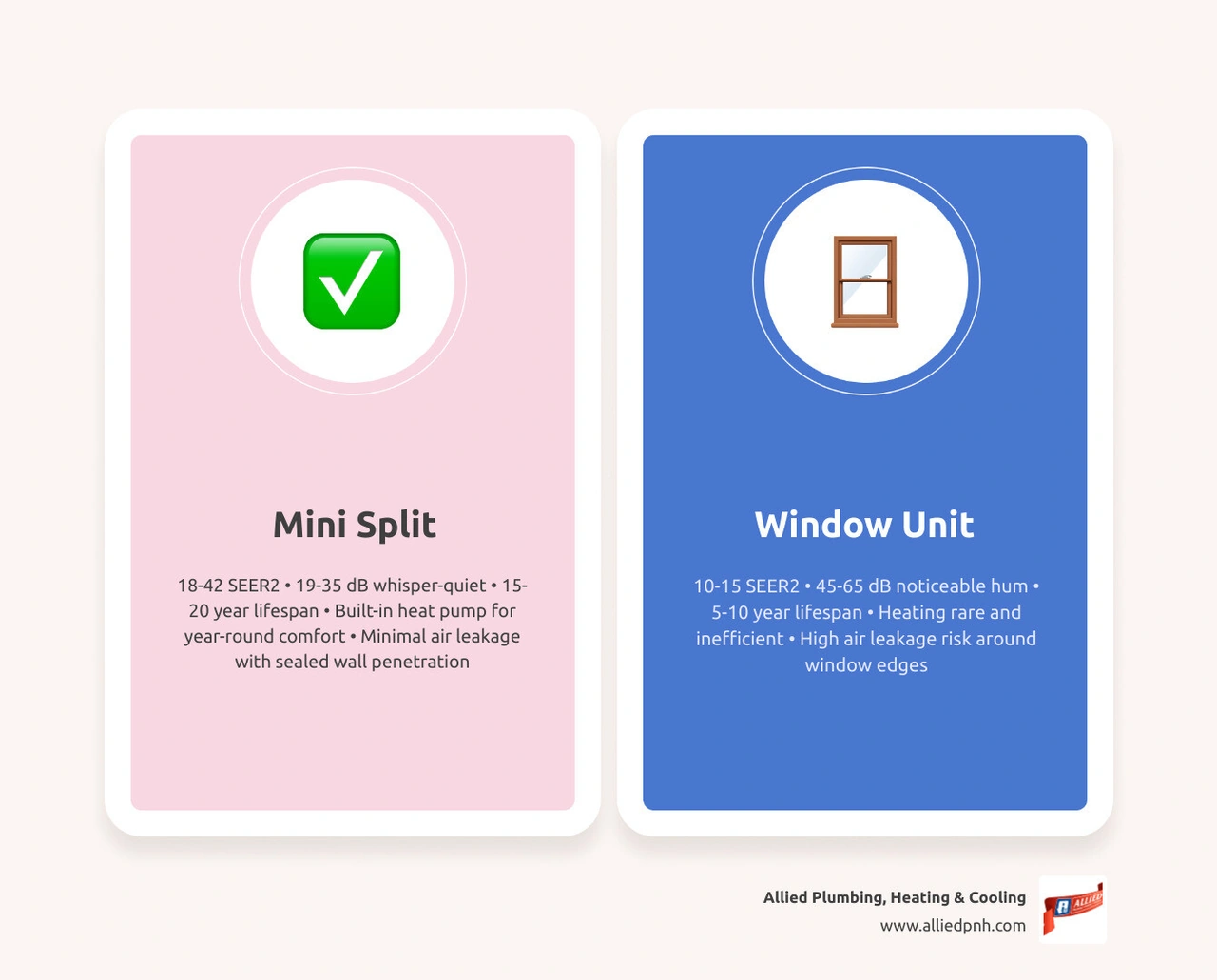
• Energy efficiency (SEER2) — Mini Split: 18–42 — Window Unit: 10–15
• Noise level — Mini Split: 19–35 dB (whisper-quiet) — Window Unit: 45–65 dB (noticeable hum)
• Heating capability — Mini Split: Yes (heat pump) — Window Unit: Rarely, and inefficiently
• Lifespan — Mini Split: 15–20 years — Window Unit: 5–10 years
• Installation — Mini Split: Professional, permanent — Window Unit: DIY, seasonal
• Best for — Mini Split: Homeowners, long-term use — Window Unit: Renters, short-term use
• Air leakage risk — Mini Split: Minimal (sealed 3-inch hole) — Window Unit: Yes (around window edges)
If you own your home in Springfield, Rochester, or Chatham and want reliable, long-term comfort, a mini split almost always wins on total value. If you are renting or need a quick, low-cost fix for a single room this summer, a window unit still gets the job done.
Every summer, homeowners across Springfield wrestle with the same question: is it worth hauling out that old window AC again, or is it finally time to upgrade? It is a fair question. Window units have cooled American homes for decades, and they are familiar, affordable, and easy to find. But the cooling landscape has changed. Ductless mini split systems have become more accessible, more efficient, and more capable than ever, and the gap between these two options is wider than most people realize.
Whether you are trying to cool a single bedroom, a converted garage, or your entire home without ductwork, understanding the real differences between these two systems will help you make a decision you will not regret five years from now.
Must-know mini split vs window unit comparison terms:
• best rooms for a mini split system
• ductless mini split systems explained
• how many mini split heads do i need
Fundamental Differences in Design and Operation
To truly understand how these systems compare, we have to look under the hood. While both systems are designed to remove heat from your indoor air and release it outside, they do so using completely different architectural designs.
A window air conditioner is a self-contained, "all-in-one" box. Every single component—the compressor, condenser, expansion valve, evaporator, and fans—is packed tightly into a single metal chassis that sits directly on your windowsill. This means the loudest, most vibration-heavy part of the system (the compressor) is sitting right inside your living space, separated from your room by only a thin piece of plastic and some insulated foam.
A ductless mini split, on the other hand, utilizes a "split" architecture. It divides the labor between two distinct units: an indoor air handler and an outdoor condenser. By moving the noisy compressor outside, mini splits fundamentally change the indoor comfort experience.
Because of this split design, mini splits avoid several structural drawbacks common to window units:
• Air Leakage: Window units are notoriously difficult to seal perfectly. No matter how much foam tape or plastic accordion paneling you use, outdoor air, humidity, dust, and insects will find a way through the gaps. Mini splits only require a small, highly insulated three-inch hole through the wall for the refrigerant lines, which is completely sealed with specialized weatherproofing foam.
• Home Security: A window unit acts as a physical barrier that prevents you from locking your window. This makes them a known security vulnerability on ground floors. A mini split keeps your windows completely free, functional, and locked securely.
• Aesthetics and Natural Light: Hauling a heavy metal box into your window frame blocks up to 70% of your natural light and ruins your view of the backyard. Mini splits mount high on the wall, completely preserving your windows.
To learn more about how these systems function without traditional ductwork, explore our guide on Ductless Mini Split Systems Explained.
How Ductless Systems Work
The magic of a ductless mini split lies in its simplicity and directness. The indoor wall, floor, or ceiling unit is connected to the outdoor condenser via a compact lineset. This lineset bundles the copper refrigerant tubing, an electrical control cable, and a condensate drain line.
During the cooling season, the indoor air handler pulls warm air from the room and passes it over cold refrigerant coils. The refrigerant absorbs the heat and carries it outside to the condenser, where the compressor releases it into the outdoor air. Because there are no ducts involved, we completely eliminate the duct losses that plague central systems. In fact, most homes lose 20% to 30% of their cooling capability through uninsulated or leaky ductwork.
When you are ready to customize your setup, Choosing a Ductless AC System for Your Space is the first step in matching the right capacity to your room's specific layout.
The Mechanics of Window Units
Window units operate on a much simpler, fixed-speed mechanical cycle. They pull warm indoor air through a front-facing grille, pass it across an evaporator coil to cool it, and blow the chilled air back into the room. Simultaneously, a separate fan blows outdoor air across the condenser coils on the back of the unit to release the absorbed heat.
Because the entire process happens in a single, unsealed window frame, window units are highly susceptible to "thermal short-circuiting"—where the hot air exhausted outside is accidentally pulled back in through the unsealed gaps around the unit, forcing the compressor to work twice as hard to maintain a cool temperature.
Energy Efficiency and Performance: A Mini Split vs Window Unit Comparison
When we look closely at the mini split vs window unit comparison, energy efficiency is where the mini split establishes its most significant lead.
To understand the difference, we have to look at how these systems are rated. Window units are measured by their Combined Energy Efficiency Ratio (CEER), which typically tops out around 12 to 15 for premium models. Mini splits are rated using the Seasonal Energy Efficiency Ratio 2 (SEER2) standard, with baseline models starting at 18 SEER2 and high-tier systems climbing all the way up to 42 SEER2.
What does this mean for your monthly utility bills in Springfield or Chatham? A mini split with a 20 SEER2 rating uses roughly 30% to 50% less electricity than a standard window unit to produce the exact same amount of cooling. If you have been struggling with hot spots or drafty rooms, transitioning to a ductless setup can easily Solve Uneven Cooling with Ductless AC while dropping your overall power consumption.
Inverter Technology vs Fixed-Speed Compressors
The primary driver behind this efficiency gap is inverter technology.
Traditional window units use fixed-speed compressors. This means they operate on a simple "on/off" cycle. When your room gets too warm, the compressor turns on at 100% capacity, running at full blast until the room cools down. Once the thermostat target is met, the compressor shuts off completely. This constant cycling creates massive power surges, puts heavy wear and tear on the system, and results in frustrating temperature swings of 3 to 4 degrees.
Mini splits utilize variable-speed inverter-driven compressors. Instead of shutting off, the inverter compressor adjusts its speed continuously to match the precise cooling demand of the room. It is the difference between keeping your car's cruise control on at 65 mph versus constantly stomping on the gas pedal and then slamming on the brakes.
Real-World Efficiency in a Mini Split vs Window Unit Comparison
Let's look at how this plays out in real-world energy consumption:
• Window Unit Performance: In perfect conditions, a standard 12,000 BTU window unit with a CEER of 12 will draw about 1,000 Watt-hours (Wh) of electricity as it cycles on and off.
• Mini Split Performance: An equivalent 12,000 BTU mini split with a SEER2 rating of 20 will only draw about 600 Wh under the same conditions.
• Idle Capabilities: Because of its inverter, a high-efficiency 24 SEER2 mini split can idle down to a incredibly low 300 Watts DC to maintain your comfort once the room is cool. Even during the peak of a 90°F Springfield summer afternoon, its continuous draw may only rise to around 400 Watts DC.
This continuous, low-wattage operation translates directly to lower energy bills and a much smaller carbon footprint. To see how these savings stack up against other permanent home upgrades, check out our Mini Split vs Central AC Cost Comparison.
Comfort, Installation, and Long-Term Maintenance
While efficiency numbers look great on paper, your day-to-day comfort is what actually determines how much you love your cooling system. Comfort is more than just temperature; it is also about sound, light, air quality, and convenience.
With a window unit, you have to accept several compromises:
1. Blocked Views: You lose a window for half the year, turning a bright room into a darker, less inviting space.
2. Air Quality Challenges: Window units have basic, low-grade mesh filters that only trap large dust bunnies. They are also prone to growing mold in their shallow condensate drip trays, which can blow spores directly into your breathing zone.
3. Uneven Air Distribution: Because they sit low in the window, they often blast freezing air directly at your feet while leaving the ceiling area warm.
A mini split completely transforms the room's dynamics. Mounted high on the wall or recessed into the ceiling, it distributes air evenly across the space. Additionally, mini splits feature advanced, multi-stage filtration systems that can accommodate higher MERV-rated filters without restricting airflow, effectively capturing pollen, pet dander, and fine dust.
If you are wondering which parts of your home would benefit most from this upgrade, look through our breakdown of the Best Rooms for a Mini Split System.
Noise Level Differences in a Mini Split vs Window Unit Comparison
If you have ever had to turn up the TV volume or raise your voice just to talk over a window air conditioner, you already know how loud they can be. A typical window unit operates between 50 and 65 decibels (dB)—roughly equivalent to the hum of a vacuum cleaner or a loud conversation.
Because a mini split's compressor sits outside, the indoor air handler runs at near-whisper levels, typically between 19 and 32 dB. To put that in perspective, 19 dB is quieter than rustling leaves or a library whisper. It provides a peaceful, undisturbed environment that is perfect for bedrooms, home offices, and nurseries.
If you ever notice your system making unusual noises, we have put together a troubleshooting guide on Why Is Your Mini Split Making Clicking Sounds to help you keep things running quietly.
Installation Complexity and Home Impact
Installing a window unit is a classic weekend chore. You drag the heavy box out of storage, balance it precariously on the sill, slide the plastic panels out, and hope it doesn't drop to the ground below.
A mini split installation is a permanent home upgrade that requires professional expertise. Our team handles the precise mounting of the indoor unit, drills a small three-inch hole through the exterior wall, runs the lineset, mounts the outdoor condenser, and connects the electrical wiring.
Proper placement of both the indoor and outdoor units is critical to maximizing airflow and system efficiency. We walk you through every step of this planning phase in our guide on Where to Place Your Mini Split Units Springfield. To see the long-term benefits of having a certified team handle your setup, read about the Advantages of Mini Split Systems Installed by Us.
Maintenance and Lifespan Expectations
Maintaining a window unit is usually a solo effort. Homeowners rinse the basic plastic filter in the sink once a year and occasionally spray down the outdoor coils. However, because these units are exposed to harsh weather, seasonal storage damage, and constant vibration, they typically only last 5 to 10 years before the compressor fails or the plastic housing degrades.
Mini splits are built to last 15 to 20 years when properly maintained. Maintenance is straightforward:
• Monthly: Slide out the permanent, washable filters, rinse them under warm water, let them dry, and slide them back in.
• Annually: Schedule a professional maintenance visit. We will clean the deep evaporator and condenser coils, clear the condensate drain line, and check the refrigerant charge to ensure peak performance.
If your system ever runs into an issue or exhibits unexpected behavior, our guide explaining Why Mini Split AC Is Displaying Error Codes can help you understand what your system is trying to tell you.
Frequently Asked Questions about Room Cooling
Deciding on the perfect cooling setup for your home in Chatham, Springfield, or Rochester can raise plenty of questions. Here are the answers to the most common concerns we hear from local homeowners.
Can a mini split system replace multiple window units?
Absolutely. This is one of the greatest advantages of a multi-zone mini split system. A single, powerful outdoor condenser can connect to and power up to eight independent indoor air handlers.
This allows you to create customized "comfort zones" throughout your home. You can keep your bedroom cool and comfortable at night while turning off the cooling in empty guest rooms or the kitchen, saving massive amounts of energy. To understand how to design the perfect zone layout for your home, take a look at our article on How Many Mini Split Heads Do I Need.
Do window units cause air leaks and security risks?
Yes, they do. Because window units rely on temporary side panels and foam strips to fill the gaps in your window frame, they are never completely airtight. Over time, these seals degrade, allowing humid air, dust, pollen, and outdoor allergens to leak directly into your home. This can be a major trigger for families dealing with asthma or seasonal allergies.
Furthermore, a window unit prevents you from locking the window sash. Intruders can easily push the unit inward or pull it from the outside to gain entry to your home. A mini split keeps your home sealed tight and your windows locked secure.
Which system offers better heating capabilities for Rochester winters?
There is simply no comparison here. While a few specialized window units offer heating, they rely on highly inefficient electric resistance elements—essentially acting as expensive space heaters that run up your utility bills.
Mini splits are true heat pumps. They feature a reversing valve that allows them to pull heat from the outdoor air and pump it indoors during the winter. Modern cold-climate mini splits are incredibly resilient, operating at high efficiency even when outdoor temperatures drop below zero. In fact, mini-split heat pumps are about three times more efficient than electric baseboard heaters, boilers, and traditional furnaces, helping you save up to $900 per year on heating bills.
If you own an older home in Rochester that currently relies on radiator heat or lacks ductwork, a mini split heat pump is often the most cost-effective way to add both heating and cooling. Learn more about this transition by checking out Mini Split Installation Rochester. You can also read our detailed guides on Central Air vs Mini Split for Older Homes, explore Mini Split Pros and Cons for Older Homes, or read our Central AC vs Ductless Mini Split Comparison to find the absolute best fit for your property.
Conclusion
At the end of the day, the mini split vs window unit comparison comes down to your long-term goals for your home. If you are renting a property or need a quick, temporary cooling fix for a single season, a window unit is a practical, low-cost tool. But if you are a homeowner in Springfield, Rochester, or Chatham looking to invest in your property’s value, comfort, and energy efficiency, a ductless mini split is the clear winner.
At Allied Plumbing, Heating & Cooling, we have spent three generations helping our neighbors stay comfortable in every season. Since 1977, we have built our reputation on reliable service, expert craftsmanship, and complete customer satisfaction. As a Daikin Comfort Pro dealer, we stand behind our installations with the Daikin Comfort Promise and industry-leading 12-year warranties, giving you ultimate peace of mind.
Ready to reclaim your windows, lower your energy bills, and enjoy whisper-quiet comfort all year long? Upgrade your home comfort with Springfield mini split services and let our experienced team design the perfect ductless solution for your home today!