How Dry Late-Summer Soil Conditions Cause Sewer Lines to Shift and Belly
How Dry Late-Summer Soil Conditions Cause Sewer Lines to Shift and Belly
The Late-Summer Plumbing Paradox: Backups Without the Rain
August in Central Illinois brings some of the hottest, driest weeks of the year, and your fading lawn is not the only thing feeling the intense heat. Deep underground, a hidden geological process is actively working against your home's infrastructure. Most homeowners do not realize how dry late-summer soil conditions cause sewer lines to shift and belly, but this hidden underground movement is responsible for countless sudden drainage failures.
It is incredibly frustrating to experience slow drains, gurgling toilets, or sudden sewage backups when there has not been a drop of rain in weeks. During heavy spring storms, people expect municipal systems to occasionally overwhelm. But a backup during an August late-summer drought feels entirely out of place. Most homeowners immediately assume a clog is just a buildup of grease, hair, or something accidentally flushed down the toilet.
Here is the reality: underground residential plumbing systems rely heavily on the tightly packed earth around them for crucial physical support. When August heat accelerates soil moisture evaporation, the ground undergoes massive structural changes. The sheer lack of moisture actually becomes the primary catalyst for severe underground pipe misalignment. Diagnosing these hidden structural issues requires professional plumbing services, because what looks like a simple blockage on the surface is very often a total loss of foundational support beneath the ground.
Understanding Soil Desiccation: How Shrinking Ground Removes Pipe Support
To understand why your drains are failing during a dry spell, you have to look at the dirt beneath your feet. Soil desiccation is the scientific term for what happens when expansive clay soils lose extreme amounts of moisture over a short period. Here in Springfield, IL, our local geology sits squarely on the Illinoian till plain. This means our regional ground is incredibly rich in dense clay, which gives it a remarkably high "shrink-swell" capacity.
When it rains heavily, this clay swells up like a giant sponge, expanding and pushing against foundations and pipes. However, during an intense dry spell, the exact opposite occurs. As the water evaporates from the topsoil down into the deeper layers, the ground physically contracts. As the earth shrinks, it pulls away from your home's foundation and the underground utility lines. This contraction is not a minor shift; it can move the earth by several inches, completely altering the underground landscape.
The Physics of Pipe Bedding
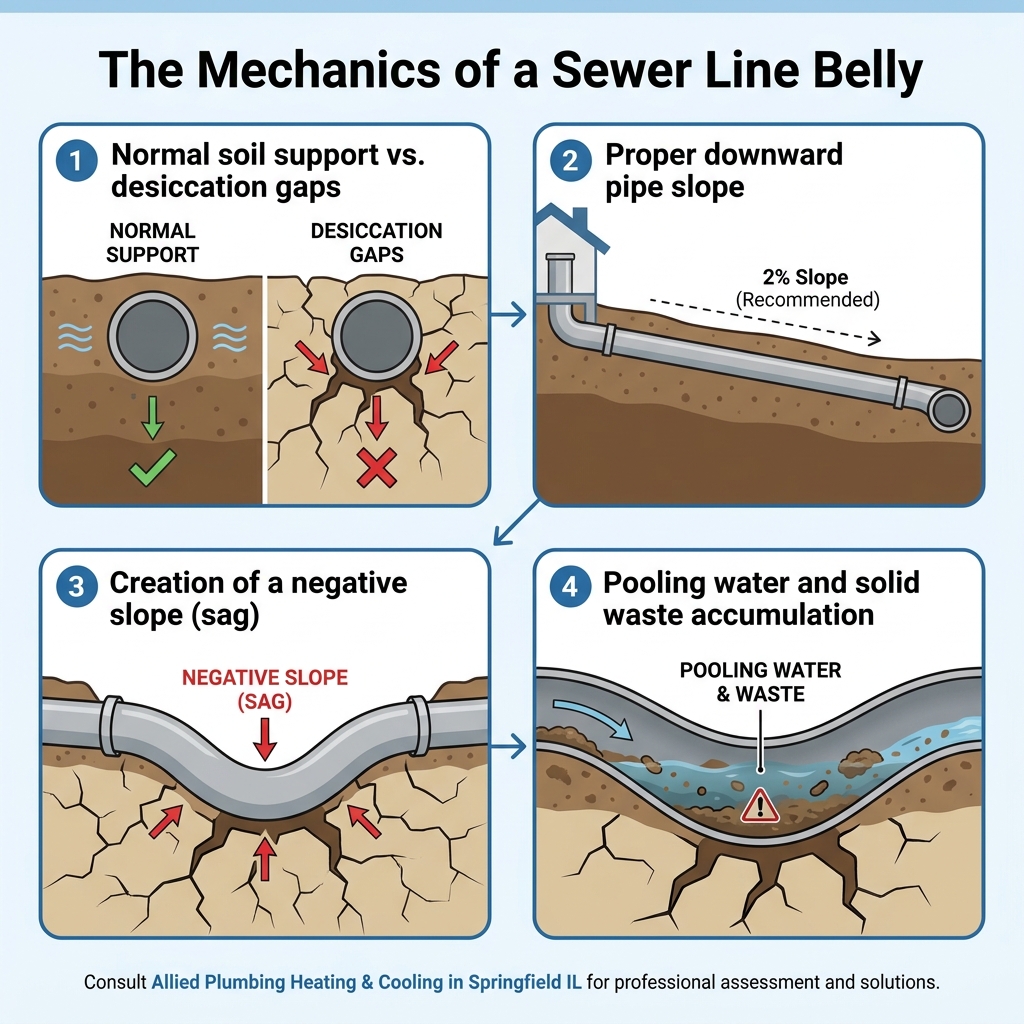
Rigid sewer pipes—whether they are modern PVC or older cast iron—are not simply floating in the dirt. During original construction, they are laid in a carefully trenched bed of compacted soil, sand, or crushed gravel. This bedding process is highly engineered to hold the pipe at a very specific downward grade. That grade is usually a quarter-inch drop per foot of pipe, ensuring that gravity can efficiently carry solid waste and water away from your home.
When drought-induced soil gaps form, the earth literally drops out from underneath the pipe. Voids and empty pockets open up in the trench, completely removing the structural bedding support that the pipes rely on to maintain their slope. The pipe is left hanging in empty space, vulnerable to the immense weight of the dirt above it (known as overburden pressure). Without the compacted earth holding it perfectly in place, the pipe has no choice but to succumb to gravity and the shifting ground around it.
What Exactly is a Sewer Line Belly?
When that vital soil support vanishes during an August late-summer drought, the heavy pipe eventually yields to the empty space beneath it. This structural failure creates what professional plumbers call a "belly." A belly is a structural sag or negative slope in a specific section of the sewer line where the earth has fallen away and the pipe has bowed downward.
Water requires a consistent downward slope to maintain forward momentum. When a pipe sags into a belly, it forms a literal trough underground. This creates a pooling area where wastewater loses all of its velocity. Without gravity pulling the waste swiftly down the line, the water slows to a crawl, and the heavier solids simply settle at the bottom of the sag.
Over time, this stagnant pool catches everything that flows through your system. Toilet paper, organic waste, soap scum, and debris gradually build up in the trough. Because the water cannot forcefully sweep the solids up and out of the negative slope, the accumulation process accelerates until it forms an impenetrable blockage.
It is important to contrast a belly with a shifted joint. A shifted joint happens when ground movement physically snaps or disconnects two sections of pipe, offsetting them so they no longer line up perfectly. A belly means the pipe might still be entirely intact and fully connected, but its structural slope is ruined. Both are direct results of shrinking soil, and both will cause massive disruptions to your home's sanitation system.
The Mechanics of a Sewer Line Belly
Early Warning Signs of Shifting Underground Pipes
Catching a bellied or shifted sewer line early can save you from a catastrophic sewage backup inside your living space. Because the damage happens deep underground in Springfield, IL, you cannot visually inspect the pipe yourself. Instead, you have to rely on secondary symptoms happening inside your house and out in your yard.
Watch closely for these early warning signs that your underground plumbing is losing its slope:
1. Gurgling sounds in toilets: As water struggles to push past the pooled waste in a belly, it traps pockets of air. That air is forced backward and bubbles up through the lowest drains in your home, often causing toilets to gurgle when a nearby sink or shower is running.
2. Foul odors from drains: A structural sag holds standing wastewater permanently. The smell of this stagnant, rotting sewage can vent back up into your bathrooms, laundry room, or basement floor drains.
3. Water backing up into lower-elevation fixtures: If you flush a second-story toilet and water immediately backs up into a basement shower or floor drain, the main line exiting your home is severely compromised.
4. Recurrent, stubborn clogs: The most common and frustrating symptom is a clog that seems to clear temporarily with a plunger, only to return a few days or weeks later in the exact same spot.
Beyond the structural sag itself, there is a secondary drought-related threat to watch for. When the soil is bone dry, tree roots become incredibly aggressive in their search for moisture. They will wrap around compromised pipes, crushing them further, or force their way into joints that have shifted due to the dry earth. Understanding how tree roots damage drain and sewer lines is crucial during a dry spell, as they will exploit any weakness caused by the shifting ground.
Finally, monitor your yard. If you notice unexpected sinkholes, dips in the lawn, or localized patches of unusually green, lush grass during a dry spell, it strongly indicates that sewage is leaking out of a broken or shifted line and fertilizing the dry soil above it.
Standard Clog vs. Structural Belly: Why Plunging Isn't Enough
When a homeowner faces a stubborn backup during an August late-summer drought, the first instinct is usually to grab a plunger or pour a bottle of harsh chemical drain cleaner down the sink. While these DIY methods might occasionally work on a simple hair clog in a bathroom P-trap, they are completely useless against a structural sag.
Understanding the difference between a standard blockage and a structural failure is critical for protecting your home.
• Primary Cause — Standard Clog: Accumulation of hair, grease, or flushed objects in a healthy pipe. — Structural Belly (Sag): Loss of soil support causing the pipe itself to bend downward.
• Typical Location — Standard Clog: Fixture traps (P-traps) or secondary branch lines inside the house. — Structural Belly (Sag): The main underground sewer line buried in the yard.
• Effectiveness of Plunging — Standard Clog: Often highly effective at dislodging localized debris. — Structural Belly (Sag): Completely ineffective; cannot fix the physical slope of the pipe.
• Recurrence Rate — Standard Clog: Low, once the specific debris is fully removed. — Structural Belly (Sag): Guaranteed to return rapidly because the trough remains in place.
Snaking or cabling a bellied line might punch a temporary hole through the accumulated waste, allowing water to flow briefly. This gives homeowners a false sense of security. Because the negative slope remains permanently in the ground, the waste will inevitably pool again and cause another severe blockage within weeks.
Furthermore, using chemical drain cleaners on a bellied line is exceptionally dangerous. Because the water is pooled and not moving, the highly corrosive chemicals simply sit in one spot inside the sag. The exothermic heat reaction generated by these cleaners can actually melt PVC pipes or accelerate corrosion in older cast iron lines, turning a repairable sag into a shattered pipe.
Emphasize the danger of ignoring recurrent backups. Continual strain on a compromised pipe can lead to localized flooding, severe sanitation hazards, and extensive water damage inside your home's lower levels.
The Critical Role of Professional Camera Inspections
If you are dealing with recurrent backups and suspect the dry earth is to blame, guessing is not an option. Visual confirmation via a high-definition sewer camera is the only definitive way to diagnose a structural belly versus a standard, stubborn clog.
During a professional inspection, technicians feed a specialized, waterproof fiber-optic camera directly down your main sewer line. As the camera travels through the dark pipe, technicians are looking for specific, undeniable indicators on the live video feed. They look for the camera head suddenly submerging underwater (which indicates standing water trapped in a belly), offset joints where the pipe has shifted apart, or aggressive root intrusion exploiting the compromised sections.
Because the camera transmits live, high-resolution video, you can see exactly where the pipe has sagged. Professionals also use advanced locators above ground that sync via radio frequency with the camera head underground. This allows the technician to walk your yard and pinpoint the exact depth and location of the sag, mapping out precisely where the structural failure has occurred.
This level of precision diagnosis requires specialized equipment and training available at professional Springfield area service locations. The team at Allied Plumbing Heating & Cooling brings deep local expertise to every call, understanding exactly how Central Illinois clay soils impact older plumbing infrastructure. We know what the Illinoian till plain does to rigid pipes during a drought, and we know how to identify the resulting damage accurately without unnecessary guesswork.
Next Steps After Diagnosis
Once a belly is definitively diagnosed, repair options depend on the severity of the sag and the condition of the surrounding pipe. Solutions may include targeted spot repairs to excavate and correct the grade of a specific section, or advanced trenchless solutions if the overall pipe integrity allows.
We strongly reinforce the rule against attempting any form of DIY sewer repair. Excavating a main sewer line, safely removing the compromised section, and properly re-bedding a new pipe with the correct crushed stone and precise downward slope requires licensed plumbing expertise and heavy excavation equipment. Doing it wrong guarantees the pipe will simply belly again during the next dry season.
Frequently Asked Questions
Can dry soil cause plumbing problems?
Yes, dry soil is a major cause of severe plumbing problems. When clay-heavy soil loses moisture during a drought, it shrinks and pulls away from foundations and underground pipes. This loss of physical support allows pipes to shift, crack, or sag under the weight of the earth above them.
What causes a sewer pipe to belly?
A sewer pipe bellies when the compacted bedding soil beneath it washes away or shrinks due to extreme desiccation. Without that firm foundational support, the heavy pipe bows downward into the empty void, creating a negative slope or trough where wastewater pools instead of flowing away.
How can you tell if a sewer line has collapsed or just shifted?
The only definitive way to tell the difference is through a professional high-definition camera inspection. While both cause severe backups and slow drains, a camera will show whether the pipe walls have physically crushed inward (a collapse) or if the pipe is intact but out of alignment (shifted or bellied).
Can a drought cause a sewer backup even if there's no rain?
Absolutely. A drought causes the ground to contract and shift, which ruins the downward slope of your sewer line. Once the slope is gone, solid waste accumulates in the sag until it forms a complete blockage, causing sewage to back up into your home regardless of the weather above ground.
Is a sewer belly repairable without digging up the whole yard?
In many cases, yes. If the camera inspection pinpoints the exact location of the belly, plumbers can often perform a targeted spot repair, digging only a small hole to fix the affected section. However, the compromised area must be physically excavated to correct the grade and install proper bedding.
Why do my drains keep backing up in late summer?
Late summer brings the driest, hottest soil conditions, which causes maximum ground shrinkage. This shifting earth alters the slope of your underground pipes, creating sags where waste gets trapped. If plunging only fixes the issue for a few days, you are likely dealing with a structural belly caused by the seasonal drought.
Do not let an August late-summer drought destroy your home's sanitation system. If you are dealing with recurrent, stubborn backups and suspect that shifting soil has compromised your pipes, a professional camera inspection is the only way to know for sure. Schedule your diagnostic visit today to uncover the real problem and restore your peace of mind before the damage worsens.
Identifying Older Galvanized Pipes in Historic Chatham Homes Before Winter Hits
October 10, 2026
Freezing temperatures put immense stress on pre-1960s plumbing. Spotting hidden internal corrosion early helps you decide if a drop in water pressure warrants a professional inspection.
Freezing temperatures put immense stress on pre-1960s plumbing. Spotting hidden internal corrosion early helps you decide if a drop in water pressure warrants a professional inspection.
Standard vs Modulating Gas Valves for Consistent Heating in Two-Story Homes
October 9, 2026
Extreme temperature differences between floors often come down to your furnace's gas valve. See how a modulating system balances airflow to eliminate hot and cold zones.
Extreme temperature differences between floors often come down to your furnace's gas valve. See how a modulating system balances airflow to eliminate hot and cold zones.
Why Your Furnace Blower Keeps Running After the Burners Shut Off
October 8, 2026
That cool breeze from your vents after a heating cycle isn't always a malfunction. Understand how the fan limit switch actively protects your heat exchanger from cracking.
That cool breeze from your vents after a heating cycle isn't always a malfunction. Understand how the fan limit switch actively protects your heat exchanger from cracking.