The Silent Water Waster: How a Dripping Faucet Wastes Hundreds of Gallons Per Year
How a dripping faucet wastes hundreds of gallons per year is easier to understand than most people expect — and the numbers are hard to ignore once you see them laid out.
Here's a quick look at annual water waste by drip rate:
• 1 drip/min — Gallons Wasted Per Year: ~34 gallons
• 10 drips/min — Gallons Wasted Per Year: ~350 gallons
• 60 drips/min — Gallons Wasted Per Year: ~2,000+ gallons
• 1 drip/sec (60/min) — Gallons Wasted Per Year: ~3,000+ gallons
That slow, rhythmic drip from your kitchen or bathroom faucet might seem harmless. But based on data from the EPA and USGS, a faucet dripping just once per second wastes more than 3,000 gallons of water every single year — enough to supply over 180 showers. Multiply that across the roughly 10% of U.S. homes with leaks wasting 90 or more gallons per day, and the national total climbs to nearly 1 trillion gallons of wasted water annually.
For homeowners in Springfield, Rochester, and Chatham, that waste shows up directly on your water bill — and it doesn't stop there.
In this guide, we'll walk you through exactly how to calculate your own faucet's water waste in three simple steps, explain what causes faucets to leak, and help you understand when a drip is a sign of a bigger plumbing problem.
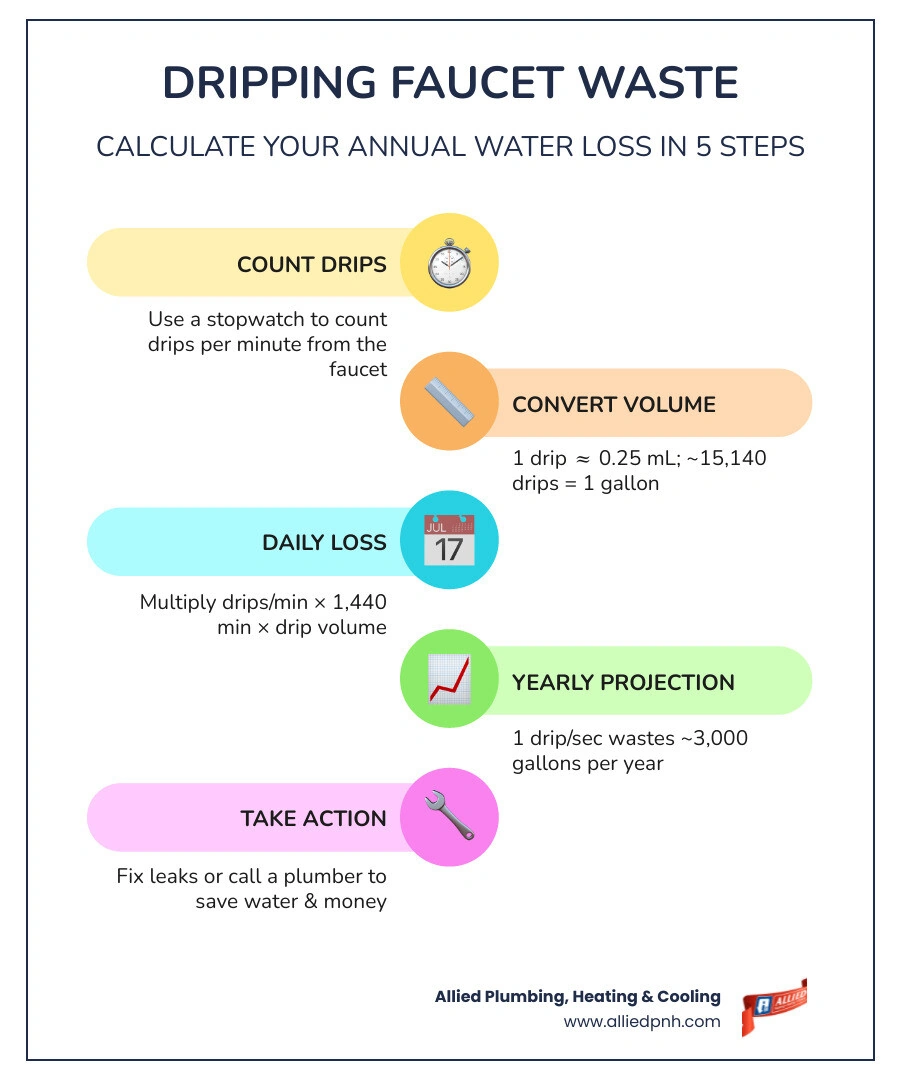
Quick look at how a dripping faucet wastes hundreds of gallons per year:
• faucet and fixture repair when to fix vs replace
• why your faucet drips and what it means for your plumbing
How a Dripping Faucet Wastes Hundreds of Gallons Per Year: The Calculation Guide
To understand the true scale of water waste in your home, you do not need complex laboratory equipment or an advanced degree in hydraulics. All you need is a basic understanding of how small volumes of water accumulate over time.
When we look at household leaks on a national scale, the numbers are staggering. Across the United States, household leaks collectively waste nearly 1 trillion gallons of water annually. This is equivalent to the annual water use of several major metropolitan areas combined. On an individual household level, the average home's leaks account for approximately 10,000 gallons of water wasted every single year.
To put that into perspective, 10,000 gallons is enough water to fill a standard backyard swimming pool or run over 270 loads of laundry. If you want to track down where this water is escaping, your water meter is your best diagnostic tool. By reading your water meter before and after a two-hour period when no water is being used in your home, you can easily determine if you have an active leak. If the meter changes, a leak is present.
For residents in Rochester, water conservation is not just about reducing your utility bills; it is about protecting our shared local water infrastructure and reducing the energy footprint required to treat and pump clean water to our neighborhoods. If you have noticed a persistent drip, calculating your specific waste can help you decide how quickly you need to act. You can read more about what these leaks indicate for your overall plumbing system in our guide on Why Your Faucet Drips and What It Means for Your Plumbing.
To calculate your exact household water waste, follow this simple three-step guide.
Step 1: Count the Drips Per Minute
The first step in calculating your water waste is determining your faucet's drip frequency. The most straightforward way to do this is by using the stopwatch method.
Grab your smartphone, open the timer app, and set a stopwatch. Sit by the leaky fixture and count how many individual drops fall within a 60-second window. If you want to speed up the process, you can perform a 15-second count and multiply that number by four to get your total drips per minute. For example, if you count 15 drips in 15 seconds, your faucet is dripping at a rate of 60 drips per minute (which is equivalent to one drip per second).
If you have a very fast, irregular drip or a tiny stream that is difficult to count drop-by-drop, you should use the measuring cup test instead. Place a standard liquid measuring cup directly under the faucet and set a timer for exactly 30 minutes. Once the time is up, look at how much water has accumulated. Multiply that volume by 48 to determine your total daily water loss.
Conducting a quick household audit in your Chatham home is an excellent weekend project. Walk through your kitchen, bathrooms, utility rooms, and outdoor spigots to count any active drips. You might be surprised to find that a slow drip in a guest bathroom you rarely use is quietly wasting water day and night.
Step 2: Convert Drips to Gallons Using Standard Metrics
Once you have established your drips-per-minute rate, you need to convert those micro-measurements into standard gallons. To do this, we rely on established scientific standards.
The United States Geological Survey (USGS) and environmental researchers use a standard conversion rate for water drops:
• One US gallon of water contains approximately 15,140 individual drips.
• One metric liter contains approximately 4,000 drips.
• Based on these standards, a single typical faucet drip has a volume of approximately 0.25 milliliters (mL).
Using these metrics, we can calculate daily water loss with a simple mathematical formula. First, determine the total number of drips your faucet produces in a single day:
Drips per minute × 60 minutes × 24 hours = Total drips per day
Next, divide that daily total by the USGS standard of 15,140 drips per gallon to find your daily water loss in gallons:
Total drips per day ÷ 15,140 = Gallons wasted per day
For example, if your faucet has a moderate leak of 30 drips per minute, it produces 43,200 drips every 24 hours. When you divide 43,200 by 15,140, you find that your faucet is wasting approximately 2.85 gallons of water every single day. While less than three gallons may not sound like a crisis, let's look at how that volume compounds over time.
Step 3: Project How a Dripping Faucet Wastes Hundreds of Gallons Per Year
Now that you have your daily waste figure, you can project your long-term water loss over months and years. This is where the true impact of how a dripping faucet wastes hundreds of gallons per year becomes incredibly clear.
If we take our daily waste figure of 2.85 gallons (from a moderate 30 drips-per-minute leak) and project it out:
• Over a 30-day month, that single faucet wastes 85.5 gallons of water.
• Over a 365-day year, it wastes 1,040 gallons of water.
If your leak is faster—such as one drip per second (60 drips per minute)—the math becomes even more alarming. A single faucet dripping once per second wastes approximately 17 gallons of water every single day. Over the course of a year, that adds up to more than 3,000 gallons of water wasted from a single fixture.
To help you visualize this impact, we have put together a comparison table showing different drip rates and their corresponding annual water waste, along with real-world equivalents:
• 10 drips/min — Daily Waste: 0.95 gallons — Monthly Waste: 28.5 gallons — Annual Waste: 346 gallons — Real-World Equivalent: Enough to run 60 standard dishwasher cycles
• 30 drips/min — Daily Waste: 2.85 gallons — Monthly Waste: 85.5 gallons — Annual Waste: 1,040 gallons — Real-World Equivalent: Over 20 standard bathtubs filled to the brim
• 60 drips/min (1 drip/sec) — Daily Waste: 5.7 gallons — Monthly Waste: 171 gallons — Annual Waste: 2,080 gallons — Real-World Equivalent: Enough water for more than 120 hot showers
• 120 drips/min (Fast drip) — Daily Waste: 11.4 gallons — Monthly Waste: 342 gallons — Annual Waste: 4,161 gallons — Real-World Equivalent: Equivalent to flushing a high-efficiency toilet 3,200 times
As you can see, even a seemingly minor drip of 10 drips per minute easily wastes hundreds of gallons per year. When that rate climbs to a moderate or fast drip, you are wasting thousands of gallons of treated water.
Common Causes of Faucet Leaks and How to Address Them
Understanding why your faucet is dripping is the first step toward stopping the waste. Faucets are mechanical devices with moving parts that undergo constant friction, pressure, and exposure to water minerals. Over time, these components naturally wear out.
The most common culprits behind a dripping faucet include:
• Worn-Out Washers: In older compression-style faucets, rubber washers seal the water flow when you turn the handle. As you turn the faucet on and off, friction gradually tears or flattens these washers, allowing water to slip past.
• Failed O-Rings: O-rings are small rubber rings that seal the connections between the faucet body and the spout. If your faucet is leaking around the base of the spout when the water is turned on, a failed O-ring is usually to blame.
• Corroded Valve Seats: The valve seat connects the faucet assembly to the spout. Over time, mineral deposits from hard water can accumulate on the valve seat, causing it to corrode and prevent the washer from sealing tightly.
• High Water Pressure: If your home's water pressure is too high, it can physically force water past seals and washers that would otherwise be perfectly watertight.
• Hard Water Mineral Buildup: Calcium and magnesium deposits can scratch delicate internal seals, creating microscopic pathways for water to escape.
If you are interested in learning more about the physical mechanics of fixture degradation, check out our detailed article on Why Faucets Drip and Leak Over Time.
For homeowners who enjoy tackling home maintenance projects, many basic faucet repairs can be completed with a few standard tools. If you want to try fixing a simple leak yourself, refer to our step-by-step instructions on How to Stop That Dripping Faucet.
Before you begin, make sure you have the following common tools on hand:
• Adjustable wrench
• Phillips and flathead screwdrivers
• Allen (hex) wrenches
• Utility knife or small pick (for removing decorative screw covers)
• Replacement washers, O-rings, or a replacement faucet cartridge
• Plumber's grease (silicone-based)
• White vinegar and an old toothbrush (for cleaning mineral deposits)
Understanding How a Dripping Faucet Wastes Hundreds of Gallons Per Year Through Mechanical Wear
To successfully repair a leak, it helps to understand the specific mechanical design of your faucet. Modern homes generally feature one of four faucet types: compression, cartridge, ceramic disc, or ball valves.
Compression faucets are the traditional dual-handle fixtures. They work by using a threaded stem to physically compress a rubber washer against a metal valve seat to block the water flow. Because they rely on physical compression, they experience the highest rate of mechanical wear and require the most frequent washer replacements.
Cartridge, ceramic disc, and ball faucets are often single-handle designs. They do not rely on rubber washers to compress against metal. Instead, they use precision-engineered cartridges or discs that slide over one another to open or block water passages.
• Cartridge Faucets: These use a hollow plastic or brass cartridge that moves up and down or rotates to control flow. When they leak, it is usually because the internal rubber seals on the cartridge have worn out, requiring a complete cartridge replacement.
• Ceramic Disc Faucets: These are highly durable and feature two polished ceramic discs that slide past each other. While they rarely wear out, they can leak if hard water minerals scratch the discs or if the small rubber seals at the bottom of the cartridge fail.
If you are dealing with a persistent leak in Springfield, professional leak detection and repair can save you from the headache of trial-and-error DIY fixes. Our experienced technicians can quickly identify your faucet type, source the exact replacement parts, and ensure your plumbing system is operating safely. If your fixture is older or heavily corroded, we can also help you evaluate whether a repair is practical or if it is time for an upgrade. For a complete breakdown of this decision, read our guide on Faucet and Fixture Repair: When to Fix vs Replace.
The Hidden Impacts of Ignoring Household Water Leaks
When homeowners discover a dripping faucet, they often view it as a minor annoyance rather than an urgent plumbing emergency. However, ignoring a household leak can lead to serious secondary damage that extends far beyond a slightly higher water bill.
One of the most immediate risks of an unaddressed faucet leak is structural water damage. Under-sink cabinets are typically constructed from particle board or thin plywood. When water drips down a faucet stem or escapes from supply line connections under the sink, it pools on the cabinet floor. Over time, this moisture causes the wood to warp, rot, and lose its structural integrity. In severe cases, the water can seep through the subfloor, damaging the ceiling below or rotting the structural wooden framing of your home.
Furthermore, damp, dark environments under sinks are the perfect breeding ground for mold and mildew. Mold can establish itself within 48 to 72 hours of water intrusion. Once mold spores colonize your cabinets or wall cavities, they can trigger respiratory issues, allergies, and require expensive remediation services to safely remove.
There is also an energy cost dimension to faucet leaks that many people overlook. If your dripping faucet is leaking hot water, your water heater has to constantly work to heat fresh cold water to replace what was lost. This constant cycling forces your water heater to consume significantly more electricity or natural gas, driving up your monthly energy bills.
To understand how a dripping faucet compares to other household water wasters, consider the common running toilet. While a dripping faucet wastes thousands of gallons per year, a running toilet is a much more severe emergency. A constantly running toilet can waste between 200 and 2,000 gallons of water every single day. If you suspect you have a leaky toilet, you can read our guide on How Running Toilets Waste Water and Money to learn how to perform a simple food-coloring test to detect silent flapper leaks.
Other common household leaks include:
• Leaky Showerheads: A showerhead dripping at a rate of 10 drips per minute wastes more than 500 gallons of water per year—enough to run 60 dishwasher loads.
• Irrigation System Leaks: Outdoor sprinkler systems are highly vulnerable to frost damage and shifting soil. A tiny irrigation leak just 1/32nd of an inch in diameter can waste approximately 6,300 gallons of water per month.
Frequently Asked Questions About Faucet Leaks
To help you keep your home's plumbing in top shape, we have compiled answers to some of the most common questions we receive from homeowners in our service areas.
How many drips are in a single gallon of water?
Based on the official USGS standard, there are approximately 15,140 drips in a single US gallon of water. This calculation assumes an average drip volume of 0.25 milliliters.
However, actual drip sizes can vary depending on your specific faucet design and water pressure. For example, kitchen faucet drips are often slightly smaller (around 0.25 mL), while bathtub faucet drips are frequently larger (averaging 0.5 mL per drop). This means a leaking bathtub faucet can actually waste up to twice as much water as a kitchen faucet at the exact same drip rate!
Can high water pressure cause my faucets to drip?
Yes, excessive static water pressure is a very common cause of recurring faucet leaks. Most residential plumbing systems are designed to operate safely between 40 and 60 pounds per square inch (PSI). If your home's water pressure exceeds 80 PSI, the excessive force can push water past perfectly good rubber seals, O-rings, and cartridges.
High water pressure also subjects your pipes to "water hammer"—a loud banging sound that occurs when water valves close suddenly. Over time, water hammer can loosen pipe connections and permanently damage your appliances. Installing a pressure-reducing valve (PRV) or pressure regulator is the best way to protect your plumbing system from high-pressure wear.
If you live in Chatham, our team can quickly test your home's water pressure and install a high-quality regulator to keep your system operating within a safe, efficient range.
Why does my faucet only seem to drip at night?
It is incredibly common for homeowners to report that a faucet holds perfectly tight during the day but begins a steady, annoying drip once they go to bed. This phenomenon is usually caused by municipal water pressure spikes.
During the day, thousands of homes and businesses in your area are constantly using water, which keeps the overall pressure in the municipal water mains relatively low. At night, however, water usage drops to near zero. This sudden drop in demand causes the pressure in the water mains to spike. If you have a faucet seal that is starting to wear out, it may hold under normal daytime pressure but fail under nighttime pressure spikes.
Thermal expansion can also play a role. As your water heater runs at night to replenish hot water used during evening showers, the water inside your plumbing system expands. If your home lacks an expansion tank, this increased thermal pressure can force its way out through the weakest seal in your home—your faucet. If you are experiencing these nighttime plumbing issues in Rochester, our professional diagnostics can pinpoint the exact cause and provide a lasting solution.
Conclusion
A dripping faucet is more than just an annoying background noise; it is a silent utility drain that wastes thousands of gallons of clean water, threatens your home with structural damage, and drives up your energy bills. Now that you know how a dripping faucet wastes hundreds of gallons per year, you can take proactive steps to calculate your water waste and address leaks before they escalate.
Whether you need a simple washer replacement, a new cartridge installation, or a complete fixture upgrade, Allied Plumbing, Heating & Cooling is here to help. As a three-generation family business serving Springfield, Rochester, and Chatham since 1977, we bring nearly five decades of experience, unparalleled customer satisfaction, and the peace of mind of the Daikin Comfort Promise to every job.
We provide reliable 24/7 emergency plumbing services to ensure your home remains safe, dry, and efficient. Do not let your hard-earned money drip down the drain. Contact us today to schedule an appointment or explore our comprehensive Allied Plumbing, Heating & Cooling plumbing services.