Why Setting Your Thermostat to 65 Won't Cool Your House Any Faster After Work
Why Setting Your Thermostat to 65 Won't Cool Your House Any Faster After Work
The "Gas Pedal" Myth: Why Cranking the AC Down Doesn't Work
Dropping your thermostat to an extreme low doesn't make the air coming out of your vents any colder—it only creates an illusion of control. If you want to know why setting your thermostat to 65 won't cool your house any faster after work, the answer comes down to a fundamental misunderstanding of how cooling systems actually operate. After a long day, walking into a home baked by August late-summer heat and humidity is intensely frustrating. The natural instinct is to march straight to the hallway, punch the down arrow until the screen reads 65°F, and wait for a blast of arctic air to instantly resolve the discomfort. At Allied Plumbing Heating & Cooling, our technicians see this exact scenario play out constantly across Springfield during the late-summer heat.
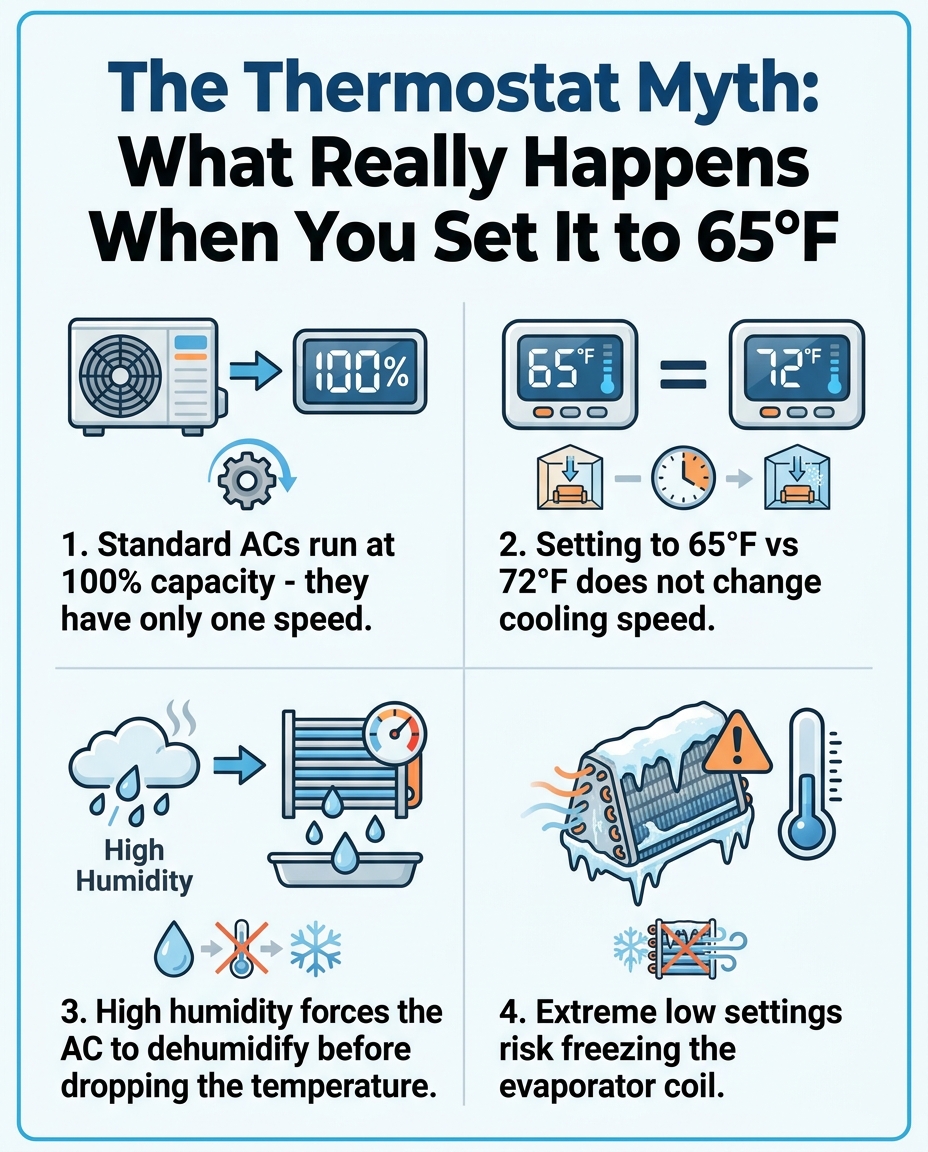
Here is the reality: your thermostat is not a gas pedal. It does not control the speed, intensity, or volume of the cooling process. Instead, a standard thermostat functions exactly like a light switch. It only has two modes for cooling: 100 percent on, or 100 percent off. When you request a drastic temperature drop, you are not telling the system to work harder. You are simply telling it to run longer. Understanding this mechanical reality is the first step toward achieving genuine comfort without destroying your equipment. When you need reliable air conditioning services, understanding how to properly operate your existing equipment is just as critical as the hardware itself.
The psychological trap of the thermostat:
• The expectation: Setting a lower number commands the system to blow colder air.
• The reality: The system always blows air at the exact same temperature, regardless of the target number.
• The result: The home cools at the exact same rate, but the compressor is forced to run endlessly, wasting energy and risking mechanical failure.
Understanding the Mechanics of a Single-Stage Air Conditioning Compressor
To fully grasp why the gas pedal myth fails, you have to look at the machinery sitting outside your home. The vast majority of residential homes rely on a single-stage air conditioning compressor. As the name implies, a single-stage system only operates at one speed: maximum capacity. When the indoor temperature rises above your setpoint, the thermostat sends a signal to the control board. The system turns on, ramps up to its full output, and stays there until the target temperature is reached.
Your air conditioner is designed to output air that is roughly 15 to 20 degrees cooler than the ambient air it pulls in from your return vents. If your home is 80°F inside, the air blowing from your supply registers will be approximately 60°F to 65°F. If you set the thermostat to 72°F, the system blows 60°F air until the room reaches 72°F, then shuts off. If you set the thermostat to 65°F, the system still blows 60°F air—it just refuses to shut off until the room reaches that extreme new target. The speed of the cooling process remains absolutely identical.
While variable-speed and two-stage compressors do exist—and can adjust their output to match the immediate cooling demand—standard single-stage units simply do not possess this capability. In our daily work repairing AC units, we've found that forcing a single-stage unit to chase an impossible number only guarantees excessive wear and tear on the internal components.
• Single-Stage (Most Common) — Operational Speeds: 100% On or 100% Off — How It Responds to a 65°F Setpoint: Runs at maximum capacity continuously until the extreme target is hit, risking a frozen coil.
• Two-Stage — Operational Speeds: High (100%) and Low (~65%) — How It Responds to a 65°F Setpoint: Ramps to high speed to recover the temperature, then drops to low speed to maintain it.
• Variable-Speed — Operational Speeds: Anywhere from 30% to 100% — How It Responds to a 65°F Setpoint: Gradually adjusts output in tiny increments to match the exact cooling load of the home.
The Thermostat Myth: What Really Happens When You Set It to 65°F
The Hidden Barrier: How Indoor Humidity Slows Down the Cooling Process
Temperature is only half of the comfort equation. When our team responds to end-of-season cooling complaints in Springfield, we often find that the real culprit is moisture. In a highly humid late-summer climate, the air inside your home acts like a heavy, wet blanket. Before your air conditioner can effectively lower the actual temperature of the room, it has to wring that moisture out of the air. This process is known as dealing with the latent cooling load.
When you walk into a hot, stuffy house, the AC must first tackle the latent heat (the airborne moisture) before it can make a dent in the sensible heat (the number on the thermometer). Because a single-stage system operates at a fixed speed, this dehumidification phase takes a specific amount of time. You cannot rush it. Cranking the thermostat down does absolutely nothing to accelerate how fast the system extracts water vapor from the indoor air.
How the latent cooling process actually works:
1. Warm, damp indoor air is pulled through the return vents and across the frigid indoor evaporator coil.
2. The moisture in the air condenses into water droplets on the cold metal fins, exactly like condensation forming on a glass of ice water.
3. This water drips into the condensate drain pan and flows safely out of the house.
4. Only after a significant volume of humidity is removed does the ambient room temperature begin to drop noticeably.
If your home consistently feels sticky and takes hours to cool down, the issue is likely a massive moisture load, not a broken thermostat. Exploring professional indoor air quality solutions can help manage this moisture independently, allowing your primary cooling system to focus strictly on temperature reduction rather than battling humidity.
The Danger of Extreme Settings: What Happens When You Force a 65°F Setpoint
Patience is a virtue, especially when it comes to HVAC equipment. When you demand a 65°F setpoint vs standard 72°F target, you are asking a machine to perform a marathon sprint without taking a single breath. While the system will try its best to comply, the mechanical consequences of this continuous operation are severe, particularly late in the season when the equipment is already fatigued from months of heavy usage.
Our service technicians frequently encounter frozen coils late in August precisely because a system was forced to chase an unrealistic setpoint. As the system runs endlessly to reach that 65-degree mark, the indoor coil gets colder and colder. If the airflow is slightly restricted by a dirty filter, or if the system simply runs for too many hours without a break, the condensation on the coil will literally freeze into a solid block of ice. Once the coil is encased in ice, it can no longer absorb heat from your home's air.
What happens when the coil freezes:
• Airflow plummets: The ice blocks the tiny spaces between the aluminum fins, choking off the air supply.
• Warm air blows from vents: Because the refrigerant can no longer absorb heat, the air circulating back into your home remains warm.
• Compressor damage: Liquid refrigerant can flow backward into the outdoor compressor (a condition called liquid slugging), causing catastrophic engine failure.
If you find yourself standing under a vent and wondering why your AC is running but not cooling your home, an overworked, iced-over coil is frequently the culprit. The only solution at that point is to turn the system completely off, let the ice melt for several hours, and start over.
Effective Strategies for Returning to a Comfortable Home
Instead of relying on the gas pedal myth and risking a mid-August breakdown, there are smarter, highly effective ways to manage your home's climate. The goal is to reduce the workload on your equipment while maintaining a comfortable environment for your family. By managing the heat gain during the day and setting realistic recovery targets, you can walk into a cool house without demanding the impossible from your AC.
A 65°F setpoint vs standard 72°F target not only risks freezing your system, but it also spikes your utility bills unnecessarily. As your local Springfield HVAC experts, we recommend adopting proactive cooling strategies that guarantee faster comfort and a longer lifespan for your equipment.
The smart cooling checklist:
• Embrace smart scheduling: Use a programmable or smart thermostat to automatically begin cooling the house 30 to 60 minutes before you typically arrive home. This gives the system time to handle the humidity load before you even walk through the door.
• Set a realistic target: Aim for 72°F to 74°F when you are home. This is a highly achievable target that provides excellent comfort without overworking the compressor.
• Block solar heat gain: Keep your blinds, shades, and curtains closed during the peak daylight hours. Sunlight beaming through windows acts like a greenhouse, dramatically increasing the sensible heat load your AC has to remove later.
• Utilize the wind-chill effect: Turn on ceiling fans in the rooms you are actively using. Moving air evaporates moisture from your skin, making a 74-degree room feel closer to 70 degrees. Just remember to turn the fans off when you leave the room, as they cool people, not empty spaces.
• Avoid massive setbacks: Do not turn your AC completely off when you leave for work. Let the temperature drift up to 78°F or 80°F. This prevents the humidity from building up to unmanageable levels while you are away.
When Slow Cooling Means Trouble: Identifying Real AC Issues
While we have established that a single-stage air conditioning compressor needs time to overcome heat and humidity, there is a distinct difference between normal operational delays and a system that is genuinely failing. If you have set a reasonable target temperature and your system is running for hours without making any progress, you may have a mechanical issue that requires professional intervention.
Ignoring the warning signs of a struggling system often turns a minor, inexpensive repair into a major end-of-season breakdown. Recognizing the symptoms early is the best way to protect your investment.
Signs your AC is actually failing, not just working hard:
• Zero temperature drop: The system runs for two hours but the indoor temperature does not drop a single degree.
• Lukewarm airflow: The air coming from the supply registers feels room-temperature or slightly warm, rather than crisp and cold.
• Short cycling: The system turns on for three minutes, abruptly shuts off, and then turns right back on again.
• Unusual noises: Grinding, squealing, or loud buzzing sounds coming from the outdoor unit indicate failing electrical or mechanical components.
We recently visited a local homeowner who scheduled routine end-of-season checks for their furnace and air conditioner. Our technician provided prompt, courteous service to ensure the system was ready for the back-to-school transition, proving that proactive maintenance is always worth the investment. As your trusted local advisor, our team at Allied Plumbing Heating & Cooling focuses on providing honest diagnostics to help families cool their homes efficiently, rather than just pushing unnecessary equipment upgrades. If your system is struggling, scheduling professional AC maintenance and repair is the safest next step.
Frequently Asked Questions About Thermostat Settings and AC Speed
Does setting the AC lower make it cool faster?
No, setting the thermostat lower does not make the house cool faster. Your air conditioner operates at a single, fixed speed and outputs air at a consistent temperature. A lower setting simply forces the system to run for a longer period of time until it reaches that extreme target, which wastes energy and risks freezing the equipment.
Why does my AC take so long to cool my house?
Your AC takes time to cool the house because it must first remove the indoor humidity before the ambient temperature can drop. When a home is warm and sticky, the system spends a significant amount of its operational time extracting airborne moisture. Because standard systems run at one speed, this dehumidification phase cannot be rushed.
What is the fastest way to cool down a hot house?
The fastest way to cool down a hot house is to set a normal target temperature, close all blinds to block solar heat, and turn on ceiling fans to circulate the air. The fans create a wind-chill effect that makes you feel cooler immediately, while the AC works steadily to remove the underlying heat and humidity without freezing up.
Should I turn my AC off while at work?
It is generally better to raise the temperature a few degrees rather than turning the AC completely off while you are at work. Allowing the house to drift up to 78°F prevents massive humidity buildup. If you turn it completely off, the system will have to work twice as hard to overcome the accumulated heat and moisture when you return.
Can running the AC constantly cause it to break?
Yes, forcing the system to run without breaks can freeze the indoor evaporator coil and permanently damage the outdoor compressor. When you demand a 65°F setpoint vs standard 72°F target, the system never gets a chance to rest. This continuous operation leads to excessive wear, frozen components, and eventual mechanical failure.
Stop Overworking Your System and Start Cooling Smarter
The gas pedal myth is one of the most persistent and damaging misunderstandings in residential heating and cooling. By recognizing that your thermostat is an on/off switch rather than a speed dial, you can protect your equipment from unnecessary strain. Battling August late-summer heat and humidity requires patience, smart scheduling, and a realistic approach to indoor comfort.
If you have adjusted your habits, utilized smart scheduling, and set reasonable targets, but your home still refuses to cool down, it is time to call in the experts. Don't let a struggling system turn into an expensive breakdown. Reach out to your local professionals for a thorough inspection to ensure your equipment is operating at its true maximum capacity. When you need us, our team is always ready to help you navigate the back-to-school transition with a perfectly cooled home.
Why Falling Leaves and Acorns Are a Hidden Threat to Your Exterior Drain Cleanouts
September 18, 2026
During early fall yard prep, a cracked or missing exterior cleanout cap can act as a direct funnel for yard debris. Find out how this hidden vulnerability leads to severe main sewer line blockages.
During early fall yard prep, a cracked or missing exterior cleanout cap can act as a direct funnel for yard debris. Find out how this hidden vulnerability leads to severe main sewer line blockages.
Understanding the Role of the Circulator Pump in Your Hydronic Heating System
September 17, 2026
You turn on your boiler for the first brisk fall cold snap, but the radiators stay freezing. Discover why a dormant circulator pump is usually the culprit.
You turn on your boiler for the first brisk fall cold snap, but the radiators stay freezing. Discover why a dormant circulator pump is usually the culprit.
Where to Place Carbon Monoxide Detectors Relative to Your Gas Furnace and Bedrooms
September 16, 2026
Finding the exact wall height and distance for a new CO alarm is a critical decision point. See the precise measurements needed to maximize early warning and prevent false alarms this fall.
Finding the exact wall height and distance for a new CO alarm is a critical decision point. See the precise measurements needed to maximize early warning and prevent false alarms this fall.