Deciding Between Limping Your 15-Year-Old AC Through August or Replacing It Now
Deciding Between Limping Your 15-Year-Old AC Through August or Replacing It Now
Is It Worth Fixing a Failing Air Conditioner Right Before Fall?
Is your air conditioner actually broken, or is it just struggling to keep up with the intense late-summer heat? When you are deciding between limping your 15-year-old AC through August or replacing it now, that distinction matters. It is a frustrating reality we witness every year at Allied Plumbing Heating & Cooling: right as the back-to-school transition begins and Springfield household routines get busier, the cooling system decides to quit. You are left staring at a failing 15-year-old unit, wondering if a temporary fix will hold out until the weather cools down, or if you are simply throwing good money after bad.
The primary dilemma comes down to risk versus reward. Paying for a band-aid fix might seem like the easiest way to survive the rest of the month, but it leaves you vulnerable to another breakdown during the next heatwave. On the other hand, investing in a new system immediately requires a larger upfront commitment, but it guarantees reliable comfort when you need it most.
Making this choice requires a pressure-free, objective look at the pros and cons of both options. Before you make a rushed decision based purely on the immediate temperature in your living room, you need to evaluate the system's exact age, its overall mechanical condition, and the long-term financial impact of your choice. To start, you need to know exactly what you are dealing with.
The Reality of Running a 15-Year-Old Unit in Late Summer
The Department of Energy considers 15 to 20 years to be the maximum reliable lifespan for a central air conditioning system. When a unit reaches that 15-year mark, it has endured over a decade and a half of harsh weather, constant vibration, and intense seasonal workloads. By the time late summer arrives, the cumulative wear and tear on these aging components reaches its absolute peak.
August places a massive, continuous strain on an air conditioner. The compressor, which is the heart of the system, has to work longer cycles to remove heat from your home. In an older unit, the internal motors are weaker, the electrical connections may be degraded, and the coils are often compromised. This makes the system highly susceptible to a sudden, catastrophic failure right when you need it the most.
The impact of brutal humidity:
With summer temperatures regularly pushing high heat and brutal humidity in Springfield, IL, our technicians frequently encounter a secondary problem created by a struggling 15-year-old unit: poor dehumidification. An air conditioner cools your home by removing moisture from the air. When an aging unit is limping along, it often lacks the sustained cooling capacity to pull that moisture out effectively. Even if the vents are technically blowing cool air, your home will feel clammy, sticky, and deeply uncomfortable.
Furthermore, running a degraded system at maximum capacity is incredibly inefficient. As parts wear out, the unit has to consume significantly more electricity just to provide a fraction of the cooling power it once had. You end up paying premium utility bills for subpar comfort, all while crossing your fingers that the system survives the month.
The Risks of a Temporary "Band-Aid" Fix
The short-term appeal of delaying a major purchase is completely understandable. When faced with a sudden breakdown during the busy back-to-school season, authorizing a quick, temporary repair feels like the path of least resistance. However, this "limping" strategy carries significant hidden risks that can ultimately cost you much more in the long run.
The Problem: A temporary patch rarely addresses the root cause of the system's decline. In our years of servicing older HVAC systems throughout the area, we've found that when a 15-year-old air conditioner experiences a major failure, it is usually a symptom of systemic wear rather than an isolated incident. Fixing one part often puts additional stress on the remaining old components.
The Cause: As a patched unit starts running again, the newly replaced part operates at peak efficiency, but the surrounding 15-year-old parts cannot keep up. The compressor might be working harder to compensate for degraded coils, or a new blower motor might overtax an aging electrical board. This imbalance frequently leads to a secondary component failure occurring days or weeks after the initial patch.
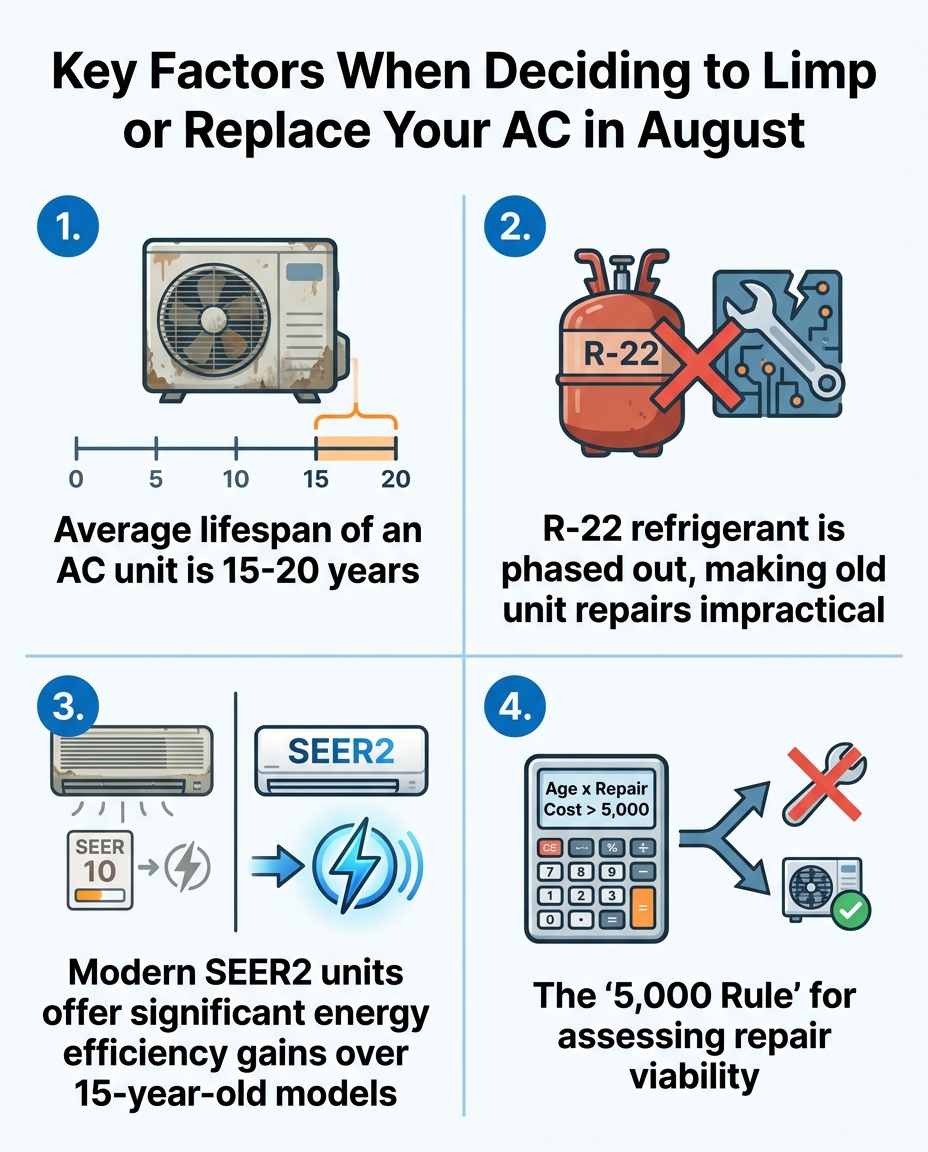
The Solution: You have to evaluate the financial gamble of sinking repair funds into a doomed unit. A highly effective way to assess repair viability objectively is by using the "5,000 rule." You simply multiply the age of your system by the estimated cost of the repair. If the resulting number exceeds 5,000, the repair is generally considered a poor financial investment, and replacement is the smarter path forward.
To better understand the math behind this decision, it helps to know exactly when the cost of AC repair exceeds the value of your system. Relying on a band-aid fix late in the season often means paying for a repair now, enduring a hot, uncomfortable house when it breaks again, and then paying for the full replacement anyway.
Navigating R-22 Phaseouts and Modern Efficiency Standards
When assessing a 15-year-old air conditioner, you must look beyond the mechanical parts and consider the refrigerant running through its lines. Understanding this technical context is crucial because it often dictates why repairing an older unit is entirely impractical today.
Systems installed 15 years ago were almost certainly designed to use R-22 refrigerant. The Environmental Protection Agency (EPA) mandated a complete phaseout of R-22 due to its negative environmental impact. As a result, the production and import of R-22 have been entirely banned in the United States.
Because the supply is strictly limited to reclaimed or previously stockpiled quantities, acquiring R-22 is incredibly difficult and highly impractical. If your aging AC has a refrigerant leak, simply "topping it off" is no longer a viable or sensible option. Major refrigerant-related repairs on these older units are often cost-prohibitive, forcing homeowners to recognize that the system has reached the end of its serviceable life.
Beyond the refrigerant issue, there is a massive gap in energy efficiency between a 15-year-old model and today's technology. Older units were built to outdated SEER (Seasonal Energy Efficiency Ratio) standards, often operating at a fraction of the efficiency required by modern regulations. Today's systems are built to strict SEER2 efficiency standards, which are designed to maximize cooling output while minimizing electricity usage.
Upgrading to a modern system eliminates the headache of obsolete refrigerants while drastically reducing your monthly energy consumption during peak demand. Instead of pouring resources into a unit that drains power and relies on phased-out chemicals, you can transition to a system built for today's environmental and economic realities.
Immediate AC Replacement: Securing Long-Term Reliability
Choosing to replace your air conditioner immediately, rather than waiting for it to fail entirely, shifts your household from a state of anxiety to a state of security. The most immediate benefit is the profound peace of mind that comes with a reliable, warranty-backed system. As the back-to-school transition accelerates, the last thing your family needs is the disruption of a hot, sleepless night caused by a sudden system breakdown.
An immediate replacement also delivers a drastic improvement in your daily living environment. Modern air conditioners provide consistent, even cooling throughout the home, eliminating the hot and cold spots that plague older systems. Furthermore, a new system dramatically improves indoor air quality and humidity control. With properly functioning coils and advanced blower technology, a new unit effortlessly pulls excess moisture from the air, leaving your home feeling crisp and comfortable.
Many homeowners hesitate because of the upfront commitment, but financing a new system now is often more financially prudent than paying for a temporary fix followed by a full replacement shortly after. By utilizing flexible financing options, you can secure a high-efficiency system immediately while keeping your monthly household budget predictable and manageable.
Additionally, upgrading to a high-efficiency system can open the door to valuable financial incentives. Generic federal tax credits and local utility incentive programs frequently apply to qualifying high-efficiency AC or heat pump installations. While you should always verify current programs with your utility provider or tax professional, these incentives can significantly offset the initial investment, making immediate replacement the smartest financial move.
Side-by-Side: Repairing vs. Replacing Your AC in August
To help you weigh your options clearly, it helps to look at the differences side-by-side. When you are deciding between limping your 15-year-old AC through August or replacing it now, a scannable comparison framework can highlight the true impact of each choice.
• Short-Term Relief vs. Long-Term Reliability — Limping Through (Band-Aid Fix): Provides temporary cooling, but leaves you vulnerable to secondary breakdowns. — Immediate Replacement: Guarantees reliable, uninterrupted comfort backed by a manufacturer warranty.
• Energy Consumption — Limping Through (Band-Aid Fix): High. Struggling old units run longer cycles and consume maximum electricity. — Immediate Replacement: Low. Modern SEER2 units optimize energy use, lowering monthly utility bills.
• Risk of Complete Breakdown — Limping Through (Band-Aid Fix): Very High. The strain of late-summer heat often causes aging compressors to fail entirely. — Immediate Replacement: Virtually None. A new system is built to handle peak seasonal demand effortlessly.
• Home Comfort & Dehumidification — Limping Through (Band-Aid Fix): Poor. Aging units struggle to remove humidity, resulting in a sticky, clammy environment. — Immediate Replacement: Excellent. Advanced airflow and coil technology ensure crisp, dry, and even cooling.
When to Consider Limping Through
• Minor, non-refrigerant issues: If the repair is a simple, inexpensive electrical component (like a contactor) and the unit has been otherwise perfectly maintained throughout its life.
• Imminent relocation: If you are moving out of the home within the next few months and a major investment does not align with your immediate real estate plans.
When to Replace Immediately
• Major component failure: If the compressor is failing, the motor is seizing, or there is a major leak of obsolete R-22 refrigerant.
• Chronic discomfort: If the home is consistently uncomfortable, humid, and clammy despite the AC running constantly all afternoon.
Key Factors When Deciding to Limp or Replace Your AC in August
How to Choose What's Best for Your Springfield Home
Synthesizing this decision framework ultimately comes down to your specific household needs. Every home, comfort preference, and financial situation is completely unique. While the data strongly points toward replacing a 15-year-old unit, making the final call requires a tailored approach.
1. Assess the overall condition: Look beyond the immediate broken part. Have you noticed rising energy bills, strange noises, or poor airflow over the last two years?
2. Calculate the 5,000 rule: Take the estimated cost of the temporary fix and multiply it by 15. If the number is high, you are likely throwing money away.
3. Request a comprehensive evaluation: We advise homeowners to request a full system evaluation before committing to a costly repair. You need to know the state of the ductwork, the electrical draw of the compressor, and the condition of the evaporator coil.
4. Make a proactive decision: Do not wait for an emergency breakdown at 4:00 p.m. on a Friday. Proactive decisions allow you to explore financing, choose the right equipment, and schedule installation on your terms.
It is incredibly important to work with a contractor who prioritizes your best interests over a quick sale. As a local, family-owned business, our team at Allied Plumbing Heating & Cooling provides honest, no-pressure assessments to help you make the best financial and comfort decision for your family. We proudly serve Springfield and surrounding service areas, ensuring that you have all the facts before you invest in your home's comfort.
Frequently Asked Questions About Late-Summer AC Failures
Is it worth fixing a 15-year-old air conditioner?
In most cases, fixing a 15-year-old air conditioner is not a sound financial investment if the repair is significant. Units of this age have reached the end of their reliable lifespan, utilize obsolete R-22 refrigerant, and operate at very low efficiency levels. Pouring money into a major repair usually results in a temporary fix, inevitably leading to a full replacement shortly after.
What happens if my AC breaks down completely in August?
If your AC breaks down completely in August, your home will rapidly absorb the late-summer heat and humidity, making the indoor environment deeply uncomfortable and potentially unsafe for vulnerable family members. Furthermore, HVAC contractors are often at peak capacity during late-summer heatwaves. A complete breakdown forces you into an emergency replacement scenario, limiting your time to research options and secure financing calmly.
How much efficiency does a 15-year-old AC lose?
A 15-year-old AC loses a significant amount of efficiency due to standard mechanical wear and tear, dirty coils, and degraded motors. Even if it was highly rated when installed, it cannot compete with today's strict SEER2 standards. Running an aging, inefficient unit forces it to consume maximum electricity for minimal cooling output, leading to excessively high utility bills.
Should I replace my AC before it completely breaks?
Yes, replacing your AC before it completely breaks is highly recommended. A proactive replacement allows you to carefully review equipment options, secure favorable financing, and schedule the installation at your convenience. Waiting for a catastrophic failure often leads to rushed decisions, uncomfortable nights, and the stress of dealing with an emergency breakdown.
How long does an AC unit typically last in the Midwest?
In the Midwest, a central air conditioning unit typically lasts between 15 and 20 years with proper, consistent maintenance. The extreme temperature swings—from brutal summer heat and humidity to long periods of winter inactivity—place unique stress on the outdoor condenser. Once a unit crosses the 15-year threshold, the likelihood of major component failure increases dramatically.
Secure Your Home's Comfort Before the School Year Starts
As the August late-summer heat persists and the back-to-school transition demands your full attention, reliable cooling is essential for your household's routine. You should not have to spend your evenings worrying about whether your aging air conditioner will survive the night.
If you are tired of paying for temporary fixes and high energy bills, it is time to explore a permanent solution. Reach out for a professional, pressure-free evaluation of your aging system today. Our team is ready to provide you with honest insights and clear next steps so you can secure your home's comfort with total confidence.
Why Falling Leaves and Acorns Are a Hidden Threat to Your Exterior Drain Cleanouts
September 18, 2026
During early fall yard prep, a cracked or missing exterior cleanout cap can act as a direct funnel for yard debris. Find out how this hidden vulnerability leads to severe main sewer line blockages.
During early fall yard prep, a cracked or missing exterior cleanout cap can act as a direct funnel for yard debris. Find out how this hidden vulnerability leads to severe main sewer line blockages.
Understanding the Role of the Circulator Pump in Your Hydronic Heating System
September 17, 2026
You turn on your boiler for the first brisk fall cold snap, but the radiators stay freezing. Discover why a dormant circulator pump is usually the culprit.
You turn on your boiler for the first brisk fall cold snap, but the radiators stay freezing. Discover why a dormant circulator pump is usually the culprit.
Where to Place Carbon Monoxide Detectors Relative to Your Gas Furnace and Bedrooms
September 16, 2026
Finding the exact wall height and distance for a new CO alarm is a critical decision point. See the precise measurements needed to maximize early warning and prevent false alarms this fall.
Finding the exact wall height and distance for a new CO alarm is a critical decision point. See the precise measurements needed to maximize early warning and prevent false alarms this fall.