Decoding the Difference Between a Normal AC Hum and a Failing Compressor Motor
Decoding the Difference Between a Normal AC Hum and a Failing Compressor Motor
Why Is My Outside AC Unit Humming So Loudly?
Is your outdoor cooling unit suddenly keeping you awake at night with a strange, persistent noise? Decoding the Difference Between a Normal AC Hum and a Failing Compressor Motor is a highly practical skill every homeowner should develop, especially when your system is working overtime. By the time the August and back-to-school cooling season arrives, your outdoor condenser has likely been running for hundreds of hours. Here at Allied Plumbing Heating & Cooling, we frequently see how that cumulative workload can cause subtle shifts in how your equipment sounds, leaving you wondering if a sudden humming noise is just a quirk of an aging machine or an urgent mechanical emergency.
Hearing a loud, unfamiliar noise from the outdoor condenser unit naturally causes immediate anxiety. Your central air conditioner is a major investment, and the compressor is its most expensive component. The concrete problem you face is telling the difference between a harmless, standard operational hum and the harsh, vibrating mechanical groan of a compressor motor that is actively tearing itself apart. Making this distinction accurately leads directly to a critical decision point: knowing exactly whether to shut the system down immediately at the thermostat to prevent catastrophic electrical failure, or whether it is safe to let it keep running.
As the late-summer heat persists, understanding these auditory cues becomes incredibly valuable. Aging units naturally develop new vibrations and deeper tones over the years. However, there is a distinct boundary between normal wear and active mechanical failure. Learning to identify that boundary protects your equipment from severe damage and keeps your home comfortable. Understanding how your air conditioning systems are supposed to sound is the first step in catching a minor issue before it escalates into a complete system breakdown.
Establishing the Baseline: What Does a Normal Electrical Hum Sound Like?
Before you can identify a mechanical problem, you need to know exactly what a healthy system sounds like. Every central air conditioner makes noise. The outdoor condenser unit houses several moving parts and high-voltage electrical components, all of which generate sound during standard operation. When the thermostat calls for cooling, a specific sequence of operations begins, and each step has its own distinct acoustic signature.
First, you will typically hear a distinct click followed immediately by a low-level, steady electrical hum. This is the contactor pulling in. The contactor is an electrical switch that allows high-voltage power to flow to the compressor and the fan motor. The magnetic coil inside this switch naturally vibrates slightly as alternating current passes through it, creating a soft, rhythmic buzzing sound. Immediately after this electrical hum, you should hear the smooth, consistent whir of the fan motor engaging. The fan blade moves a massive volume of air across the condenser coils, creating a rushing sound that blends with the mechanical operation.
Underneath the sound of the rushing air, the compressor itself produces a deep, steady hum. In Springfield IL, where high summer temperatures and humidity require continuous system operation, you will hear this baseline hum frequently. Our technicians constantly remind homeowners that because your system cycles on and off multiple times a day to manage the regional heat, becoming familiar with this standard operational sound is highly recommended. It allows you to notice immediately when something changes.
It is also perfectly normal for an aging unit to develop a slightly louder baseline hum over the years. As rubber vibration isolation pads compress and metal panels weather, the cabinet may resonate a bit more than it did when it was brand new. This gradual increase in volume does not necessarily indicate a failure. The key characteristic of a normal hum is that it remains steady, rhythmic, and free of violent vibrations. If your system is maintaining the temperature in your home and the noises are consistent, you are likely hearing standard operation. However, if you suspect the noise has crossed the line into abnormal territory, seeking professional AC repair and service is the safest way to verify the health of your equipment.
The Warning Signs: Identifying the Mechanical Groan of a Failing Compressor
While a steady hum is normal, a harsh, vibrating mechanical groan is a massive red flag. When a compressor motor begins to fail, the acoustic signature of the outdoor unit changes dramatically. Instead of a smooth, rhythmic sound, the noise becomes erratic, aggressive, and noticeably louder. These warning signs often indicate that the motor is drawing excessive electrical current or that internal mechanical components are grinding against each other.
One of the most alarming sounds our team encounters in the field is a "hard start." This occurs when the compressor struggles to overcome the initial physical resistance required to pump refrigerant. You might hear a loud, struggling groan or a sharp shrieking sound that lasts for several seconds before the compressor finally kicks in—or fails to start entirely. During a hard start, the motor pulls an immense electrical load, which can sometimes cause the lights inside your home to dim momentarily. If you notice dimming lights paired with a harsh noise from the outdoor unit, the compressor is under severe distress.
Another highly common auditory warning sign points to a failing run capacitor rather than the compressor itself. The run capacitor acts like a battery that provides a continuous boost of electrical energy to keep the motor spinning. If the capacitor fails, the compressor will try to start but lack the necessary torque. This results in a very loud, aggressive humming or buzzing sound, but the fan may not spin, and the system will not cool your home. The motor is essentially locked in place, pulling locked-rotor amps, which causes it to overheat rapidly. If you are researching how to fix loud outdoor AC unit noises, understanding the difference between these specific sounds is highly beneficial.
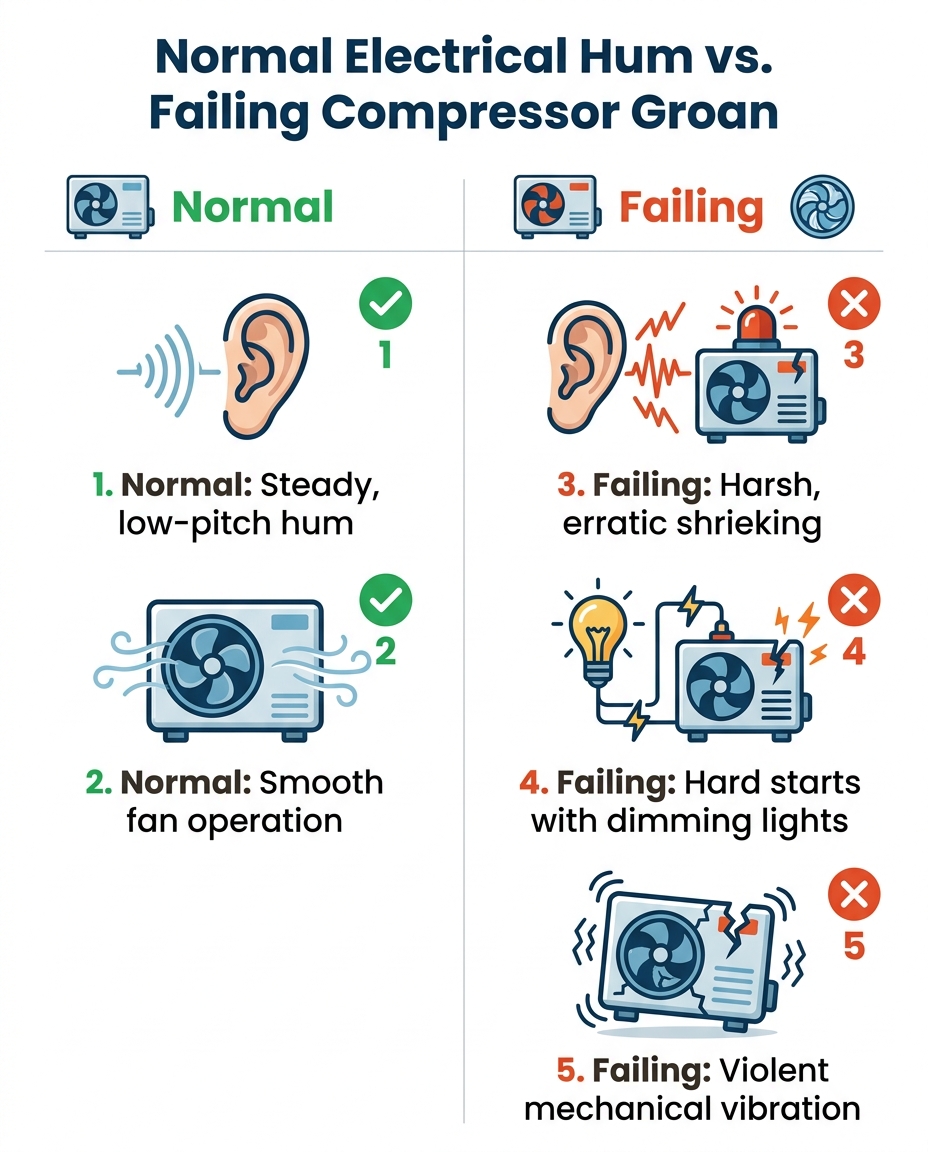
Normal Electrical Hum vs. Mechanical Groan
To help you distinguish between safe operation and a system in distress, use this quick auditory comparison:
• Pitch and Tone — Normal Electrical Hum: Low-pitch, steady, rhythmic, and consistent. — Failing Mechanical Groan: Harsh, erratic, shrieking, or aggressively loud buzzing.
• Fan Operation — Normal Electrical Hum: Accompanies smooth, continuous fan blade rotation. — Failing Mechanical Groan: Often accompanied by a fan that stutters, spins slowly, or won't spin at all.
• Physical Vibration — Normal Electrical Hum: Mild, contained vibration within the metal cabinet. — Failing Mechanical Groan: Violent shaking or rattling that can be felt if standing nearby.
• Electrical Impact — Normal Electrical Hum: No noticeable impact on household power. — Failing Mechanical Groan: May cause indoor lights to dim briefly when the sound starts.
Normal Electrical Hum vs. Failing Compressor Groan
How Late-Summer Heat Pushes Aging Compressors to the Brink
Air conditioning breakdowns rarely happen at convenient times. They overwhelmingly occur during the hottest weeks of the year. By the time August arrives, your cooling system has endured months of continuous cycling. This prolonged operation creates cumulative thermal stress on the mechanical and electrical components. The heat generated by the compressor motor itself, combined with the extreme ambient temperatures outside, pushes aging equipment to its absolute physical limits.
In Springfield IL, high summer humidity adds another layer of intense strain. Air conditioners do not just lower the temperature; they also dehumidify the air. High humidity forces the system to run much longer cycles to handle the latent heat load. This means the compressor motor runs continuously for extended periods, reducing the time it has to cool down between cycles. Over a long, humid summer, this constant demand accelerates mechanical wear on internal bearings and degrades the electrical insulation inside the motor windings.
Aging compressors gradually lose their resilience against this type of relentless heat. Parts that were once perfectly lubricated begin to experience friction. Electrical capacitors that store energy lose their ability to hold a charge due to prolonged exposure to high temperatures. This is exactly why a system that sounded fine in June might start emitting a struggling, mechanical groan by late August. Catching these auditory shifts early is the best way to prevent a total system failure at the worst possible time.
Staying proactive makes a massive difference. A pattern we see often during the back-to-school transition is that systems maintained proactively survive these late-season heatwaves much better. We strongly recommend scheduling routine yearly summer and winter checkups to stay ahead of these late-season strains and keep equipment running smoothly. By ensuring your heating and air conditioning systems are professionally maintained twice a year, our technicians can catch degrading capacitors and stressed motors early. This proactive approach prevents sudden auditory shifts from turning into complete breakdowns. Exploring comprehensive indoor air quality solutions and maintaining your core equipment ensures that the heavy workload of late summer doesn't destroy your system.
The Critical Decision: When to Shut Down Your AC Immediately
When you hear an abnormal noise coming from your outdoor condenser, you face an immediate decision: do you let it run and hope it resolves, or do you turn it off? Making the wrong choice can turn a relatively simple repair into a massive, expensive replacement. If you hear a loud, struggling groan, a harsh buzzing, or a shrieking sound, and the fan blade is not spinning, you must shut the system off at the thermostat immediately.
Continuing to run a struggling compressor is incredibly dangerous for the equipment. If the motor is locked up and unable to spin, it will continue to pull massive amounts of electricity in a futile attempt to start. This generates extreme heat inside the sealed compressor shell. Within minutes, this heat can melt the insulation off the copper windings, causing a severe electrical short. Worse, the extreme temperatures can cause the refrigerant oil to turn highly acidic. This condition, known as an acid burnout, contaminates the entire refrigerant line set and destroys the system from the inside out.
A strict warning regarding safety: You should never attempt any DIY electrical testing or open the condenser cabinet yourself. The components inside an outdoor air conditioning unit hold lethal electrical charges. Even if you turn off the power at the breaker panel, the dual-run capacitor stores high-voltage electricity and can deliver a dangerous shock. There are no user-serviceable parts inside that cabinet.
If your system is making a harsh mechanical groan, switch your thermostat to the "Off" position. Do not run the fan, and do not attempt to restart the system to see if the noise goes away. Leave the equipment completely powered down until a licensed professional can arrive to perform safe, accurate diagnostics.
Why Accurate Auditory Diagnostics Require Professional Expertise
Distinguishing between a bad capacitor (a simpler, targeted fix) and a dying compressor (a major component replacement) is nearly impossible by ear alone. While the harsh buzzing sound of a locked rotor is a clear warning sign, determining the root cause requires specialized diagnostic tools. A licensed technician uses digital multimeters to measure the exact microfarad output of the capacitor and clamp meters to read the precise amperage the motor is drawing. This data reveals exactly what is failing inside the cabinet.
Attempting to guess the problem based on sound alone often leads to wasted time and dangerous situations. In our years of servicing Springfield homes, we have seen countless instances where reusing an old, degraded capacitor with a new fan motor, or misdiagnosing a hard-starting compressor, causes cascading failures throughout the system. Professional diagnostics remove the guesswork entirely. Our technicians understand the complex relationship between the electrical signaling and the mechanical operation of the unit, ensuring that the actual root cause of the noise is addressed.
Furthermore, resolving these deep mechanical issues now ensures your entire HVAC system is stable before the weather shifts. A struggling electrical system can sometimes impact the shared components of your HVAC setup. By addressing the loud humming from your condenser in late summer, you guarantee a smoother transition into the cooler months. You can rely on Allied Plumbing Heating & Cooling's multi-generational expertise to accurately diagnose whether that hum is normal wear or a sign of impending failure. Our deep understanding of regional weather patterns and equipment lifecycles means we provide honest, data-backed solutions. If you want to ensure your home is ready for the upcoming season, having your system professionally evaluated now perfectly prepares you for reliable heating services later.
Frequently Asked Questions About AC Compressor Noises
What does a bad AC compressor sound like?
A bad AC compressor typically sounds like a harsh, vibrating groan, a loud mechanical shriek, or a heavy clanking noise. Unlike a standard, steady hum, these noises are erratic and aggressive. You may also hear a loud, prolonged buzzing sound if the compressor motor is locked up and struggling to start.
Why is my outside AC unit humming loudly?
Your outside unit may hum loudly due to a failing run capacitor, a stuck electrical contactor, or a compressor motor that is pulling excessive amperage. If the fan is not spinning while the unit hums loudly, the motor is likely receiving power but lacks the torque to turn over. This requires immediate professional attention.
Should I turn off my AC if it's humming?
Yes, if the humming is unusually loud, harsh, or accompanied by a fan that refuses to spin, you should turn off the AC at the thermostat immediately. Leaving the system running while it struggles can cause the compressor motor to overheat, leading to catastrophic electrical failure or acid burnout in the refrigerant lines.
How do I know if my AC compressor is failing?
Signs of a failing compressor include loud mechanical groans on startup, the system frequently tripping your electrical breaker, or the outdoor unit running constantly without actually cooling your home. You may also notice the lights in your house dimming briefly when the unit attempts to turn on.
Can a bad run capacitor sound like a dying compressor?
Yes, a bad run capacitor often mimics the sound of a dying compressor. Because the capacitor fails to deliver the necessary electrical boost, the compressor motor becomes locked and emits a very loud, struggling buzz. Only a professional with a multimeter can safely determine which component has failed.
Is it safe to run the AC if the fan spins but the compressor groans?
No, it is not safe to run the system under these conditions. Even if the fan is spinning, a loudly groaning compressor indicates severe mechanical friction or electrical strain. Continuing to run the system will accelerate the damage, potentially destroying the motor entirely. Shut the system down and call for professional diagnostics.
Get Expert Diagnostics for Your Noisy AC Unit
Dealing with a noisy, struggling air conditioner at the end of a long, hot summer is incredibly stressful. You do not have to guess whether that loud hum is a harmless quirk of age or the sound of an impending breakdown. The safest and most effective way to protect your home's comfort is to get a definitive answer on your compressor's health. Schedule an inspection with our experienced team today for professional diagnostics, and let us restore your peace of mind before the season ends.
Comparing Prepaid HVAC Maintenance Agreements vs A La Carte Fall Tune-Ups
October 3, 2026
Treat heating maintenance as more than a simple transaction. Weigh the long-term benefits of an ongoing service plan against a one-off furnace check before the first winter freeze hits.
Treat heating maintenance as more than a simple transaction. Weigh the long-term benefits of an ongoing service plan against a one-off furnace check before the first winter freeze hits.