Why Topping Off Freon is a Band-Aid Fix for a Bigger Leak Problem
Why Topping Off Freon is a Band-Aid Fix for a Bigger Leak Problem
The Late-Summer Temptation: Why a Quick AC Recharge Isn't the Answer
If your system starts blowing warm air during the sweltering August heat, you will quickly discover why topping off freon is a band-aid fix for a bigger leak problem. You walk into your Springfield home after a long day, expecting a blast of refreshing, cold air, but instead, the thermostat refuses to budge below 78 degrees. At this point in the late-summer cooling season, with back-to-school transitions underway, the temptation to look for a shortcut is incredibly strong, especially when a quick "recharge" seems like the easiest way to limp through until fall.
For comprehensive, long-term solutions, it is always best to rely on professionally installed and maintained air conditioning systems rather than temporary patches.
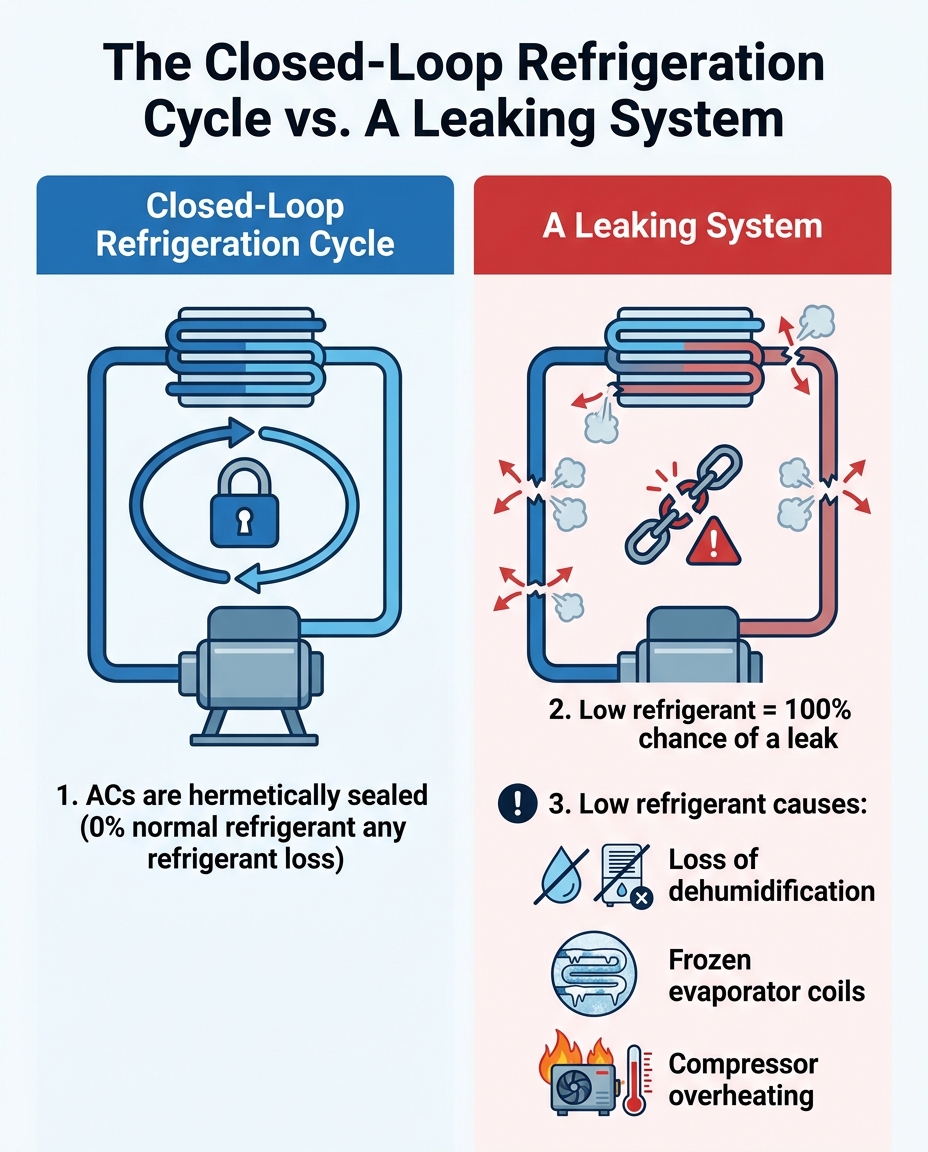
Here at Allied Plumbing Heating & Cooling, our technicians frequently see this homeowner dilemma play out across Springfield: you notice the warm air, call our team, and hope we can just add a little refrigerant to get the system cooling again. It sounds simple, affordable, and fast. However, this line of thinking fundamentally misunderstands how residential cooling equipment actually operates. Air conditioners are closed-loop systems. This means that low refrigerant always indicates a physical leak, not normal consumption.
When you choose to simply top off a leaking system, you are essentially pouring water into a bucket with a hole in the bottom. The system might blow cold air for a few weeks, or even a few months, but the underlying breach remains active. Eventually, the newly added refrigerant will escape into the atmosphere, leaving you right back where you started—with a warm house and a struggling air conditioner. Understanding the mechanics of your cooling system is the first step toward making a responsible, cost-effective decision for your home.
The Physics of a Sealed Refrigerant System
To understand why a quick recharge is never a permanent solution, you have to look at the basic physics of a hermetically sealed refrigeration cycle. Your air conditioner does not consume refrigerant in the same way your car consumes gasoline or oil. Instead, it continuously cycles the exact same chemical charge back and forth between a liquid and a gaseous state.
Think of your air conditioning system like a car tire. A tire is designed to hold a specific volume of air indefinitely. If you wake up and find a tire is flat, you do not assume the tire simply "used up" the air. You immediately know there is a puncture—a nail in the tread or a faulty valve stem. You might pump air into the tire to drive it to the repair shop, but you know that adding air does not fix the hole. Your cooling system operates on the exact same principle. It only needs refrigerant if there is a physical breach in the copper lines or coils.
Inside the system, the compressor pressurizes the refrigerant gas, sending it to the outdoor condenser coil where it releases heat absorbed from your home. It then travels indoors to the evaporator coil, where it expands, drops in temperature, and absorbs more heat from your indoor air. This cycle repeats endlessly. Because the loop is entirely sealed, the chemical charge should remain perfectly stable for the entire lifespan of the equipment.
Why 'Consumption' is a Myth
The idea that an air conditioner "runs out" of freon over time is a persistent myth in the home service industry. Refrigerant is not a consumable fuel. It does not burn away, evaporate, or degrade through normal operation.
In fact, a perfectly intact system in a Springfield IL home could run for decades without ever needing a single ounce of added refrigerant. If a technician hooks up their gauges and tells you the system is low, the conversation should immediately pivot from "how much does a recharge cost?" to "how are we going to find and fix the leak?" Accepting a top-off without a leak search ignores the laws of physics governing the equipment.
The Closed-Loop Refrigeration Cycle vs. A Leaking System
The Hidden Costs of Running on Low Refrigerant
Ignoring a leak and operating an undercharged system does far more than just reduce your comfort. It actively damages the internal components of your air conditioner and severely degrades your indoor air quality. When refrigerant levels drop, the entire thermodynamic balance of the system is thrown off, leading to a cascade of mechanical failures.
One of the most immediate casualties of low refrigerant is the system's ability to dehumidify the air. During the August late-summer cooling season, Midwest humidity can be oppressive. Your air conditioner is responsible for latent cooling (removing moisture) just as much as sensible cooling (lowering the temperature). When the system is undercharged, the evaporator coil cannot effectively extract moisture from the indoor air. Your home will start to feel sticky, clammy, and uncomfortable, even if the air blowing out of the vents feels slightly cool.
Beyond comfort, low refrigerant places an immense strain on the compressor. The compressor is the heart of your air conditioning system, and it relies on the cool, returning refrigerant gas to keep its internal motor from overheating. When the system is low on charge, the returning gas is too warm. The compressor runs hotter and longer than it was designed to, leading to premature wear and, eventually, catastrophic failure. Replacing a burnt-out compressor is one of the most expensive repairs in the HVAC industry, often prompting a full system replacement.
Evaporator Coil Freezing
It sounds counterintuitive, but low refrigerant actually causes the indoor evaporator coil to drop below freezing. Because there is less refrigerant in the coil to absorb heat, the temperature of the copper drops dramatically. The moisture that normally drips into the drain pan freezes onto the coil instead.
The freezing progression looks like this:
• Condensation freezes: A thin layer of frost develops on the copper tubing.
• Airflow restriction: The frost builds into a solid block of ice, blocking air from passing through the fins.
• System shutdown: The lack of airflow causes the system to blow completely warm air, and the compressor may lock up or shut down on a safety limit.
When you see ice on your indoor unit or the outdoor refrigerant lines, a leak is the most likely culprit.
Environmental Regulations and the True Cost of 'Topping Off'
The decision to repeatedly recharge a leaking air conditioner is not just a mechanical issue; it is a regulatory and environmental concern. Refrigerants are highly regulated chemicals because of their impact on the atmosphere. Older refrigerants, such as R-22 (commonly known as Freon), are ozone-depleting substances, while newer refrigerants act as potent greenhouse gases.
Under Section 608 of the Clean Air Act, the Environmental Protection Agency (EPA) mandates strict protocols for the handling, recovery, and disposal of refrigerants. While residential systems have different leak rate thresholds than massive commercial chillers, the underlying principle remains: knowingly venting refrigerant into the atmosphere is environmentally irresponsible. When a technician adds refrigerant to a system they know is leaking, without offering or attempting a repair, they are contributing to environmental harm.
Furthermore, the industry is undergoing massive chemical phaseouts. R-22 has been completely phased out of production and importation. If you have an older system that uses R-22, topping it off is incredibly impractical and resource-intensive, as the remaining supplies are strictly limited. Even the current standard, R-410A, is facing phasedowns in favor of newer, more environmentally friendly alternatives. Relying on continuous recharges ties you to a shrinking supply of expensive, heavily regulated chemicals.
• Properly Charged (Sealed) — Cooling Performance: Optimal temperature drop — Humidity Control: Excellent moisture removal — Compressor Risk: Low (normal operation) — Environmental Impact: Zero (fully contained)
• Low Charge (Leaking) — Cooling Performance: Struggles to reach setpoint — Humidity Control: Poor (home feels sticky) — Compressor Risk: High (overheating risk) — Environmental Impact: Active chemical venting
How Professionals Pinpoint Microscopic Copper Coil Leaks
Finding a refrigerant leak is not a DIY project. The breaches in the copper lines or aluminum coils are often microscopic pinholes that cannot be seen with the naked eye. Handling refrigerant, hooking up gauge manifolds, and performing high-pressure tests requires specialized, licensed expertise and EPA certification. Attempting to troubleshoot a sealed system without the proper training can result in severe injury or permanent equipment damage.
As a local, family-owned business, we prioritize an honest, permanent leak detection process over the unethical "churn and burn" practice of repeatedly charging customers for temporary top-offs. When you call for professional AC repair, technicians use a multi-step diagnostic approach to locate the exact source of the failure.
1. Visual and Auditory Inspection: Technicians start by looking for oil stains around the fittings, valves, and coils. Refrigerant carries a specialized lubricating oil through the system; where refrigerant leaks out, oil is often left behind.
2. Electronic Leak Detectors: Professionals use highly sensitive electronic "sniffers" that detect the specific chemical signature of refrigerant gas in the air. By passing the wand over the coils and joints, they can pinpoint the general area of the leak.
3. Ultrasonic Leak Detection: In noisy environments or for high-pressure leaks, ultrasonic tools can "hear" the high-frequency hiss of gas escaping from a microscopic pinhole, even if it is inaudible to human ears.
4. UV Dye Injection: For incredibly slow, hard-to-find leaks, a technician may inject a specialized UV dye into the system. As the system runs, the dye circulates with the oil. The technician returns later with a UV light, and the exact site of the leak will glow brightly.
5. Nitrogen Isolation Testing: If the leak is severe or the system is empty, technicians will pressurize the lines with dry nitrogen to listen for the leak and verify that the system holds pressure before introducing new refrigerant.
Once the leak is isolated, the technician can present you with real options: repairing the coil, replacing the leaking component, or, if the system is old and the leak is severe, discussing a full system replacement.
The Value of Proactive System Maintenance
The best way to handle a refrigerant leak is to catch it before it causes a mid-summer breakdown. This is where routine, proactive system maintenance becomes invaluable. When a system slowly loses refrigerant over the winter, you might not notice the problem until the first major heatwave in August, when the compromised compressor finally gives up.
During a routine seasonal checkup, technicians do more than just change the filter. They hook up specialized gauge manifolds to verify the exact refrigerant pressures and temperatures. They measure the superheat and subcooling—technical metrics that tell them exactly how much refrigerant is flowing through the expansion valve and returning to the compressor. If these numbers are even slightly off, it indicates a slow leak.
Catching a slow leak early prevents the compressor from sustaining long-term heat damage. It allows you to schedule a repair on your own terms, rather than waiting for an emergency failure on a 95-degree afternoon. Consistent professional monitoring provides peace of mind and significantly extends the lifespan of the equipment. One local homeowner relies on our team for yearly summer and winter checkups, noting that this consistent, professional service ensures their heating and air conditioning needs are met reliably twice a year, without unexpected interruptions.
If you are unsure about the status of your system, learning how to know when your AC has refrigerant issues can help you spot the early warning signs, such as longer run times, ice on the lines, or a subtle loss of cooling power, before the situation escalates.
Protecting Your Home's Cooling Infrastructure
Ultimately, a quick top-off might seem like a convenient fix, but it guarantees future failure because the underlying leak remains active. Every time a technician simply adds refrigerant without addressing the root cause, you are throwing money at a temporary band-aid while the heart of your system—the compressor—slowly degrades from heat stress.
Investing in a proper leak search and repair protects your home's cooling infrastructure. It restores full dehumidification power, ensures efficient operation, and keeps your energy bills in check. If your system is blowing warm air, do not settle for a quick recharge. Request a comprehensive diagnostic to find the leak, fix the breach, and restore your comfort the right way.
Frequently Asked Questions
Is it normal to have to add freon to AC?
No, it is never normal to add refrigerant to a residential air conditioner. The system is a hermetically sealed loop designed to hold its exact factory charge for its entire lifespan. If a technician tells you the system needs more refrigerant, it means there is a physical leak that must be located and repaired.
Can you just add freon to a leaking AC?
While it is technically possible to add refrigerant to a leaking system, it is highly discouraged and often environmentally irresponsible. Topping off a leaking unit is a temporary band-aid; the new refrigerant will inevitably leak out again. This practice wastes valuable resources, harms the environment, and forces your compressor to run under dangerous strain.
How long does a freon recharge last on a leaking system?
The lifespan of a recharge depends entirely on the size of the hole in your copper lines. A microscopic pinhole might hold a charge for a few months, while a larger breach could leak out the new refrigerant in a matter of days or even hours. Because the leak will only grow larger over time, each subsequent recharge will last for a shorter duration.
What happens to the compressor if a home AC is low on freon?
When an air conditioner is low on refrigerant, the compressor loses its primary source of cooling. The returning refrigerant gas is supposed to keep the internal motor from overheating. Without enough refrigerant, the compressor runs excessively hot, leading to severe mechanical wear, electrical burnout, and eventually, total catastrophic failure.
Why does my AC blow warm air even after a recent recharge?
If your system is blowing warm air shortly after a top-off, the leak in your system is likely severe, and the newly added refrigerant has already escaped. Alternatively, the low refrigerant levels may have caused the evaporator coil to freeze solid, completely blocking airflow. In either case, a proper leak repair is required to restore function.
How do HVAC technicians find microscopic freon leaks?
Professionals use specialized, highly sensitive equipment to locate leaks that cannot be seen with the naked eye. Common methods include electronic sniffers that detect refrigerant gas, ultrasonic tools that hear high-frequency hissing, and UV dye injections that illuminate the exact source of the leak under a special light.
Identifying Older Galvanized Pipes in Historic Chatham Homes Before Winter Hits
October 10, 2026
Freezing temperatures put immense stress on pre-1960s plumbing. Spotting hidden internal corrosion early helps you decide if a drop in water pressure warrants a professional inspection.
Freezing temperatures put immense stress on pre-1960s plumbing. Spotting hidden internal corrosion early helps you decide if a drop in water pressure warrants a professional inspection.
Standard vs Modulating Gas Valves for Consistent Heating in Two-Story Homes
October 9, 2026
Extreme temperature differences between floors often come down to your furnace's gas valve. See how a modulating system balances airflow to eliminate hot and cold zones.
Extreme temperature differences between floors often come down to your furnace's gas valve. See how a modulating system balances airflow to eliminate hot and cold zones.
Why Your Furnace Blower Keeps Running After the Burners Shut Off
October 8, 2026
That cool breeze from your vents after a heating cycle isn't always a malfunction. Understand how the fan limit switch actively protects your heat exchanger from cracking.
That cool breeze from your vents after a heating cycle isn't always a malfunction. Understand how the fan limit switch actively protects your heat exchanger from cracking.