Why is my ac blowing warm air troubleshooting steps for homeowners
When your home starts feeling more like a sauna than a sanctuary, the first place to look isn't the attic or the backyard—it’s your thermostat. It sounds simple, but a surprising number of service calls in Springfield and Rochester are resolved just by correcting a few settings.
The first of our why is my ac blowing warm air troubleshooting steps is to verify that your system is actually told to cool. Ensure the system switch is set to "Cool" and not "Heat" or "Off." If you recently had a power flicker or a guest in the house, these settings can easily be bumped.
Next, look at the fan setting. This is a big one. If your fan is set to "On," the blower will run 24/7, even when the cooling cycle isn't active. This means that between cooling cycles, the system is simply recirculating unconditioned, room-temperature air through your vents, which can feel quite warm. Switching the fan to "Auto" ensures the blower only pushes air when it’s actually being chilled.
If the settings look correct but the screen is blank, your batteries might be dead. Most thermostats require a fresh set of AA or AAA batteries once a year. If the thermostat can't "talk" to the rest of the HVAC system, your outdoor unit won't know it's time to start working.
Sometimes the issue is electrical. Your AC system actually uses two different power sources: one for the indoor air handler and one for the outdoor condenser. If the circuit breaker for the outdoor unit trips, the indoor fan will continue to blow air, but it won't be cold because the compressor (the heart of the cooling process) isn't running. Check your electrical panel for any tripped breakers and reset them once. If it trips again immediately, stop and call us—this indicates a more serious electrical fault.
For more detailed guidance on these initial checks, you can explore our guide on Solutions for an AC Thats Blowing Warm Air.
Thermostat and Power Troubleshooting Quick Guide
• Fan set to "On" — Symptom: Continuous airflow that feels lukewarm — Fix: Switch setting to "Auto"
• Wrong Mode — Symptom: Vents blowing hot air (Heat mode) — Fix: Switch to "Cool" mode
• Dead Batteries — Symptom: Blank screen or unresponsive unit — Fix: Replace batteries (usually AA/AAA)
• Tripped Breaker — Symptom: Indoor fan blows, but outdoor unit is silent — Fix: Reset breaker at the main panel
• Blown Fuse — Symptom: Outdoor unit won't start despite power — Fix: Requires professional replacement
Addressing Airflow and Maintenance Issues
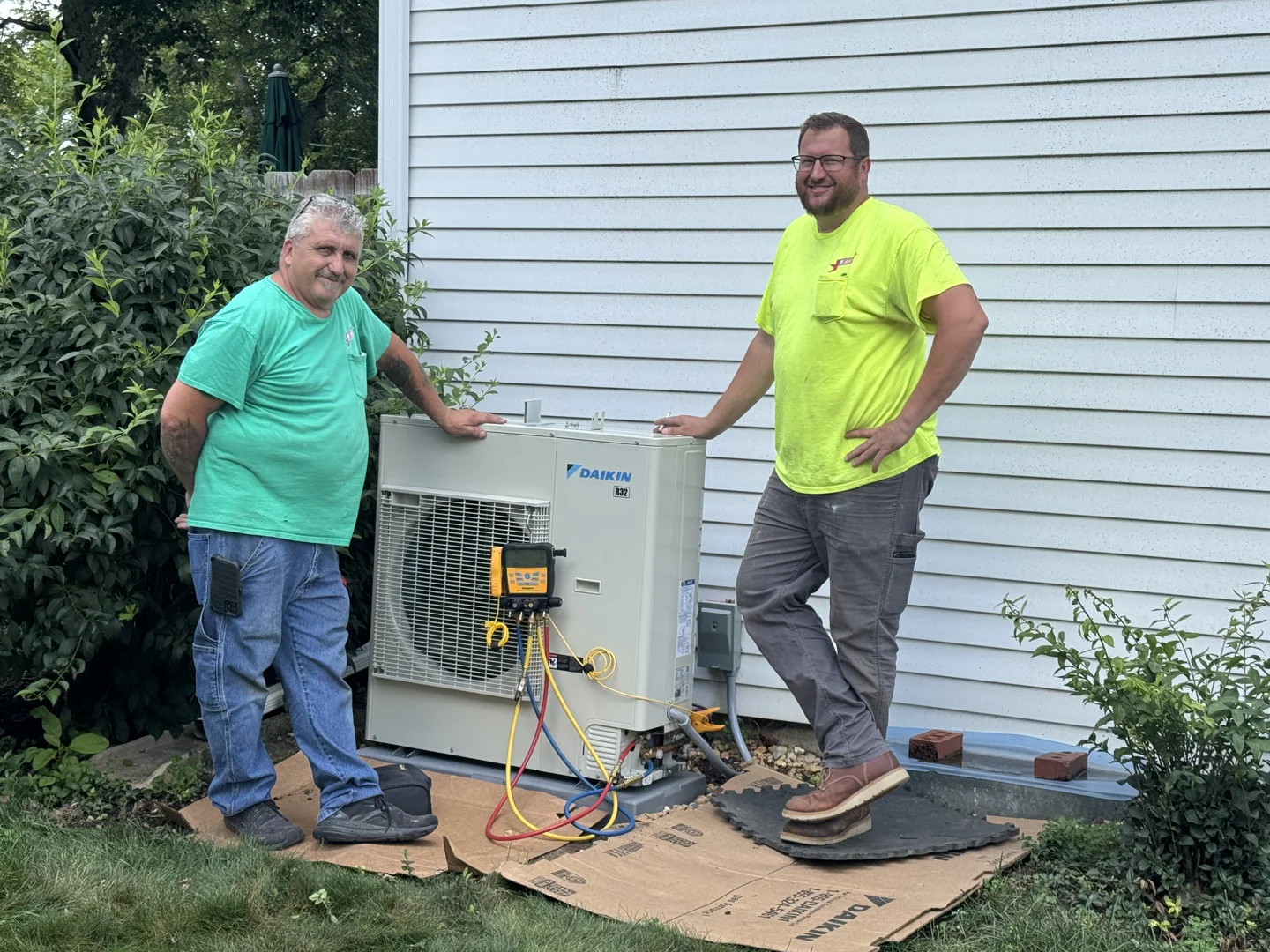
If your settings are correct but you’re still losing the battle against the heat, the culprit is likely airflow. In our experience serving Chatham and the surrounding areas, a clogged air filter is a primary cause of an AC blowing hot air.
When a filter is caked in dust, pet hair, and Springfield pollen, your AC has to work significantly harder to pull air through the system. This restriction doesn't just make the air feel weak; it can actually cause the entire system to fail. Simply replacing a dirty filter can improve your AC’s energy efficiency by 5-15%, which is a huge win for your comfort and your utility bill.
Beyond the filter, check your return grilles and supply vents. If you’ve recently rearranged furniture or added heavy rugs, you might be accidentally "suffocating" your system. Ensure at least 80% of your vents are open and unobstructed to maintain the pressure balance the system needs to function. If you're wondering Why AC is Running but Not Cooling Your Home, airflow is almost always the first place we look.
How a dirty filter leads to why is my ac blowing warm air troubleshooting steps
A dirty filter does more than just block air; it can cause your evaporator coils to freeze. It sounds counterintuitive—how can a frozen unit blow warm air? Here is the science: your evaporator coil needs a steady stream of warm return air to keep the refrigerant inside from getting too cold. Without that airflow, the coil drops below freezing, and condensation turns into a block of ice.
This ice acts as an insulator, preventing the refrigerant from absorbing any heat from your home. The result? Your AC runs and runs, but the air coming out of the vents is barely moving and definitely isn't cold.
To prevent this, we recommend:
• Monthly Inspections: Check your filter every 30 days, especially during the peak of summer in Rochester.
• Regular Replacement: Most filters need to be swapped every 1 to 3 months.
• Professional Maintenance: Regular maintenance can prevent up to 80% of all common AC breakdowns by catching these airflow issues before they spiral.
Inspecting the Outdoor Condenser Unit
Did you know that 90% of the time the culprit of your hot air issue is going to be in your outdoor condenser unit? This unit is responsible for releasing the heat collected from inside your home into the outdoor air. If it can't "breathe," that heat has nowhere to go.
The most common issue we see in Springfield is debris buildup. Grass clippings, fallen leaves, and "cotton" from local trees can coat the condenser coils like a blanket. When these coils are dirty, the heat exchange process fails, and your AC starts blowing warm air.
Follow these why is my ac blowing warm air troubleshooting steps for your outdoor unit:
1. The 2-Foot Rule: Keep at least two feet of clear space around your outdoor unit. Trim back any bushes, weeds, or tall grass that might be crowding it.
2. Clear Debris: Turn off the power at the outdoor disconnect switch and use a garden hose to gently rinse the coils. Do not use a pressure washer, as the high pressure can bend the delicate aluminum fins.
3. Check the Fins: If you notice the "fins" (the tiny metal slats) are bent or crushed, it restricts airflow. A tool called a "fin comb" can be used to straighten them, though this is often best left to a pro during an AC Repair Springfield IL visit.
4. Observe the Fan: While the system is called for cooling, look at the top of the outdoor unit. The large fan should be spinning rapidly. If it’s stationary or moving slowly, you might have a failed fan motor or a bad capacitor.
Identifying Refrigerant and Mechanical Failures
If you've checked the thermostat, changed the filter, and cleaned the outdoor unit but the air is still warm, you may be facing a mechanical or refrigerant issue. Unlike air filters, refrigerant isn't something that "runs out" like gas in a car. It circulates in a closed loop. If your refrigerant is low, it means you have a leak.
Knowing How to Know When AC Has Refrigerant Issues can save your compressor from total failure. When levels are low, the system can't absorb enough heat, often leading to the evaporator coils freezing over.
Common Signs of a Refrigerant Leak:
• Hissing or Bubbling: If you hear these sounds near the indoor or outdoor unit, it’s likely the sound of pressurized refrigerant escaping.
• Ice on the Lines: Visible frost on the copper lines leading into your home is a major red flag.
• Long Cooling Cycles: If your AC is running all day and night but the temperature never drops, the system is struggling to move heat.
Mechanical failures, such as a failing compressor, often announce themselves with noise. If you hear grinding (like "coins in a dryer"), chattering, or loud rattling coming from the outdoor unit, the compressor may be reaching the end of its life. Since the compressor is the "heart" of the system, running it while it's struggling can cause permanent damage.
When to stop why is my ac blowing warm air troubleshooting steps and call a pro
While we love empowering homeowners to handle basic maintenance, there is a point where DIY becomes dangerous or illegal. Refrigerant handling is strictly regulated by the EPA, and only licensed technicians are permitted to handle, recharge, or repair refrigerant lines.
You should stop troubleshooting and call for Chatham emergency service if:
• You suspect a leak: You see ice or hear hissing.
• The breaker keeps tripping: This indicates a high-voltage short or a failing component like a capacitor.
• The unit makes scary noises: Grinding or shrieking sounds are signs of mechanical failure.
• Electrical testing is needed: Checking capacitors and contactors involves working with live high-voltage electricity, which requires professional diagnostic tools and training.
Frequently Asked Questions about AC Troubleshooting
Should I turn off my AC if it is blowing warm air?
Yes, absolutely. If your AC is blowing warm air, it’s often a sign that the compressor is overheating or the coils are frozen. Continuing to run the system can cause the compressor to burn out or lead to liquid refrigerant "slugging" back into the motor, which can destroy it. Turn the system off at the thermostat and give us a call to prevent a simple repair from turning into a full system replacement.
How often should I replace my air filter in Springfield?
In the Springfield area, we recommend checking your filter once a month. If you have pets, allergies, or live near a construction site or dusty field, you will likely need to replace it every 30 days. At a minimum, never go longer than 90 days without a fresh filter. Replacing a dirty filter can improve your AC’s energy efficiency by 5-15% and is the easiest way to prevent warm air issues.
What are the signs of a failing AC compressor?
The compressor is the most expensive part of your outdoor unit. Signs of failure include the outdoor fan running but the compressor not kicking in, loud metallic noises (grinding or rattling), or the circuit breaker for the outdoor unit tripping every time the AC tries to start. If you notice these, turn the unit off immediately to avoid further electrical damage.
Conclusion
Dealing with an AC that has lost its chill is never fun, but by following these why is my ac blowing warm air troubleshooting steps, you can often find a quick solution. From checking your thermostat batteries to clearing the leaves away from your outdoor unit, a little bit of homeowner "detective work" goes a long way.
However, when the problem moves into the realm of electrical components, refrigerant leaks, or mechanical failures, you need a team you can trust. Allied Plumbing, Heating & Cooling is a 3-generation family business that has been keeping homes comfortable in Springfield, Rochester, and Chatham since 1977.
We stand behind our work with the Daikin Comfort Promise and 12-year warranties on select systems, ensuring you have reliability and peace of mind for years to come. Whether you need a quick tune-up or a complex Air Conditioning Repair Springfield IL, our experienced technicians are ready to help. Don't sweat through another Illinois summer—give us a call and let us restore the comfort to your home today!