Why Understanding Mini Split Pros and Cons for Older Homes Matters Before You Commit
Understanding the mini split pros and cons for older homes is essential before making any HVAC decision — especially if your house was built before the 1970s and has never had ductwork.
Here is a quick summary to help you decide:
Mini Split Pros for Older Homes
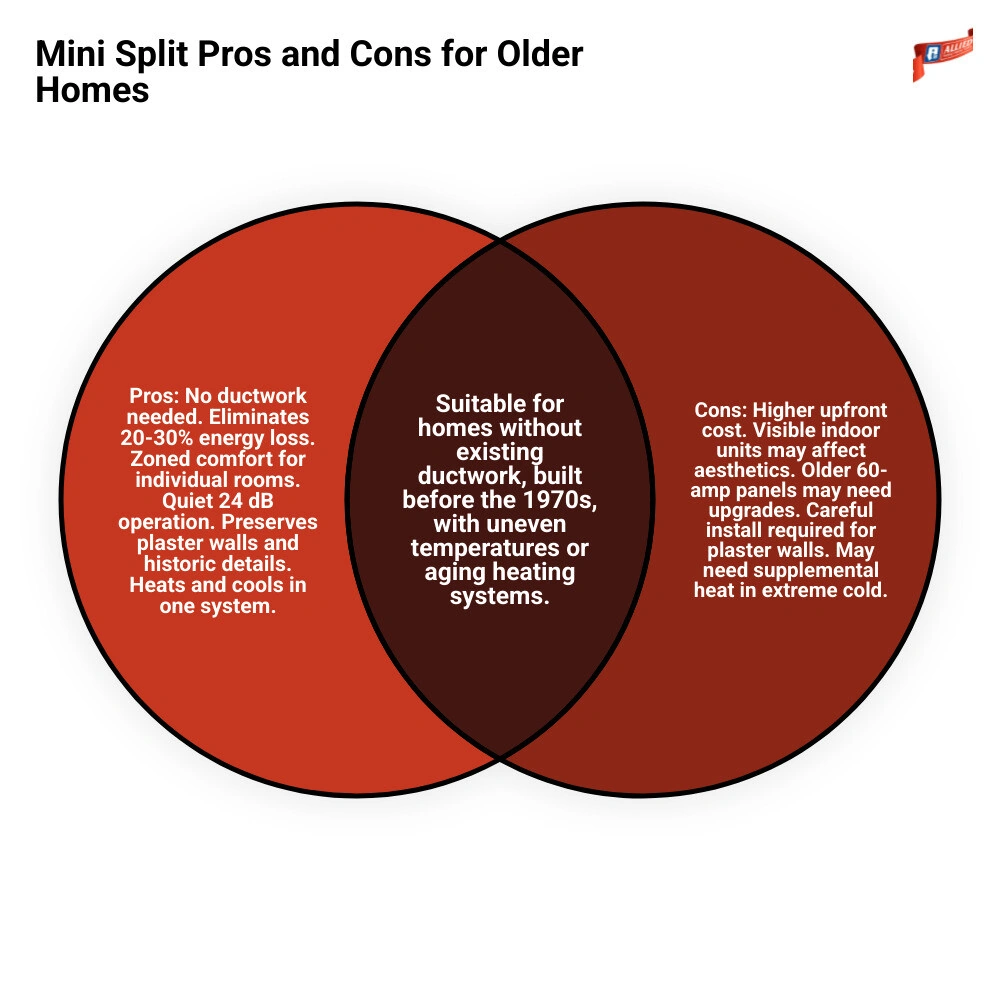
• No ductwork needed — installs through a small 3-inch wall opening
• Eliminates the 20–30% energy loss common in leaky duct systems
• Zoned comfort lets you heat or cool individual rooms independently
• Operates as quietly as 24 decibels — quieter than a whisper
• Preserves original plaster walls, trim, and historic architectural details
• Functions as both a heater and air conditioner in a single system
Mini Split Cons for Older Homes
• Higher upfront cost compared to window units or space heaters
• Visible indoor wall units may not suit every historic aesthetic
• Older electrical panels (60-amp) may need upgrading before installation
• Plaster and lath walls require careful, professional installation to prevent damage
• Multi-zone systems may underperform if all zones run at full demand at once
• May need supplemental heat during extreme cold snaps
Older homes in Springfield, Rochester, and Chatham are full of character — solid craftsmanship, original woodwork, high ceilings, and details you simply cannot find in new construction. But that same charm often comes with a frustrating reality: no ductwork, uneven room temperatures, and aging heating systems that struggle to keep up. One room roasts while another stays freezing. Energy bills climb. And the idea of tearing into original plaster to run duct chases feels like an architectural crime.
That is exactly why ductless mini split systems have become one of the most talked-about upgrades for older homes. They offer a way to add modern, efficient comfort with minimal disruption to the structure and character of the home. But like any HVAC solution, they come with real trade-offs worth understanding before you invest.
Mini split pros and cons for older homes terms at a glance:
• best rooms for a mini split system
• ductless mini split systems explained
• how many mini split heads do i need
Weighing the Mini Split Pros and Cons for Older Homes
When you own a historic property in Springfield, Rochester, or Chatham, upgrading your HVAC system feels a bit like performing surgery on a family heirloom. You want modern comfort, but you do not want to sacrifice the very things that make your home special. To help you visualize how ductless options stack up against traditional systems, let's look at a direct comparison.
• Ductwork Required — Ductless Mini Split Systems: None (Uses small refrigerant lines) — Traditional Central HVAC Retrofit: Extensive (Requires building soffits/duct chases)
• Structural Impact — Ductless Mini Split Systems: Minimal (3-inch hole through exterior wall) — Traditional Central HVAC Retrofit: Invasive (Cutting through plaster walls and ceilings)
• Zoned Control — Ductless Mini Split Systems: Standard (Individual room thermostats) — Traditional Central HVAC Retrofit: Difficult/Expensive (Requires automated dampers)
• Energy Efficiency — Ductless Mini Split Systems: High (Up to 30.0 SEER2, zero duct energy loss) — Traditional Central HVAC Retrofit: Moderate (Prone to 20–30% duct leakage)
• Aesthetics — Ductless Mini Split Systems: Visible indoor unit on wall, floor, or ceiling — Traditional Central HVAC Retrofit: Virtually invisible (Only registers are visible)
• Typical Lifespan — Ductless Mini Split Systems: 15 to 20 years (With regular maintenance) — Traditional Central HVAC Retrofit: 15 to 20 years (With proper duct maintenance)
Architectural Preservation and Your Vintage Home
For homeowners in Springfield's historic districts or older neighborhoods in Chatham and Rochester, preserving architectural integrity is often the top priority. Traditional ducted heating and cooling systems require a massive network of metal or flexible ducts. If your home was built without these ducts in mind, retrofitting them means dropping ceilings, building bulky drywall chases in the corners of your beautiful rooms, or sacrificing precious closet space.
When we look at Ductless Mini Split Systems Explained, the preservation benefits become crystal clear. Instead of moving air through bulky metal passages, mini splits transfer heat using small, insulated copper lines wrapped in a protective conduit. Because this conduit is only about three inches in diameter, it can easily be routed through closets, behind walls, or along the exterior of your home, leaving your original crown molding, plaster ceilings, and historic woodwork completely untouched.
The Magic of Inverter Technology
In addition to saving your walls, modern mini splits utilize advanced inverter technology to keep your home comfortable. Traditional heating and cooling systems operate like a standard light switch—they are either 100% on or 100% off. This leads to those classic temperature swings where you are shivering one minute and sweating the next as the system cycles.
Inverter technology works more like a dimmer switch. The compressor modulates its speed continuously, adjusting its output in real-time to match the exact heating or cooling needs of the room. This continuous, low-energy operation not only keeps the temperature incredibly stable but also uses significantly less electricity, helping to offset the energy lost through the drafty windows and original insulation of older structures.
Navigating the Aesthetic Impact
The most common objection to mini splits is their visual presence. Unlike central air, which hides behind small floor or wall grates, a ductless system requires an indoor unit in each conditioned space.
For some historic home purists, a white plastic box mounted high on a plaster wall can feel out of place. Fortunately, the industry has evolved. Today, there are low-profile floor-mounted consoles that sit neatly where old cast-iron radiators once lived, ceiling cassettes that sit flush with the ceiling, and even slim-duct options that hide completely out of sight. When weighing the mini split pros and cons for older homes, many homeowners find that a small, visible modern unit is a very fair trade-off for avoiding major construction and preserving their home’s structural character.
The Advantages: Why Ductless Systems Shine in Historic Properties
If you have spent even one summer in Springfield, Rochester, or Chatham with nothing but window air conditioners, you know how noisy, inefficient, and dark they can make your home. Upgrading to a ductless system offers a completely different living experience.
No Ductwork, No Problem
The absolute greatest advantage of a mini split system is that it requires absolutely zero ductwork. This is a game-changer for older homes built with solid brick, plaster and lath, or post-and-beam construction. You do not have to worry about finding space for massive metal ducts, nor do you have to live through weeks of dusty construction.
Furthermore, you avoid the "duct loss penalty." According to the U.S. Department of Energy, ducted HVAC systems typically lose 20% to 30% of their conditioned air through leaks, poor connections, and uninsulated ductwork running through hot attics or damp crawlspaces. By delivering comfort directly to the room, mini splits ensure that 100% of the air you pay to heat or cool actually reaches your living space.
True Zoned Comfort
Do you have a second-story bedroom that feels like a sauna in July, while your downstairs parlor feels like a walk-in freezer? This is a classic symptom of older home layouts, which were often designed for passive airflow rather than modern forced-air systems.
Mini splits solve this elegantly by providing independent, zoned comfort. Each indoor unit has its own thermostat. This means you can keep your bedroom cool for sleeping while turning off the units in your downstairs living areas overnight. To understand how we design these custom layouts, look at the Advantages of Mini Split Systems Installed by Us. This personalized control is incredibly convenient and prevents you from wasting money heating or cooling empty rooms.
Whisper-Quiet Performance
Older heating systems like steam radiators can be noisy, filling your quiet evenings with clanking, hissing, and banging. Window AC units are even worse, roaring so loudly that you have to turn up the television just to hear it.
Modern ductless indoor units are engineered with variable-speed fan motors that operate as quietly as 24 decibels. To put that in perspective, 24 decibels is quieter than a whisper or rustling leaves. Because the noisy compressor is located outside, all you experience indoors is a gentle, near-silent stream of perfectly conditioned air.
Improved Indoor Air Quality
Traditional ductwork can become a breeding ground for dust, pet dander, mold, and allergens over the decades. Every time a central system kicks on, it circulates these particles throughout your home.
Ductless mini splits feature multi-stage filtration systems built directly into each indoor unit. Because there are no ducts to collect debris, and the filters are easily accessible for regular cleaning, you get a much cleaner, healthier breathing environment. This is a massive benefit for families in older homes that may naturally suffer from higher levels of dust or moisture.
Understanding the Mini Split Pros and Cons for Older Homes: Disadvantages and Challenges
While the benefits are substantial, we believe in giving our neighbors in Springfield, Rochester, and Chatham a complete, transparent picture. There are real challenges to consider when retrofitting an older home with ductless technology.
The Upfront Investment
There is no getting around it: installing a multi-zone mini split system is a significant upfront investment. While it is often comparable to—or even less than—the cost of retrofitting a home with a full central ducted system and plaster repair, it is still a major financial commitment.
However, it is important to look at the long-term picture. Thanks to their incredible efficiency, mini splits can reduce monthly energy bills by 30% to 50% compared to older heating and cooling equipment. Over time, these operational savings, combined with available 2026 energy tax credits and rebates, help balance the initial layout.
Electrical Infrastructure Limitations
Many historic homes in Springfield, Rochester, or Chatham still have their original electrical infrastructure, sometimes with service panels rated for only 60 or 100 amps. Modern multi-zone mini split systems run on 230V circuits and require a dedicated breaker.
If your home’s electrical panel is already near capacity, you will likely need to upgrade to a 200-amp panel to safely support your new HVAC system. During our initial home assessment, we always inspect your electrical panel to ensure your home can safely handle the new load without any surprises during installation.
Preserving Historic Plaster and Lath Walls
Plaster and lath walls are beautiful, provide excellent soundproofing, and represent historic craftsmanship. However, they are also incredibly fragile. Drilling or cutting into them without the proper tools and techniques can cause the plaster to crack, pull away from the wooden lath, or crumble entirely.
Installing a mini split requires mounting heavy indoor units securely to the wall studs. This is not a job for a DIY enthusiast or a general contractor who lacks experience with historic materials. It requires specialized tools, such as diamond-core drill bits run at low speeds, to create clean, damage-free penetrations for the refrigerant lines. When looking at Choosing a Ductless AC System for Your Space, selecting the right unit style and an experienced installation team is critical to protecting your walls.
Efficiency, Zoning, and Performance in Extreme Weather
When evaluating the mini split pros and cons for older homes, energy efficiency and seasonal performance are usually the deciding factors.
Eliminating the Duct Loss Penalty
As we mentioned earlier, traditional metal ductwork is highly inefficient in older homes. If your ducts run through an unconditioned attic, the summer heat radiating through your roof warms the cool air inside the ducts before it ever reaches your bedrooms.
By eliminating ducts entirely, mini splits deliver 100% of the heating or cooling energy directly into your living spaces. When you compare the real-world performance in our guide on Central Air vs Mini Split for Older Homes, you will see that this direct delivery is the main reason ductless systems can cut your cooling costs by 25% to 40%.
Leveraging 2026 Energy Incentives
The year 2026 is an incredible time to upgrade your home's HVAC system. Under current federal programs like the Inflation Reduction Act, homeowners can qualify for tax credits of up to 30% (capped at $2,000) for qualifying high-efficiency heat pump installations. Local utility companies in the Springfield area also offer rebates for transitioning from inefficient systems to high-SEER2 ductless systems. These incentives make upgrading to a highly efficient system more accessible than ever.
Zoned Heating and Cooling for Multi-Story Layouts
Multi-story older homes are notorious for uneven temperatures. Heat naturally rises, meaning your second floor or converted attic space is often unbearably hot while your basement or first floor remains chilly.
With a multi-zone system, you can place indoor heads exactly where you need them most. To learn more about how we plan these layouts, check out How Many Mini Split Heads Do I Need. By customizing the placement, you can target specific problem areas like a sunny kitchen addition or a drafty master bedroom. For inspiration on layout planning, explore our article on the Best Rooms for a Mini Split System.
Cold Climate Performance and Extreme Temperatures
A common myth is that heat pumps cannot handle the freezing winters we experience in Springfield, Rochester, or Chatham. While it is true that older air-source heat pumps struggled when temperatures dropped below freezing, modern cold-climate heat pump technology has changed the game.
High-performance mini split systems can operate efficiently at temperatures well below zero, with some models maintaining excellent heating capacity down to -13°F or lower. However, because older homes often suffer from original single-pane windows and limited wall insulation, we often recommend keeping your existing boiler, furnace, or radiators as a supplemental, backup heat source for those extremely rare, sub-zero winter nights. This hybrid approach gives you the ultimate combination of modern summer cooling and reliable, cozy winter warmth.
Retrofitting Older Homes: Installation and Maintenance Considerations
A successful mini split installation in a historic home is all about the details. Let's look at what the physical installation process actually looks like and how to care for your system over time.
The Installation Process
Unlike a central air retrofit, which can turn your home into a dusty construction zone for weeks, a mini split installation is remarkably clean and fast. A typical multi-zone installation takes only one to three days.
Our team starts by helping you select the perfect spots for your indoor units. You can learn more about this crucial planning step in Where to Place Your Mini Split Units Springfield. Once the locations are set, we drill a single 3-inch hole through the exterior wall behind each unit. We run the copper refrigerant lines, electrical wiring, and a small condensate drain line through this opening, sealing it completely with weatherproofing foam to prevent drafts or moisture intrusion. On the outside of your home, we conceal these lines in decorative covers that can be painted to match your siding, keeping the exterior of your historic home looking neat and clean.
Long-Term Maintenance and Troubleshooting
One of the best things about mini split systems is how easy they are to maintain. To keep your system running at peak efficiency, you only need to perform a few simple tasks:
• Monthly Filter Cleaning: Simply pop open the front panel of your indoor unit, slide out the mesh filters, rinse them in the sink, let them dry, and slide them back in. It takes less than five minutes!
• Outdoor Unit Clearance: Keep leaves, snow, and landscaping trimmed back at least two feet from your outdoor compressor to ensure proper airflow.
• Annual Professional Tune-ups: Once a year, have our team perform a professional inspection to check refrigerant levels, clean the outdoor coils, and ensure the condensate drain lines are clear.
If your system ever behaves unexpectedly, we have guides to help you understand what is going on. For example, if you notice unusual noises, read about Why Your Mini Split is Making Clicking Sounds. If your system stops running and shows a flashing light, check out Why Mini Split AC is Displaying Error Codes to help us diagnose the issue quickly.
How Resale Value is Affected by Mini Splits
Does adding visible indoor units hurt your home's historic charm and resale value? In almost all cases, the answer is a resounding "no."
While a tiny minority of historic purists might dislike the look of a wall unit, the vast majority of modern homebuyers place an incredibly high value on lower utility bills, reliable cooling, and zoned comfort. Replacing ugly, loud window units with a sleek, highly efficient ductless system is a massive selling point that can significantly increase your home’s market appeal. For a deeper look at the financial side of this upgrade, see our Mini Split vs Central AC Cost Comparison.
Frequently Asked Questions about Ductless Systems
Do mini splits use a lot of electricity in drafty older homes?
No! Because of their advanced inverter compressors, mini splits are incredibly efficient, even in drafty homes. Instead of constantly turning on and off at full power, they run continuously at a very low, steady speed, adjusting their output to maintain your desired temperature. This eliminates the massive energy spikes associated with traditional HVAC systems.
Will installing a mini split devalue my historic home?
Quite the opposite. Buyers today expect modern climate control. Adding a highly efficient, quiet, and reliable heating and cooling system increases your home's comfort and appeal. By choosing low-profile units and painting the exterior line covers to match your siding, you can enjoy all the benefits of modern comfort without compromising your home's historic curb appeal.
Can a mini split handle extreme cold in Springfield winters?
Yes, modern cold-climate mini splits are designed to operate efficiently in freezing temperatures. However, because older homes often have original windows and drafty walls, we typically recommend a hybrid approach—using your mini split for year-round comfort and keeping your original radiators or furnace as a backup for the coldest winter days.
Conclusion: Partner with Allied Plumbing, Heating & Cooling
Upgrading your historic home's heating and cooling system is a major decision, but you do not have to navigate it alone.
At Allied Plumbing, Heating & Cooling, we are a third-generation family business that has been serving Springfield, Rochester, and Chatham since 1977. We understand the unique architectural challenges of older homes in our community. As a proud provider of the Daikin Comfort Promise, we offer industry-leading 12-year warranties, giving you ultimate peace of mind that your investment is protected for the long haul.
Are you ready to enjoy modern comfort without sacrificing your home's historic charm? Schedule your Springfield mini split consultation today!