Why Knowing How to Prepare for the Shift to Low GWP Refrigerants Matters for Springfield Homeowners
Knowing how to prepare for the shift to low GWP refrigerants can save you from surprise repair bills, system downtime, and compliance headaches down the road. If your home runs on an R-410A air conditioner or heat pump, this transition directly affects you — and the window to plan ahead is narrowing.
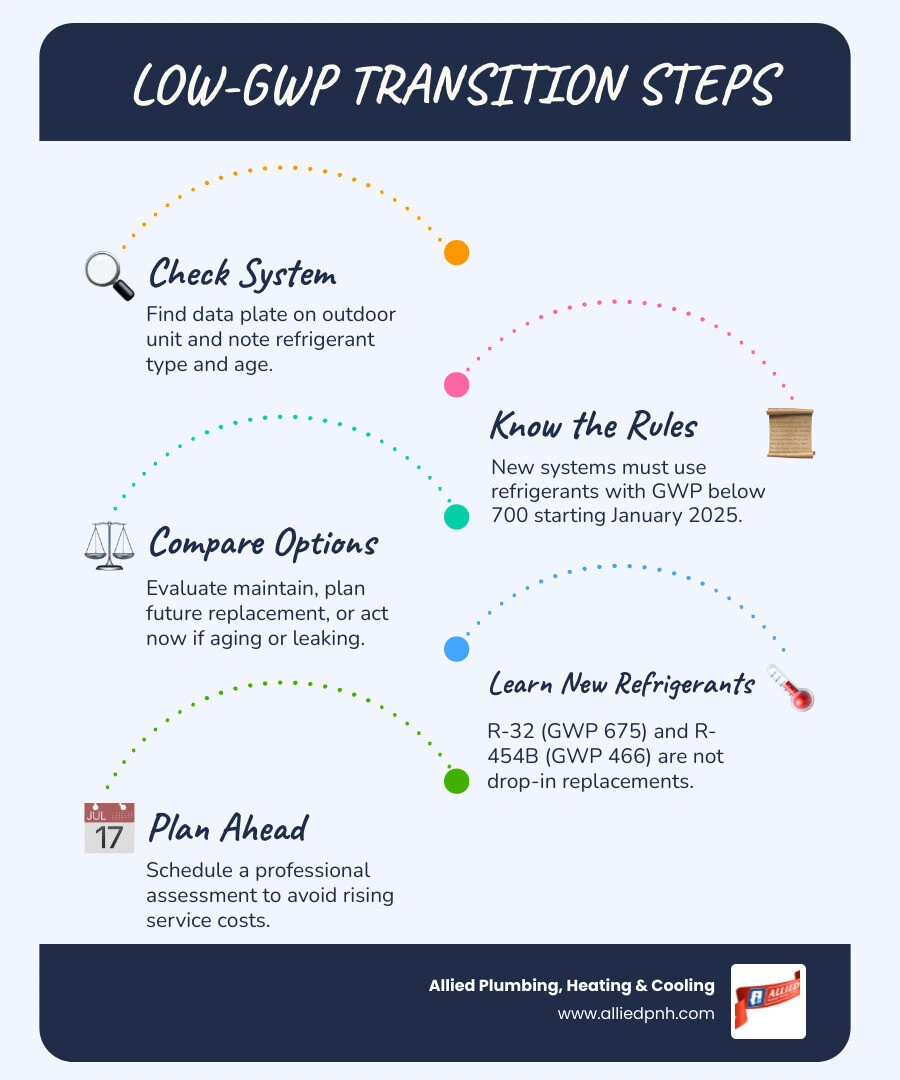
Here is a quick overview of the key steps to prepare:
1. Check your system - Find the data plate on your outdoor unit and note the refrigerant type and age.
2. Understand the rule change - As of January 1, 2025, new residential AC and heat pump systems must use refrigerants with a GWP below 700. R-410A has a GWP of 2,088 and is no longer used in newly manufactured equipment.
3. Assess your options - Decide whether to maintain your current system, plan a future replacement, or act now if your unit is aging or leaking.
4. Know the new refrigerants - R-32 (GWP 675) and R-454B (GWP 466) are the primary replacements. Neither is a drop-in substitute for R-410A — new equipment is required.
5. Stay ahead of rising service costs - Supplies of virgin R-410A are shrinking, which means servicing older systems will keep getting more expensive.
6. Schedule a professional assessment - A licensed HVAC technician can review your system's condition, refrigerant type, and remaining useful life to help you make the right call.
The HVAC industry is in the middle of one of its biggest shifts in decades. Driven by the EPA's American Innovation and Manufacturing (AIM) Act — which mandates an 85% phasedown of high-GWP refrigerants by 2036 — manufacturers stopped producing R-410A equipment at the start of 2025. For Springfield, Rochester, and Chatham homeowners, that means the familiar refrigerant powering most residential AC systems is on its way out.
The good news is that this transition does not have to be disruptive. Existing R-410A systems can still be serviced using reclaimed refrigerant, and the new low-GWP alternatives like R-32 and R-454B are already proven technologies used widely around the world. But costs for maintaining older systems will climb as supply tightens — and the homeowners who plan ahead will spend far less than those who wait for an emergency to force the decision.
This guide walks you through everything you need to know: what the new refrigerants are, what the regulations require, how to evaluate your current system, and what your options look like going forward.
Simple guide to how to prepare for the shift to low gwp refrigerants terms:
• how ac refrigerant changes affect homeowners
• r410a vs r454b refrigerant what you need to know
Understanding Low-GWP Refrigerants and the Regulatory Push
To understand why this change is happening, we have to look at how refrigerants are measured. Global Warming Potential, or GWP, is a scale that measures how much heat a greenhouse gas traps in the atmosphere relative to carbon dioxide (which has a baseline GWP of 1).
For the last two decades, the standard refrigerant for home air conditioners has been R-410A. While R-410A is highly effective and does not deplete the ozone layer, it carries a massive GWP of 2,088. This means releasing just one pound of R-410A into the air has the same warming effect as releasing over a ton of carbon dioxide.
To address this, the federal government passed the AIM Act (American Innovation and Manufacturing Act), aligning the United States with the international Kigali Amendment to the Montreal Protocol. Under this framework, the EPA is leading a phasedown of high-GWP hydrofluorocarbons (HFCs). The goal is an 85% reduction in HFC production and consumption by 2036.
The first major milestone of this phasedown for homeowners took effect on January 1, 2025. On this date, the EPA banned the manufacture of new residential air conditioning and heat pump systems that use refrigerants with a GWP of 700 or higher. Because R-410A far exceeds this limit, manufacturers have fully transitioned their production lines to a new generation of environmentally friendly alternatives.
If you want to know more about the background of these rules and how they impact your household, check out our article on how ac refrigerant changes affect homeowners.
The New Standard: R-32 vs. R-454B Refrigerants
With R-410A phased out for new equipment, the HVAC industry has coalesced around two primary low-GWP alternatives for residential systems: R-32 and R-454B. Both options meet the EPA’s strict GWP ceiling of 700, but they have slightly different chemical makeups and performance profiles.
• R-32 has a GWP of 675. It is a single-component refrigerant, meaning it is not a blend of different gases. This gives it zero "temperature glide," making it incredibly stable and easy to recover and reclaim. In terms of performance, R-32 is a powerhouse. It can use up to 30% less charge weight compared to R-410A while maintaining or even improving the system's overall cooling capacity. It also boasts up to 10% better energy efficiency, helping you keep your summer electricity bills under control.
• R-454B has an even lower GWP of 466. It is a zeotropic blend consisting of R-32 and a hydrofluoroolefin (HFO) called R-1234yf. Because it is a blend, it has a very minor temperature glide of about 1°C, but it is highly compatible with existing system designs. Many major manufacturers have selected R-454B as their primary choice for residential heat pumps and central air conditioners due to its exceptionally low environmental footprint.
To see a deeper comparison of how these two options stack up against the legacy standard, read our detailed breakdown on r410a vs r454b refrigerant what you need to know.
Here is a quick look at how these refrigerants compare side-by-side:
• R-410A — GWP (AR4 Baseline): 2,088 — Safety Classification: A1 (Non-flammable) — Key Advantage: Legacy standard; widely installed but phased out for new systems
• R-32 — GWP (AR4 Baseline): 675 — Safety Classification: A2L (Mildly Flammable) — Key Advantage: Outstanding efficiency; up to 30% smaller charge weight
• R-454B — GWP (AR4 Baseline): 466 — Safety Classification: A2L (Mildly Flammable) — Key Advantage: Lowest GWP of the primary options; excellent operating envelope
How to Prepare for the Shift to Low GWP Refrigerants in Your Home
You do not need to panic or rush out to buy a new air conditioner immediately. However, taking a proactive approach to how to prepare for the shift to low gwp refrigerants will keep your home comfortable and protect your wallet.
The first step is a basic system inventory. Go outside to your condensing unit and look for the metal manufacturer's data plate. This plate lists key information, including the model number, serial number, manufacture date, and the specific type of refrigerant the system uses. If your system was installed before 2025, it almost certainly runs on R-410A (or potentially R-22 if it is more than 15 years old).
Understanding your system's refrigerant is critical because of leakage rates. Industry studies show that residential heat pumps and central air conditioners leak an average of 5% of their refrigerant charge annually. Over a typical 15-year equipment lifespan, that adds up to nearly 150% of the system's total charge being lost and refilled.
In our local area, including Springfield, Rochester, and Chatham, total annual refrigerant leakage releases thousands of tons of CO2 equivalent into the atmosphere. By keeping your system sealed and well-maintained, you prevent these emissions and avoid the need for costly refrigerant top-offs.
When you are ready to evaluate your home's setup, you can learn more about finding the perfect fit for our local climate in our guide to choosing the right ac for a midwest home.
Step-by-Step Guide on How to Prepare for the Shift to Low GWP Refrigerants
If you want to stay ahead of the curve, follow this practical checklist:
1. Locate and Record System Details: Take a photo of your AC unit's data plate. Note down the refrigerant type and the age of the system.
2. Evaluate System Performance: Is your system keeping up with the humid Springfield summer heat? If it struggles on 90-degree days or has a history of refrigerant leaks, flag it for closer evaluation.
3. Schedule a Professional Audit: Have a trusted technician perform a comprehensive leak check and system health audit.
4. Align with Your Budget: If your system is over 10 to 12 years old, start incorporating a replacement plan into your home improvement budget so you are not caught off guard by a sudden breakdown.
5. Plan Your Next Purchase Wisely: If you are planning an upgrade, make sure you discuss the newer, highly efficient R-32 or R-454B options with your comfort consultant.
If your system is showing its age, you can read about the warning signs in our article on signs it's time for an ac replacement.
Managing Existing R-410A Systems and How to Prepare for the Shift to Low GWP Refrigerants
If your current R-410A system is running perfectly, you do not need to replace it. The EPA's regulations restrict the manufacture of new equipment, but they do not force you to retire a working system. You can continue to run and service your R-410A unit for the rest of its natural lifespan.
However, servicing these units will become more challenging over time. Because the production of virgin R-410A is being phased down, the supply of new gas is shrinking. To fill the gap, the industry relies heavily on reclaimed and recycled refrigerant. As the supply-demand gap widens, the cost of R-410A gas will continue to rise.
To protect your system and avoid expensive repairs, focus heavily on leak prevention. Regular annual tune-ups are your best line of defense. During a maintenance visit, a technician can use electronic leak detectors to find and repair tiny pinhole leaks before they drain your system's charge. Keeping your coils clean and replacing filters regularly also reduces physical stress on the system, preventing vibration-induced leaks.
If your older unit does experience a major breakdown, you will have to weigh the cost of repairs against the long-term benefits of upgrading. We discuss this exact scenario in our guide on when the cost of ac repair exceeds the value of your system.
Safety and Design Considerations for A2L Refrigerants
As the industry transitions to R-32 and R-454B, you might hear these new gases referred to as "A2L refrigerants." It is important to understand what this means.
The ASHRAE safety standard classifies refrigerants based on toxicity and flammability:
• Class A represents low toxicity (safe for residential use).
• Class 1 means no flame propagation (like R-410A).
• Class 2L is a relatively new category indicating "mild flammability" with a low burning velocity (less than 10 centimeters per second).
While A2L refrigerants are technically flammable, they are incredibly difficult to ignite. They require a very high concentration of gas and a high-energy ignition source (like an open flame) to catch fire, and even then, they burn very slowly. They are completely different from highly flammable hydrocarbon gases like propane (which is classified as an A3 refrigerant).
To ensure complete safety, manufacturers have redesigned HVAC systems from the ground up for A2L use. New systems include built-in safety mitigation controls, such as:
• Integrated Leak Sensors: If a leak is detected inside the indoor coil, the sensor automatically activates the system blower to safely disperse the gas, keeping concentrations far below the flammability limit.
• Shielded Electrical Components: Contactors, relays, and switches are sealed or spark-proof to eliminate potential ignition sources.
• Thicker Coil Walls and Robust Joints: Enhanced construction quality minimizes the risk of physical leaks developing in the first place.
Because of these safety features and physical differences, you cannot put an A2L refrigerant into an older system designed for R-410A. The electronics, expansion valves, compressor lubricants, and safety sensors are completely incompatible. Trying to mix them is a serious safety hazard and will instantly ruin your equipment.
If you are experiencing frequent system issues, you can learn more about what to look out for in our article on ac repair red flags that mean you need a new system.
Retrofit vs. Replacement Decisions for Rochester Homeowners
For homeowners in Rochester, Chatham, and Springfield, deciding whether to keep patching up an old R-410A system or invest in a new low-GWP system comes down to simple math and peace of mind.
If your air conditioner is less than 8 to 10 years old and has a clean service history, keeping it running is usually the smartest choice. Investing in regular maintenance and prompt leak repairs will help you get the maximum value out of your initial investment.
However, if your system is over 12 years old and requires a major repair — such as a new compressor, a replacement condenser coil, or a major refrigerant recharge — a full replacement is almost always the more economical long-term decision.
Upgrading to a modern system utilizing R-32 or R-454B offers substantial benefits:
• Lower Utility Bills: Modern low-GWP systems are highly optimized, often delivering a 10% to 15% reduction in cooling energy consumption compared to older units.
• Future-Proof Servicing: You will not have to worry about the skyrocketing costs of phased-out R-410A refrigerant if your system ever needs service in the future.
• Enhanced Comfort: Newer systems feature advanced variable-speed blowers and compressors that do a far better job of controlling indoor humidity during our sticky Rochester summers.
When you are ready to explore what a new system installation looks like, check out our step-by-step walkthrough in a guide to new ac installation.
Frequently Asked Questions About the Refrigerant Transition
We know that regulatory changes can bring up a lot of questions. Here are the answers to the most common concerns we hear from local homeowners.
Can I use R-32 or R-454B in my existing R-410A system?
No. You cannot use these new refrigerants in an older system. R-32 and R-454B operate under different pressures, use different compressor lubricants, and require specific system components. Additionally, legacy R-410A systems do not have the mandatory leak detection sensors and spark-proof electrical components required to safely handle mildly flammable A2L gases.
Are low-GWP A2L refrigerants safe for residential use?
Yes, they are exceptionally safe. Before these gases were approved, they underwent years of rigorous testing by safety organizations and manufacturers. Because they have a very high lower flammability limit (LFL), it takes a massive, concentrated leak and a continuous, high-energy open flame to cause ignition. With the mandatory safety sensors and robust construction of new equipment, the risk of an indoor fire is virtually non-existent.
What happens if my current R-410A system leaks?
If your current system develops a leak, it can still be repaired and recharged. Our technicians can use reclaimed R-410A to restore your system to proper working order. However, keep in mind that as the EPA phasedown continues, the supply of R-410A will shrink, and the cost of the gas will rise. Over time, repairing a leak on an older system will become less practical, making a system replacement the wiser financial path.
Conclusion
The shift to low-GWP refrigerants is a positive step forward for the environment and system efficiency, but navigating the change requires a trusted partner. At Allied Plumbing, Heating & Cooling, we have been serving families across Springfield, Rochester, and Chatham since 1977. As a three-generation, family-owned business, we pride ourselves on delivering honest advice, exceptional craftsmanship, and absolute reliability.
We stand behind our work with the Daikin Comfort Promise, offering industry-leading 12-year parts and labor warranties on qualifying systems. Whether you want to keep your current R-410A system running at peak performance with a professional tune-up, or you want to discuss upgrading to a future-proof, highly efficient low-GWP system, our team is here to help 24/7.
To learn more about why local families trust us for their home comfort needs, read our article on ac installation: why hire us for your home.
If you are ready to schedule a professional system audit or discuss your upgrade options, visit our air conditioning service page today to get started!