Analyzing How Peak Demand Pricing Changes the Way You Should Run Your Air Conditioner
Analyzing How Peak Demand Pricing Changes the Way You Should Run Your Air Conditioner
The Hidden Costs of Cooling During Peak Utility Hours
Your air conditioner is running nonstop, but the house still feels warm, and your monthly utility statement keeps climbing higher. At Allied Plumbing Heating & Cooling, we frequently hear this exact frustration from homeowners as the back-to-school season approaches. Analyzing How Peak Demand Pricing Changes the Way You Should Run Your Air Conditioner is the first step toward getting real relief from the intense August late-summer afternoon heat. For years, homeowners have been told to pick a comfortable temperature on the thermostat and leave it alone. That advice worked well in the past, but modern utility billing structures have completely changed the financial rules of keeping your home cool.
Between 2 PM and 7 PM, the power grid experiences its highest strain. Because everybody is running heavy appliances and cooling systems at the exact same time, utility providers shift the extra costs onto the consumer through Time-of-Use (TOU) or peak demand pricing. This means the electricity you use at 4 PM costs significantly more than the exact same amount of electricity used at 8 AM. You are now faced with a clear decision point: continue running your cooling system normally and absorb the premium charges, or adopt a proactive morning cooling strategy to bypass the most expensive hours of the day.
How Time-of-Use Rates Penalize Afternoon AC Operation
Time-of-Use utility rates are designed to discourage heavy electricity consumption when the power grid is under the most stress. During these peak demand periods, utility companies charge a premium rate for every kilowatt-hour of energy your home pulls from the grid. If you rely on a traditional "set it and forget it" thermostat habit, your air conditioner will naturally work its hardest right when electricity is at its absolute most expensive.
Utilities shift these costs to homeowners because generating extra power during peak times requires activating secondary, less efficient power plants. To offset that operational cost, the premium is passed down to Springfield IL area homes that run high-draw appliances—like central air conditioners—during the late afternoon. Our team typically sees that if your thermostat is set to 72 degrees all day, the system will naturally cycle on more frequently as the outdoor temperature rises, directly overlapping with the premium billing window.
The 2 PM to 7 PM Danger Zone
The most critical window for peak demand pricing usually falls between 2 PM and 7 PM. This creates a perfect storm for your utility bill because the natural peak of outdoor temperatures aligns exactly with the most expensive time to buy electricity. As the afternoon sun beats down on your roof and walls, heat naturally transfers inside, forcing your cooling equipment to run longer cycles.
• Morning (6 AM - 1 PM) — Grid Demand Level: Low to Moderate — AC Workload: Light (cooler outdoor temps) — Cost Impact: Standard / Off-Peak Rates
• Afternoon (2 PM - 7 PM) — Grid Demand Level: Maximum Peak — AC Workload: Heavy (hottest outdoor temps) — Cost Impact: Premium / Peak Rates
• Evening (8 PM onwards) — Grid Demand Level: Decreasing — AC Workload: Moderate (home is cooling down) — Cost Impact: Standard / Off-Peak Rates
Understanding this daily schedule is the foundation of changing how you cool your home. By acknowledging that the 2 PM to 7 PM window is a financial danger zone, you can start looking for ways to shift your energy consumption to the cheaper morning hours.
Thermal Mass vs. Air Temperature: The Key to Off-Peak Cooling
The problem: Most homeowners think their air conditioner only exists to cool the air inside the rooms. However, air holds very little thermal energy. If you only cool the air, the moment the AC shuts off during a hot afternoon, the house will immediately begin to feel warm again. This happens because the physical structure of the home is still radiating heat inward.
The cause: Everything inside your home—the drywall, the hardwood floors, the heavy furniture, and the cabinetry—acts as a thermal battery. This concept is known as "thermal mass." Throughout the day, these solid objects absorb heat. If your thermal mass is warm, it will constantly warm up the air around it, forcing your cooling system to cycle back on. Cooling just the air provides temporary relief, but chilling the thermal mass provides lasting, deep comfort for Springfield IL area homes, a pattern we see often when helping families optimize their systems.
The solution: To successfully bypass peak demand pricing, you must focus on cooling the thermal mass, not just the air. If you run your system heavily during the off-peak morning hours, you actively chill the walls, floors, and furniture. These chilled physical objects act like a giant block of ice inside your home. When the expensive afternoon hours arrive, the chilled thermal mass slowly absorbs the incoming heat. Because the physical structure of the house is cold, the air remains comfortable much longer, allowing you to keep the cooling system powered down during the most expensive part of the day.
The Mechanics of the Super-Cooling Strategy
Super-cooling is a proactive operational strategy that leverages your home's thermal mass and your utility's off-peak hours. Instead of waiting for the house to get hot, you intentionally drop the thermostat several degrees below your normal comfort level early in the morning. This forces the air conditioner to run long, continuous cycles when electricity is at its cheapest.
Here is how the mechanics of super-cooling actually play out during the August late-summer afternoon heat:
• The Charging Phase: By dropping the temperature to 68 or 69 degrees early in the morning, you force the AC to work hard. This "charges" your home's thermal mass with cold energy.
• The Transition Phase: Right before the peak demand hours begin—usually around 1 PM or 2 PM—you raise the thermostat setting significantly, often to 78 degrees or higher. This prevents the system from turning on.
• The Coasting Phase: Throughout the expensive afternoon window, the system stays off. The home will slowly warm up, but because the walls and furniture were deeply chilled all morning, the indoor environment remains highly comfortable for several hours.
• The Recovery Phase: Once the peak pricing window ends in the evening, you return the thermostat to your normal, comfortable setting.
The goal is not to endure a hot house in the afternoon. The goal is to use the morning's cheap electricity to build a buffer of cold thermal mass that carries you comfortably through the expensive afternoon hours.
Adapting Super-Cooling for Intense Midwest Humidity
If you research super-cooling online, you will often find guides written for dry, desert climates like Arizona or Nevada. However, running a cooling system in the dry desert is vastly different from managing the heavy, oppressive August late-summer heatwaves in the Midwest. In Illinois, heatwaves combine high temperatures with extreme peak humidity, which completely changes how your home feels and how your equipment operates.
In the HVAC industry, we measure two types of heat: sensible heat (the actual temperature reading on a thermometer) and latent heat (the amount of moisture in the air). Our technicians at Allied Plumbing Heating & Cooling see firsthand how high humidity makes a home feel much warmer than the thermostat indicates because moisture prevents your body from cooling itself naturally. It also forces your air conditioner to work twice as hard, as the system must extract gallons of water from the indoor air before it can effectively lower the sensible temperature.
This is why morning super-cooling is highly effective in the Midwest. When you drop the temperature early in the day, you force the system to run long, uninterrupted cycles. These long cycles act as a massive dehumidification process, stripping heavy moisture out of the air before the afternoon heat even hits. By the time 2 PM rolls around, your home is not only physically colder, but the air is also exceptionally dry. Dry air feels significantly cooler than humid air, making it much easier to ride out the afternoon without the system kicking on. If you struggle with heavy moisture indoors, integrating proper indoor air quality solutions alongside a super-cooling strategy can drastically improve your overall comfort.
Step-by-Step: Timing Your Thermostat for Peak Efficiency
Implementing a super-cooling strategy requires precision. You cannot simply drop the temperature by ten degrees at 3 PM and expect to save money—in fact, doing so during peak hours will cause your utility bill to skyrocket. To make this method work for Springfield IL area homes, we recommend following a strict daily schedule.
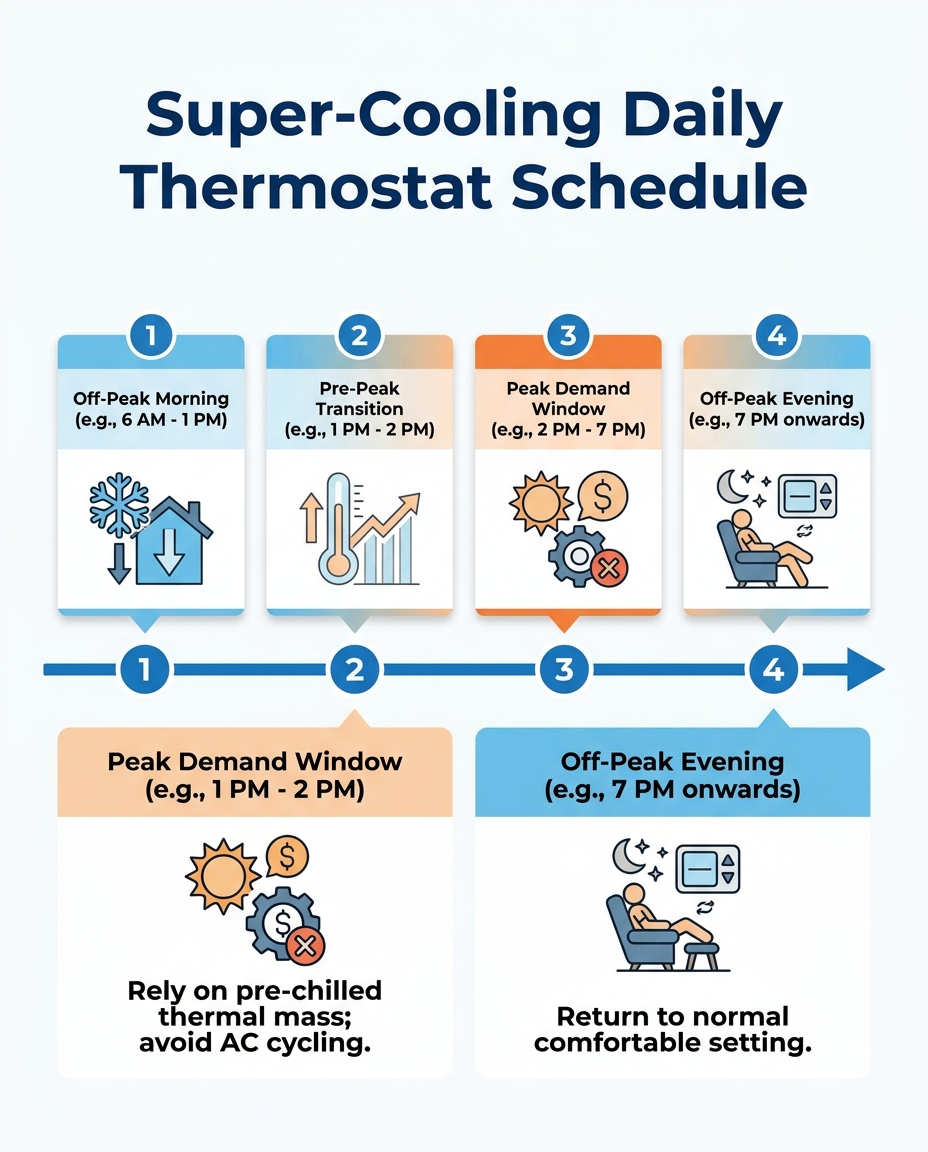
1. Step 1: Drop the temperature early. Between 6 AM and 8 AM, lower your thermostat to a very cool setting, typically between 68 and 70 degrees. This is when electricity is cheapest and the outdoor air is mildest, making it highly efficient for your equipment to run.
2. Step 2: Maintain the chill. Leave the thermostat at this low setting throughout the entire morning. Do not adjust it if you leave for work. The goal here is to thoroughly chill the thermal mass and extract as much latent heat (humidity) from the house as possible.
3. Step 3: Raise the setting before the peak. At 1 PM or 2 PM—right before your utility's peak demand hours begin—raise the thermostat to 78 degrees or higher. This ensures the system will not cycle on when rates jump.
4. Step 4: Coast through the afternoon. Do not override the thermostat during the 2 PM to 7 PM window. Rely entirely on the pre-chilled thermal mass to keep the space comfortable.
5. Step 5: Return to normal. Once the peak window closes (usually after 7 PM), adjust the thermostat back to your standard evening preference.
The quick fix warning: It is highly important to follow the morning pre-cooling phase. If you wait until the house is already hot and then try to blast the AC, the system will consume maximum power during the most expensive time of day. To understand the physics behind this common mistake, read our guide on why setting your thermostat lower doesn't cool your house faster.
Super-Cooling Daily Thermostat Schedule
Ensuring Your AC System is Ready for the Morning Run
Asking an air conditioner to super-cool a house puts a sustained, heavy load on the equipment. While it runs during the most efficient time of day, running continuously for six or seven hours requires the machinery to be in excellent condition. In our experience, if your system is struggling with basic operation, attempting a super-cooling strategy could lead to frozen coils, tripped breakers, or unexpected breakdowns.
Before implementing this strategy in Springfield IL area homes, the equipment must be properly prepared. We've found that the blower motor needs to push adequate airflow to prevent the evaporator coil from freezing during long morning cycles. This requires a completely clean air filter and clear return vents. Additionally, the condensate drain line must be clear; because super-cooling extracts massive amounts of humidity, the system will produce heavy condensation that must drain away quickly. Finally, optimal refrigerant levels are required to ensure the system can actually achieve the deep chill needed to cool the thermal mass.
Because these checks involve testing electrical loads and handling refrigerant, they require a licensed professional. At Allied Plumbing Heating & Cooling, our team understands how to optimize residential cooling systems specifically for Illinois utility rate structures, which makes a massive difference. One local homeowner recently scheduled routine late-summer checks for their air conditioner with us. Because our technician provided prompt, courteous service and verified the equipment was fully optimized, the customer found the visit to be a highly worthwhile investment before the heavy back-to-school heatwaves began. Routine checkups verify your system can handle advanced operational strategies without failing.
Frequently Asked Questions About AC Peak Demand Strategies
Does super cooling your house actually work?
Yes, super-cooling is a highly effective strategy when executed correctly. It works by chilling the physical structure of your home (the thermal mass) rather than just the air. By running the system heavily during off-peak morning hours, the walls and furniture absorb the cold, allowing the house to remain comfortable through the August late-summer afternoon heat while the system stays off.
What is the best temperature for AC during peak hours?
The recommended setting during peak demand hours is 78 degrees or higher. The goal during this window is to prevent the system from turning on while electricity rates are at their highest. If you have properly pre-cooled the home in the morning, the indoor temperature will slowly rise toward this number, keeping you comfortable without triggering expensive utility charges.
How do you pre-cool a house in the summer?
Pre-cooling involves dropping the thermostat significantly during the early morning. Set the thermostat to 68 or 70 degrees between 6 AM and 1 PM. This forces the system to extract humidity and chill the home's thermal mass while electricity is cheaper, building a buffer of cold energy to combat the afternoon heat.
Should I turn off my AC completely during peak hours?
You do not need to turn the system off at the breaker, but you should adjust the thermostat so it doesn't run. Setting the thermostat to a high temperature (like 80 degrees) during peak hours achieves the same result as turning it off. This ensures the equipment will only cycle on if the indoor temperature reaches an unsafe or highly uncomfortable level.
How does indoor humidity affect peak demand cooling strategies?
High humidity makes the air feel warmer and forces the AC to work harder. In the Midwest, latent heat (moisture) is a major factor. Super-cooling in the morning acts as a massive dehumidification cycle, pulling heavy moisture out of the air. Dry air feels cooler, which makes it much easier to tolerate a slow rise in sensible temperature during the afternoon peak hours.
Take Control of Your Summer Cooling Costs
Understanding the relationship between thermal mass and peak utility pricing empowers you to stay comfortable without overpaying for electricity. The traditional advice of setting one temperature and leaving it alone simply does not align with modern Time-of-Use billing. By adopting a clear, actionable super-cooling strategy, you can actively combat high rates, utilizing cheaper morning power to build a lasting defense against the afternoon heat.
To ensure your equipment is fully prepared to handle the sustained morning run times required for this strategy, proactive maintenance is highly recommended for Springfield IL area homes. Reach out to our team at Allied Plumbing Heating & Cooling to schedule professional AC service and take back control of your home's comfort and efficiency this season.
Common Homeowner Questions Answered: Is That First-Run Furnace Smell Dangerous?
October 5, 2026
Wondering if that first-run furnace smell is dangerous? Get clear answers and have your common homeowner questions answered before the cold weather hits.
Wondering if that first-run furnace smell is dangerous? Get clear answers and have your common homeowner questions answered before the cold weather hits.
Comparing Prepaid HVAC Maintenance Agreements vs A La Carte Fall Tune-Ups
October 3, 2026
Treat heating maintenance as more than a simple transaction. Weigh the long-term benefits of an ongoing service plan against a one-off furnace check before the first winter freeze hits.
Treat heating maintenance as more than a simple transaction. Weigh the long-term benefits of an ongoing service plan against a one-off furnace check before the first winter freeze hits.