Why AC Refrigerant Changes Matter for Springfield, IL Homeowners Right Now
Understanding how AC refrigerant changes affect homeowners is more important than ever heading into 2026. Here is a quick summary of what you need to know:
• Your current system is not illegal. You can keep using and repairing your R-410A system.
• New equipment sold after January 1, 2025 must use low-GWP refrigerants like R-454B or R-32.
• R-410A will become harder and more expensive to source as supply shrinks over time.
• New refrigerants are safe — they are mildly flammable but engineered with built-in safety features.
• Retrofitting old systems to new refrigerants is not possible — they require entirely different equipment.
• Financial incentives exist to help offset the cost of upgrading to a newer, more efficient system.
If your home in Springfield, Rochester, or Chatham still runs on an older AC system, you have probably heard rumblings about refrigerant rules changing. Maybe your technician mentioned R-410A during a recent service call. Maybe you caught a headline about the EPA phasing out certain refrigerants. Either way, it is easy to feel uncertain about what any of this actually means for your home, your wallet, and your comfort.
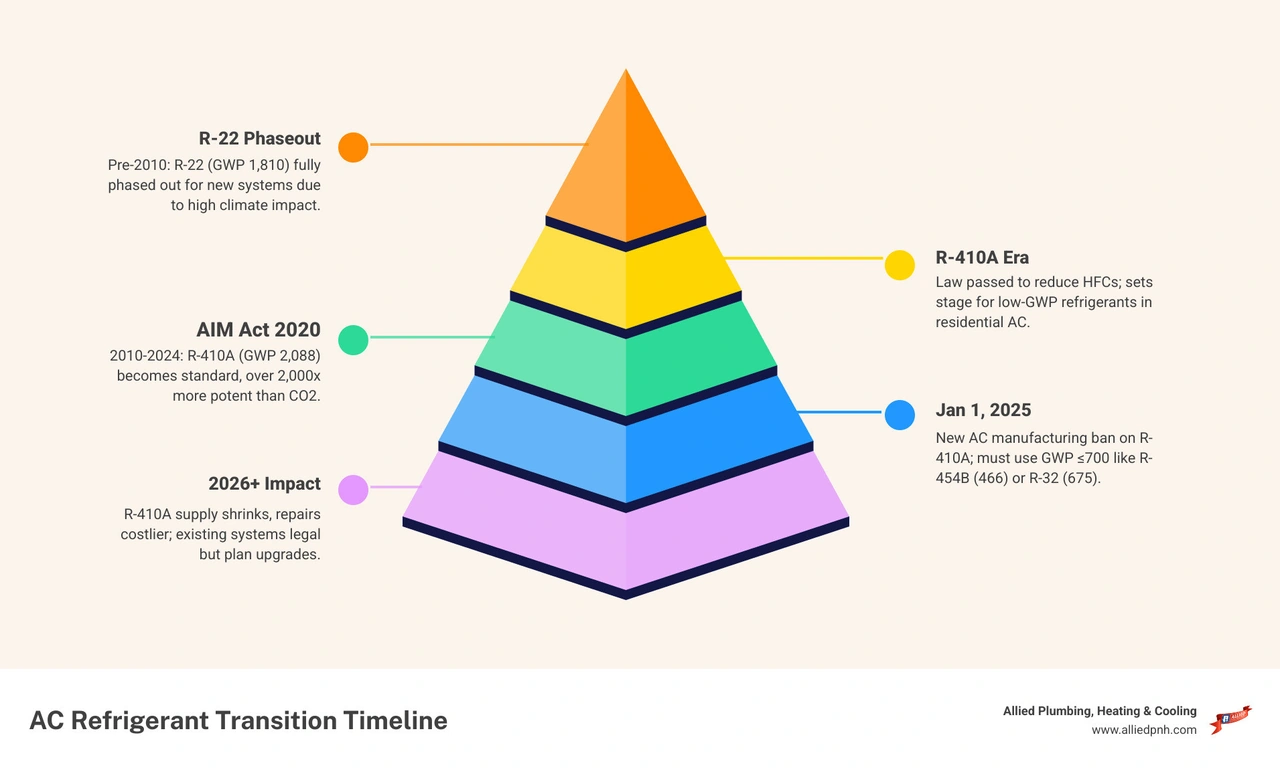
The short version: the HVAC industry is going through its biggest regulatory shift in decades. Under the AIM Act of 2020 and EPA mandates that took effect January 1, 2025, manufacturers can no longer produce new residential AC equipment that uses R-410A — a refrigerant with a Global Warming Potential (GWP) of 2,088, which is more than 2,000 times more potent than carbon dioxide. New systems must now use refrigerants with a GWP of 700 or less, such as R-454B (GWP: 466) or R-32 (GWP: 675).
What this does not mean is that you need to rip out your current system tomorrow. But it does mean the rules around maintaining, repairing, and eventually replacing your AC are shifting in ways every homeowner should understand now — before a breakdown forces the decision.
How AC Refrigerant Changes Affect Homeowners in Springfield, IL
As we move through 2026, we are seeing the full impact of the Environmental Protection Agency's (EPA) "Technology Transitions" rule. This rule is part of the American Innovation and Manufacturing (AIM) Act, which was passed to phase down the use of hydrofluorocarbons (HFCs). For homeowners in Springfield, IL, this means the cooling landscape has fundamentally shifted.
What changed in 2025 and what homeowners should understand in 2026
The biggest milestone occurred on January 1, 2025. From that date forward, manufacturers stopped producing new residential air conditioners and heat pumps that use R-410A. While there is a "sell-through" period for existing inventory, 2026 is the year where the new standard becomes the rule rather than the exception. If you are shopping for a new system today, you will likely be looking at equipment designed for the next generation of refrigerants.
Why R-410A is being replaced
You might remember the transition from R-22 (Freon) to R-410A (Puron) years ago. R-22 was phased out because it was an ozone-depleting substance. R-410A was the "green" alternative at the time because it didn't hurt the ozone layer. However, R-410A has a high Global Warming Potential (GWP).
As part of the global Kigali Amendment, the U.S. is committed to reducing greenhouse gas emissions. By moving to refrigerants with a GWP under 700, we are significantly reducing the climate impact of our home cooling systems. It is a massive step forward for environmental protection, but it does require new technology to handle these more efficient gases.
What Refrigerants Are Replacing R-410A and Are They Safe?
The two primary contenders replacing R-410A are R-454B and R-32. These are classified as A2L refrigerants. While that sounds like a secret government code, it actually tells us a lot about how they behave.
• R-22 — Type: HCFC — GWP (Global Warming Potential): 1,810 — Safety Class: A1 (Non-flammable)
• R-410A — Type: HFC — GWP (Global Warming Potential): 2,088 — Safety Class: A1 (Non-flammable)
• R-32 — Type: HFC — GWP (Global Warming Potential): 675 — Safety Class: A2L (Mildly Flammable)
• R-454B — Type: HFO/HFC Blend — GWP (Global Warming Potential): 466 — Safety Class: A2L (Mildly Flammable)
How AC refrigerant changes affect homeowners choosing a new system
When we install a new system in Rochester or Chatham today, it looks very similar to the old ones, but the "brain" and safety features are more advanced. Because A2L refrigerants are "mildly flammable," manufacturers have added safety controls like Refrigerant Detection Systems (RDS). These sensors monitor the system; if they detect a leak, they automatically trigger the indoor blower to dissipate the gas safely.
Are A2L refrigerants safe for homes?
The term "mildly flammable" can sound scary, but it is important to put it in perspective. These gases are very difficult to ignite. In fact, many common household items like hairspray or cleaning aerosols are more flammable than R-32 or R-454B.
The "2L" classification means the gas has a low burning velocity—it doesn't catch fire easily and won't sustain a flame under normal conditions. When combined with the fact that AC systems are closed loops, the risk to your family is incredibly low.

Do You Need to Replace Your Current AC Right Away?
One of the most common questions we get at Allied Plumbing, Heating & Cooling is: "Is my current AC now illegal?" The answer is a resounding no.
How ac refrigerant changes affect homeowners with existing R-410A systems
If your R-410A system is working perfectly, keep using it! There is no law requiring you to replace a functional unit. You can still get it serviced, and R-410A will be available for repairs for years to come. However, as the supply of R-410A is phased down by the EPA, the cost of the gas itself will likely rise. We recommend a proactive maintenance strategy to ensure your system stays leak-free, as "topping off" a leaking unit will become increasingly expensive.
Can older systems be retrofitted to new refrigerants?
We often get asked if we can just "swap out" the old gas for the new, low-GWP stuff. Unfortunately, the answer is no. A2L refrigerants operate at different pressures and require different lubricants and safety sensors. Trying to put R-32 into an R-410A system is dangerous and will void your warranty. When it is time to switch to the new refrigerant, you will need to replace the full system.
When repair makes sense and when replacement is smarter
Deciding whether to fix an old R-410A unit or upgrade to a new R-32 or R-454B system usually comes down to the "50% Rule." If the cost of the repair is more than half the value of a new system—especially if the unit is over 10-12 years old—it is usually smarter to replace it.
Consider replacement if:
• Your system uses R-22 (which is now extremely rare and expensive).
• You have a major leak in an older R-410A evaporator coil.
• Your compressor has failed.
• Your energy bills are skyrocketing due to poor efficiency.
Leak Problems, Warning Signs, and Why Recharging Is Not the First Step
Refrigerant is not like gasoline in a car; your AC doesn't "burn" it. It is a closed loop. If your refrigerant is low, it means you have a leak. Simply adding more gas without fixing the hole is like trying to fill a bucket with a hole in the bottom—it’s a waste of money and bad for the environment.
Signs your AC may have a refrigerant leak
How do you know if you're losing gas? Keep an eye out for these red flags:
• Warm air: If your vents are blowing air that feels lukewarm, the system can't absorb heat.
• Long run times: The AC runs all day but the house never gets cool.
• Ice buildup: Low pressure causes the evaporator coil to drop below freezing, turning humidity into ice.
• Hissing or bubbling: These sounds often indicate gas escaping through a pinhole or a failing valve.
If you notice these, check out our guides on How To Know When Ac Has Refrigerant Issues and Why Is Your Ac Freezing Up During Hot Weather for more details.
Why leaks must be repaired before any recharge
Under EPA Section 608 regulations, it is illegal to knowingly vent refrigerants into the atmosphere. Beyond the legalities, a leak allows moisture and acid to enter your system, which can eat away at the compressor from the inside out. Fixing the leak protects your investment and ensures your system operates at peak efficiency. If your Ac Blowing Hot Air or you're wondering Why Ac Is Running But Not Cooling Your Home, a leak is a very likely culprit.
Is it legal for homeowners to handle refrigerant themselves?
Absolutely not. Handling refrigerants requires EPA certification. It is illegal for non-certified individuals to purchase or handle these chemicals. This isn't just a "red tape" issue—refrigerants are under high pressure and can cause "refrigerant burns" on the skin or displace oxygen in enclosed spaces, leading to suffocation.
Environmental and health effects of refrigerant leaks
While modern refrigerants are much safer than those used 50 years ago, they still carry risks. Because refrigerant gas is heavier than air, it can pool near the floor in a basement or mechanical room, which can be dangerous for pets or small children. Environmentally, high-GWP leaks are a major contributor to the greenhouse effect.
How to Check What Refrigerant Your AC Uses and Prepare for the Transition
Knowledge is power. Knowing what is inside your outdoor unit can help you plan for the future.
How to identify your system’s refrigerant type
You don't need to be a pro to find this out. Go to your outdoor condenser unit and look for the "data plate"—a metal sticker or engraved plate. It will list the model number, serial number, and "Refrigerant Type." It will likely say R-22 (if it's very old), R-410A, or—if it's brand new—R-32 or R-454B.
If you're having trouble finding it or your system won't start, see our guide on How To Fix An Ac That Wont Turn On or read about Solutions For An Ac Thats Blowing Warm Air.
Maintenance steps homeowners should take now
The best way to "prepare" for these changes is to take care of what you have.
1. Schedule a Spring Tune-Up: Have a professional check your refrigerant levels and inspect connections for wear.
2. Change Filters: Restricted airflow puts extra stress on the system, which can lead to vibration-related leaks.
3. Clear the Area: Keep weeds and debris at least two feet away from your outdoor unit to ensure proper airflow.
Incentives, tax credits, and rebates worth checking before you upgrade
The transition to low-GWP refrigerants often goes hand-in-hand with higher efficiency ratings (SEER2). This means many new systems qualify for significant savings:
• Federal Tax Credits: Under the Inflation Reduction Act, you may be eligible for credits up to $2,000 for high-efficiency heat pumps or $600 for high-efficiency central AC.
• Utility Rebates: Many local utility providers in the Springfield area offer rebates for installing ENERGY STAR certified equipment.
• Manufacturer Incentives: Companies often offer seasonal rebates to help homeowners move into newer technology.
Frequently Asked Questions About New AC Refrigerant Rules
Will my current AC become illegal to use?
No. Your existing R-410A or R-22 system is perfectly legal to operate and repair as long as parts and refrigerant are available. There is no "mandatory replacement" law for homeowners.
Will repairs for older R-410A or R-22 systems get harder?
Yes, over time. As the EPA limits production, the supply of R-410A will tighten, and R-22 is already becoming quite scarce. This leads to longer lead times for parts and higher costs for the refrigerant itself.
Should I replace my system now or wait?
If your system is under 10 years old and running well, wait! Just keep up with maintenance. If your system is 15+ years old and facing a major repair, now is a great time to look at a new, high-efficiency system to take advantage of current tax credits and avoid the rising costs of old refrigerants.
Conclusion
The transition to new refrigerants is a big change, but it doesn't have to be a stressful one. By moving to low-GWP options like R-32 and R-454B, we are creating a more sustainable future for Springfield, Rochester, and Chatham.
At Allied Plumbing, Heating & Cooling, we have been helping families stay comfortable since 1977. As a 3-generation business, we’ve seen these transitions before, and we know how to navigate them. Whether you need a simple repair or are ready to explore the latest in high-efficiency cooling, we are here for you 24/7. Plus, with our Daikin Comfort Promise and 12-year warranties, you can rest easy knowing your home is in expert hands.
Don't wait for the summer heat to catch you off guard. More info about air conditioning services is just a click away, or give us a call to schedule your system inspection today!