Resetting Your AC's Disconnect Box After a Springfield Summer Storm
Resetting Your AC's Disconnect Box After a Springfield Summer Storm
The Immediate Aftermath of a July Power Outage
Here at Allied Plumbing Heating & Cooling, our dispatch board always lights up the moment a severe weather system passes. Your power flickers, the lights go dark, and the wind hammers the roof. When the grid finally stabilizes, the lights come back on inside, but your house remains uncomfortably quiet. Your outdoor condenser remains completely silent, and the reality of resetting your AC's disconnect box after a Springfield summer storm suddenly becomes a pressing priority. In the heavy, oppressive humidity and wet ground conditions left behind by July storms in Central Illinois, the urgency to restore cooling is immediate. The house heats up rapidly, and you are faced with a critical decision: determining if it is safe to check the outdoor electrical equipment yourself, or if an expert is required.
The immediate aftermath of a severe weather event is a chaotic time for any homeowner. You are likely dealing with reset clocks, blinking appliances, and the realization that the temperature inside your home is steadily climbing. For residents in Springfield IL and surrounding Central Illinois areas, a pattern we see often every summer is the natural instinct to rush outside, find the metal box next to the air conditioner, and start flipping switches to get the cold air flowing again. However, interacting with high-voltage outdoor equipment immediately following a torrential downpour requires a deep understanding of the risks involved. Rushing this process can lead to severe injury or catastrophic damage to your cooling equipment.
The Urgency of Restoring Comfort
When the power goes out during a peak summer heatwave, the indoor temperature can rise by several degrees per hour. The thermal envelope of your home begins to absorb the outdoor heat, and the indoor humidity spikes, making the air feel thick and unbreathable. While the desire to get the system running is completely understandable, our team always stresses that the safety of you and your family must take precedence. A silent air conditioner after a power outage is often a sign that the system's built-in safety mechanisms have done their job, sacrificing a fuse or tripping a breaker to protect the expensive compressor from a fatal electrical surge.
Understanding the Role of the AC Disconnect Box
Before you even step outside, it helps to understand what you are actually looking at. In our years of keeping Central Illinois homes cool, we've found that the outdoor disconnect box is often misunderstood. It is not just a random switch; it is a highly specific, code-mandated piece of safety equipment. The National Electrical Code (NEC) requires a disconnect box to be installed within sight of the AC condenser unit. The primary purpose of this box is to provide a fast, reliable way for an HVAC technician to completely cut power to the unit while they are actively working on it, ensuring they cannot be accidentally electrocuted if someone inside the house flips a breaker.
Anatomy of the Disconnect
Disconnect boxes generally come in two distinct styles, and knowing which one you have dictates how you interact with it. The first is a switch-style disconnect, which operates much like a heavy-duty light switch or a standard circuit breaker. You simply flip the toggle from the "off" position to the "on" position. The second, and often more common style, is a pull-block disconnect. This features a handle attached to a block that physically bridges the electrical connection. To cut the power, you pull the block entirely out of the box. To restore power, you flip the block over or align it with the "on" markings and push it firmly back into the slot.
A Frontline Defense Against Surges
It is important to clarify that the disconnect box is a localized safety mechanism, entirely separate from the main electrical panel inside your home. While your indoor panel protects the wiring inside your walls, the outdoor disconnect box is the final gatekeeper before high-voltage electricity reaches your air conditioner. During the height of the Midwest summer thunderstorm season, this box acts as a frontline defense against electrical anomalies. Many disconnect boxes contain heavy-duty cartridge fuses designed to blow instantly if a massive surge of power attempts to travel from the grid into your delicate HVAC components.
How Lightning and Grid Fluctuations Impact Your System
To understand why your disconnect box tripped or blew a fuse in the first place, we have to look at the physics of a power outage. When a severe storm rolls through, the danger to your air conditioner is rarely the power going out—the real danger occurs the moment the power comes back on. Sudden power restoration causes massive surges that can easily overwhelm standard AC fuses. As the utility company re-energizes the lines, a massive spike of electricity rushes into your home's electrical system, seeking a path to ground.
The Threat of Grid Fluctuations
Our technicians routinely see the aftermath of local utility grids in the region experiencing voltage drops and spikes during severe weather alerts. If lightning strikes a nearby transformer, it can send thousands of volts cascading through the local lines. Even without a direct lightning strike, the fluctuating power demands of a struggling grid can cause rolling brownouts. During a brownout, the voltage drops, but your air conditioner still demands the same amount of total power to run the compressor. To compensate for the low voltage, the system pulls incredibly high amperage. This high amperage generates immense heat, which melts wires, destroys capacitors, and forces the disconnect fuses to blow to stop the thermal runaway.
If you find that your system is completely unresponsive, a tripped box is actually the system working correctly. It means the fuses or the breaker sacrificed themselves to protect the expensive compressor from catastrophic failure. Understanding these mechanics is helpful when diagnosing AC electrical problems after a power outage. The damage caused by the Midwest summer thunderstorm season is rarely visible from the outside of the unit; it is hidden within the electrical pathways that govern the system's operation.
Critical Safety Protocols Before Approaching the Unit
As your local family-owned safety advocate at Allied Plumbing Heating & Cooling, we prioritize your well-being over a quick DIY fix. We've seen firsthand that handling high-voltage electrical equipment is inherently dangerous, and doing so in the immediate aftermath of a storm exponentially increases the risk. The lingering danger of saturated soil typical of localized flash flooding during summer downpours creates a highly conductive environment. If there is a fault in the wiring and you touch the metal disconnect box while standing in a puddle, the electricity will use your body as the fastest path to ground.
Your Post-Storm Safety Checklist
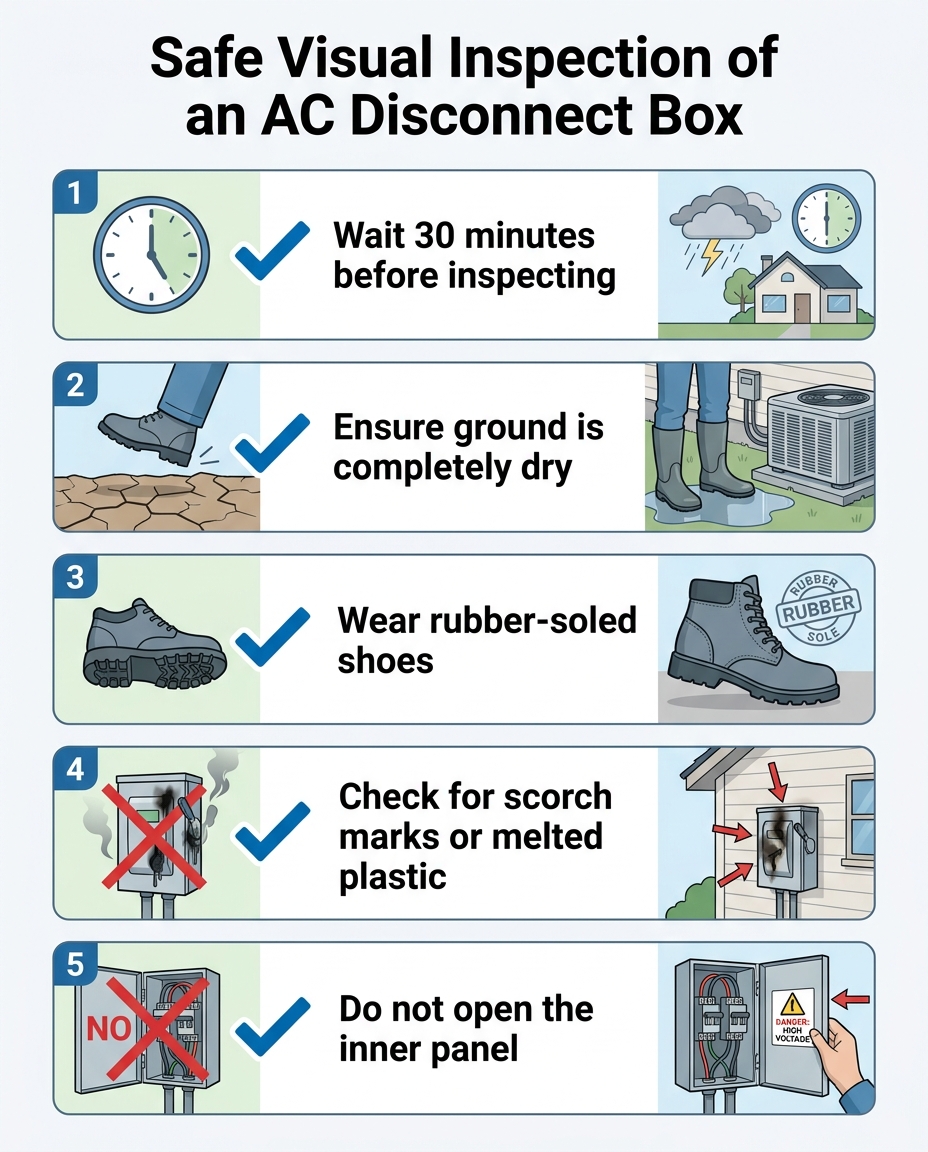
Before you even think about touching the outdoor equipment, you must establish firm safety boundaries. We recommend following these non-negotiable protocols to protect yourself from severe electrocution risks:
• Check the indoor panel first: Always start your troubleshooting inside the dry, safe environment of your home. Locate your main electrical panel and check if the dedicated breaker for the air conditioner has tripped. If it has, reset it once. If it immediately trips again, stop entirely—you have a hard short circuit.
• Assess the ground conditions: Look out the window at the area surrounding your AC condenser. If there is standing water, deep mud, or actively flowing runoff around the concrete pad, do not approach the unit. Wait until the ground has fully drained.
• Wear protective footwear: Never walk outside barefoot or in sandals to check electrical equipment. Wear heavy, rubber-soled shoes or boots to insulate yourself from the wet ground.
• Ensure complete dryness: Your hands must be completely dry. Do not hold a wet umbrella in one hand while attempting to touch the disconnect box with the other.
• Look for visible damage: Before touching the metal box, look for obvious signs of lightning damage. If you see scorch marks, blackened metal, or melted plastic on the siding or the box itself, stay away.
For homeowners in Springfield IL and surrounding Central Illinois areas, adapting to these safety protocols is a necessary part of summer homeownership. Safety always supersedes the desire for immediate cooling, no matter how uncomfortable the indoor temperature becomes.
Safe Visual Inspection of an AC Disconnect Box
Safely Inspecting and Resetting the Disconnect
If you have verified that the ground is dry, your hands are dry, and there are no visible signs of catastrophic electrical damage, you can perform a basic visual inspection and reset. This guidance is strictly informational, outlining what a homeowner can safely do without crossing the line into dangerous, licensed professional work. Never attempt to bypass safety mechanisms or modify the electrical connections.
The Step-by-Step Reset Process
1. Wait 30 minutes after power is restored: This is the most frequently skipped step, and we cannot stress its importance enough. When the power goes out, the refrigerant pressures inside your air conditioner are unbalanced. If you force the system to turn on immediately, the compressor has to fight against immense head pressure, which can stall the motor. Waiting half an hour allows the pressures to equalize and gives the internal thermostat time to reset its time-delay function.
2. Perform a sensory inspection: Approach the box without touching it. Look for scorch marks or melted plastic. Lean in slightly and smell the air around the box. If you detect the sharp, metallic smell of ozone or the distinct odor of burning electrical insulation, do not touch the box. Call our professionals immediately.
3. Resetting a switch-style disconnect: If your box features a simple toggle switch and the switch is in the "off" or "tripped" position, firmly push it to the "on" position. Step back and listen for the condenser to engage.
4. Resetting a pull-block disconnect: If you have a pull-block, carefully open the outer metal lid. Grasp the handle of the block and pull it straight out. Inspect the block itself for melting. If it looks intact, check the markings. Usually, one side says "ON" and the other says "OFF." Orient the block so the "ON" side is facing the correct direction according to the manufacturer's markings, and push it firmly back into the slot until it seats completely.
Strict Warning: Under no circumstances should you attempt to unscrew or open the inner metal panel of the disconnect box. That panel covers the high-voltage lugs that carry lethal electrical currents. Furthermore, if your disconnect box uses cartridge fuses, do not attempt to manually pull or replace blown fuses yourself. Throughout the Midwest summer thunderstorm season, DIY fuse replacement is a leading cause of severe electrical injuries for homeowners.
Blown Fuses vs. Tripped Breakers: Knowing the Difference
Understanding the severity of your situation often comes down to distinguishing between a simple tripped breaker and a blown fuse. While both interrupt the flow of electricity to protect your equipment, they do so under different circumstances and indicate different levels of electrical trauma to your system.
Comparing Electrical Safeguards
• Primary Function — Indoor Circuit Breaker: Protects the home's internal wiring from overheating due to sustained overloads. — Outdoor Disconnect Fuse: Protects the outdoor condenser from massive, sudden power surges (like lightning).
• Mechanism — Indoor Circuit Breaker: Trips mechanically when amperage exceeds the limit; can be reset indefinitely. — Outdoor Disconnect Fuse: A metal filament melts physically to break the circuit; must be replaced once blown.
• Symptoms of Failure — Indoor Circuit Breaker: The switch is sitting in the middle position; easily pushed to "off" then "on". — Outdoor Disconnect Fuse: Unit is completely unresponsive even after the main indoor breaker is verified as on.
• Next Steps — Indoor Circuit Breaker: Reset once. If it trips again immediately, call a professional. — Outdoor Disconnect Fuse: Requires a licensed technician to diagnose the root cause and install exact replacements.
The most dangerous action our repair crews witness is a homeowner repeatedly resetting a tripping AC breaker. If you flip the breaker inside your house, and it immediately snaps back to the "off" position, the system is experiencing a hard electrical short. Forcing the breaker back on forces the compressor to run under dangerous electrical loads, which will eventually melt the internal windings and destroy the unit entirely. Replacing a blown cartridge fuse in the outdoor box requires verifying the correct amperage and diagnosing the root cause of the surge, a task that must be handled by an expert familiar with the Midwest summer thunderstorm season and its effects on local grids.
When to Call a Licensed Professional for AC Electrical Issues
In our experience restoring cooling performance across Springfield, there is a distinct line between safe homeowner troubleshooting and dangerous DIY electrical work. Once you have verified the indoor breaker and safely checked the outdoor disconnect block, your role in the repair process is complete. If the system still refuses to turn on, it is time to draw a hard line and guide the situation toward professional intervention.
Recognizing the Triggers for Expert Help
You should immediately call a licensed technician if you experience any of the following explicit triggers: burning smells coming from the vents or the outdoor unit, loud buzzing or humming noises from the condenser that do not result in the fan spinning, or a main breaker that trips immediately after being reset. These are all signs of severe electrical trauma. Lightning surge damage often requires specialized diagnostic tools to properly assess. A professional technician will use a multimeter to check the incoming voltage and a megohmmeter (often called a megger) to test the insulation resistance of the compressor windings. They will also test the capacitor and the contactor, two components that frequently fail after a power surge.
Reiterating our core safety message: handling high-voltage outdoor equipment is strictly for licensed technicians. The risk of arc flashes, severe burns, and lethal electrocution is simply too high to justify attempting an unsafe fix. If you are dealing with an unresponsive system after a severe weather event, expert help is readily available for residents facing these exact post-storm issues across Springfield and surrounding communities.
By respecting the power of electricity and understanding the limits of safe visual inspection, you can protect your home, your equipment, and your family. For homeowners in Springfield IL and surrounding Central Illinois areas, knowing when to step back and let a professional take over is the smartest home maintenance decision you can make.
Frequently Asked Questions
Why is my AC not turning on after a power outage?
Your AC is likely protecting itself from electrical damage. When the power fluctuates, the system's built-in safety mechanisms, such as the outdoor disconnect fuses or the indoor circuit breaker, will intentionally trip to stop a surge from destroying the compressor. Additionally, many modern thermostats have a built-in 5 to 10-minute time delay that prevents the unit from starting immediately to allow internal refrigerant pressures to equalize.
How do I safely reset my outside AC disconnect?
Safety starts with ensuring the surrounding ground is completely dry and you are wearing rubber-soled shoes. If your box has a switch, firmly toggle it from off to on. If you have a pull-block design, carefully pull the block out, ensure the "ON" indicator is oriented correctly, and push it firmly back into place. Never unscrew the inner metal panel to expose the wiring.
Why does my AC breaker keep tripping after a storm?
A breaker that repeatedly trips is signaling a severe electrical fault, such as a short circuit or a grounded compressor. When lightning or a power surge damages the internal insulation of the AC motor, the system pulls far more electricity than it safely can, forcing the breaker to trip. You should never repeatedly reset a tripping breaker, as this can cause permanent, irreversible damage to the equipment.
Can a power surge ruin an AC compressor?
Yes, a massive power surge can easily ruin a compressor in a fraction of a second. The immense voltage spike generates intense heat that melts the delicate copper windings inside the motor, causing a hard short to the metal casing. Once the compressor windings are fused or broken, the entire compressor must be replaced, which is often one of the most expensive repairs in HVAC.
How long should I wait to turn my AC back on after a power outage?
Our team recommends waiting at least 30 minutes before attempting to turn the system back on. This waiting period allows the highly pressurized refrigerant inside the compressor to settle and equalize. If you attempt to start the unit while the pressure is still unbalanced, the motor will struggle to turn against the resistance, which can overheat the system and blow the fuses.
Upgrading to a High-Recovery Water Heater for Families with Overlapping Morning Showers
September 15, 2026
A bigger tank isn't always the answer to morning hot water shortages. We break down why recovery speed matters more than gallon capacity when back-to-back showers drain your system.
A bigger tank isn't always the answer to morning hot water shortages. We break down why recovery speed matters more than gallon capacity when back-to-back showers drain your system.
Diagnosing a Furnace Flame Sensor That Shuts the System Down After Three Seconds
September 15, 2026
Turning on your heat only to watch the burners die instantly is a frustrating fall surprise. We explain why this three-second safety lockout happens to protect your home.
Turning on your heat only to watch the burners die instantly is a frustrating fall surprise. We explain why this three-second safety lockout happens to protect your home.
Locating Drafty Areas in Your Basement That Threaten Exposed Water Lines
September 15, 2026
Early fall is the ideal time to find hidden air leaks around rim joists and basement windows. Map out structural vulnerabilities now to prevent frozen pipes in January.
Early fall is the ideal time to find hidden air leaks around rim joists and basement windows. Map out structural vulnerabilities now to prevent frozen pipes in January.