Diagnosing a Springfield Home's Second Floor That Stays 10 Degrees Hotter Than the First
Diagnosing a Springfield Home's Second Floor That Stays 10 Degrees Hotter Than the First
Why Is My Upstairs Sweating While the Downstairs Freezes?
Are you tired of trying to sleep in a sweltering upstairs bedroom while the ground floor feels like an icebox? Diagnosing a Springfield home's second floor that stays 10 degrees hotter than the first requires looking beyond the thermostat. Many homeowners assume their air conditioner is simply broken or too small to handle the square footage. The reality is usually much more complex. At Allied Plumbing Heating & Cooling, our technicians see this frustrating scenario force a difficult decision: do you keep trying ineffective quick fixes like closing downstairs vents, or do you address the actual ductwork and return air root causes?
A persistent 10-degree temperature differential in a two-story home is almost always an airflow imbalance issue, not a failing compressor. If you need help with your air conditioning, professional air conditioning services can identify and resolve the root cause.
The Physics of Thermal Stratification in Two-Story Homes
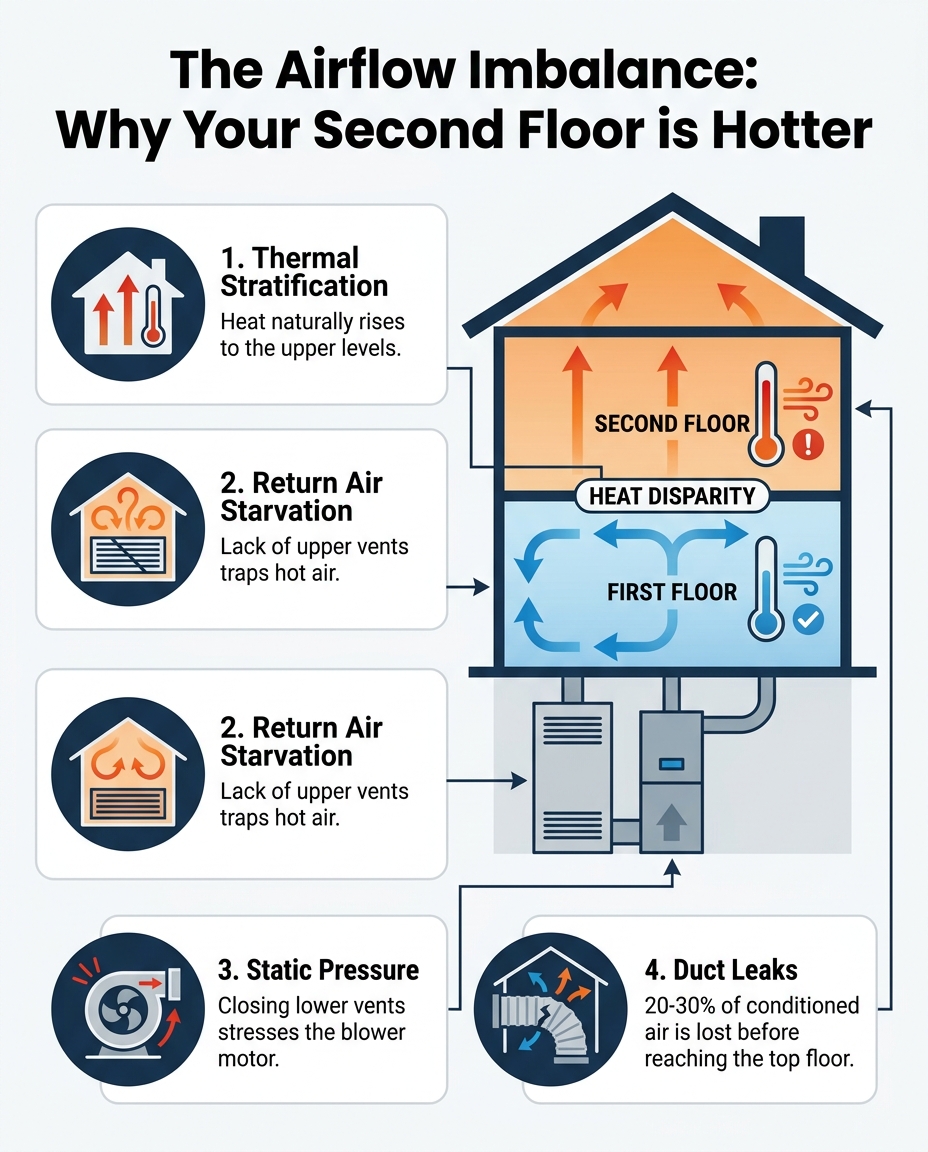
To understand why your second floor feels like an oven, we have to look at the baseline science of how air moves within an enclosed space. The primary force at play is thermal stratification. This is the natural, physical process where warm air—which is less dense and lighter—rises to the highest point in a structure, while cool, dense air sinks to the lowest level. During peak summer heat, the architecture of a standard two-story home inherently fights against your cooling system.
In the countless Springfield homes our team has evaluated, most builder-grade HVAC systems are installed as a single zone. This means one thermostat, usually located on the first floor, dictates the cooling for the entire house. Because the cold air naturally sinks and pools on the ground level, the thermostat quickly registers that the target temperature has been reached and shuts the system off. Meanwhile, the rising heat remains trapped upstairs.
• Air Density — First Floor Dynamics: Heavy, cold air naturally sinks and pools here. — Second Floor Dynamics: Lighter, warm air constantly rises to this level.
• Thermostat Reading — First Floor Dynamics: Satisfies quickly, shutting off the cooling cycle prematurely. — Second Floor Dynamics: Remains unmonitored; system turns off before cooling reaches here.
• Heat Gain — First Floor Dynamics: Shaded by the second floor and roof; less direct solar impact. — Second Floor Dynamics: Absorbs radiant heat directly from the attic and roof deck.
• Airflow Distance — First Floor Dynamics: Short distance from the basement or ground-level blower. — Second Floor Dynamics: Requires maximum velocity to push air up long vertical duct runs.
An HVAC system must be specifically designed to overcome this natural physics. When a system lacks the proper duct sizing or velocity to push dense, conditioned air up to the second floor, thermal stratification wins every time.
The Hidden Culprit: Return Air Starvation on the Second Floor
When a home experiences a consistent 10-degree temperature differential, the most common structural reason is not a lack of cold air being pushed in, but a lack of warm air being pulled out. This is the function of return air vents. While supply vents blow conditioned air into a room, return vents suck the stale, warm air back to the HVAC equipment to be cooled and dehumidified.
The Problem: Many older two-story designs lack adequate—or any—return vents in upper-level bedrooms. Builders often relied on a single, large return grille in the downstairs hallway to service the entire house.
The Cause: Thanks to our multi-generational experience at Allied Plumbing Heating & Cooling diagnosing the specific architectural and ductwork quirks common in older Springfield-area homes, our team frequently finds that second floors suffer from "return air starvation." If you close a bedroom door that lacks a return vent, the room becomes pressurized. The supply vent tries to pump cold air into a space that is already full of warm air. Because the warm air has no escape route, the cold air simply cannot enter effectively.
The Solution: Shifting the focus from a "broken AC" to "unbalanced airflow" is the first step toward true comfort. Without a dedicated pathway for the trapped heat to leave the second floor, your air conditioner will continue to work overtime with little to no impact on upstairs comfort.
The Airflow Imbalance: Why Your Second Floor is Hotter
Why Closing Downstairs Vents Harms Your System
Faced with a freezing downstairs and a boiling upstairs during peak summer heat, the most common homeowner instinct is to close the first-floor supply registers. The logic seems sound: if you block the air from entering the first floor, it will be forced to travel upstairs. Unfortunately, this DIY myth actually damages your HVAC system.
Closing vents increases what HVAC professionals call static pressure. Your ductwork and blower motor are mathematically sized to move a specific volume of air. When you shut vents, you are not redirecting air; you are blocking it. This acts exactly like putting your thumb over the end of a garden hose. The pressure inside the system spikes, creating massive resistance against the blower motor.
The consequences of high static pressure include:
• Stressed Blower Motors: The fan has to work twice as hard to push air against the closed vents, leading to premature motor failure and skyrocketing energy bills.
• Frozen Evaporator Coils: By restricting the volume of warm air passing over the indoor cooling coil, the refrigerant inside drops below freezing. Condensation on the coil turns to solid ice, completely blocking airflow and shutting down your cooling.
• Increased Duct Leakage: The excess pressure forces conditioned air out of tiny seams and gaps in your ductwork before it ever reaches the second floor.
Closing vents rarely solves the upstairs heat issue, but it frequently leads to expensive emergency repairs.
How Leaky Ductwork Exacerbates the Problem
Even if your system is perfectly sized and your vents are wide open, compromised duct integrity can ruin your second-floor comfort. According to ENERGY STAR data, 20 to 30 percent of the air moving through residential duct systems is lost to leaks, holes, and poor connections. When you are already fighting a 10-degree temperature differential, losing a third of your cooling capacity is disastrous.
When our crews inspect ductwork during the peak of a Springfield summer, we routinely see how the journey from your basement or ground-floor blower to the second-floor bedrooms is the longest run in your house. This long vertical path provides numerous opportunities for air to escape. Every joint, elbow, and seam that isn't properly sealed with mastic or foil tape bleeds cold air into the walls.
Furthermore, if your ductwork runs through unconditioned spaces like an attic, the problem multiplies. Attics can easily reach 130 degrees on a sunny afternoon. If the ducts are leaky or poorly insulated, the conditioned air inside absorbs that extreme heat. By the time the air finally pushes out of the second-floor register, it has lost its cooling power. You are effectively paying to air condition the inside of your walls and your attic, while your bedrooms remain uncomfortably warm.
The Impact of High Humidity on Cooling Capacity
Regional climate factors heavily compound airflow issues, making a warm second floor feel significantly more oppressive. Air conditioners perform two distinct jobs simultaneously: sensible cooling (lowering the actual temperature) and latent cooling (removing moisture from the air).
Springfield IL experiences intense summer humidity often exceeding 70%, which heavily taxes residential HVAC systems and exposes poor duct design. When airflow is weak on the second floor, the system cannot pull enough humid air across the cold evaporator coil to properly dehumidify the space. As a result, the upstairs isn't just hot—it's damp, sticky, and stagnant.
High indoor humidity prevents your body from cooling itself through natural sweat evaporation. A room that is 78 degrees with 40% humidity might feel perfectly comfortable, but that same room at 78 degrees with 65% humidity will feel absolutely miserable during peak summer heat. Addressing the airflow imbalance is essential for restoring latent cooling. For comprehensive solutions regarding moisture control, improving your home's indoor air quality and ventilation is a critical step in making the second floor livable again.
Professional Solutions to Restore Balanced Airflow
Transitioning from diagnostics to real solutions means abandoning the idea of quick fixes. Based on the airflow imbalances we correct every day at Allied Plumbing Heating & Cooling, a consistent 10-degree temperature differential requires professional intervention to alter how air moves through your home. Here are the most effective methods to permanently fix the airflow imbalance.
1. Adding Second-Floor Return Vents
The most direct way to relieve the pressure imbalance is to give the trapped warm air an escape route. Adding or enlarging return air drops on the second floor allows the HVAC system to pull the hottest air out of the bedrooms and send it back to the equipment to be cooled.
• What it involves: A professional assessment of your wall cavities to find a path for new ductwork.
• Why it works: It depressurizes the bedrooms, allowing the cold supply air to flow freely into the space.
2. Implementing a Zone Control System
If your ductwork is accessible and in good condition, zoning is a highly effective solution. This involves separating the upstairs and downstairs into distinct climate zones, each controlled by its own thermostat.
• What it involves: Installing automated dampers inside the ductwork that open and close based on the demands of the separate thermostats.
• Why it works: It allows the system to prioritize the second floor during peak afternoon heat, forcing maximum cooling upstairs while temporarily reducing airflow to the already-cool ground floor.
3. Installing Supplemental Cooling
In some older homes, modifying the existing ductwork is simply not physically possible or cost-effective. In these cases, bypassing the central ductwork entirely is the best approach. Targeted systems can provide independent cooling exactly where it is needed.
• What it involves: Installing a localized system specifically for the upper level.
• Why it works: It completely eliminates the struggle of pushing air up two stories. If you want to explore this route, solving uneven cooling issues with ductless AC is often the most efficient way to conquer a stubborn second floor.
Frequently Asked Questions About Uneven Cooling
Why is my upstairs 10 degrees hotter than downstairs?
A 10-degree difference is typically caused by thermal stratification combined with inadequate return air on the second floor. Heat naturally rises, and if your upper level lacks return vents to pull that hot air out, the cold air from your AC cannot properly enter the rooms. Additionally, long duct runs to the second floor often suffer from pressure drops and air leaks along the way.
Does closing downstairs vents help cool the upstairs?
No, closing downstairs vents actually harms your HVAC system by drastically increasing static pressure inside the ductwork. This resistance forces the blower motor to work harder, which can lead to premature motor failure and cause the indoor evaporator coil to freeze over. Instead of pushing air upstairs, it usually just forces cold air to leak out of duct seams into your walls or basement.
Will a bigger AC cool my second floor better?
Installing a larger air conditioner will not solve a hot second floor if the underlying issue is ductwork or airflow restriction. An oversized unit will actually short-cycle, meaning it cools the first floor so rapidly that it shuts off before any cold air reaches the upstairs. This short-cycling also prevents the system from running long enough to remove humidity, leaving your home damp and uncomfortable.
How do I fix a hot second floor without replacing my AC?
You can fix a hot second floor by addressing the airflow distribution rather than the equipment itself. Professional solutions include adding return air vents to the upstairs bedrooms, sealing leaky ductwork, or installing a zone control system with automated dampers. During peak summer heat, supplementing the space with a targeted ductless unit is also a highly effective alternative to replacing the main system.
Is it normal for a two-story house to have uneven cooling?
While a slight temperature variation of 2 to 3 degrees is normal due to the physics of heat rising, a severe difference of 7 to 10 degrees indicates a structural airflow flaw. Builder-grade homes often feature single-zone systems that are not adequately designed to overcome thermal stratification. A properly designed and balanced HVAC system should keep both floors within a comfortable, uniform range.
How does high humidity affect my second floor's temperature?
High humidity makes a warm second floor feel significantly hotter because moisture in the air prevents your body's sweat from evaporating efficiently. When airflow to the upper level is weak, the AC cannot pull enough air over the indoor coil to properly dehumidify the space. Controlling humidity is just as important as lowering the temperature for overall comfort.
Take Control of Your Home's Airflow This Summer
Dealing with a 10-degree temperature differential between floors is not a life sentence you have to endure every summer. As we have seen, a sweltering second floor is a solvable physics and airflow problem, not necessarily a sign that your air conditioner is failing. By shifting your focus away from ineffective quick fixes like closing vents, and instead looking at ductwork integrity and return air balance, you can achieve whole-home comfort.
Addressing these airflow imbalances is the definitive path to a comfortable home. If you are ready to stop sweating through the night, consult the team at Allied Plumbing Heating & Cooling for a proper diagnostic assessment to permanently fix your home's airflow.
Upgrading to a High-Recovery Water Heater for Families with Overlapping Morning Showers
September 15, 2026
A bigger tank isn't always the answer to morning hot water shortages. We break down why recovery speed matters more than gallon capacity when back-to-back showers drain your system.
A bigger tank isn't always the answer to morning hot water shortages. We break down why recovery speed matters more than gallon capacity when back-to-back showers drain your system.
Diagnosing a Furnace Flame Sensor That Shuts the System Down After Three Seconds
September 15, 2026
Turning on your heat only to watch the burners die instantly is a frustrating fall surprise. We explain why this three-second safety lockout happens to protect your home.
Turning on your heat only to watch the burners die instantly is a frustrating fall surprise. We explain why this three-second safety lockout happens to protect your home.
Locating Drafty Areas in Your Basement That Threaten Exposed Water Lines
September 15, 2026
Early fall is the ideal time to find hidden air leaks around rim joists and basement windows. Map out structural vulnerabilities now to prevent frozen pipes in January.
Early fall is the ideal time to find hidden air leaks around rim joists and basement windows. Map out structural vulnerabilities now to prevent frozen pipes in January.