Why Your Basement Floor Drain Backs Up Only During Heavy July Rains
Why Your Basement Floor Drain Backs Up Only During Heavy July Rains
When Summer Storms Turn Your Basement Drain Into a Geyser
Before the summer storm season reaches its peak, there is one critical area of your home you need to check. If you are trying to figure out why your basement floor drain backs up only during heavy July rains, you are dealing with a highly specific plumbing issue that requires a targeted solution. Watching water suddenly rise from your basement floor during a severe thunderstorm is a stressful experience for any homeowner. Here at Allied Plumbing Heating & Cooling, our team fields countless frantic calls during these sudden deluges. The immediate panic usually gives way to confusion: is this a standard plumbing clog, or is something much larger happening underground?
During the peak of the season, intense July microbursts drop massive volumes of water in very short windows. This sudden deluge instantly overwhelms local infrastructure, causing rapid changes in underground water pressure. As a homeowner, you face a critical decision point. You have to determine whether you should pay for a standard drain snaking service, or if you need to invest in a targeted municipal surcharge defense to protect your property. If you need comprehensive plumbing services to protect your home, understanding the root cause of the issue is the first step. Guessing at the problem only leads to repeated flooding and wasted money. Establishing exactly why the water is entering your home is the only way to permanently protect your basement from future summer downpours.
The Hidden Culprit: Municipal Sewer Surcharges Explained
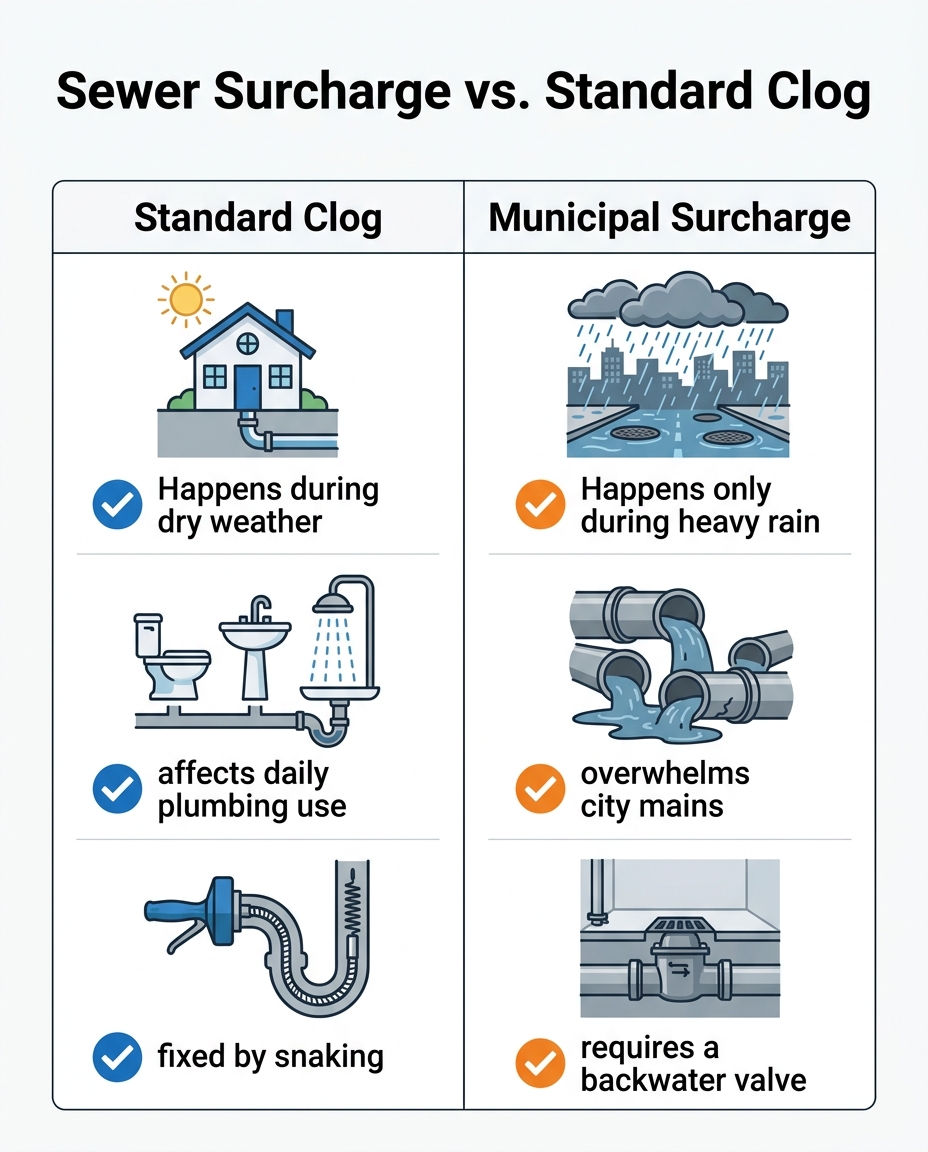
To stop the flooding, you first have to understand where the water is actually coming from. A standard private lateral clog happens when an obstruction—like tree roots, grease, or debris—blocks the pipe that connects your home to the city main. This type of clog causes backups during everyday plumbing use, meaning you will notice water backing up when you run the washing machine or flush a toilet, regardless of the weather outside.
A municipal sewer surcharge is an entirely different mechanical failure. In our years of serving the community, we've found that many older Springfield neighborhoods operate on aging municipal infrastructure that simply cannot handle modern peak storm volumes. When a severe summer downpour hits, the sheer volume of stormwater entering the city system exceeds the capacity of the main sewer lines. The city main becomes completely overwhelmed. Because the water cannot flow forward through the municipal grid fast enough, it has nowhere to go but backward. It surges up into the private lateral lines of connected homes, eventually finding its way out through the lowest point in the house—which is almost always the basement floor drain. If you suspect this is happening, securing professional plumbing repair that addresses the specific mechanics of a surcharge is critical.
How Hydrostatic Pressure Overwhelms Your Drain
The force driving this water into your home is known as hydrostatic pressure. In simple terms, hydrostatic pressure is the pressure exerted by a fluid at equilibrium due to the force of gravity. When the municipal sewer line fills completely and water begins stacking up in the vertical access points (like manholes), the immense weight of that standing water pushes outward and upward in every available direction.
Water always seeks the path of least resistance and the lowest point of entry. In a residential plumbing system, the lowest open point is the basement floor drain. The hydrostatic pressure from the overloaded city main is strong enough to force hundreds of gallons of water backward through your private lateral line, completely bypassing the normal gravity-fed drainage of your home. This is why the water seems to bubble up like a geyser—the pressure from the city street is actively pushing it inside.
How to Tell if Your Backup is Weather-Related or a True Clog
Accurate diagnostics prevent you from wasting money on the wrong solution. Because heavy July rains and summer downpours create such specific symptoms, you can observe a few key indicators to determine the true nature of your basement drain issue. Use this diagnostic checklist to narrow down the problem:
• Timing of the backup: The backup occurs exclusively during or immediately after severe rainfall. Once the storm passes and the rain stops, the water in the basement drain slowly recedes on its own as the city main catches up.
• Everyday plumbing usage: The drain behaves completely normally during dry weather. You can run the washing machine, take multiple showers, and flush toilets simultaneously without any sluggish drainage or gurgling sounds.
• Water quality and appearance: Observe the water coming up from the drain. While a combined sewer system can contain sanitary waste, a weather-related surcharge often brings up a large volume of murky, muddy stormwater rather than just concentrated household waste.
• Neighborhood trends: Talk to your neighbors. If homeowners in similarly aged homes on your street are experiencing the exact same basement drain issue during the exact same storm, it is a near certainty that the municipal main is surcharging.
Comparing the Two Common Causes
• Weather Conditions — Standard Private Clog: Happens during dry or wet weather — Municipal Sewer Surcharge: Only happens during heavy rainfall
• Trigger Event — Standard Private Clog: Running household plumbing fixtures — Municipal Sewer Surcharge: Sudden, high-volume summer storms
• Water Recession — Standard Private Clog: Requires mechanical clearing to drain — Municipal Sewer Surcharge: Recedes naturally when the rain stops
• Scope of Issue — Standard Private Clog: Isolated to your specific property — Municipal Sewer Surcharge: Often affects multiple homes on the street
Sewer Surcharge vs. Standard Clog
The Diagnostic Trap: Why Standard Rooter Services Won't Work
One of the most frustrating financial traps a homeowner can fall into is paying for repeated drain snaking when the actual issue is a municipal surcharge. If your basement drain only backs up during severe storms, your private lateral line is likely perfectly clear. Running a heavy-duty snake or auger through a clear pipe does absolutely nothing to stop city water from surging backward during the next storm.
Many homeowners experience the frustration of paying for a rooter service, feeling a false sense of security, and then watching their basement flood again three weeks later during the next major thunderstorm. A mechanical snake is designed to cut through tree roots, grease blocks, and physical obstructions. It cannot change the hydrostatic pressure of an overwhelmed city sewer system. Understanding the difference between professional drain cleaning vs snaking is helpful, but neither service will stop a municipal surge.
This highlights the importance of accurate, honest diagnostics over quick-fix sales tactics. Our team at Allied Plumbing Heating & Cooling understands the specific infrastructure challenges of older Springfield neighborhoods firsthand. We prioritize honest diagnostics over selling unnecessary rooter services that won't actually solve the problem. If the city water is pushing backward into your home, you do not need a drain clearing service—you need a permanent mechanical barrier to block the flow.
The Permanent Fix: Installing a Backwater Valve
When heavy July rains and summer downpours threaten your basement, we consistently recommend the installation of a backwater valve as the definitive solution for a municipal sewer surcharge. A backwater valve is a specialized, one-way mechanical device installed directly into your home's main sewer line, typically beneath the basement floor. Its sole purpose is to allow wastewater to flow out of your home normally, while physically blocking any city water from reversing direction and entering your basement.
Having a backwater valve provides immense peace of mind during peak storm seasons. You no longer have to watch the weather forecast with dread or run down to the basement with towels every time the sky turns dark. However, this is not a simple DIY project. Installation requires professional assessment to ensure proper placement, correct slope calibration, and strict adherence to local plumbing codes. If the valve is installed at the wrong angle, your everyday household waste will not flow out properly, creating an entirely new set of plumbing headaches.
How a Backwater Valve Protects Your Basement
The mechanics of a backwater valve are relatively straightforward but highly effective. Inside the valve assembly is a small, hinged flap resting on a slight downward slope. During normal dry weather, gravity allows your household wastewater to push the flap open and flow out to the city main. When a summer storm overwhelms the municipal system and water begins to surge backward up your lateral line, the reverse pressure catches the flap and forces it tightly shut against a gasket.
This creates a watertight seal that physically stops the municipal surcharge from advancing any further into your home. Once the storm passes and the city main drains, the hydrostatic pressure drops, and the flap naturally releases, restoring normal outward flow. To ensure it remains ready for the next storm, the valve requires minimal but vital maintenance. The access cover must be removed periodically to clean the flap and gasket, ensuring they remain completely free of debris so the seal stays watertight.
Preparing Your Home for the Rest of Storm Season
Protecting your basement from older Springfield neighborhoods' infrastructure challenges requires a holistic approach. While a backwater valve secures the floor drain, you must also ensure the rest of your home is prepared to handle high volumes of water. The continuing threat of late-summer storms in the Midwest means you need to act before the next major forecast hits. Follow these actionable steps to fortify your home:
1. Direct water away from the foundation: Ensure your gutters are completely clear of debris and that your downspouts are discharging water at least six feet away from your foundation. If water pools near the exterior walls, it greatly increases the hydrostatic pressure against your basement.
2. Check your sump pump operation: Do not wait for a storm to find out your sump pump has failed. Test the pump by pouring a bucket of water into the pit until the float switch activates. Verify that the pump kicks on, drains the pit quickly, and turns off smoothly.
3. Inspect for foundational seepage: Walk the perimeter of your basement and look for signs of weeping tile failure. Check for damp spots on the concrete walls, efflorescence (white, chalky stains), or active trickles of water where the wall meets the floor.
4. Consult with local experts: Every neighborhood has unique topography and infrastructure quirks. Reach out to experienced Springfield area plumbers like our team. We understand the specific vulnerabilities of aging municipal grids and can recommend the right targeted defenses for your exact location.
Frequently Asked Questions: Why Your Basement Floor Drain Backs Up Only During Heavy July Rains
Why does my basement drain back up when it rains heavy?
When your basement drain backs up during heavy rain, it is typically caused by a municipal sewer surcharge. The city's main sewer lines become completely overwhelmed by the sudden volume of stormwater. Because the water cannot flow forward fast enough, hydrostatic pressure forces it backward through your private lateral line and up through your basement drain.
Is a basement floor drain backup an emergency?
Yes, a basement floor drain backup is a plumbing emergency that requires immediate attention. Even if the water appears to be mostly clear stormwater, it has traveled through the municipal sewer system and can carry harmful bacteria, raw sewage, and contaminants. You should avoid contact with the water and seek professional assessment to prevent extensive property damage and health risks.
How do I stop water from coming up my basement drain?
The most effective way to stop water from coming up your basement drain during a storm is to install a backwater valve. This device acts as a one-way mechanical barrier in your main sewer line. It allows your household wastewater to flow out normally but automatically closes shut when city water attempts to reverse course and push into your home.
Who is responsible for sewer backup in basement?
In most municipalities, the homeowner is entirely responsible for the maintenance and repair of the private lateral sewer line from the house all the way to the connection point at the city main. Even if the backup is caused by an overwhelmed city system, the physical damage to your basement and the cost of installing preventative measures like a backwater valve fall on the property owner.
Can a backwater valve be installed in an existing older home?
Yes, a backwater valve can absolutely be installed in an existing older home. The process involves excavating a small section of the concrete basement floor near the main sewer exit, cutting into the existing pipe, and securing the valve in place with the correct slope. While it requires professional excavation and plumbing work, it is a standard retrofit that provides permanent protection.
Stop Wasting Money on the Wrong Drain Solution
In our experience, a weather-dependent backup is a very specific mechanical failure that requires a targeted mechanical defense. If you are dealing with a situation where your basement floor drain backs up only during heavy July rains, standard drain clearing will not save you. Paying for repeated rooter services on a clear line is a frustrating waste of money when the actual problem lies with overwhelmed infrastructure in older Springfield neighborhoods.
You deserve the satisfaction of having a clear, honest diagnosis that actually solves the root problem. A backwater valve provides the permanent barrier you need to keep city water out of your home for good. Do not wait for the next severe weather warning to take action. Encourage a proactive approach and secure your home's plumbing defenses before the next major summer storm hits, ensuring your basement remains dry and protected all season long.
Upgrading to a High-Recovery Water Heater for Families with Overlapping Morning Showers
September 15, 2026
A bigger tank isn't always the answer to morning hot water shortages. We break down why recovery speed matters more than gallon capacity when back-to-back showers drain your system.
A bigger tank isn't always the answer to morning hot water shortages. We break down why recovery speed matters more than gallon capacity when back-to-back showers drain your system.
Diagnosing a Furnace Flame Sensor That Shuts the System Down After Three Seconds
September 15, 2026
Turning on your heat only to watch the burners die instantly is a frustrating fall surprise. We explain why this three-second safety lockout happens to protect your home.
Turning on your heat only to watch the burners die instantly is a frustrating fall surprise. We explain why this three-second safety lockout happens to protect your home.
Locating Drafty Areas in Your Basement That Threaten Exposed Water Lines
September 15, 2026
Early fall is the ideal time to find hidden air leaks around rim joists and basement windows. Map out structural vulnerabilities now to prevent frozen pipes in January.
Early fall is the ideal time to find hidden air leaks around rim joists and basement windows. Map out structural vulnerabilities now to prevent frozen pipes in January.