Why High Summer Humidity Makes Your Basement Water Heater Sweat
Why High Summer Humidity Makes Your Basement Water Heater Sweat
Finding a Puddle Under Your Water Heater During a Humid July
Before the first major heatwave hits, there is one thing every homeowner should check downstairs. July brings a specific kind of heavy, sticky heat, and when you walk into your unconditioned basement only to step into a growing puddle of water, panic is usually the first response. Your mind immediately jumps to a ruptured tank, flooded floors, and a massive replacement bill. But before you shut off the main water valve in a frenzy, you need to understand exactly why high summer humidity makes your basement water heater sweat. What looks like a catastrophic failure might actually be a simple, harmless case of summer condensation.
The sudden appearance of water around the base of your tank forces an immediate decision: do you call for emergency help, or do you wait and monitor the situation? Knowing how to tell the difference between a natural seasonal reaction and a genuine mechanical failure can save you a tremendous amount of stress. If you are ever unsure of what you are looking at after a thorough inspection, reaching out for comprehensive plumbing services is the best way to protect your home from water damage.
The Science of Condensation: Cold Inlet Water Meets Muggy Air
To understand why your water heater looks like it just ran a marathon, we have to look at the basic science of condensation. You see this exact same physical reaction when you take a glass of ice water out to the patio on a hot afternoon. The glass doesn't have a leak; the cold surface is simply drawing moisture out of the warm air, causing water droplets to form on the outside. Your water heater goes through the exact same process, just on a much larger scale.
Here in Springfield IL, our subtropical summer climate frequently pushes dew points into the upper 60s and low 70s. The dew point is the temperature at which air can no longer hold all of its water vapor, forcing that moisture to turn into liquid. When the heavy, moisture-laden air of a midwestern summer finds its way into your home, it seeks out the coldest surfaces available.
Understanding the Temperature Delta
The underground chill: The municipal water lines that feed your home are buried deep underground, well below the frost line. Down there, the soil stays consistently cool, meaning the water entering your tank is often a frigid 50 to 60 degrees Fahrenheit, even when it is 95 degrees outside.
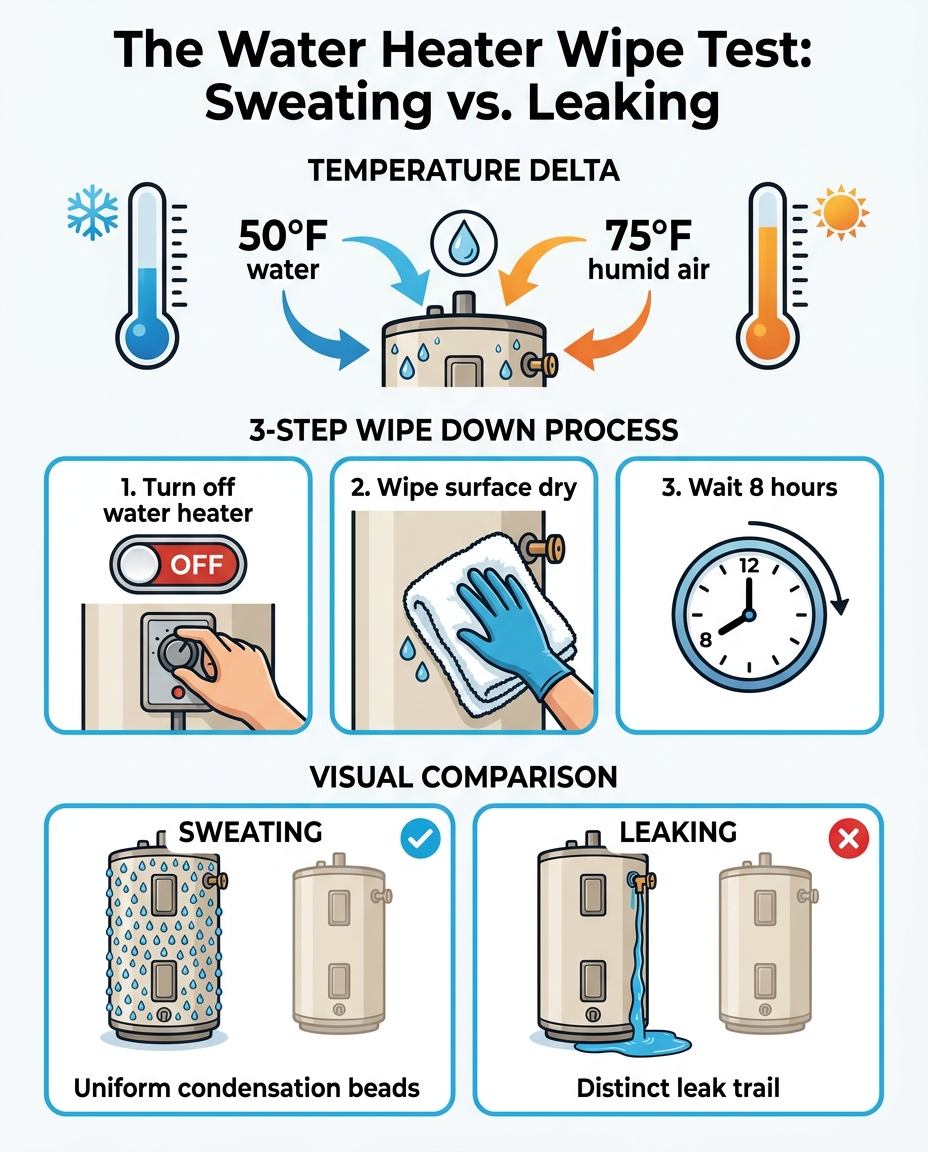
The metal transfer: When you use hot water for a shower or a load of laundry, your tank refills with this cold municipal water. The metal exterior of the tank rapidly cools down to match the temperature of the water inside. When the 75-degree, highly humid basement air collides with the 50-degree metal surface of the tank, the massive temperature delta forces the air to instantly drop its moisture. The metal tank essentially acts as a giant, unintentional dehumidifier.
Why Unconditioned Basements Trap Summer Moisture
Stagnant airflow: Most basements are unconditioned, meaning they do not have active supply and return vents constantly circulating air from your HVAC system. Without that constant movement, the air grows stagnant and heavy.
The moisture sink: Because cold air sinks and basements are below grade, they naturally trap humidity. Any moisture that enters through foundation walls, open windows, or everyday activities settles in the lowest level of your home. Without proper ventilation to dry out the air, that humidity has nowhere to go except onto your cold plumbing fixtures, cold water pipes, and the exterior jacket of your water heater.
How to Perform the 'Wipe Test' on Your Sweating Tank
When you find water pooling in July, you need a safe, reliable way to figure out if you are dealing with condensation or a compromised tank. The easiest way to diagnose this without any special tools is by performing the "wipe test." This simple process helps you track exactly where the water is coming from.
1. Turn off the energy source: Safety always comes first. If you have an electric water heater, flip the breaker in your electrical panel to the "off" position. If you have a gas water heater, turn the gas control valve to the "pilot" setting so the main burner does not fire while you are working near it.
2. Dry the surrounding floor: Grab several large bath towels and completely dry the puddle on the floor. You need a blank canvas to see if the water is actively pooling from a specific direction or just dripping straight down from the sides.
3. Wipe down the entire tank: Use a dry, absorbent cloth to wipe down the entire exterior of the water heater. Start from the very top and work your way down to the base. Make sure you dry the cold water inlet pipe at the top as well, as condensation often starts there and rolls down the sides.
4. Wait and observe: Leave the area and come back in two to three hours. Do not use any hot water in the house during this time, as you want the tank to remain stable.
5. Check the moisture pattern: When you return, inspect the tank. If the moisture has reappeared as a uniform, bead-like sweat across the entire surface of the metal, you are looking at harmless condensation. If the sides are mostly dry but there is a distinct, continuous trail of water running down from a specific fitting, or water bubbling out from the bottom seam, you have a leak.
If your wipe test reveals a distinct, localized drip rather than an all-over sweat, it is time to stop testing and call for professional plumbing repair before the minor leak turns into a major flood.
The Water Heater Wipe Test: Sweating vs. Leaking
When to Worry: Spotting a True Water Heater Leak
While a sweating tank in Springfield IL is a normal summer nuisance, actual leaks require immediate attention. Because water always finds the path of least resistance, a leak near the top of the tank can easily mimic condensation as it spreads out and runs down the sides. You need to know exactly what visual cues separate a harmless physical reaction from a failing appliance.
• Moisture Pattern — Summer Condensation (Sweating): Uniform beads of water covering large areas of the tank, similar to morning dew. — Actual Tank or Valve Leak: A focused, distinct line or trail of water originating from a single source.
• Water Volume — Summer Condensation (Sweating): Small puddles that dry up on cooler, less humid days or when the AC runs longer. — Actual Tank or Valve Leak: A constantly growing puddle that never fully dries, regardless of the weather.
• Water Temperature — Summer Condensation (Sweating): The water on the outside of the tank feels cool to the touch. — Actual Tank or Valve Leak: The water pooling on the floor or dripping from the side feels warm or hot.
• Location of Puddle — Summer Condensation (Sweating): Directly under the edges of the tank, distributed somewhat evenly. — Actual Tank or Valve Leak: Pooling heavily on one side, usually under a specific valve or pipe connection.
Checking the Pressure Relief Valve
The safety mechanism: Every water heater is equipped with a Temperature and Pressure (T&P) relief valve, usually located on the side or near the top of the tank. This valve is designed to open and release water if the internal pressure reaches dangerous levels.
Spotting a failure: If the valve is failing or if the tank is overheating, it will slowly drip water down the side of the tank or through the attached discharge pipe. This is a very common issue that homeowners mistake for condensation. If you find water specifically originating from this brass valve, you should read up on why your water heater pressure relief valve is leaking to understand the next steps.
Inspecting the Tank Base for Corrosion
Internal degradation: Over time, the sacrificial anode rod inside your water heater breaks down. Once it is fully depleted, corrosive elements in the water begin attacking the steel lining of the tank itself. Eventually, this causes micro-fractures in the metal.
The warning signs: If you perform the wipe test and the sides of the tank remain bone dry, but water continues to seep out from the very bottom rim where the tank meets the floor, you are not dealing with humidity. A leak from the inner tank shell cannot be patched or repaired; it means the structural integrity of the unit has failed and a full replacement is necessary.
Managing Basement Humidity to Stop Tank Sweating
If you have confirmed through the wipe test that your tank is merely sweating, the good news is that your plumbing is perfectly fine. The bad news is that you have an environmental problem. Stopping the sweat requires addressing the air quality in your basement, not the water heater itself. Leaving high humidity unchecked in July will eventually lead to bigger problems than a puddle on the floor.
The threat of mold and rust: When a basement remains constantly damp, mold and mildew can begin to grow on floor joists, drywall, and stored cardboard boxes in as little as 48 hours. Furthermore, prolonged exposure to moisture will cause the metal jacket of your water heater, your furnace cabinet, and your washer and dryer to prematurely rust.
Deploying a dehumidifier: The most effective, immediate solution is to run a dedicated, high-capacity dehumidifier in the basement space. A portable unit pulls the heavy, moisture-laden air across cold coils, extracts the liquid, and exhausts dry air back into the room. If you position the dehumidifier near a floor drain, you can attach a small hose for continuous draining, eliminating the need to manually empty the bucket every day.
Whole-home solutions: If portable units are not keeping up with the moisture load, or if your entire house feels sticky and uncomfortable, it is time to look at systemic solutions. Upgrading your home's indoor air quality and humidity control systems can actively regulate moisture levels across every room, preventing condensation on plumbing fixtures while making your living spaces significantly more comfortable.
How Proper Airflow and Cooling Reduce Basement Moisture
Your plumbing and your HVAC system are often treated as entirely separate entities, but they interact constantly. The way you cool your home in the summer has a direct impact on whether or not your water heater sweats. In Springfield IL, a well-maintained cooling system is your first line of defense against indoor humidity.
The dehumidification cycle: An air conditioner does not just blast cold air into a room; it actively removes heat and moisture from the indoor air. As warm air is pulled through the return ducts and passes over the cold evaporator coil in your HVAC system, condensation forms on the coil and drains away outside. This process naturally lowers the humidity level of the entire house.
The basement airflow problem: The issue arises when the basement is isolated from this cycle. If the basement doors are always closed, and there are no return air vents pulling stagnant air out of the basement, the moisture simply sits there. The air conditioner upstairs is doing its job, but the basement is left to fend for itself.
Improving circulation: You can help reduce tank sweating by leaving the basement door open to allow conditioned air to mix, or by running a simple box fan to keep the air moving around the utility area. If your home constantly struggles with high humidity and your AC seems to run non-stop without making the house feel dry, your cooling system might be undersized, oversized, or struggling with dirty coils. Having a professional evaluate your air conditioning services can ensure your system is pulling its weight in the fight against summer moisture.
Honest Diagnostics and Peace of Mind for Your Plumbing
Discovering water where it shouldn't be is always unsettling, but a sweating water heater is a natural, manageable occurrence, not an immediate disaster. By understanding the temperature delta between your cold inlet water and the humid summer air, you can take control of the situation. Running the simple wipe test empowers you to figure out exactly what is happening without panicking.
At Allied Plumbing Heating & Cooling, we believe in a family-owned, honest approach that prioritizes saving you an emergency fee over forcing an unnecessary service call. We would much rather you run the wipe test, realize it is just high humidity, and enjoy the rest of your summer with peace of mind. However, if you run the test and the water keeps trailing down from a valve, or if you simply want a professional set of eyes to make sure your equipment is safe and up to code, we are always here to help. You deserve honest diagnostics and clear answers, ensuring your home remains dry, safe, and comfortable all season long.
Frequently Asked Questions
How do I know if my water heater is leaking or sweating? The easiest way to tell the difference is to dry the tank completely and watch how the moisture returns. If tiny, uniform beads of water form all over the exterior like a cold glass of water, the tank is sweating. If a distinct, continuous trail of water runs down from a specific valve or seeps out from the bottom seam, the tank is leaking and requires professional attention.
Is it normal for a water heater to sweat in the summer? Yes, it is incredibly common for water heaters to sweat during the hot, humid summer months. The municipal water entering your tank comes from underground pipes and remains very cold. When that 50-degree water cools the metal tank, and hot, sticky summer air hits it, condensation naturally forms on the exterior.
How do I stop my water heater from sweating? To stop a water heater from sweating, you have to remove the excess moisture from the air surrounding it. Running a dedicated dehumidifier in the basement is the most effective way to dry out the environment. Improving overall airflow by keeping basement doors open or running a fan can also prevent heavy, moist air from stagnating around the cold tank.
Why is there a puddle under my water heater in the summer? A summer puddle is usually the result of heavy condensation dripping off the sides of the tank and pooling on the floor over several days. Because unconditioned basements lack the airflow needed to evaporate this moisture, the water slowly accumulates. However, you should always perform a wipe test to ensure the puddle isn't being caused by a failing pressure relief valve or a rusted tank bottom.
Can water heater condensation cause mold in my basement? Yes, chronic condensation can absolutely lead to mold growth if left unmanaged. While the water heater itself won't grow mold on its hot metal surface, the constant dripping creates a damp environment on the surrounding floor and nearby drywall. Keeping the basement humidity below 50 percent is crucial for preventing mold spores from taking root in your home.
Upgrading to a High-Recovery Water Heater for Families with Overlapping Morning Showers
September 15, 2026
A bigger tank isn't always the answer to morning hot water shortages. We break down why recovery speed matters more than gallon capacity when back-to-back showers drain your system.
A bigger tank isn't always the answer to morning hot water shortages. We break down why recovery speed matters more than gallon capacity when back-to-back showers drain your system.
Diagnosing a Furnace Flame Sensor That Shuts the System Down After Three Seconds
September 15, 2026
Turning on your heat only to watch the burners die instantly is a frustrating fall surprise. We explain why this three-second safety lockout happens to protect your home.
Turning on your heat only to watch the burners die instantly is a frustrating fall surprise. We explain why this three-second safety lockout happens to protect your home.
Locating Drafty Areas in Your Basement That Threaten Exposed Water Lines
September 15, 2026
Early fall is the ideal time to find hidden air leaks around rim joists and basement windows. Map out structural vulnerabilities now to prevent frozen pipes in January.
Early fall is the ideal time to find hidden air leaks around rim joists and basement windows. Map out structural vulnerabilities now to prevent frozen pipes in January.