Why Choosing the Right AC for a Midwest Home Is More Complex Than You Think
Choosing the right AC for a Midwest home means balancing two extremes that most other regions never face together: brutal winters that can drop well below freezing and humid summers that push cooling systems to their limits. In Springfield, IL, that combination creates a unique challenge for homeowners who want reliable year-round comfort without overpaying on energy bills.
Here's a quick overview of what matters most when selecting an AC system in the Midwest:
1. System type - Split systems, dual-fuel, mini-splits, or geothermal each suit different homes and budgets
2. Proper sizing - A Manual J load calculation beats any rule-of-thumb estimate
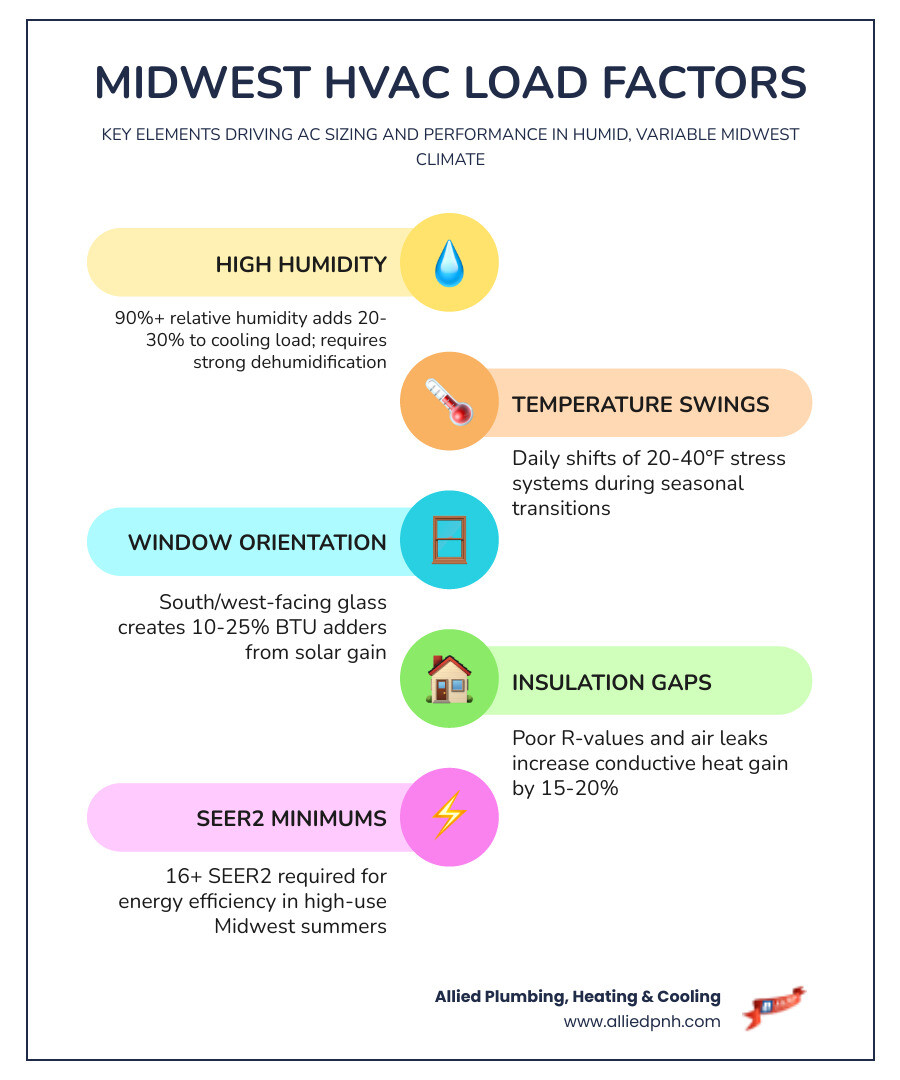
3. Dehumidification - Midwest summers demand strong moisture removal, not just temperature drop
4. Efficiency ratings - Look for SEER2 16+ for meaningful energy savings
5. Window and insulation factors - South- and west-facing glass can add 10-25% to your cooling load
6. Available incentives - Federal tax credits and Illinois utility rebates can significantly offset upfront costs
HVAC systems account for roughly 48% of a home's total energy use. With cooling costs making up around 12-13% of the average household energy bill, getting this decision right has real financial consequences — not just comfort ones.
The Midwest climate doesn't let you pick a system designed for the South or the Pacific Northwest and call it a day. Variable weather, high summer humidity, and cold snaps that can push past what standard heat pumps handle efficiently all factor into which system will actually perform for your home over the long haul.
I'm looking for the best cooling solution. What are the challenges of choosing the right ac for a midwest home?
When we talk to our neighbors in Springfield, Sherman, or Chatham, the conversation usually starts with the heat. But in the Midwest, heat is only half the story. The real villain is the humidity. Choosing the right ac for a midwest home requires a system that doesn't just lower the mercury but also wrings the moisture out of the air.
If you’ve lived through a July in Sangamon County, you know the "air you can wear." A standard, oversized AC might cool your house down to 72 degrees in ten minutes, but it won't run long enough to remove the humidity. This leaves you feeling cold and clammy—like sitting in a damp basement. Our Air Conditioning Springfield IL experts emphasize that the "right" system is one that runs in longer, more efficient cycles to manage that moisture.
Furthermore, we have to consider the "shoulder seasons." In places like Rochester or Auburn, we might need the AC on Monday and the furnace on Wednesday. This variable weather puts immense strain on equipment that isn't built for rapid transitions. You need a robust system supported by a comprehensive Air Conditioning Service Page to ensure your unit can pivot as fast as the Illinois sky.
Why is choosing the right ac for a midwest home different than in other regions?
In the desert Southwest, they care about raw cooling power. In the Northeast, they focus on heating. Here in the heart of the country, we need a "decathlete" system. Our Air Conditioning Services are tailored to the fact that our peak cooling loads often coincide with 90% humidity.
The seasonal transitions in the Midwest are notoriously sharp. We don't get a long, slow spring; we get "Mud Season" followed immediately by "Mosquito Season." This means your AC needs to be ready to go from zero to sixty. Because our homes often have older ductwork or historic layouts (especially in places like Athens or Pleasant Plains), the air distribution needs to be much more precise to handle these sudden shifts.
Is a dual-fuel setup the smartest way of choosing the right ac for a midwest home?
For many of our customers, the answer is a resounding yes. A dual-fuel system—also known as a hybrid system—combines an electric heat pump with a gas furnace.
Here is why this is a game-changer for choosing the right ac for a midwest home:
• The 25°F Threshold: Heat pumps are incredibly efficient at cooling and can heat your home beautifully when it’s between 25°F and 60°F outside.
• The Gas Backup: Once the Illinois winter drops below 25°F, the system automatically switches to the gas furnace. This ensures you aren't relying on expensive "emergency heat" strips when the wind starts howling across the cornfields.
• Year-Round Optimization: You get the dehumidification benefits of a modern AC in the summer and the reliable "toasty" heat of gas in the winter.
If your current unit is struggling to keep up with these swings, it might be time to look into an AC Replacement Springfield IL that utilizes this hybrid technology.
Which HVAC systems provide the best year-round comfort for homes in Springfield, IL?
Finding the right fit depends on your home’s age, size, and existing infrastructure. Whether you’re in a new build in Glenarm or a century-old farmhouse in New Berlin, we have options that balance energy consumption with comfort.
• Split System (AC + Furnace) — Best For: Homes with existing ductwork — Cooling Efficiency: High (Up to 26 SEER2) — Heating Reliability: Excellent (Gas)
• Dual-Fuel (Heat Pump + Gas) — Best For: Energy-conscious Midwest homes — Cooling Efficiency: Very High — Heating Reliability: Excellent (Hybrid)
• Mini-Split (Ductless) — Best For: Older homes, additions, garages — Cooling Efficiency: Exceptional — Heating Reliability: Good (Cold-Climate models)
• Geothermal — Best For: Long-term owners, large lots — Cooling Efficiency: Maximum — Heating Reliability: Maximum
For those looking at a Central air installation, the split system remains the most prevalent choice. However, we are seeing a massive surge in AC Installation Springfield IL requests for geothermal systems. While they require more space for underground loops, they leverage the stable 55°F temperature of the earth to provide the most efficient cooling and heating known to man.
Should I consider a ductless system for my older home?
If you live in a historic home in Springfield or Petersburg, you might be dreading the idea of cutting holes in your original plaster walls for ductwork. This is where Ductless AC Springfield IL shines.
Choosing a ductless AC system for your space allows you to:
1. Preserve History: No invasive ductwork required.
2. Zone Your Cooling: Only cool the rooms you're using (like that upstairs bedroom that’s always 10 degrees hotter).
3. Improve Air Quality: Mini-splits often feature multi-stage filtration that works wonders alongside our other Indoor air quality solutions.
How do variable-speed compressors improve comfort?
Traditional AC units are either "on" or "off." It’s like a car that only goes 0 mph or 100 mph. Variable-speed compressors (often called inverter technology) can run at any speed between 10% and 100%.
This is vital for our AC Service Springfield IL customers because:
• Consistent Temps: It keeps your home within 0.5 degrees of your setting. No more shivering when the AC kicks on and sweating when it kicks off.
• Dehumidification: By running at a lower speed for longer periods, it pulls significantly more moisture out of the air.
• Quiet Operation: These units are often 5 times quieter than standard models—perfect for those quiet nights in Riverton or Williamsville.
• Smart Integration: They pair perfectly with smart thermostats to learn your schedule and optimize for variable Midwest weather.
How do my windows and insulation affect the AC size I need?
One of the biggest mistakes homeowners make is buying an AC based solely on square footage. At Allied, we use a Manual J load calculation. This isn't just a "guess-timate"; it’s a scientific look at how your home gains and loses heat.
We look at your attic insulation, the direction your house faces, and even the number of people living there. A 2,000-square-foot home in Rochester with vaulted ceilings and giant south-facing windows needs a much different system than a 2,000-square-foot ranch in Jerome shaded by old oak trees. Our Professional AC installation services ensure you don't end up with an oversized unit that short-cycles or an undersized unit that runs forever.
Why window orientation dictates your cooling load
Windows are essentially "holes" in your insulation. In the Midwest, the sun sits low in the sky during the late afternoon.
• West-facing windows: These are the "heat monsters." They catch the brutal afternoon sun just when the outside temperature is at its peak. You may need a 15-20% BTU adder for rooms with large west-facing glass.
• South-facing windows: These provide great light but constant solar radiation all day.
• The Low-E Solution: Upgrading to Low-E glass can help, but if you aren't ready for new windows, exterior shading or high-quality films can reduce the load.
If you notice your AC can't keep up specifically between 4:00 PM and 7:00 PM, those are classic Signs it's time for an AC replacement or at least a resizing of your current system.
The role of insulation and air sealing in system sizing
You wouldn't try to cool your house with the front door wide open, but poor insulation is effectively doing just that.
• Attic R-Values: In Illinois, we recommend high R-values (R-49 to R-60) to keep the summer heat from radiating through your ceiling.
• Ductwork Integrity: Leaky ducts can waste 20-40% of your conditioned air before it even reaches your living room.
• The "Freeze Up" Risk: If your home is poorly insulated, your AC has to work overtime. This can lead to the evaporator coil getting too cold. If you’ve ever wondered Why is your AC freezing up during hot weather, poor airflow or extreme demand due to heat gain are often the culprits.
What efficiency ratings and rebates should I look for when upgrading my system?
When you start shopping, you’ll see a lot of acronyms. Here’s the "Midwest Translation":
• SEER2 (Seasonal Energy Efficiency Ratio): This is the "MPG" of your AC. The higher the number, the less electricity it uses. For our region, a SEER2 of 16 to 18 is the "sweet spot" for balancing upfront cost and long-term savings.
• EER2: This measures how efficient the unit is at a specific high temperature (95°F). This matters for those August heat waves in Springfield.
• HSPF2: This measures the heating efficiency of a heat pump.
Regular AC Maintenance Springfield IL is the only way to ensure your unit actually hits these rated numbers year after year. A dirty coil can drop a 16 SEER unit down to a 12 SEER in just one season.
Navigating federal tax credits and local Illinois incentives
The government and utility companies actually want to help you pay for choosing the right ac for a midwest home.
• Federal Tax Credits: Under the Inflation Reduction Act, you can claim up to $2,000 per year for high-efficiency heat pumps and up to $600 for high-efficiency central AC.
• Local Rebates: Many Illinois utility providers offer instant rebates ranging from $300 to $1,000 for ENERGY STAR-certified equipment.
• Long-term ROI: High-efficiency systems (20+ SEER2) can reduce cooling costs by 30-50% compared to older 10 SEER units.
We always recommend AC maintenance for year-round comfort to protect that investment. If you're spending the money on a high-efficiency system, you want to make sure it lasts its full 15-20 year lifespan.
How can I keep my AC running reliably through extreme Illinois weather?
Maintenance in the Midwest isn't a luxury; it's a necessity. Between the cottonwood seeds in the spring and the sub-zero wind chills in the winter, your outdoor unit takes a beating. If your system fails during a 95-degree humid stretch, you’ll be looking for AC Repair Springfield IL along with everyone else in town.
We recommend a bi-annual approach. In the spring, we focus on the AC. In the fall, we pivot to the furnace or heat pump. Our AC Service Springfield IL team looks for small issues—like a fraying contactor or a dying capacitor—before they turn into a 2:00 AM emergency call.
Essential maintenance for harsh winters and hot summers
• Coil Cleaning: Cottonwood and dust act like a blanket, suffocating your AC.
• Refrigerant Checks: A system that is just 10% low on "freon" can cost 20% more to operate.
• Winterizing: While we don't recommend airtight plastic wraps (which trap moisture and attract nesting rodents), a breathable cover or a simple piece of plywood on top can prevent falling ice from damaging the fan.
• Filter Changes: This is the #1 thing you can do. In the Midwest, with our pollen and dust, change your filters every 30-90 days.
Our AC Maintenance Springfield IL plans take the guesswork out of this, ensuring your system is ready for whatever the Illinois sky throws at it.
Frequently Asked Questions about Midwest Air Conditioning
Can a heat pump handle a Springfield winter?
Modern "cold-climate" heat pumps are incredible and can handle temperatures down to -5°F or even -15°F. However, for most homes in our area, we still recommend a dual-fuel setup. Having that gas furnace backup provides peace of mind during those rare but brutal "Polar Vortex" events when the grid is stressed and temperatures stay below zero for days.
How do I know if my AC unit is the wrong size?
There are three big signs:
1. Short-cycling: The unit turns on and off every 5-10 minutes. This means it’s too big.
2. Never-ending cycles: The unit runs all day but the house never gets below 78 degrees. This means it’s too small (or very inefficient).
3. High Humidity: If the house is 70 degrees but you still feel sticky, the unit is likely too large and isn't running long enough to dehumidify.
Are smart thermostats worth the investment for variable weather?
Absolutely. In the Midwest, the temperature can swing 40 degrees in a single day. A smart thermostat can "pre-cool" your home in the morning before the afternoon heat hit, and it can automatically switch between heating and cooling modes so you don't wake up shivering or sweating.
Conclusion
Choosing the right ac for a midwest home doesn't have to be a headache. At Allied Plumbing, Heating & Cooling, we’ve been helping our neighbors in Springfield and the surrounding communities stay comfortable since 1977. As a 3-generation family business, we know exactly what Illinois weather can do to a home.
We are proud to offer the Daikin Comfort Promise, which includes industry-leading 12-year warranties on select systems. Whether you need a quick repair in Virden, a new installation in Sherman, or seasonal maintenance in Rochester, we provide 24/7 reliability and peace of mind.
Ready to upgrade your home's comfort? Explore our Air Conditioning Services or give us a call today. We’ll make sure your Midwest abode stays cool, dry, and efficient all summer long!